
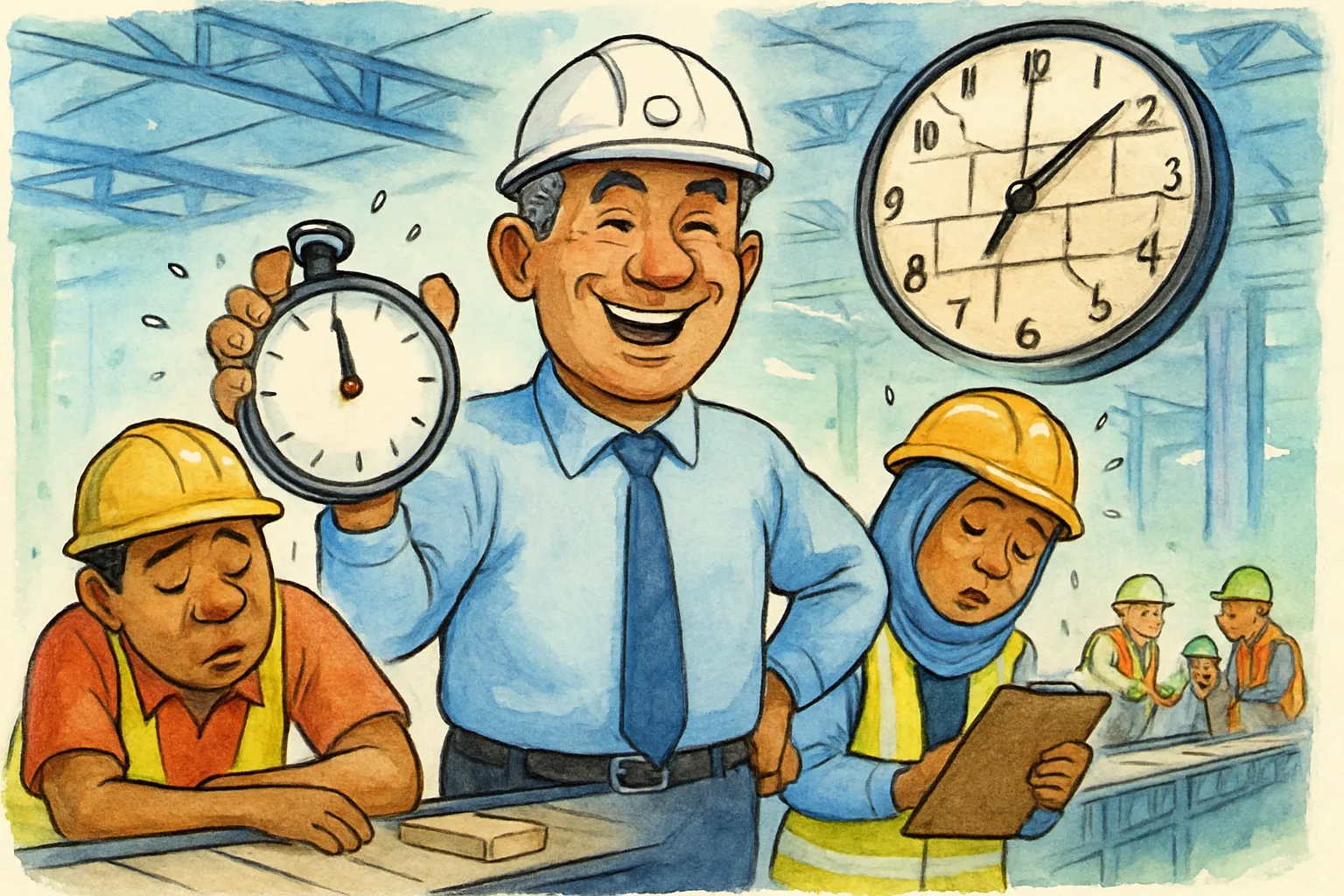
On many Indonesian sites, long hours are still read as commitment. A supervisor who stays on for a second shift, a maintenance crew that works through the weekend to bring a line back, an office team answering messages at midnight: these are praised far more often than they are measured. The evidence published over the past eighteen months points the other way. Long hours and a strained psychosocial environment are not a sign of productive capacity. They are an early signal of errors, illness and lost output.
In late April 2026, the International Labour Organization (ILO) published a global report estimating that psychosocial risks at work are linked to more than 840,000 deaths each year. In Indonesia, labour force survey data for August 2025 show that roughly one in four workers works excessive hours. Meanwhile, the government has placed labour productivity at the centre of its development agenda. For executives of foreign-owned companies operating here, these three developments belong in the same conversation. This article explains why, and what a practical response looks like.
Background: fatigue, strain and the limits of human capacity
Fatigue is a reduced capacity to perform mental or physical work. It is driven mainly by insufficient sleep, extended time awake, time of day and workload, and its effects on performance are well documented: slower reactions, narrowed attention, weaker judgement and more frequent lapses (Caldwell et al., 2019). Dawson and McCulloch (2005) argue that managing fatigue is fundamentally about protecting the opportunity to sleep, which is why rosters, overtime and commuting time matter more than slogans about staying alert. Indonesian ergonomics literature reaches the same point from the work design side. Workload that exceeds capacity, prolonged static postures and poor work and rest patterns accumulate as fatigue and erode both output and quality (Tarwaka, 2015).
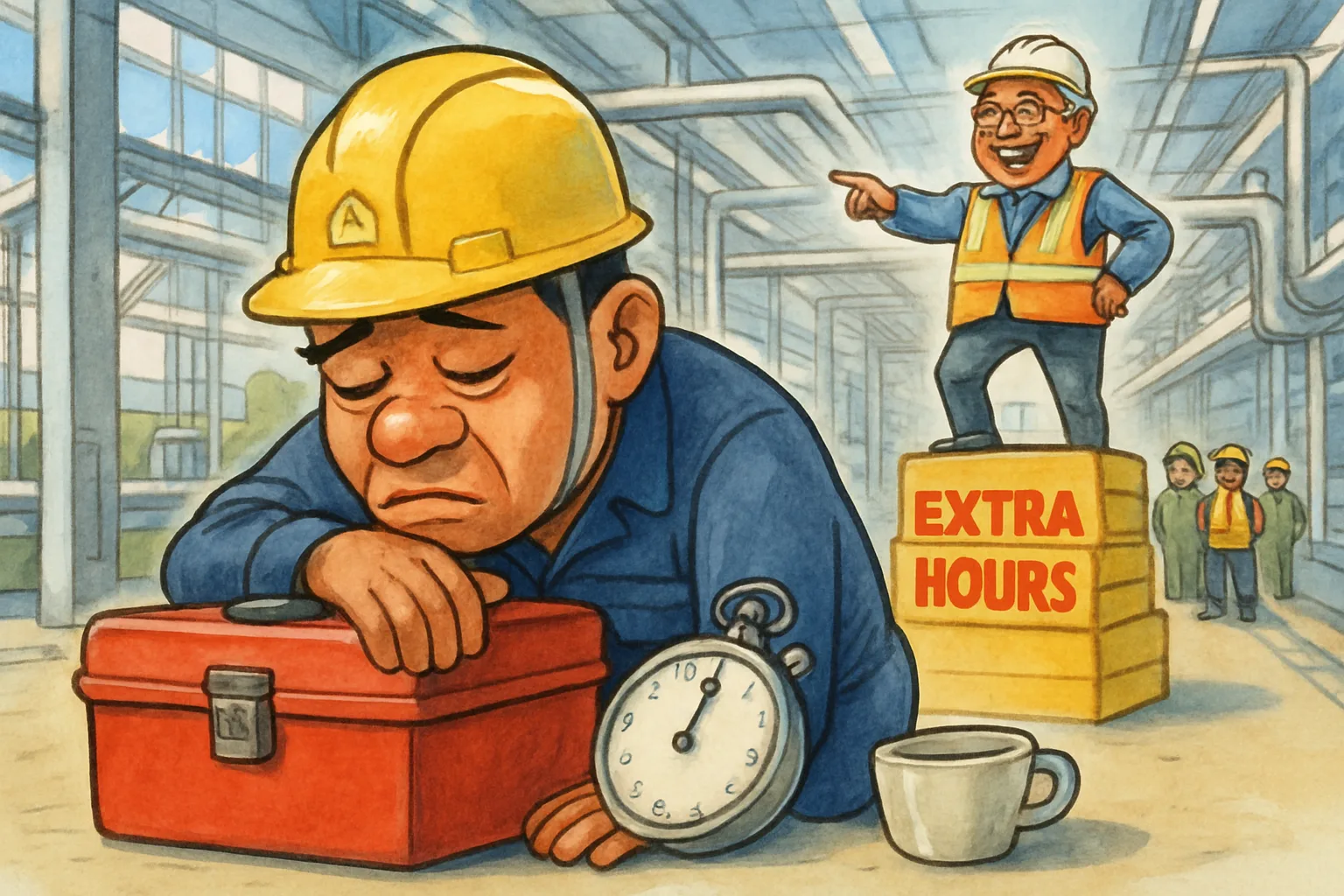
Psychosocial risk is the broader frame. It concerns how work is designed, organised and managed: job demands, control over the work, role clarity, the balance between effort and reward, job security and relationships at work. ISO 45003:2021 provides guidance for managing these risks within an occupational health and safety management system, and ISO 45001:2018 already expects hazard identification to consider social factors such as workload, work hours, victimisation, harassment and bullying (clause 6.1.2.1).
The long-term health burden is not speculative. The joint WHO and ILO estimates attributed 745,194 deaths from ischaemic heart disease and stroke in 2016 to working 55 hours or more per week (Pega et al., 2021).
Indonesian law already frames both working time and psychological factors. Under Law No. 13 of 2003 on Manpower, as amended by Law No. 6 of 2023, normal working time is 7 hours a day over six days or 8 hours a day over five days, in both cases 40 hours a week (Article 77 paragraph (2)). Government Regulation No. 35 of 2021 limits overtime to 4 hours a day and 18 hours a week, and requires the consent of the worker concerned (Article 26 paragraph (1)). Minister of Manpower Regulation No. 5 of 2018 on the safety and health of the work environment (Permenaker 5/2018) treats psychological factors as part of the work environment alongside physical, chemical, biological and ergonomic factors. Its potential psychological hazards include role ambiguity, role conflict, quantitative and qualitative overload, career development and responsibility for others. Legal scholars have nonetheless argued that Indonesia still lacks a dedicated regulation on workers' mental health, and have proposed adding work anxiety, burnout and depression to the psychological factor standard (Mustamin et al., 2022).
Current developments
Three recent developments sharpen the issue.
The ILO's 2026 global estimate
For the World Day for Safety and Health at Work 2026, the ILO released The psychosocial working environment: Global developments and pathways for action (International Labour Organization, 2026). According to UN News, the report estimates that more than 840,000 people die each year from health conditions linked to psychosocial risks, with nearly 45 million disability-adjusted life years lost and an economic cost of about 1.37 percent of global GDP each year (United Nations, 2026). The estimate combines five risk factors: job strain, effort and reward imbalance, job insecurity, long working hours, and workplace bullying and harassment. Most of the deaths result from cardiovascular disease and mental disorders, including suicide. Importantly, the report treats these risks as structural. They arise from how work is organised, and they can be reduced through better work design, stronger occupational safety and health systems and social dialogue.
Excessive hours in Indonesia
Indonesia's National Labour Force Survey (Sakernas) for August 2025 shows that 25.47 percent of employed people, about 37.32 million workers, worked excessive hours, which Statistics Indonesia (BPS) defines as more than 48 hours a week (Databoks, 2026a; GoodStats, n.d.; Kompas.com, 2026). The share was higher among men (28.50 percent) than women (20.91 percent) (GoodStats, n.d.). Economists interviewed by Kompas linked overwork to low wages and informal employment, with many workers adding hours or second jobs to meet basic needs (Kompas.com, 2026).
Productivity as national policy, and a new labour law
On 7 October 2025, the government launched the National Productivity Master Plan 2025 to 2029, developed with support from the Asian Productivity Organization. At the launch, the Minister of Manpower at the time, Yassierli, an ergonomist by academic training, observed that economic growth of around 5 percent had not been matched by productivity growth, which he put at around 2.6 percent (Bisnis.com, 2025). Ministry data later cited by Databoks put average labour productivity growth in 2025 at 3.75 percent (Databoks, 2026b).
Then, on 6 October 2026, the House of Representatives passed the Labour Protection Bill (RUU Pelindungan Ketenagakerjaan), reported to contain 23 chapters and 313 articles (Okezone, 2026). Its number, its date of entry into force and any changes to the rules on working time and overtime can only be confirmed once the promulgated text is available.
Taken together, these facts expose a tension. Indonesia is trying to raise output per worker while a quarter of its workforce already works beyond the 48-hour weekly threshold treated as excessive, in a range where fatigue and cardiovascular risk rise. Extra hours can lift output in the short term, but they draw down the human capacity on which sustained productivity depends. Output per hour, with errors, rework, absence and turnover counted honestly, is the more meaningful measure.
Recommendations for organisations
The response does not require a new programme so much as a different way of reading existing data and decisions.
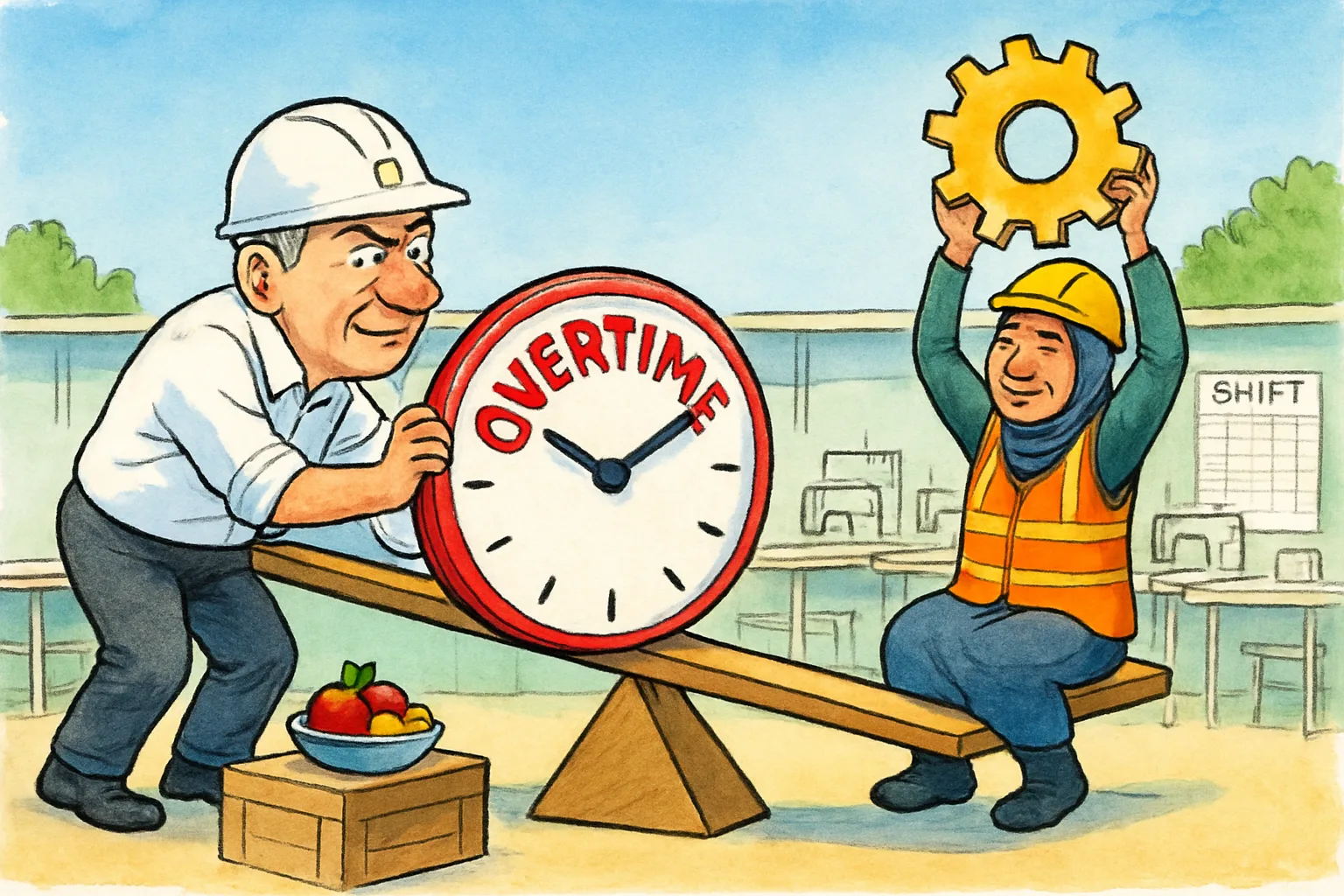
- Measure hours as a risk, not only as a cost. Track actual hours, consecutive shifts, rest between shifts and the concentration of overtime by person and by crew. Set internal triggers well below the legal ceiling and report them to management alongside incident and absence data.
- Treat fatigue as a hazard in risk assessment. Address fatigue and psychosocial factors explicitly in HIRADC and JSA for safety critical tasks such as energy isolation, lifting, driving and process start up, and choose controls that do not rely on a tired person recognising their own impairment.
- Assess the psychosocial environment with a recognised instrument. Permenaker 5/2018 provides the legal footing for measuring psychological factors. Use the results to fix work design: staffing levels, role clarity, workload peaks and the way overtime is allocated.
- Redesign the work before asking people to work longer. Ergonomic assessment of workstations, manual handling, heat and noise often reveals capacity losses that overtime is quietly compensating for.
- Train for competence, not attendance. Skills rehearsed under realistic conditions are retained better and performed more reliably, which reduces the time pressure that drives overtime. Schedule training within normal hours rather than at the end of a long shift.
- Equip line leaders. Supervisors make most overtime decisions and exert most informal pressure. Give them clear authority and simple rules to rotate tasks, stop work and decline unsafe extensions.
- Involve workers. The P2K3 committee and worker representatives are the natural forum for reviewing rosters and survey results, consistent with the ILO's emphasis on social dialogue.
How this connects with Nusa Safety's work
Several of these steps fall within work Nusa Safety already performs. Our ergonomics and work environment assessment measures physical factors and posture risk with reference to Permenaker 5/2018, and applied ergonomics training prepares supervisors and HSE teams to continue that work internally. Bringing psychosocial hazards into hazard identification is part of SMK3 and ISO 45001 implementation, while HSE leadership for line management addresses the supervisors who allocate overtime.
On the digital side, APEX Risk allows teams to run HIRADC and JSA within projects and carry the findings into a corporate risk register and a corrective action register, so that fatigue controls are tracked with owners and targets rather than left in meeting notes. AIRA builds BowTie assessments in which fatigue can be modelled as an escalation factor that weakens behavioural barriers, with Tripod latent factors pointing back to organisational causes such as rostering. For competence, the PSM Simulator includes human factor cases classified as slip, lapse, mistake or violation, and the LOTO Simulator scores the full energy isolation sequence and records field decisions such as a request to skip a gas test. Both are training aids that let workers rehearse critical procedures repeatably, and neither replaces site procedures or permit systems. Certified training programmes are delivered together with licensed PJK3 partners, and Nusa Safety does not issue certificates.
Conclusion
The ILO's 2026 estimate, Indonesia's data on excessive hours and the national productivity agenda point to the same conclusion. Human capacity cannot be drawn on indefinitely through longer hours. It is built through work design, competence and leadership, and it is protected by treating fatigue and psychosocial strain as hazards with measurable controls. Organisations that make this shift can expect fewer errors and absences, and productivity gains that last. The new labour protection law, once its text is published, offers a natural moment to review rosters, overtime practice and the psychosocial content of the risk register.
This article is general information and not legal advice. For questions on how specific regulations apply to your company, please consult a qualified advocate.
References
- Bisnis.com. (2025, October 7). Marak PHK, Menaker: Daya saing kita kurang. https://ekonomi.bisnis.com/read/20251007/12/1918149/marak-phk-menaker-daya-saing-kita-kurang
- Caldwell, J. A., Caldwell, J. L., Thompson, L. A., & Lieberman, H. R. (2019). Fatigue and its management in the workplace. Neuroscience & Biobehavioral Reviews, 96, 272-289. https://doi.org/10.1016/j.neubiorev.2018.10.024
- Databoks. (2026a). 25% of Indonesians work more than 49 hours a week in 2025. Katadata. https://databoks.katadata.co.id/en/employment/statistics/69683a7549e69/25-of-indonesians-work-more-than-49-hours-a-week-in-2025
- Databoks. (2026b, March 4). Produktivitas tenaga kerja di Indonesia naik 3,75% pada 2025. Katadata. https://databoks.katadata.co.id/agroindustri/statistik/69a7c95942bdc/produktivitas-tenaga-kerja-di-indonesia-naik-375-pada-2025
- Dawson, D., & McCulloch, K. (2005). Managing fatigue: It's about sleep. Sleep Medicine Reviews, 9(5), 365-380. https://doi.org/10.1016/j.smrv.2005.03.002
- GoodStats. (n.d.). Laki-laki lebih banyak dapat jam kerja berlebih dibanding perempuan pada 2025. https://data.goodstats.id/statistic/laki-laki-lebih-banyak-dapat-jam-kerja-berlebih-dibanding-perempuan-pada-2025-bajIx
- International Labour Organization. (2026). The psychosocial working environment: Global developments and pathways for action. https://www.ilo.org/topics-and-sectors/safety-and-health-work/world-day-safety-and-health-work-2026
- International Organization for Standardization. (2018). ISO 45001:2018 Occupational health and safety management systems, requirements with guidance for use. ISO.
- International Organization for Standardization. (2021). ISO 45003:2021 Occupational health and safety management, psychological health and safety at work, guidelines for managing psychosocial risks. ISO.
- Kementerian Ketenagakerjaan Republik Indonesia. (2018). Peraturan Menteri Ketenagakerjaan Nomor 5 Tahun 2018 tentang Keselamatan dan Kesehatan Kerja Lingkungan Kerja. https://peraturan.go.id/files/bn567-2018.pdf
- Kompas.com. (2026, February 12). Fenomena overwork di Indonesia, upah rendah dan jam kerja panjang. https://lestari.kompas.com/read/2026/02/12/124433086/fenomena-overwork-di-indonesia-upah-rendah-dan-jam-kerja-panjang
- Mustamin, W., Santoso, B., & Sajidin, S. (2022). Indonesian workers' mental health protection: An urgency? Journal of Judicial Review, 24(2), 273-288. https://journal.uib.ac.id/index.php/jjr/article/view/7231
- Okezone. (2026, October 6). Tok! DPR sahkan RUU Pelindungan Ketenagakerjaan hari ini. https://economy.okezone.com/read/2026/10/06/320/3246234/tok-dpr-sahkan-ruu-pelindungan-ketenagakerjaan-hari-ini
- Pega, F., Náfrádi, B., Momen, N. C., Ujita, Y., Streicher, K. N., Prüss-Üstün, A. M., & Technical Advisory Group. (2021). Global, regional, and national burdens of ischemic heart disease and stroke attributable to exposure to long working hours for 194 countries, 2000-2016. Environment International, 154, 106595. https://doi.org/10.1016/j.envint.2021.106595
- Republik Indonesia. (2003). Undang-Undang Nomor 13 Tahun 2003 tentang Ketenagakerjaan.
- Republik Indonesia. (2021). Peraturan Pemerintah Nomor 35 Tahun 2021 tentang Perjanjian Kerja Waktu Tertentu, Alih Daya, Waktu Kerja dan Waktu Istirahat, dan Pemutusan Hubungan Kerja. https://peraturan.bpk.go.id/Details/161904
- Republik Indonesia. (2023). Undang-Undang Nomor 6 Tahun 2023 tentang Penetapan Peraturan Pemerintah Pengganti Undang-Undang Nomor 2 Tahun 2022 tentang Cipta Kerja menjadi Undang-Undang. https://peraturan.bpk.go.id/Details/246523
- Tarwaka. (2015). Ergonomi industri: Dasar-dasar pengetahuan ergonomi dan aplikasi di tempat kerja (Edisi II). Harapan Press.
- United Nations. (2026, April). Long hours, stress and harassment are causing hundreds of thousands of early deaths, says UN labour agency. UN News. https://news.un.org/en/story/2026/04/1167356
