
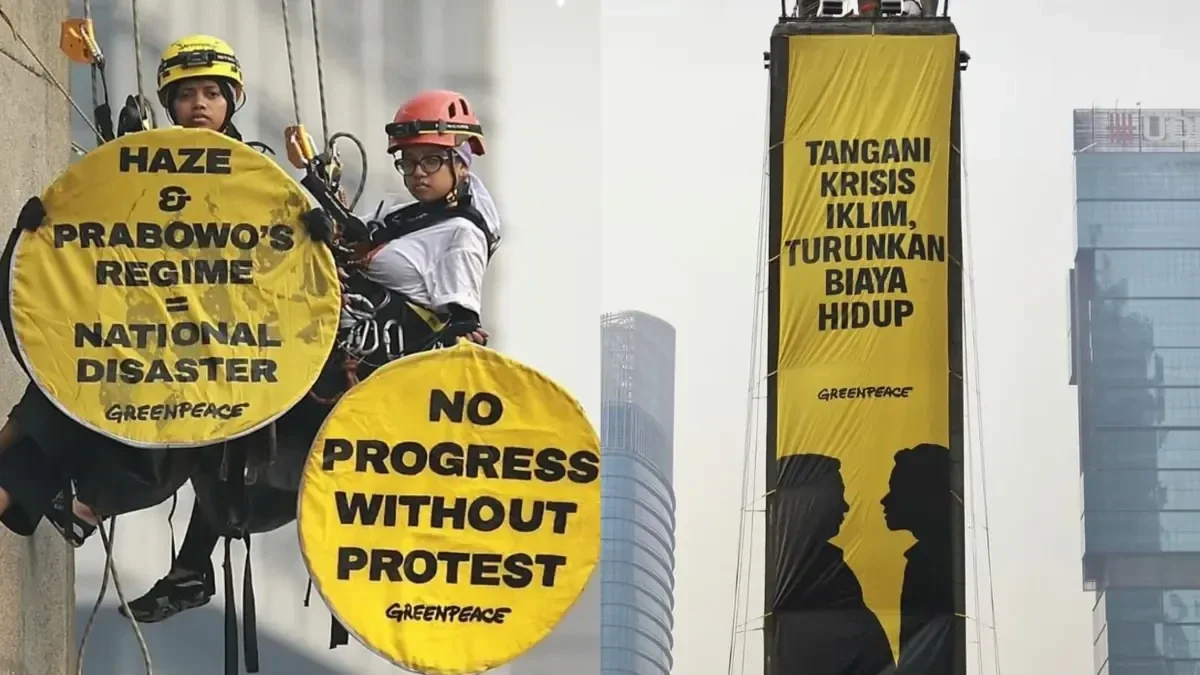
On 20 October 2026, two large banners hung from the Selamat Datang monument at the Hotel Indonesia roundabout (Bundaran HI) in Jakarta. Six Greenpeace Indonesia activists were at the top of the structure, and the images spread quickly. Many people asked the same two things: how did they get up there, and how were they brought down safely?
This article does not assess the campaign's message. It uses the event to explain what professional work at height demands: the Indonesian regulation, rope access practice as set out by the Industrial Rope Access Trade Association (IRATA), the equipment, and the rescue arrangements companies need. It is not a climbing guide and does not encourage climbing any structure without authorisation, training and a rescue plan.
Background: what Indonesian regulation requires
Law No. 1 of 1970 on Work Safety is the parent law. The technical rule is Minister of Manpower Regulation No. 9 of 2016 on Occupational Safety and Health in Work at Height. It defines work at height broadly, as work at a place with a difference in level and a potential to fall that could injure or kill people or damage property. Scaffolds, roof edges, towers and facades all qualify.
Article 3 lists five elements every activity must satisfy: planning, work procedures, safe working techniques, personal protective equipment with fall protection devices and anchors, and competent workers. The regulation requires a risk assessment and allows work at height only when the task cannot be done from ground level. Written procedures must cover fall protection, equipment management, supervision, securing the work area and emergency preparedness, and a rescue team must be on standby while work is in progress.
For rope access, Regulation 9/2016 requires two ropes, a working line and a safety line, each fixed to its own anchor point. The safety line carries a self-locking fall arrester that follows the worker, and the working line carries the devices for ascent and descent. It replaced the earlier rope access guideline KEP.45/DJPPK/IX/2008. According to the legal database of the Audit Board (BPK), two of its provisions were revoked by Minister of Manpower Regulation No. 11 of 2026 on Labour Inspection Procedures, while the rest remains in force.
Competence runs in two streams: workers on high buildings at levels 1 and 2, and workers at height, the stream that includes rope access, at levels 1, 2 and 3. Each level has defined authority. A level 1 worker, for example, installs anchors only under the supervision of a higher level. Workers must hold a competency certificate and a K3 licence from the Ministry of Manpower. A review in the PPSDM Migas journal Swara Patra shows how these requirements translate into preventive measures on construction sites (Trianto, 2020).
Rope access practitioners in Indonesia have their own body, the Indonesian Rope Access Association (Asosiasi Rope Access Indonesia, ARAI). When the Minister of Manpower received ARAI in July 2018 to discuss the Indonesia Rope Challenge, the Director General for labour inspection and K3 stressed that even a competition had to meet Regulation 9/2016 (detikFinance, 2018).
The current issue: what was reported at Bundaran HI
Kompas.com reported that on Tuesday, 20 October 2026, six Greenpeace Indonesia activists unfurled two large banners from the monument, one reading "Bencana Makin Parah, Hidup Makin Susah, Apa Kerja Pemerintah?" (Disasters are worse, life is harder, what is the government doing?), on the second anniversary of the current administration (Kompas.com, 2026a). Investortrust.id (2026) reported that the other banner, facing the Merdeka Palace, read "Tangani Krisis Iklim, Turunkan Biaya Hidup" (Address the climate crisis, lower the cost of living). Greenpeace said the message concerned the climate crisis, environmental degradation and socio-economic pressures (Kompas.com, 2026b).
A joint team from the Central Jakarta Metro Police, the local military district command and the Jakarta provincial government brought all six down. Police said the priority was the activists' safety and prepared six ambulances and oxygen. They reported that the activists, two women and four men, appeared weak and that the first to come down, a woman, needed oxygen. All six were taken to the Polda Metro Jaya medical clinic (Tribrata News Polri, 2026; CNN Indonesia, 2026a). Police said they would review CCTV footage to establish how the activists climbed, and noted that the monument is a protected cultural heritage structure (detikNews, 2026). The six were sent home that evening (CNN Indonesia, 2026b).
Authorities have not officially described the climbing method, although Suara.com (2026) published an explainer pointing to a single rope technique. Whatever the method, the reports show two things: time at height takes a physical toll, and bringing people down safely takes planning and equipment.
How professional rope access works
The two-rope principle
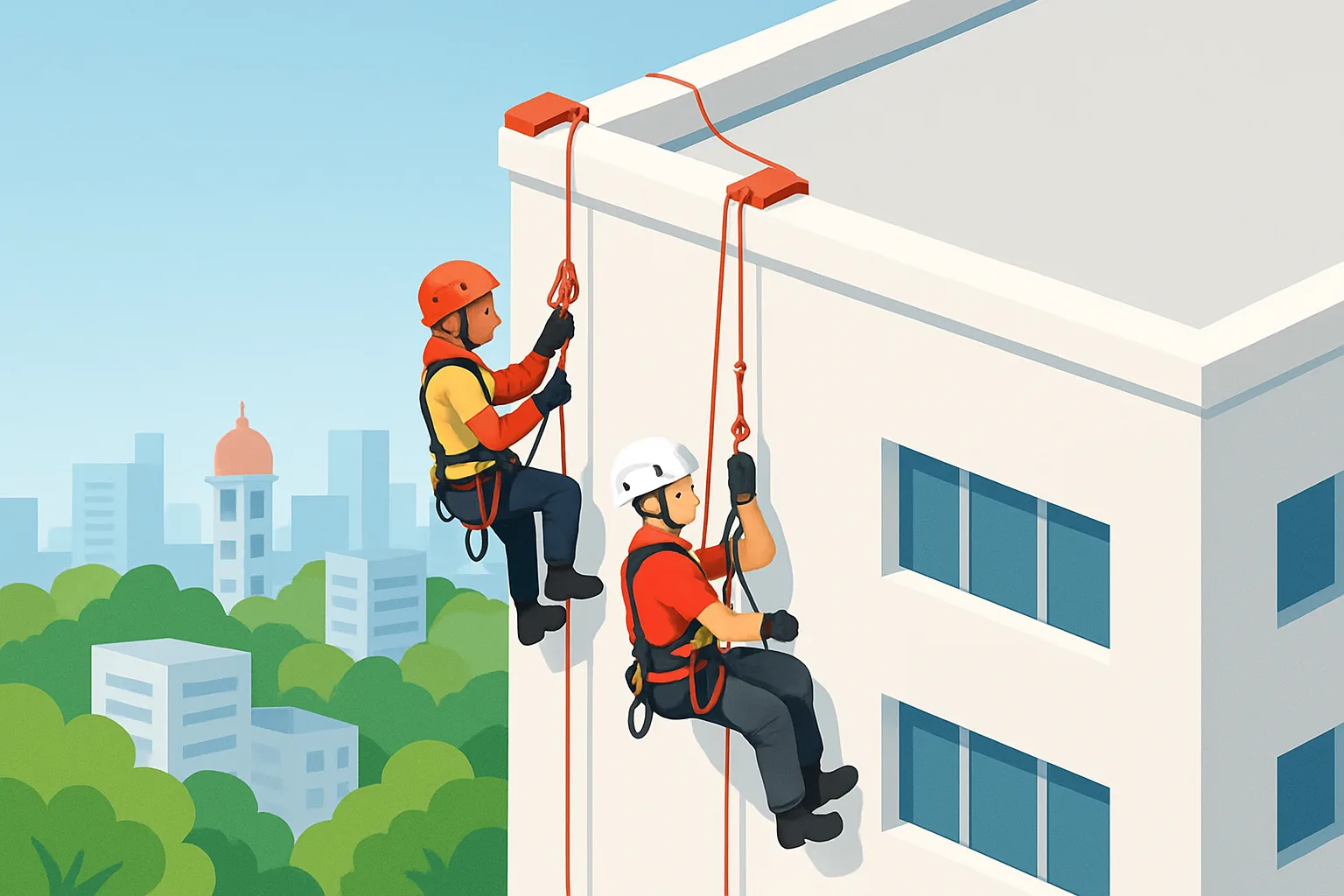
The IRATA International Code of Practice (ICOP) starts from redundancy. Each technician is attached to a working line for access, egress and support, and a separate safety line as backup, each secured to its own reliable anchorage, so that the failure of one component does not lead to a fall (Industrial Rope Access Trade Association [IRATA], 2013). Regulation 9/2016 writes the same principle into Indonesian law. The ICOP also requires a team of at least two technicians, one of whom is a Level 3 safety supervisor who checks that the anchor lines are correctly rigged.
The equipment set
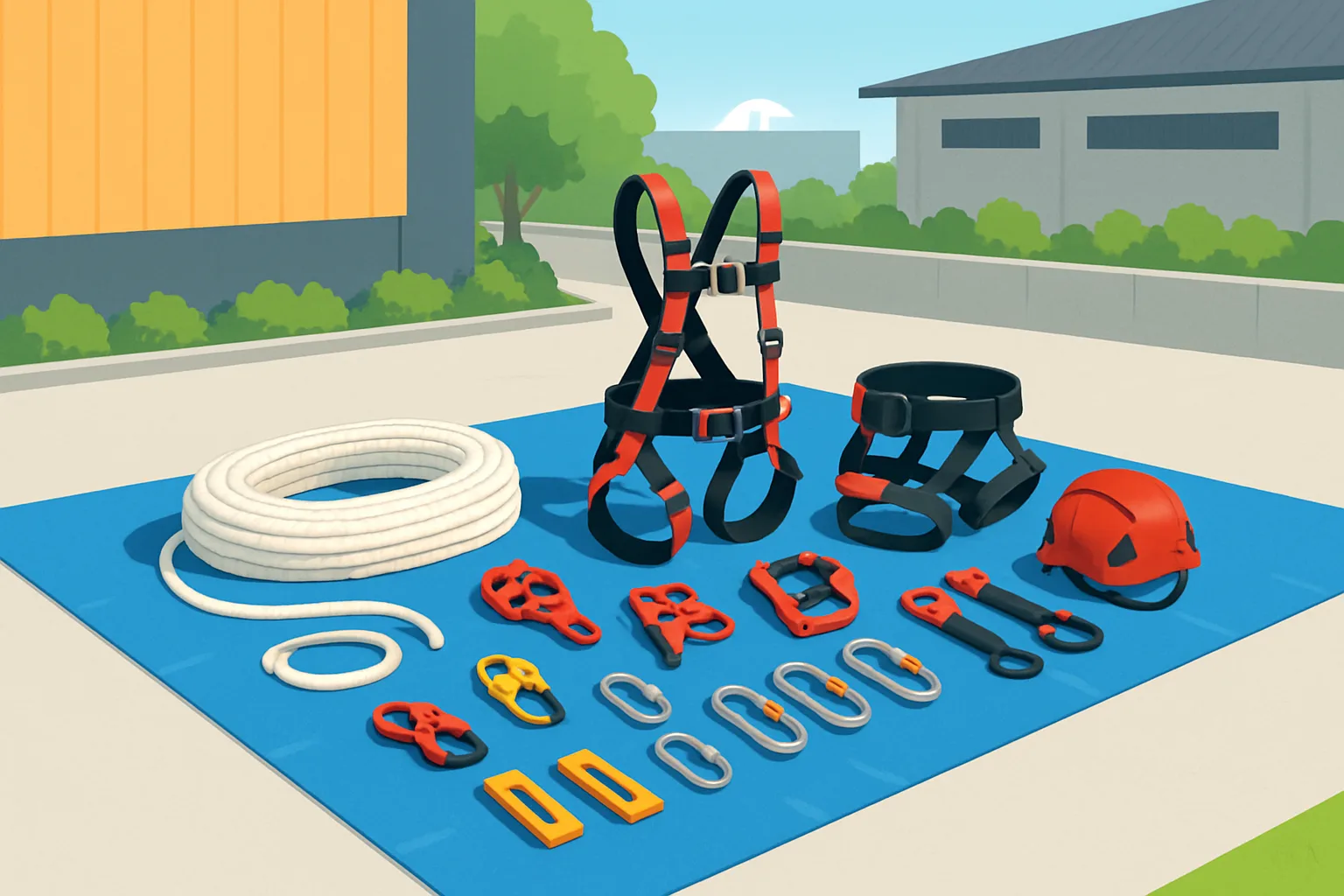
A rope access kit is a set of tested components, each built to its own standard:
- Low stretch kernmantel (semi-static) rope to EN 1891 Type A, in a diameter the devices are approved for, with rope and edge protectors wherever it passes a sharp or abrasive edge.
- A sit harness (EN 813) combined with a full body harness (EN 361).
- Rope adjustment devices to EN 12841: Type A back-up devices on the safety line, Type B ascenders on the working line, and Type C descenders, preferably auto-locking, for controlled descent.
- Hand and chest ascenders (also covered as rope clamps by EN 567) with a foot loop.
- Locking connectors to EN 362 and anchor devices to EN 795, with slings, rigged so each line has its own anchor.
- A helmet to EN 12492 with a chin strap, and tool lanyards so nothing falls on people below.
How a technician ascends a rope
The method is mechanical rather than acrobatic. In the rope ascent taught in professional courses, often called a frog system, a chest ascender on the harness and a hand ascender with a foot loop are attached to the working line. Both slide up but lock under load. The technician stands in the foot loop, the chest ascender moves up, the technician sits back into the harness, and the hand ascender is moved higher. The back-up device travels up the safety line, ready to arrest a fall. Changeovers, such as switching from ascent to descent, are trained and assessed separately, because that is where errors happen.
Rigging from above
Industrial ropes are normally rigged from above. The team reaches the anchor area by a permanent route such as a roof or platform, installs and checks anchors, and lowers the ropes down the work face. Without access from above, the job may need aid climbing, a higher risk method requiring Level 3 planning. The rigging plan belongs in the method statement and permit to work.
Rescue is part of the system
A rope access plan without a rescue method is incomplete. A person hanging motionless in a harness can develop suspension intolerance; in a NIOSH laboratory study of experienced construction workers, suspension times ranged from about four minutes to the one-hour limit of the test (Turner et al., 2008). The ICOP therefore expects the team to rescue a colleague promptly and describes rigging for rescue that, where possible, lets a casualty be retrieved without a rescuer descending or ascending to them, using rigging strong enough for a two-person load (IRATA, 2013). The joint evacuation at Bundaran HI, with ambulances and oxygen ready, shows the resources that an unplanned retrieval from height can require.
Competence levels
Under IRATA's Training, Assessment and Certification Scheme, Level 1 technicians work under the supervision of a Level 3, Level 2 adds more complex rigging and rescue, and Level 3 can take full responsibility for rope access safety on a project and must hold a current first aid certificate (IRATA, n.d.). Each grade is assessed independently. In Indonesia, the legal requirement is the Ministry of Manpower K3 licence for workers at height. Some contracts ask for both.
What companies should have in place
- Ask first whether the work needs to be at height at all, and prefer guardrails, platforms or mobile elevating work platforms before personal fall protection and rope access, in line with the hierarchy of controls in clause 8.1.2 of SNI ISO 45001:2018.
- Prepare a written risk assessment, method statement and rigging plan for each job, and issue a permit to work that names the supervisor.
- Verify valid work at height licences at the right level, and IRATA or equivalent certification where the contract requires it, with expiry dates on file.
- Write a site and task specific rescue plan, have the equipment and trained people on site before work starts, and rehearse it.
- Inspect equipment before each use and periodically, keep a register by serial number, and withdraw any item that has arrested a fall or shows damage.
- Control the zone below with barricades and exclusion areas, and use tool lanyards to prevent dropped objects.
- Set stop-work criteria for wind, rain and heat.
How Nusa Safety can support
Our Working at Height (TKBT/TKPK) programme prepares workers and their documents for licensed work at height and rope access courses. Certified training and competency assessment are delivered with licensed PJK3 and LSP partners; Nusa Safety does not issue certificates. The Risk Assessment and JSA Workshop helps teams build task risk assessments and rigging plans, and Emergency Preparedness and Drills puts a rescue plan through realistic exercises. SOP and Technical Guidelines Development supports written procedures and permit to work forms, and Statutory Equipment Inspection coordinates inspection with licensed partners. APEX Risk keeps task risks and controls in one register. To discuss your situation, contact us.
Conclusion
Whatever one thinks of the banner, the images from Bundaran HI made a technical point. With the right equipment, people can climb to a great height. Doing it safely, with a sure way down, depends on competence, redundancy and rescue planning. For companies, the test is easy to state and harder to pass: can every rope on site be traced to a planned anchor, a licensed and supervised technician, and a rescue team that was ready before work began?
This article is general information and not legal advice; for questions on how specific regulations apply to your organisation, please consult a qualified advocate.
References
- Badan Standardisasi Nasional. (2018). SNI ISO 45001:2018 Sistem manajemen keselamatan dan kesehatan kerja, persyaratan dengan panduan penggunaan. BSN.
- CNN Indonesia. (2026a, October 20). Polisi evakuasi enam aktivis Greenpeace pasang spanduk di Bundaran HI. https://www.cnnindonesia.com/nasional/20261020151840-12-1417559/polisi-evakuasi-enam-aktivis-greenpeace-pasang-spanduk-di-bundaran-hi
- CNN Indonesia. (2026b, October 21). Polda Metro pulangkan 6 aktivis Greenpeace yang pasang spanduk di HI. https://www.cnnindonesia.com/nasional/20261021112248-12-1417878/polda-metro-pulangkan-6-aktivis-greenpeace-yang-pasang-spanduk-di-hi
- detikNews. (2026, October 20). Polisi dalami cara Greenpeace naik ke Patung Selamat Datang Bundaran HI. https://news.detik.com/berita/d-8715476/polisi-dalami-cara-greenpeace-naik-ke-patung-selamat-datang-bundaran-hi
- detikFinance. (2018, July 24). Kemnaker dukung Indonesia Rope Challenge 2018. https://finance.detik.com/berita-ekonomi-bisnis/d-4133504/kemnaker-dukung-indonesia-rope-challenge-2018
- European Committee for Standardization. (1998). EN 1891:1998 Personal protective equipment for the prevention of falls from a height, low stretch kernmantel ropes. CEN.
- European Committee for Standardization. (2002). EN 361:2002 Personal protective equipment against falls from a height, full body harnesses. CEN.
- European Committee for Standardization. (2006). EN 12841:2006 Personal fall protection equipment, rope access systems, rope adjustment devices. CEN.
- European Committee for Standardization. (2008). EN 813:2008 Personal fall protection equipment, sit harnesses. CEN.
- European Committee for Standardization. (2012). EN 795:2012 Personal fall protection equipment, anchor devices. CEN.
- European Committee for Standardization. (2012). EN 12492:2012 Mountaineering equipment, helmets for mountaineers, safety requirements and test methods. CEN.
- European Committee for Standardization. (2013). EN 567:2013 Mountaineering equipment, rope clamps, safety requirements and test methods. CEN.
- Industrial Rope Access Trade Association. (2013). IRATA International code of practice for industrial rope access (TC-102ENG). IRATA International. https://irata.org/uploads/documents/International_Code_of_Practice_(ICOP)_-_English_TC-102ENG.pdf
- Industrial Rope Access Trade Association. (n.d.). About the scheme, training, assessment and certification scheme (TACS). IRATA International. https://irata.org/page/about-certification/
- Investortrust.id. (2026, October 20). Aksi bentang spanduk di Bundaran HI, 6 aktivis Greenpeace dievakuasi polisi. https://investortrust.id/national/119894/aksi-bentang-spanduk-di-bundaran-hi-6-aktivis-greenpeace-dievakuasi-polisi
- Kompas.com. (2026a, October 20). Greenpeace bentangkan spanduk protes soal bencana di Monumen Selamat Datang Bundaran HI. https://megapolitan.kompas.com/read/2026/10/20/10364021/greenpeace-bentangkan-spanduk-protes-soal-bencana-di-monumen-selamat
- Kompas.com. (2026b, October 21). Penjelasan Greenpeace soal aksi bentangkan spanduk protes di Bundaran HI. https://megapolitan.kompas.com/read/2026/10/21/11225681/penjelasan-greenpeace-soal-aksi-bentangkan-spanduk-protes-di-bundaran-hi
- Peraturan Menteri Ketenagakerjaan Nomor 9 Tahun 2016 tentang Keselamatan dan Kesehatan Kerja dalam Pekerjaan pada Ketinggian. Berita Negara Republik Indonesia Tahun 2016 Nomor 386. https://peraturan.bpk.go.id/Details/146109/permenaker-no-9-tahun-2016
- Peraturan Menteri Ketenagakerjaan Nomor 11 Tahun 2026 tentang Tata Cara Pengawasan Ketenagakerjaan. https://peraturan.bpk.go.id/Details/351282/permenaker-no-11-tahun-2026
- Suara.com. (2026, October 20). Apa itu single rope technique, cara aktivis Greenpeace panjat patung Bundaran HI. https://www.suara.com/lifestyle/2026/10/20/170318/apa-itu-single-rope-technique-cara-aktivis-greenpeace-panjat-patung-bundaran-hi
- Tribrata News Polri. (2026). Polisi evakuasi enam aktivis Greenpeace dari puncak monumen Bundaran HI. https://tribratanews.polri.go.id/blog/nasional-3/polisi-evakuasi-enam-aktivis-greenpeace-dari-puncak-monumen-bundaran-hi-107530
- Trianto, W. M. (2020). Bekerja di ketinggian pada pekerjaan konstruksi, peraturan dan tindakan pencegahan. Majalah Ilmiah Swara Patra, 10(1), 39-50. https://doi.org/10.37525/sp/2020-1/247
- Turner, N. L., Wassell, J. T., Whisler, R., & Zwiener, J. (2008). Suspension tolerance in a full-body safety harness, and a prototype harness accessory. Journal of Occupational and Environmental Hygiene, 5(4), 227-231.
- Undang-Undang Nomor 1 Tahun 1970 tentang Keselamatan Kerja.
