
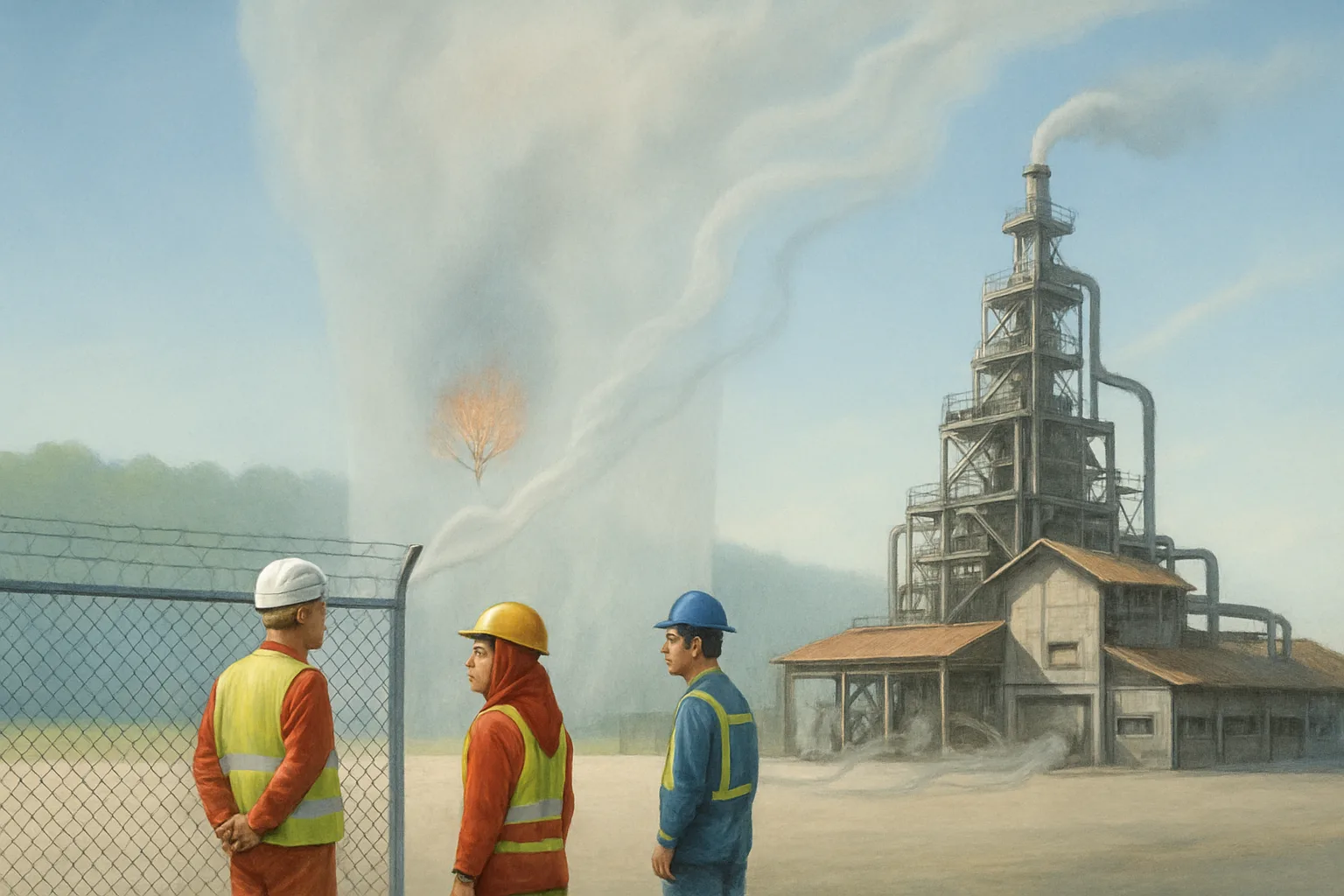
Most emergency response plans in Indonesian workplaces are written from the inside out. They start with what can go wrong within the site and assume that the outside world will stay as it is: roads open, hospitals reachable, air breathable. The forest and land fire season of 2026 has tested that assumption. For weeks, workplaces and schools in parts of Sumatra and Kalimantan have operated under smoke they did not produce and cannot switch off.
This article treats forest and land fires (karhutla) as an external emergency, one that originates beyond the fence line but reaches the workplace through air, water, access roads and people. It draws system-level lessons for safety, environment and the wellbeing of workers and their families, without blaming any individual or company.
Background: why an external emergency is different
Indonesian law already looks beyond the fence. Law No. 1 of 1970 on Work Safety includes among its safety requirements fire prevention and extinguishing, escape routes during fires and other dangerous events, and the control of dust, smoke and gases. Government Regulation No. 50 of 2012 makes emergency planning part of the occupational safety and health management system (SMK3) that companies must implement and that audits assess. SNI ISO 45001:2018, clause 8.2, requires an organisation to plan its response to emergency situations, test it periodically, and communicate relevant information to workers, contractors, visitors, emergency services, government authorities and, where appropriate, the local community (Badan Standardisasi Nasional, 2018). Law No. 24 of 2007 on Disaster Management gives business entities a role in disaster management. For land-based businesses, Government Regulation No. 4 of 2001 and Minister of Environment and Forestry Regulation P.32/MENLHK/SETJEN/KUM.1/3/2016 set out the duty to prevent and control forest and land fires.
All of them require foreseeable emergencies to be identified. An external emergency differs from an internal one in three ways. The organisation cannot remove the source, so control must focus on exposure, consequence and recovery. The event is prolonged, often lasting weeks rather than hours, so fatigue, supply and morale become hazards in their own right. And it affects workers' families and communities at the same time, so the boundary between occupational and public health becomes thin.
The wildland fire research briefing book of the U.S. Environmental Protection Agency's Office of Research and Development describes wildland fire smoke as a complex mixture of gases, hazardous air pollutants, water vapour and fine particulate matter (PM2.5), able to affect communities near the fire and far downwind (U.S. Environmental Protection Agency [EPA], n.d.). Several findings in that book matter directly for Indonesia's peatlands:
- In inhalation studies on mice, smoke from burning peat and eucalyptus caused more lung inflammation than smoke from oak, and flaming smoke was more toxic per unit mass than smouldering smoke (Kim et al., 2019).
- After a 2008 peat fire in rural North Carolina, emergency department visits for asthma, chronic obstructive pulmonary disease, pneumonia and acute bronchitis, and heart failure rose significantly in the exposed counties, with elevated risk lasting up to five days after exposure (Rappold et al., 2011).
- In California, out-of-hospital cardiac arrest risk peaked on heavy smoke days and persisted for several days (Jones et al., 2020).
- Daily and even hourly PM2.5 exposure was associated with reduced attention in adults within hours (Cleland et al., 2022), which matters for drivers, operators and other safety-critical roles.
Regional evidence agrees. Modelling of the 2015 haze estimated about 100,300 excess deaths across Indonesia, Malaysia and Singapore (Koplitz et al., 2016). A study of Central Kalimantan estimated that peatland fires raised annual mean PM2.5 by about 26 µg/m³ in 2011 to 2015 (Uda et al., 2019), against a World Health Organization guideline of 5 µg/m³ for the annual mean and 15 µg/m³ for the 24-hour mean (World Health Organization, 2021). A recent meta-analysis of Kalimantan studies reported a 36.6 percent rise in respiratory clinic visits on haze days (Aprianti et al., 2025).
The current situation: the 2026 season
On 16 October 2026, the Meteorology, Climatology and Geophysics Agency (BMKG) recorded 478 high-confidence hotspots, with South Sumatra the highest at 189, and reported that smoke had briefly entered western Java, including Greater Jakarta. BMKG expected relatively dry conditions to continue from 17 to 24 October in southern Sumatra, Java, Bali, Nusa Tenggara and parts of Kalimantan (CNN Indonesia, 2026b).
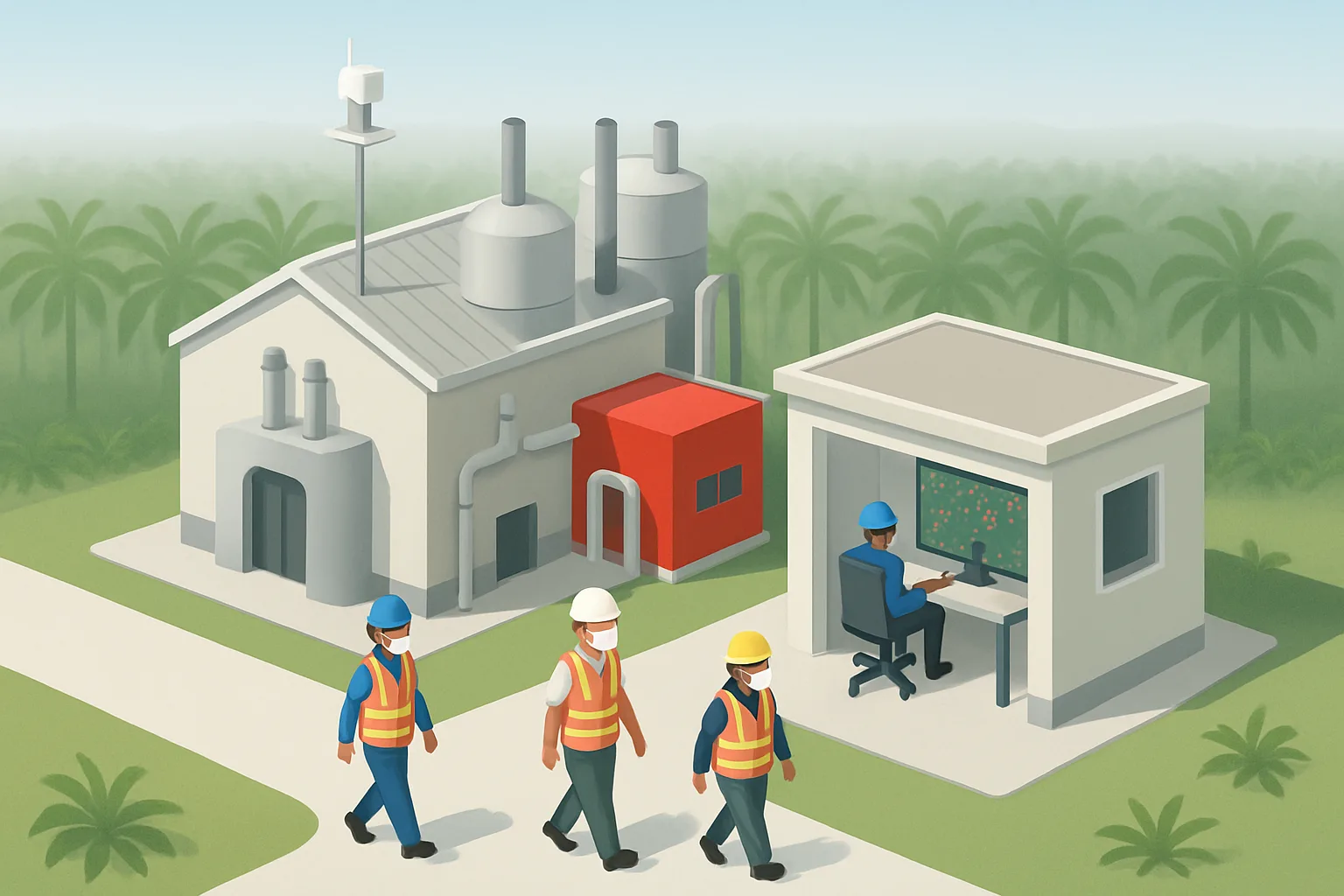
CNN Indonesia (2026a) reported that the Ministry of Health had recorded 283,270 cases of acute respiratory infection (ISPA) in seven provinces affected by the fires. On 15 October 2026, the Minister of Health urged infants, toddlers, older people and pregnant women to limit outdoor activity, advised those who must go out to wear a mask, ideally an N95, and asked anyone with persistent cough or eye or skin irritation to visit a community health centre (Kementerian Kesehatan Republik Indonesia, 2026). In Palangka Raya, the city health office recorded 10,240 ISPA cases from June to early October (detikHealth, 2026), and the city education office extended distance learning for kindergarten to junior secondary pupils from 19 to 21 October, citing four consecutive days of air quality monitoring (Prokalteng, 2026).
Each fact has a workplace counterpart: hotspot data is an early warning, ISPA cases are absences and reduced capacity, and school closures leave many workers caring for children while trying to keep their shift.
Lessons and recommendations
Put external hazards in the risk register
HIRADC and corporate risk registers should name smoke, approaching fire, access disruption and contaminated water as hazards with their own causes, consequences and controls, reviewed before the dry season. A BowTie analysis is useful here: the threats sit outside the fence, so the weight falls on preventive barriers at the boundary and on recovery barriers inside it.
Define trigger-action plans tied to air quality and hotspot data
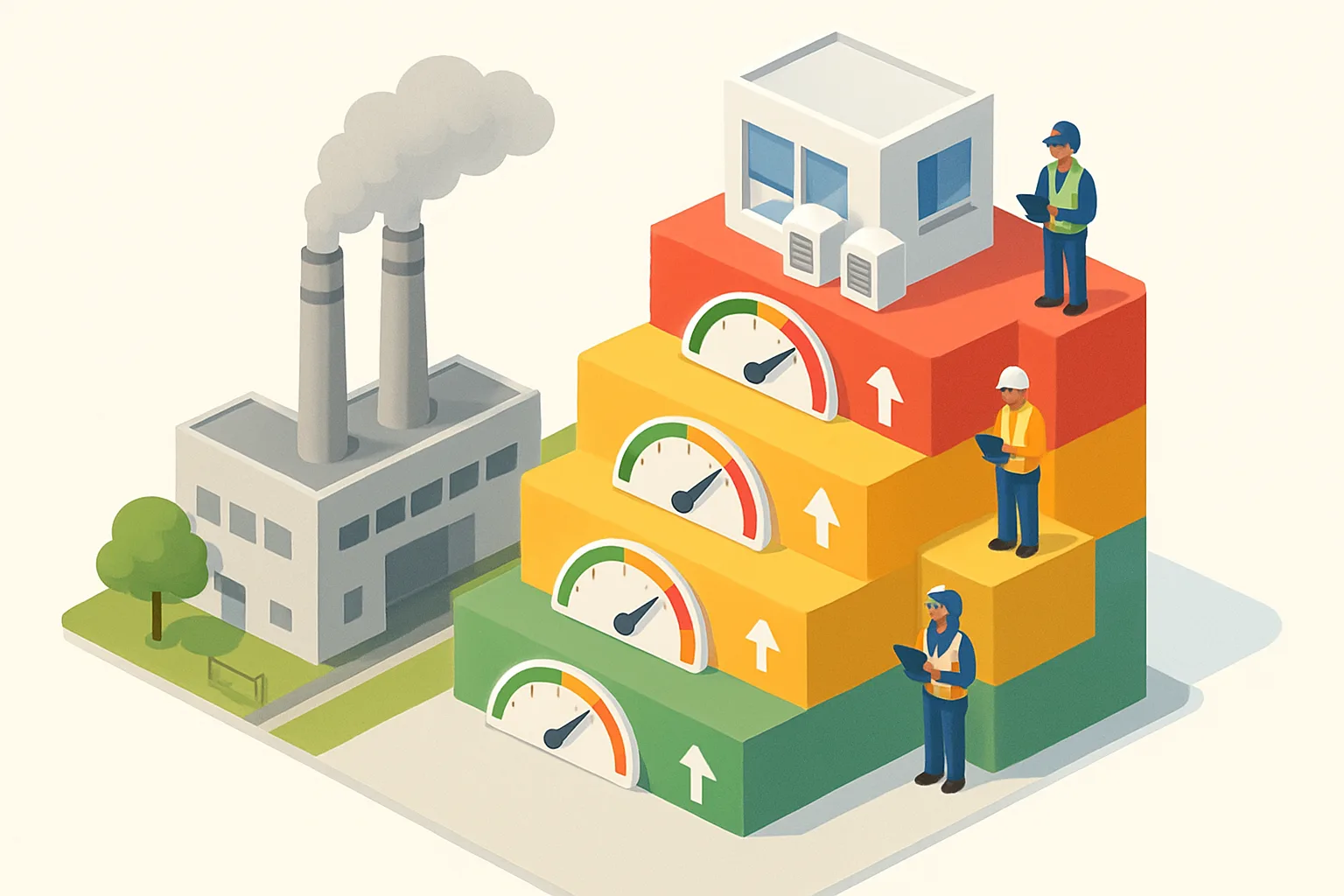
Decisions under smoke should not rest on one person's judgement on a hazy morning. Organisations can define levels linked to the national Air Pollutant Standard Index (ISPU) under Regulation P.14/MENLHK/SETJEN/KUM.1/7/2020, whose categories run from good (up to 50), moderate (51 to 100), unhealthy (101 to 200) and very unhealthy (201 to 300) to hazardous (above 300), and to BMKG hotspot counts within a set radius of the site. Each level should state what changes and who decides. California's wildfire smoke standard offers a precedent: employers must act once the PM2.5 air quality index reaches 151, provide respirators for voluntary use, and make their use mandatory above 500 (California Code of Regulations, Title 8, Section 5141.1). The scales differ from ISPU, but the principle of pre-agreed triggers transfers well. Low-cost sensors can fill gaps between official monitors, although EPA tests found they read high in smoke and need correction (EPA, n.d.).
Protect outdoor workers properly
When the hazard is the air itself, work modification comes first: reschedule heavy outdoor tasks, shorten exposure and move tasks indoors where possible. Respiratory protection, when needed, must be real protection. The National Institute for Occupational Safety and Health (2023) notes that cloth masks, surgical masks and bandanas do not seal to the face and do not filter smoke particles, while N95 or P100 respirators reduce exposure only when properly fitted and worn. That implies fit testing, training, a supply sized for weeks, and attention to workers with beards or respiratory conditions.
Create cleaner-air spaces
Staying indoors helps only if indoor air is cleaner. EPA research found that smoke infiltrates buildings, that indoor PM2.5 depends on ventilation maintenance, filter efficiency and door and window practice, and that portable air cleaners help but their filters load quickly in smoke (EPA, n.d.). Offices, control rooms, mess halls, clinics and worker camps should have at least one designated cleaner-air room with sealed openings, adequate filtration and an indoor monitor.
Plan for fire at the boundary and blocked access
Where sites border fire-prone land, plans need evacuation routes that account for smoke on roads, alternative muster points, firebreaks, water for suppression, and agreed roles with the local disaster management agency (BPBD), the Manggala Agni forest fire brigade and fire-care community groups. Business continuity planning under ISO 22301:2019 should cover suppliers, logistics and the minimum crew for safe critical operations.
Watch the water and the ash
Environmental effects outlast the smoke. A review by EPA researchers found that nutrients, metals and organic chemicals in burned watersheds increased, sometimes by orders of magnitude, occasionally exceeding drinking water standards even in treated water, with most effects lasting under five years (Paul et al., 2022). Sites drawing raw water near burned areas should add post-fire sampling, manage ash and runoff on their own land, and record fire-related impacts in environmental reporting.
Look after wellbeing, not only lungs
Prolonged haze strains people in ways incident statistics rarely capture. During the 2013 Singapore haze, perceived danger and the number of physical symptoms were associated with higher psychological stress scores (Ho et al., 2014). Workers worry about children, elderly parents and their own breathing. Practical support includes flexible hours during school closures, clinic information, masks for families, and supervisors who check in rather than only count attendance.
Communicate clearly and coordinate early
EPA's Smoke Ready Communities work showed the value of building smoke response plans with local health and emergency partners before the season (EPA, n.d.). Internally, one source of truth for air quality, triggers and decisions prevents rumour and inconsistent practice between shifts and contractors.
How Nusa Safety can support
Our Emergency Preparedness and Drills programme designs smoke and boundary-fire scenarios, tabletop exercises and drills, and our Fire and Emergency Safety Audit reviews the emergency response plan, fire team organisation and evacuation. The Risk Assessment and JSA Workshop helps teams add external hazards to HIRADC, Engineering Studies and Risk Assessments supports deeper analysis for assets near fire-prone land, and Environmental Compliance and PROPER covers post-fire environmental obligations.
On the digital side, APEX Risk holds HIRADC, business impact analysis and a physical climate risk register in one corporate risk register with key risk indicators, and AIRA helps assessors build a BowTie for scenarios such as smoke ingress or fire reaching the site boundary. Certified fire brigade and first aider training is delivered with licensed PJK3 partners; Nusa Safety does not issue certificates. To discuss your situation, contact us.
Conclusion
The 2026 karhutla season is a reminder that emergency preparedness ends at the fence only on paper. Smoke crosses boundaries, reduces attention and lung function, fills clinics and closes schools, and fire can affect water sources long after it is out. Organisations that treat karhutla as a foreseeable external emergency, with named hazards, pre-agreed triggers, effective respiratory protection, cleaner-air spaces, environmental follow-up and genuine care for workers and families, will be better prepared for the next season.
This article is general information and not legal advice; for questions on how specific regulations apply to your organisation, please consult a qualified advocate.
References
- Aprianti, R., Fachri, M., & Lusida, N. (2025). Systematic review of the impact of haze in Kalimantan: A meta-analysis of PM2.5 exposure on non-communicable disease. JONDPAC, 3(2). https://doi.org/10.61843/jondpac.v3i2.1008
- Badan Standardisasi Nasional. (2018). SNI ISO 45001:2018 Sistem manajemen keselamatan dan kesehatan kerja, persyaratan dengan panduan penggunaan. BSN.
- California Code of Regulations, Title 8, Section 5141.1. Protection from wildfire smoke. California Department of Industrial Relations. https://www.dir.ca.gov/title8/5141_1.html
- Cleland, S. E., Wyatt, L. H., Wei, L., Paul, N., Serre, M. L., West, J. J., Henderson, S. B., & Rappold, A. G. (2022). Short-term exposure to wildfire smoke and PM2.5 and cognitive performance in a brain-training game: A longitudinal study of U.S. adults. Environmental Health Perspectives, 130(6), 067005. https://doi.org/10.1289/EHP10498
- CNN Indonesia. (2026a, October 14). Kemenkes catat 283.270 orang idap ISPA akibat karhutla. https://www.cnnindonesia.com/nasional/20261014112830-20-1415126/kemenkes-catat-283270-orang-idap-ispa-akibat-karhutla
- CNN Indonesia. (2026b, October 17). BMKG: Asap karhutla mulai jauhi Jabodetabek. https://www.cnnindonesia.com/nasional/20261017194602-20-1416556/bmkg-asap-karhutla-mulai-jauhi-jabodetabek
- detikHealth. (2026, October 13). Dampak kabut asap, puluhan ribu warga terserang ISPA. https://health.detik.com/fotohealth/d-8704634/dampak-kabut-asap-puluhan-ribu-warga-terserang-ispa
- Ho, R. C., Zhang, M. W., Ho, C. S., Pan, F., Lu, Y., & Sharma, V. K. (2014). Impact of 2013 south Asian haze crisis: Study of physical and psychological symptoms and perceived dangerousness of pollution level. BMC Psychiatry, 14, 81. https://doi.org/10.1186/1471-244X-14-81
- International Organization for Standardization. (2019). ISO 22301:2019 Security and resilience, business continuity management systems, requirements. ISO.
- Jones, C. G., Rappold, A. G., Vargo, J., Cascio, W. E., Kharrazi, M., McNally, B., & Hoshiko, S. (2020). Out-of-hospital cardiac arrests and wildfire-related particulate matter during 2015-2017 California wildfires. Journal of the American Heart Association, 9(8), e014125. https://doi.org/10.1161/JAHA.119.014125
- Kementerian Kesehatan Republik Indonesia. (2026, October 15). Menkes imbau kelompok rentan batasi aktivitas di luar rumah saat kabut asap. https://kemkes.go.id/id/menkes-imbau-kelompok-rentan-batasi-aktivitas-di-luar-rumah-saat-kabut-asap
- Kim, Y. H., King, C., Krantz, Q. T., Hargrove, M. M., George, I. J., McGee, J., Copeland, L., Hays, M. D., Landis, M. S., Higuchi, M., Gavett, S. H., & Gilmour, M. I. (2019). The role of fuel type and combustion phase on the toxicity of biomass smoke following inhalation exposure in mice. Archives of Toxicology, 93(6), 1501-1513. https://doi.org/10.1007/s00204-019-02450-5
- Koplitz, S. N., Mickley, L. J., Marlier, M. E., Buonocore, J. J., Kim, P. S., Liu, T., Sulprizio, M. P., DeFries, R. S., Jacob, D. J., Schwartz, J., Pongsiri, M., & Myers, S. S. (2016). Public health impacts of the severe haze in Equatorial Asia in September-October 2015. Environmental Research Letters, 11(9), 094023. https://doi.org/10.1088/1748-9326/11/9/094023
- National Institute for Occupational Safety and Health. (2023). Protecting workers and the public from wildfire smoke. Centers for Disease Control and Prevention. https://www.cdc.gov/niosh/bulletin/2023/wildfire-smoke.html
- Paul, M. J., LeDuc, S. D., Lassiter, M. G., Moorhead, L. C., Noyes, P. D., & Leibowitz, S. G. (2022). Wildfire induces changes in receiving waters: A review with considerations for water quality management. Water Resources Research, 58(9), e2021WR030699. https://doi.org/10.1029/2021WR030699
- Peraturan Menteri Lingkungan Hidup dan Kehutanan Nomor P.14/MENLHK/SETJEN/KUM.1/7/2020 tentang Indeks Standar Pencemar Udara.
- Peraturan Menteri Lingkungan Hidup dan Kehutanan Nomor P.32/MENLHK/SETJEN/KUM.1/3/2016 tentang Pengendalian Kebakaran Hutan dan Lahan.
- Peraturan Pemerintah Nomor 4 Tahun 2001 tentang Pengendalian Kerusakan dan/atau Pencemaran Lingkungan Hidup yang Berkaitan dengan Kebakaran Hutan dan/atau Lahan.
- Peraturan Pemerintah Nomor 50 Tahun 2012 tentang Penerapan Sistem Manajemen Keselamatan dan Kesehatan Kerja.
- Prokalteng. (2026, October 19). Kabut asap masih berbahaya, Disdik Palangka Raya perpanjang PJJ. Jawa Pos. https://prokalteng.jawapos.com/pemerintahan/pemko-palangka-raya/19/10/2026/kabut-asap-masih-berbahaya-disdik-palangka-raya-perpanjang-pjj/
- Rappold, A. G., Stone, S. L., Cascio, W. E., Neas, L. M., Kilaru, V. J., Carraway, M. S., Szykman, J. J., Ising, A., Cleve, W. E., Meredith, J. T., Vaughan-Batten, H., Deyneka, L., & Devlin, R. B. (2011). Peat bog wildfire smoke exposure in rural North Carolina is associated with cardiopulmonary emergency department visits assessed through syndromic surveillance. Environmental Health Perspectives, 119(10), 1415-1420. https://doi.org/10.1289/ehp.1003206
- Uda, S. K., Hein, L., & Atmoko, D. (2019). Assessing the health impacts of peatland fires: A case study for Central Kalimantan, Indonesia. Environmental Science and Pollution Research, 26. https://doi.org/10.1007/s11356-019-06264-x
- Undang-Undang Nomor 1 Tahun 1970 tentang Keselamatan Kerja.
- Undang-Undang Nomor 24 Tahun 2007 tentang Penanggulangan Bencana.
- U.S. Environmental Protection Agency, Office of Research and Development. (n.d.). U.S. EPA wildland fire research: How we can understand and mitigate the public health and environmental impacts of wildland fire [Briefing book]. U.S. EPA.
- World Health Organization. (2021). WHO global air quality guidelines: Particulate matter (PM2.5 and PM10), ozone, nitrogen dioxide, sulfur dioxide and carbon monoxide. WHO.
