

Most foreign companies arrive in Indonesia with a mature group safety standard, an ISO 45001 certificate somewhere in the family, and a regional HSE manager who knows the work. What they often do not have is a map of the Indonesian obligations that attach to the local entity, the PT PMA, from the day it hires its first worker. Those obligations are not optional extras on top of the group system. They are statutory, they are checked by labour inspectors, and several of them have changed since 2025.
This guide is written for country managers, HR directors and regional HSE leads who need one clear picture. It covers who carries the legal duty, what applies from day one, what is triggered at 100 workers or at high risk, which people you must appoint, how inspection works now, and the mistakes we see most often on PMA sites. Each obligation is tied to the regulation that creates it so your team can check the source.
Who carries the duty in a PT PMA
Indonesian work safety law places duties on the pengusaha (the employer) and the pengurus (the person who directly leads a workplace or an independent part of it), as defined in Law No. 1 of 1970 on Work Safety (UU 1/1970), Article 1. In practice the pengurus is usually the plant manager, site manager or president director, depending on how the entity is organised.
The duty follows the workplace, not the passport of the shareholder. A PT PMA with a factory in Bekasi and a warehouse in Central Java has two workplaces, and each needs its own arrangements. The first practical step is to name the pengurus for each workplace in writing, so that everyone, including the inspector, knows who answers for safety on that site.
The legal map in one view
These are the instruments that shape OHS compliance for most PMA operations. The list is not exhaustive, but it covers what an inspector or an SMK3 auditor will normally test.
- UU 1/1970 on Work Safety, the baseline law for safety conditions, induction, accident reporting and the safety committee.
- Law No. 13 of 2003 on Manpower, which sets the worker's right to OHS protection (Article 86) and the duty of every company to apply an OHS management system integrated with its management system (Article 87). Parts of this law were amended by Law No. 6 of 2023 (Job Creation). The House of Representatives also passed a new Labour Protection Law on 6 October 2026 (Okezone, 2026). Its number, its relationship to UU 13/2003 and its transitional provisions should be checked against the promulgated text once it is published.
- Government Regulation No. 50 of 2012 (PP 50/2012) on the OHS management system known as SMK3, with assessment procedures in Minister of Manpower Regulation No. 26 of 2014.
- Minister of Manpower Regulation No. 13 of 2025 (Permenaker 13/2025) on the safety and health committee (P2K3), in force since 19 November 2025 and replacing PER.04/MEN/1987.
- Minister of Manpower Regulation PER.02/MEN/1992 on the appointment, duties and authority of OHS experts (Ahli K3).
- Technical regulations per hazard, for example Permenaker 8/2020 on lifting and transport equipment, Permenaker 12/2015 on electrical safety, Permenaker 5/2018 on the work environment and KEP.186/MEN/1999 on fire response units.
- Minister of Manpower Regulation No. 11 of 2026 (Permenaker 11/2026) on labour inspection procedures, in force since 3 July 2026, which revoked Permenaker 33/2016 as amended by Permenaker 1/2020. It has since been amended by Permenaker 15/2026, promulgated on 12 October 2026, which according to the Ministry's legal database adjusts, among other things, how inspectors examine unpaid worker entitlements and how inspection results are verified and re-examined.
- Government Regulation No. 28 of 2025 (PP 28/2025) on risk-based business licensing, which matters for OHS because the risk level of your business activity can trigger safety obligations.
Obligations that apply from day one
These duties do not depend on headcount. A new PT PMA with twenty people on site already carries them.
- Company manpower reporting (WLKP). Law No. 7 of 1981 requires employers to report in writing to the manpower office within 30 days of establishing, restarting or relocating the company, and to report annually afterwards. Under Permenaker 18/2017 as amended by Permenaker 4/2019, this reporting is done online, and companies registered in OSS are linked to the WLKP system. Many PMA teams leave this to the corporate secretary and never check that it was filed.
- Induction of new workers. UU 1/1970 Article 9 requires the pengurus to explain workplace hazards, protective measures and required personal protective equipment to every new worker before they start. An English slide deck shown to Indonesian operators does not meet the spirit of this duty, and inspectors know it.
- Posting and protective equipment. UU 1/1970 Article 14 requires the pengurus to display the safety requirements and the law in the workplace, to post safety signs and guidance material, and to provide required protective equipment free of charge.
- First aid. PER.15/MEN/VIII/2008 requires trained first aiders and first aid facilities in proportion to the number of workers and the hazard potential of the workplace, with the ratios set out in its annex.
- Fire response. KEP.186/MEN/1999 requires management to form a fire response unit at the workplace, with organisational and planning requirements that depend on the number of workers and the fire hazard level.
- Worker health examinations. Pre-employment, periodic and special medical examinations are set out in PER.02/MEN/1980, with periodic examinations at least once a year. Confirm with your occupational health provider which provisions currently apply to your sector.
- Accident reporting. UU 1/1970 Article 11 requires every workplace accident to be reported. PER.03/MEN/1998 Article 4 sets the procedure, with a written report to the local manpower office within 2 x 24 hours. Work accident insurance claims through BPJS Ketenagakerjaan follow separate rules and deadlines under Government Regulation No. 44 of 2015 and its amendments.
- Work environment. Permenaker 5/2018 sets threshold limit values for physical and chemical factors and standards for biological, ergonomic and psychological factors, and requires the employer to control them.
Equipment and installations: the riksa uji obligation
Cranes, forklifts, boilers, pressure vessels, lifts, electrical installations, lightning protection and fire protection systems are regulated objects in Indonesia. Each must be inspected and tested (riksa uji) under its technical regulation before use and periodically afterwards, and operators of many of these objects must hold a licence. The main regulations are Permenaker 8/2020 (lifting and transport equipment), Permenaker 37/2016 (pressure vessels and storage tanks), Permenaker 38/2016 (power and production machinery), Permenaker 12/2015 as amended by Permenaker 33/2015 (electrical), and Permenaker 6/2017 (elevators and escalators).
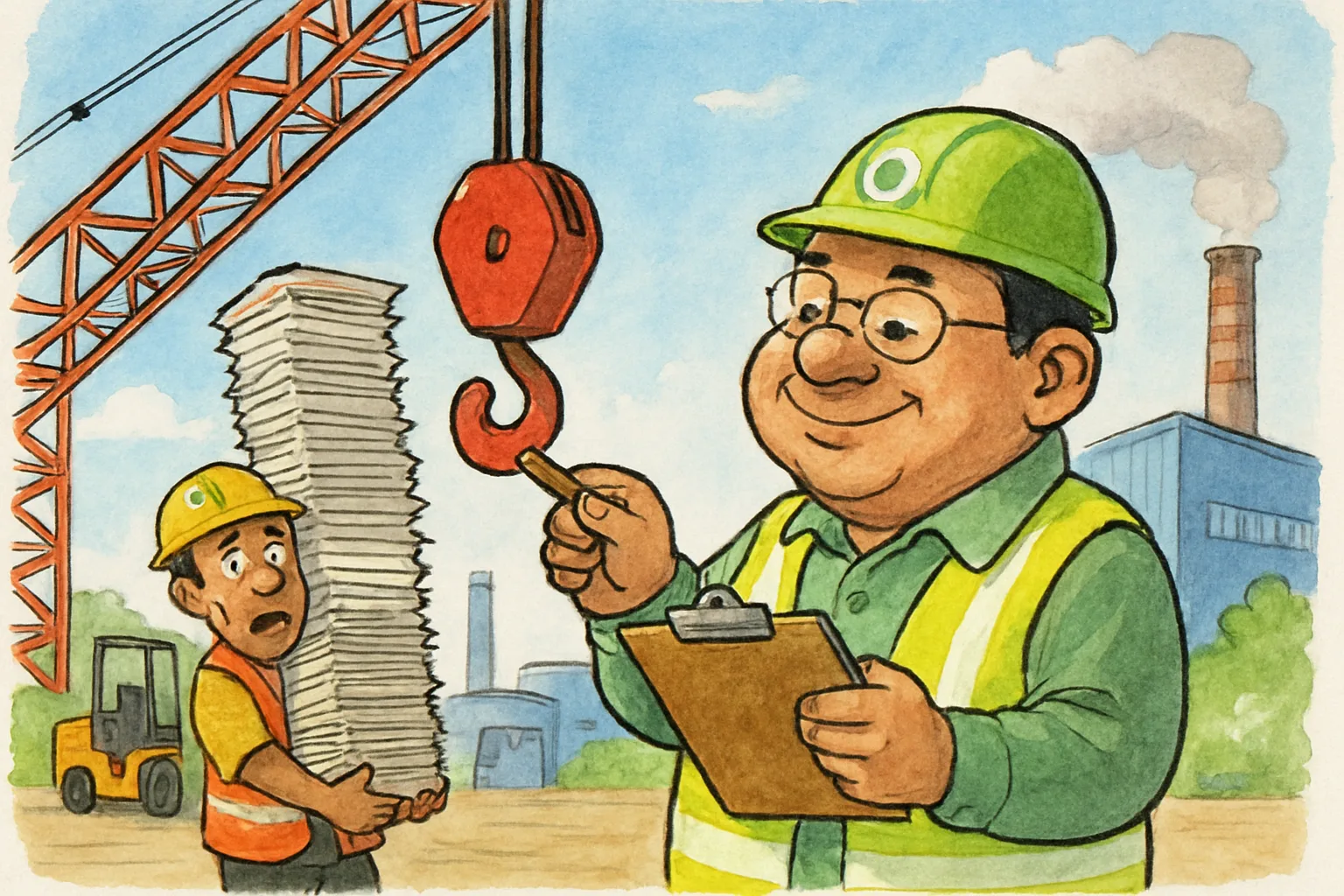
Permenaker 11/2026 also partially revoked provisions of several OHS technical regulations, including Permenaker 12/2015 on electrical safety, so check the current text before relying on a procedural article in an older technical regulation. In practice the testing is carried out by a licensed PJK3 inspection company or by a specialist inspector, and the result is a certificate stating whether the object meets OHS requirements.
The common PMA mistake is to import equipment with a manufacturer's test certificate from the home country and assume it is enough. It is not. Budget for local inspection before commissioning, and keep a register that shows every regulated object, its last test date and its next due date.
Obligations triggered at 100 workers or high risk
Two of the biggest obligations share the same trigger: at least 100 workers, or a high level of risk.
- SMK3. PP 50/2012 Article 5 paragraph (2) requires every company that employs at least 100 workers or has a high level of hazard potential to apply SMK3. The two criteria are alternatives, so either one is enough. SMK3 assessment is carried out by an audit body appointed under Permenaker 26/2014, with three assessment levels of 64, 122 and 166 criteria.
- P2K3. Permenaker 13/2025 Article 3 paragraph (2) requires a safety and health committee at every workplace that employs at least 100 workers or has a high risk level. Article 3 paragraph (3) links the meaning of high risk to the rules on business licensing, which today means PP 28/2025. We cover the committee in detail in our guide to P2K3 committee requirements under Permenaker 13/2025.
A practical check for high risk is to look at the risk level of your business activities (KBLI) in your OSS licence records, and then confirm with your licensing adviser how it reads against these rules. Do not rely on the group's internal risk ranking. Indonesian law uses its own classification.
A question we hear often is whether contractor and outsourced workers count toward the 100 threshold. The answer affects many PMA sites with lean direct headcount and large contractor crews. We have not found an explicit counting rule for contractor and outsourced workers in either regulation, so confirm the approach with the provincial manpower office. Until you have a firm view, plan as if they count.
People you must appoint
Indonesian OHS compliance depends on named, appointed people, not only on documents.
- Ahli K3 Umum (general OHS expert). An Ahli K3 is appointed by the Minister or an authorised official on the written request of the pengurus, under PER.02/MEN/1992 Article 4. Under Permenaker 13/2025 Article 5 paragraph (3), the secretary of the P2K3 must be an appointed Ahli K3, so any company that needs a P2K3 also needs at least one appointed Ahli K3.
- Specialist Ahli K3, for example electrical, fire, chemical or lifting, where the technical regulation requires one.
- Licensed operators and technicians for regulated equipment, such as crane operators, boiler operators and electrical technicians.
- First aiders and fire response personnel, as described above.
The appointment belongs to the person and the company together. When your appointed Ahli K3 resigns, the appointment does not move with your next hire, and P2K3 changes must be reported within a short deadline. Expatriate HSE managers are a recurring question. Whether a foreign national can be appointed as Ahli K3 should be checked against the current rules, and with the manpower office, before you design your organisation around it. The safer design is to have an Indonesian Ahli K3 as P2K3 secretary, with the expatriate in a regional or advisory role.
Your global standard and Indonesian law
An ISO 45001 certificate is evidence of a good system, but it does not replace SMK3. SMK3 is a legal duty under PP 50/2012, and its assessment is carried out by an audit body appointed by the government, not by a commercial certification body acting on its own. In the same way, a group incident reporting app does not replace the 2 x 24 hour report to the manpower office.
The efficient approach is one integrated system that meets both. Map the group standard to the 166 SMK3 criteria and the Indonesian technical regulations, keep a single set of records, and add the Indonesian-specific elements: the obligations register in Bahasa Indonesia, the P2K3, the appointed experts and the riksa uji file.
Labour inspection under Permenaker 11/2026
Labour inspection changed in July 2026. Permenaker 11/2026 organises supervision into guidance, examination, testing, law enforcement and development of the inspection system, with an emphasis on prevention, risk-based supervision and the use of data. Where an inspector finds a violation, published summaries of the regulation report that a first inspection note (Nota Pemeriksaan I) gives up to 30 working days to comply, and that a second note follows as a final warning before the matter moves to administrative or judicial enforcement. Because Permenaker 15/2026 has since amended the regulation, check the current text for the exact periods.
Sanctions depend on the obligation. UU 1/1970 Article 15 paragraph (2) allows its implementing regulations to impose criminal penalties of up to three months of confinement or a fine of up to Rp100,000. Failure to apply SMK3 where PP 50/2012 requires it is a compliance finding in its own right. If you face a nota pemeriksaan or an investigation, the technical response is something a consultant can help with, but questions of legal liability belong with an Indonesian advocate.
A 90-day setup sequence for a new PT PMA
This is the sequence we use with new operations. It assumes a site that is already hiring.
- Days 1 to 15. Name the pengurus for each workplace. Confirm WLKP and BPJS Ketenagakerjaan registration. Build an OHS obligations register in Bahasa Indonesia and English that lists each regulation, the article, the duty, the owner and the evidence.
- Days 15 to 45. Run a hazard identification and risk assessment for actual tasks on site. Build the equipment register and book riksa uji for anything not yet tested. Set up induction in Bahasa Indonesia, first aid and fire response arrangements.
- Days 45 to 90. Appoint the Ahli K3. If you meet the threshold, form the P2K3 and submit it for determination to the provincial manpower office. Start the SMK3 gap assessment against the 166 criteria and agree a target date for external assessment.
Mistakes we see on PMA sites
- Group manuals translated into Bahasa Indonesia but never mapped to Indonesian regulations, so the system looks complete but misses statutory items such as the riksa uji file or the P2K3 report.
- Owners assuming that the EPC contractor's safety system covers them during construction and commissioning. The owner's workplace duties start when its own people start work.
- An Ahli K3 appointment held by someone who has already left the company.
- A P2K3 that exists only as a decree on the wall. An Indonesian study at one company found that P2K3 members often held the role on top of a full-time job, lacked OHS expertise and did not meet every month (Sinaga et al., 2019). We see the same pattern in manufacturing.
- Accident reports sent to head office in hours but never to the local manpower office.

How we can help
Nusa Safety works with foreign-owned companies on OHS compliance in Indonesia: obligations registers, SMK3 and ISO 45001 implementation, internal SMK3 audits, P2K3 setup and coaching, and HSSE application modules for registers, inspections and reporting. Competency certification and statutory equipment inspection are arranged through licensed PJK3 partners, and legal opinions are referred to an advocate. If you are setting up or reviewing a site, our services overview explains how we work, and our SMK3 and ISO 45001 implementation support covers the path to assessment. We are glad to start with a short call to review your current status.
This article is general information based on regulations as we understood them on the date of publication. It is not legal advice.
References
- Republik Indonesia. (1970). Undang-Undang Nomor 1 Tahun 1970 tentang Keselamatan Kerja. https://peraturan.go.id/files/UU0011970.pdf
- Republik Indonesia. (1981). Undang-Undang Nomor 7 Tahun 1981 tentang Wajib Lapor Ketenagakerjaan di Perusahaan.
- Republik Indonesia. (2003). Undang-Undang Nomor 13 Tahun 2003 tentang Ketenagakerjaan.
- Republik Indonesia. (2015). Peraturan Pemerintah Nomor 44 Tahun 2015 tentang Penyelenggaraan Program Jaminan Kecelakaan Kerja dan Jaminan Kematian.
- Republik Indonesia. (2012). Peraturan Pemerintah Nomor 50 Tahun 2012 tentang Penerapan Sistem Manajemen Keselamatan dan Kesehatan Kerja. https://peraturan.go.id/files/pp50-2012pjl.pdf
- Republik Indonesia. (2023). Undang-Undang Nomor 6 Tahun 2023 tentang Penetapan Peraturan Pemerintah Pengganti Undang-Undang Nomor 2 Tahun 2022 tentang Cipta Kerja menjadi Undang-Undang.
- Republik Indonesia. (2025). Peraturan Pemerintah Nomor 28 Tahun 2025 tentang Penyelenggaraan Perizinan Berusaha Berbasis Risiko. https://peraturan.bpk.go.id/Details/319773
- Kementerian Tenaga Kerja dan Transmigrasi Republik Indonesia. (1980). Peraturan Menteri Tenaga Kerja dan Transmigrasi Nomor PER.02/MEN/1980 tentang Pemeriksaan Kesehatan Tenaga Kerja dalam Penyelenggaraan Keselamatan Kerja.
- Kementerian Tenaga Kerja Republik Indonesia. (1992). Peraturan Menteri Tenaga Kerja Nomor PER.02/MEN/1992 tentang Tata Cara Penunjukan, Kewajiban dan Wewenang Ahli Keselamatan dan Kesehatan Kerja. https://jdih.kemnaker.go.id/peraturan/detail/242/peraturan-menteri-ketenagakerjaan-nomor-2-tahun-1992
- Kementerian Tenaga Kerja Republik Indonesia. (1998). Peraturan Menteri Tenaga Kerja Nomor PER.03/MEN/1998 tentang Tata Cara Pelaporan dan Pemeriksaan Kecelakaan. https://jdih.kemnaker.go.id/peraturan/detail/2214/peraturan-menteri-tenaga-kerja-nomor-3-tahun-1998
- Kementerian Tenaga Kerja Republik Indonesia. (1999). Keputusan Menteri Tenaga Kerja Nomor KEP.186/MEN/1999 tentang Unit Penanggulangan Kebakaran di Tempat Kerja.
- Kementerian Tenaga Kerja dan Transmigrasi Republik Indonesia. (2008). Peraturan Menteri Tenaga Kerja dan Transmigrasi Nomor PER.15/MEN/VIII/2008 tentang Pertolongan Pertama pada Kecelakaan di Tempat Kerja.
- Kementerian Ketenagakerjaan Republik Indonesia. (2014). Peraturan Menteri Ketenagakerjaan Nomor 26 Tahun 2014 tentang Penyelenggaraan Penilaian Penerapan Sistem Manajemen Keselamatan dan Kesehatan Kerja. https://peraturan.bpk.go.id/Details/146448/permenaker-no-26-tahun-2014
- Kementerian Ketenagakerjaan Republik Indonesia. (2017). Peraturan Menteri Ketenagakerjaan Nomor 18 Tahun 2017 tentang Tata Cara Wajib Lapor Ketenagakerjaan di Perusahaan dalam Jaringan.
- Kementerian Ketenagakerjaan Republik Indonesia. (2018). Peraturan Menteri Ketenagakerjaan Nomor 5 Tahun 2018 tentang Keselamatan dan Kesehatan Kerja Lingkungan Kerja.
- Kementerian Ketenagakerjaan Republik Indonesia. (2019). Peraturan Menteri Ketenagakerjaan Nomor 4 Tahun 2019 tentang Perubahan atas Peraturan Menteri Ketenagakerjaan Nomor 18 Tahun 2017 tentang Tata Cara Wajib Lapor Ketenagakerjaan di Perusahaan dalam Jaringan. https://peraturan.bpk.go.id/Download/137055/Permenaker%20No.%204%20Tahun%202019.pdf
- Kementerian Ketenagakerjaan Republik Indonesia. (2020). Peraturan Menteri Ketenagakerjaan Nomor 8 Tahun 2020 tentang Keselamatan dan Kesehatan Kerja Pesawat Angkat dan Pesawat Angkut. https://peraturan.bpk.go.id/Details/163270/permenaker-no-8-tahun-2020
- Kementerian Ketenagakerjaan Republik Indonesia. (2025). Peraturan Menteri Ketenagakerjaan Nomor 13 Tahun 2025 tentang Panitia Pembina Keselamatan dan Kesehatan Kerja. https://jdih.kemnaker.go.id/peraturan/detail/2788/peraturan-menteri-ketenagakerjaan-nomor-13-tahun-2025
- Kementerian Ketenagakerjaan Republik Indonesia. (2026). Peraturan Menteri Ketenagakerjaan Nomor 11 Tahun 2026 tentang Tata Cara Pengawasan Ketenagakerjaan. https://jdih.kemnaker.go.id/peraturan/detail/3070/peraturan-menteri-ketenagakerjaan-nomor-11-tahun-2026
- Kementerian Ketenagakerjaan Republik Indonesia. (2026). Peraturan Menteri Ketenagakerjaan Nomor 15 Tahun 2026 tentang Perubahan atas Peraturan Menteri Ketenagakerjaan Nomor 11 Tahun 2026 tentang Tata Cara Pengawasan Ketenagakerjaan. https://jdih.kemnaker.go.id/peraturan/detail/3109/peraturan-menteri-ketenagakerjaan-nomor-15-tahun-2026
- Okezone. (2026, October 6). Tok! DPR sahkan RUU Pelindungan Ketenagakerjaan hari ini. https://economy.okezone.com/read/2026/10/06/320/3246234/tok-dpr-sahkan-ruu-pelindungan-ketenagakerjaan-hari-ini
- Sinaga, L., Kurniawan, B., & Wahyuni, I. (2019). Pengaruh rangkap jabatan terhadap efektivitas kinerja P2K3 dalam upaya peningkatan keselamatan dan kesehatan kerja di PT X. Jurnal Kesehatan Masyarakat, 7(3). https://ejournal3.undip.ac.id/index.php/jkm/article/view/25791
