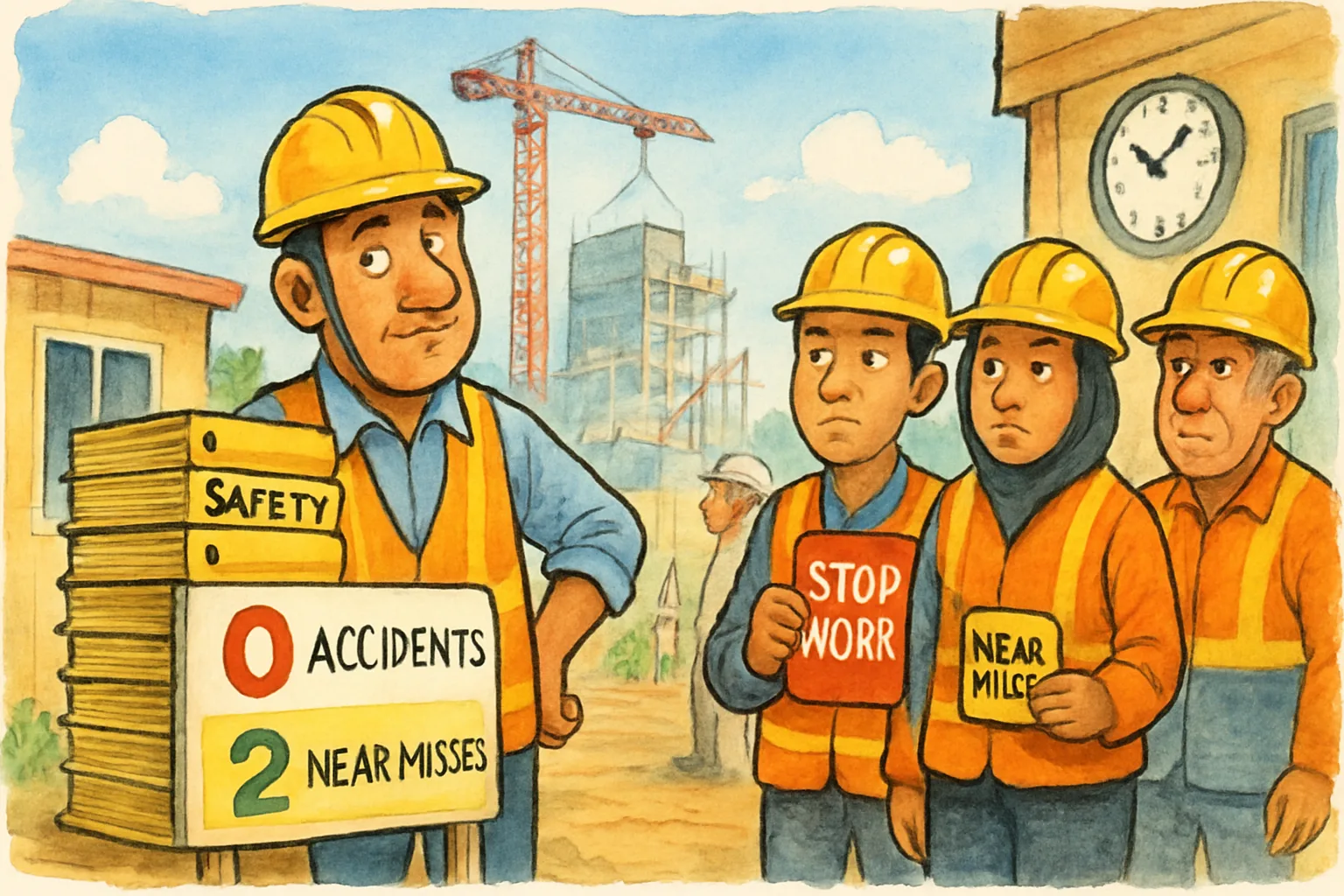
Picture a national contractor with dozens of project sites, each with an SMKK plan, permits to work, toolbox talks and a safety statistics board. Yet the question that matters to the board is harder to answer: do supervisors stop work when the schedule is at risk, do subcontractor workers report a near miss without fear, and does a project manager treat a safety recommendation as an investment or as a delay? These are questions about safety culture, and they cannot be answered by counting documents.
Conventional culture assessment is slow and narrow: a few sites visited, a small sample interviewed, files often prepared for the visit. This article explains the concept of safety culture maturity, a mixed-method framework that combines perception with evidence, and how Nusa Safety has moved that framework online through NSCAS, the Nusa Safety Culture Assessment System. It also sets out what the method cannot do.
Background: accident data and what lies behind it
According to the Ministry of Manpower, drawing on BPJS Ketenagakerjaan data, Indonesia recorded 298,137 work accident cases in 2022 and 370,747 cases in 2023 (Kontan, 2025). The ministry later reported 462,241 cases in 2024 and 319,382 cases in 2025 (ANTARA, 2026; Muhamad, 2026). The 2025 decline is welcome, but the figure is still above 2022, and the pattern is persistent rather than accidental.
Accident counts are lagging indicators. They show the outcome, not which part of the organisation produced it. After reviewing the lessons of Chernobyl, the International Nuclear Safety Advisory Group defined safety culture as the assembly of characteristics and attitudes in organisations and individuals which establishes that safety issues receive the attention warranted by their significance (International Nuclear Safety Advisory Group, 1991). The ACSNI Study Group in the United Kingdom identified three features of a positive culture: communication founded on mutual trust, shared perceptions of the importance of safety, and confidence in the efficacy of preventive measures (Health and Safety Commission, 1993).
In Indonesia the concept has a legal footing. ILO Convention No. 187 defines, in Article 1, a national preventative safety and health culture in which the right to a safe and healthy working environment is respected at all levels and prevention is accorded the highest priority (International Labour Organization, 2006). Indonesia ratified the convention through Presidential Regulation No. 34 of 2014. At company level, SNI ISO 45001:2018 asks top management to develop, lead and promote a culture that supports the intended outcomes of the OH&S management system (Badan Standardisasi Nasional, 2018).
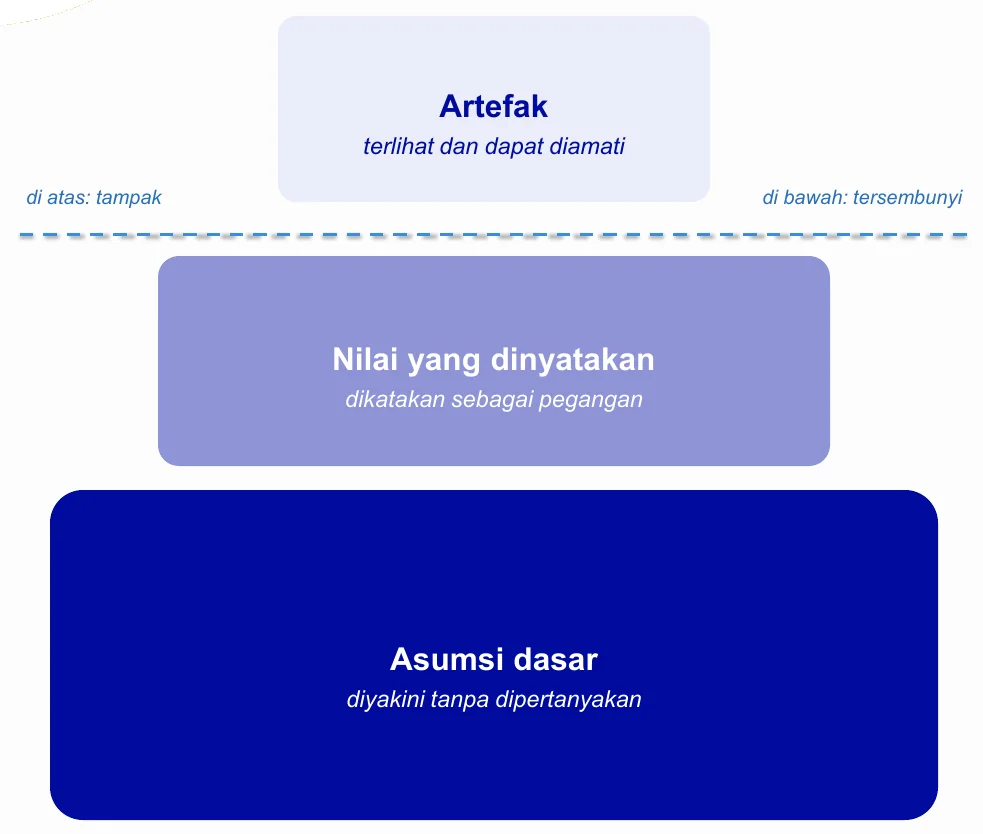
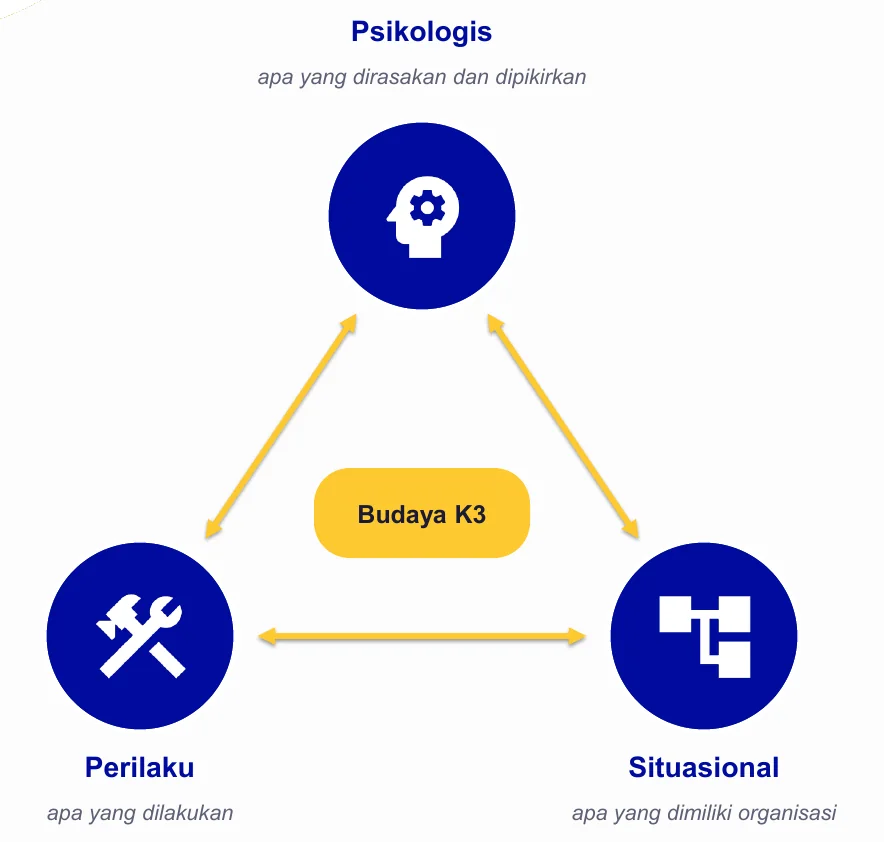
Three theoretical lenses explain why culture is difficult to measure. Schein and Schein (2017) divide culture into visible artefacts, espoused values and basic underlying assumptions. A questionnaire reaches the first two layers, but assumptions such as "the schedule matters more than the procedure" surface only through conversation and through comparing what people say with what they do. Cooper (2000) describes safety culture as the interaction of psychological, situational and behavioural factors, so no single data source is enough. Reason (1997) adds that a safety culture is an informed culture built on reporting, just, flexible and learning subcultures.
Safety climate is related but not identical. Zohar (1980) defined it as employees' shared perceptions of safety policies, procedures and practices. Climate is closer to the surface and changes faster, while culture is deeper and more stable (Guldenmund, 2000; Flin et al., 2000). The link to performance is well documented: Neal et al. (2000) showed how climate shapes safety knowledge, motivation, compliance and participation, and a meta-analysis by Christian et al. (2009) found that safety climate is associated with safety behaviour and with accidents and injuries. Culture measurement therefore gives an earlier signal than accident statistics.
The current issue: compliance is necessary, but it is not maturity
In June 2026, the Ministry of Manpower stated that it is pushing companies to raise the maturity of their safety culture in order to reduce work accidents. Deputy Minister Afriansyah Noor stressed that prevention cannot rely only on fulfilling administrative requirements and complying with OSH regulations (ANTARA, 2026). For companies that already run SMK3 under Government Regulation No. 50 of 2012, or SMKK under Minister of Public Works and Housing Regulation No. 10 of 2021, the question is now how deeply the system is lived at every level, including by subcontractors.

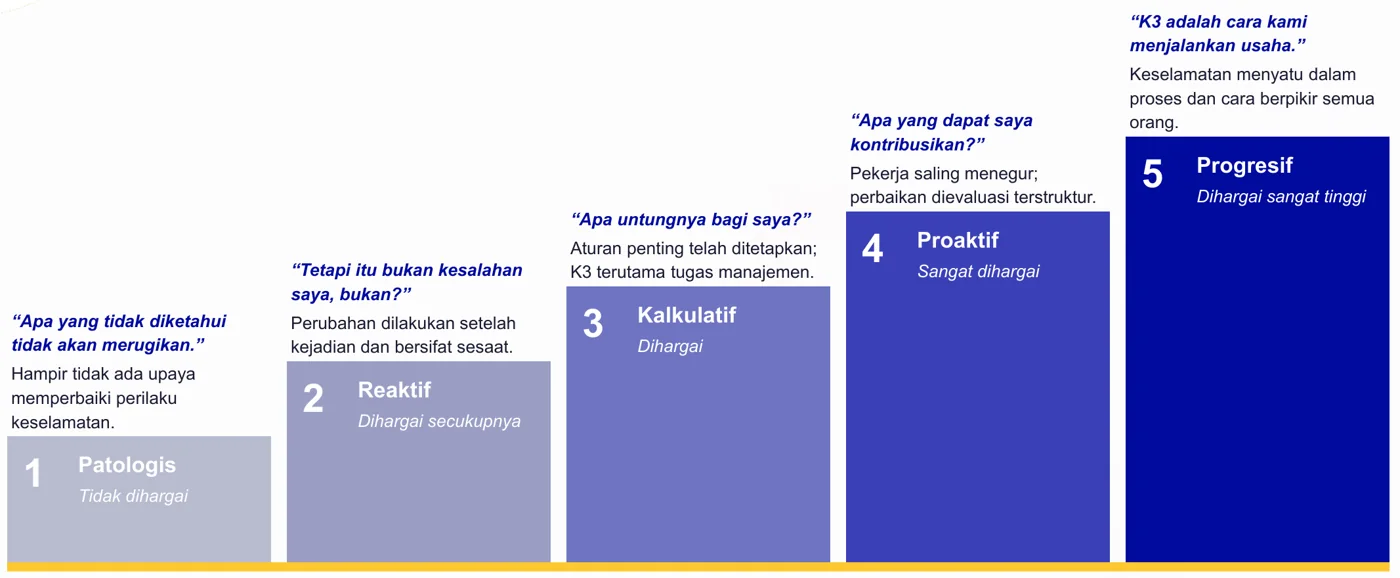
Maturity models give that question a structure. Hudson (2003) and Parker et al. (2006) described a five-step ladder: pathological, reactive, calculative, proactive and generative, running from "what we do not know will not hurt us" to "safety is how we do business". Steps cannot be skipped, and a level can slip if it is not maintained. The Safety Culture Ladder, developed by the Dutch rail infrastructure manager ProRail with contractors and academics and managed by NEN since 2016, turns this ladder into an assessment scheme with six business aspects, weighted characteristics and stepwise level rules, in which leadership and involvement carries the largest weight (NEN, 2023). NEN positions it as a complement to management system standards: ISO 45001, SMK3 and SMKK assess what an organisation has, while the ladder assesses how and why people behave as they do.
The difficulty lies in measurement. Questionnaires reach many respondents and allow comparison between units and periods, but they capture mainly the surface layer and are vulnerable to socially desirable answers (Guldenmund, 2007). Interviews and focus groups reach deeper assumptions but cover few people. Site visits can be staged. A systematic review by Aziz and Djunaidi (2023) found that maturity studies across sectors combine questionnaires, interviews, focus groups, expert consultation, audit documents and accident data, and Indonesian researchers have applied maturity measurement in construction-related manufacturing (Mochtar & Widanarko, 2022). The challenge is to combine these sources consistently, at scale, across many sites.
The solution: mixed-method measurement, digitised through NSCAS
Three layers of data, one index
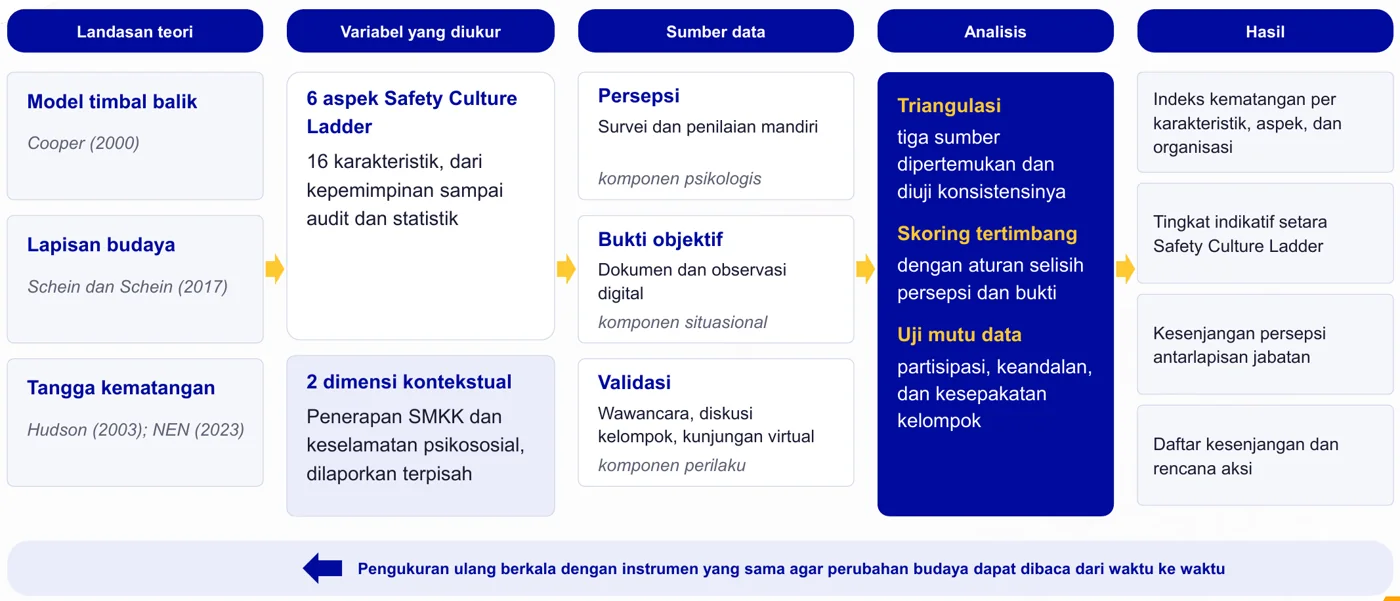
The NSCAS framework follows Cooper's three components and relies on triangulation, the principle that a finding is stronger when several methods and sources support it (Denzin, 1978).

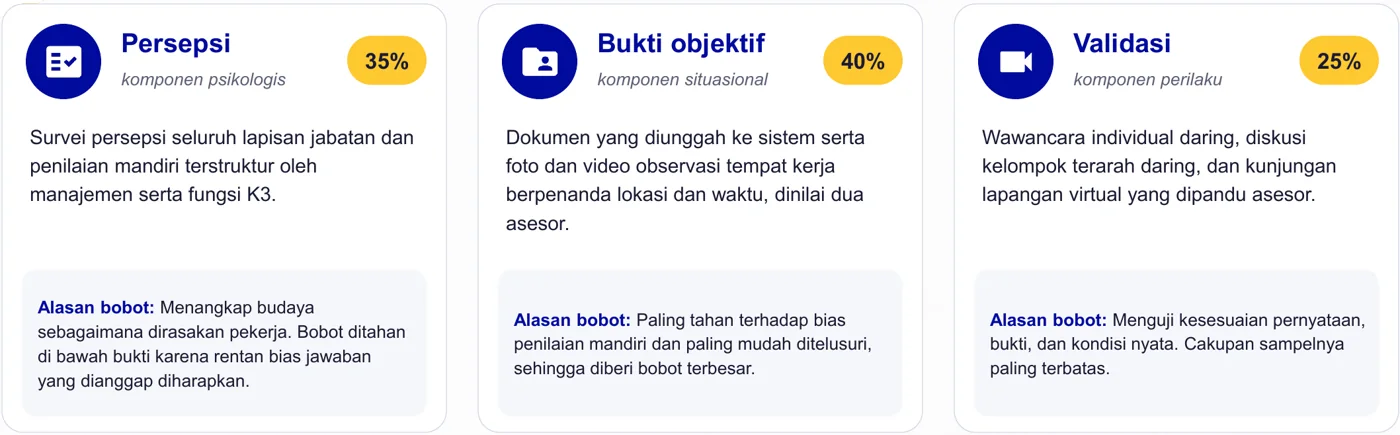
- Perception, weighted 35 percent: a survey across all job levels and a structured self-assessment by management and the HSE function. Its weight is held below evidence because of response bias.
- Objective evidence, weighted 40 percent: uploaded documents and geotagged, time-stamped photographs and videos of workplaces, each scored by two assessors. It is the most resistant to bias and the easiest to trace.
- Validation, weighted 25 percent: online interviews, online focus groups and guided virtual site walks that test whether statements, evidence and conditions agree.
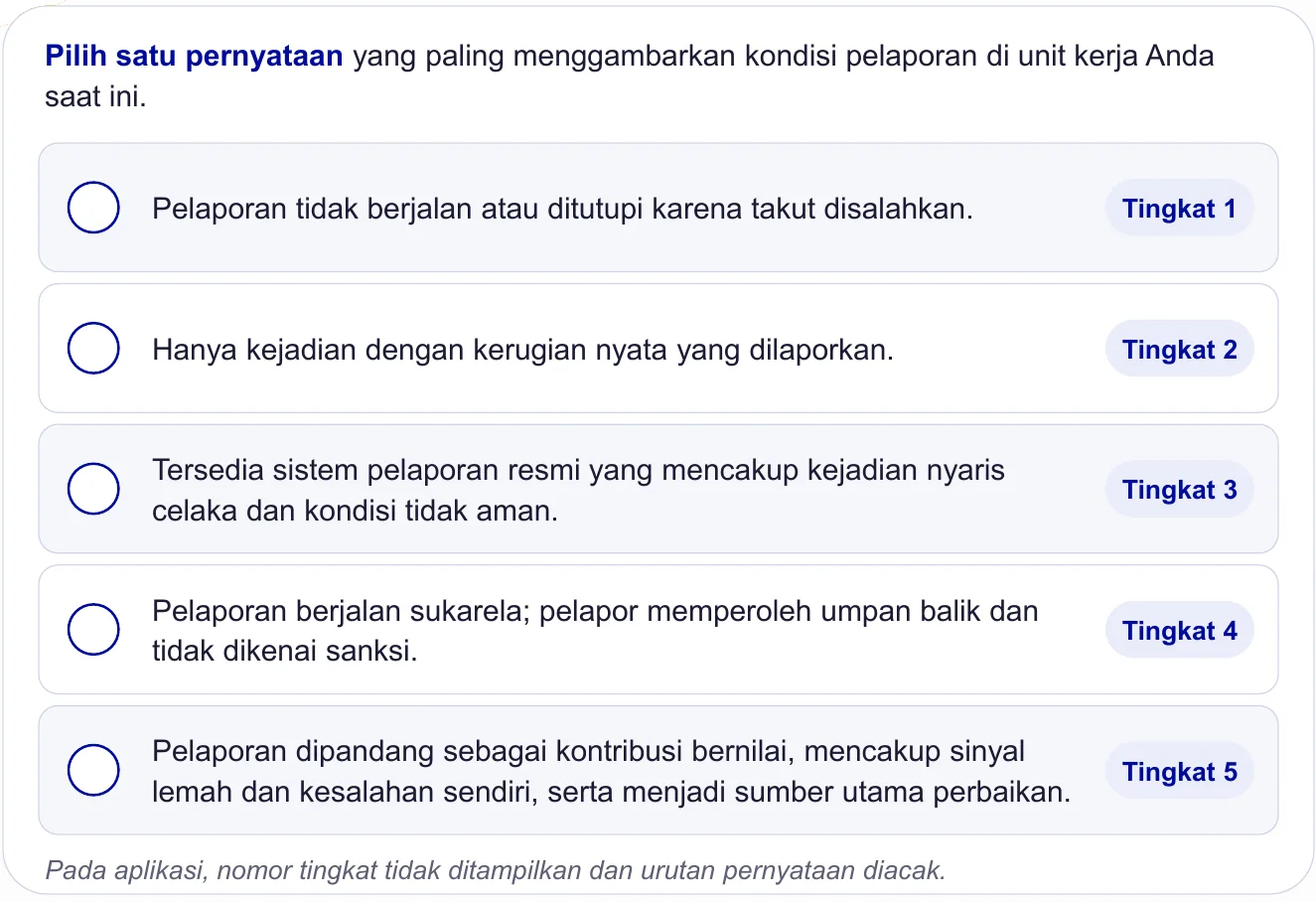
The instrument covers 16 characteristics across the six Safety Culture Ladder aspects. For each, respondents choose one of five statements describing organisational behaviour at a given maturity level, with level numbers hidden and order randomised. Management answers without a written reason and supporting evidence are not counted. A second set of items uses a five-point scale based on the seven NOSACQ-50 dimensions (Kines et al., 2011), adapted to Indonesian construction, and two national contextual dimensions, SMKK implementation and psychosocial safety, are reported separately. The questionnaire is bilingual.
Scoring is rule-based on a scale of 1.00 to 5.00. Where perception and evidence differ by one level or more, the final index takes the lower of the combined index and the evidence score, and the characteristic goes to the assessor panel. In plain terms, a claim without evidence does not raise the score. Levels are assigned stepwise against the weighted-average and minimum-per-aspect thresholds of the Safety Culture Ladder, so a level is recognised only when the one below it is met (NEN, 2023).
Data quality is controlled explicitly: at least 30 percent participation in every job stratum, a Cronbach's alpha of at least 0.70 (Nunnally & Bernstein, 1994), within-group agreement of at least 0.70 (James et al., 1984), at least five respondents per reporting cell, automatic flagging of unusual response patterns, and at least two types of evidence per characteristic. Contractor workers are sampled because Law No. 1 of 1970 places the duty of care on whoever manages a workplace, and SMKK makes the main contractor responsible for all work under its contract.
What the technology adds
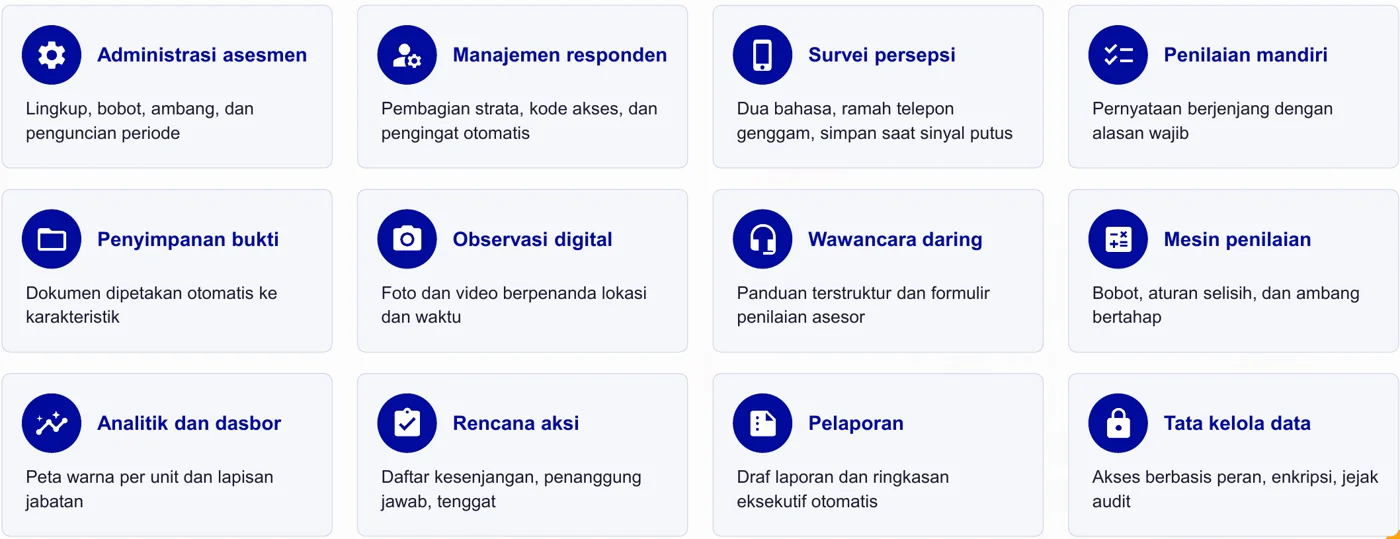
NSCAS runs in a web browser without installation, works on a field worker's phone and keeps answers when the signal drops. Its modules cover respondent access and reminders, the survey, an evidence repository, digital observation, interviews, scoring, dashboards, action planning and reporting, under role-based access, encryption and an audit trail.
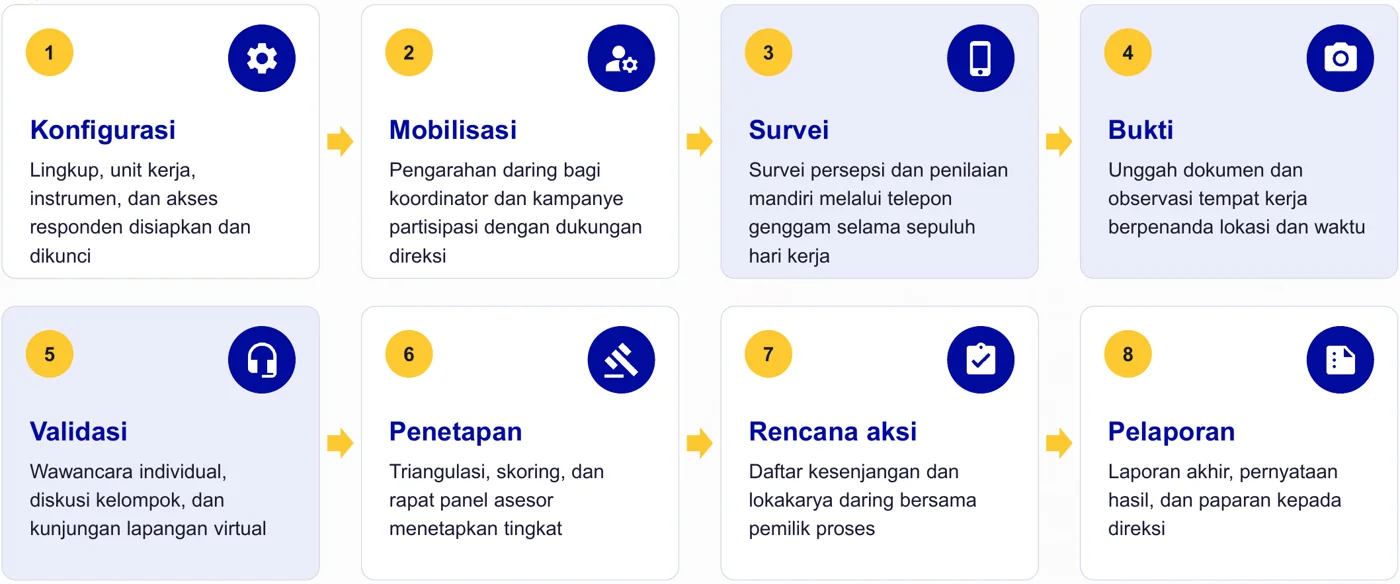
Digital verification replaces part of what physical presence used to provide. Photographs and videos can only be uploaded through the system within a time window set by the assessor, so old documentation cannot be reused. Two assessors score independently before a panel meeting. The assessor, not the organisation being assessed, chooses which project to visit virtually and directs the walk. Survey answers are cross-checked against self-assessment, documents and interviews, and every upload, score change and panel decision is logged.

The practical gains are reach, speed and consistency. Without travel, data collection runs in parallel across many project sites, and far more of the workforce, including contractor crews, can take part than in a face-to-face assessment. Routine work moves to the system, so consultant time goes to judgement: reading evidence, interviewing and deciding levels. Because the instrument and rules stay the same, repeat measurements show how culture changes over time. Consent is recorded, identities are separated from answers, results are reported only in aggregate, and data are stored in Indonesia, in line with Law No. 27 of 2022 on Personal Data Protection.
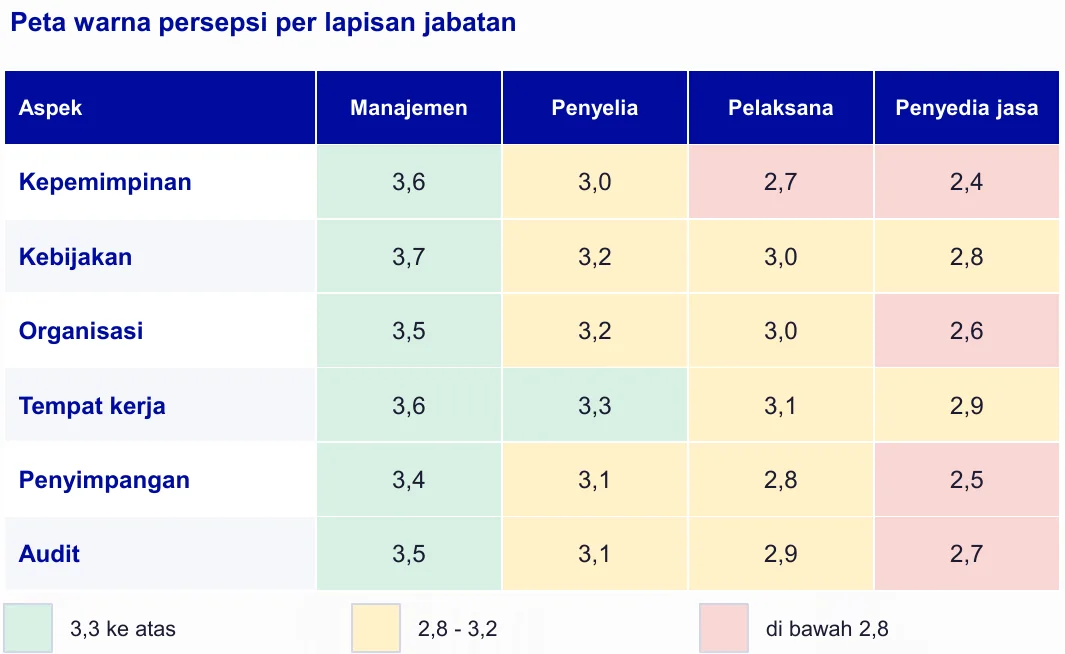
The outputs are a maturity index per characteristic, aspect and organisation, an indicative level equivalent to the Safety Culture Ladder, a heat map of perception gaps between management, supervisors, operatives and contractor workers, and a gap list with owners and deadlines.
Limitations, stated plainly
- An NSCAS result is not a Safety Culture Ladder certificate. Certification audits are performed by auditors from certification bodies recognised by NEN and must include site visits (NEN, 2023). NSCAS serves as internal diagnosis and preparation, since its gap list follows the same aspects.
- Reliability depends on participation in every stratum and on the completeness of evidence the organisation uploads. Shortfalls are reported as limitations, not hidden.
- Digital observation and virtual visits do not fully replace physical presence in sensing the atmosphere of a workplace.
How this connects with Nusa Safety's services
NSCAS is the delivery platform for our Safety Culture Maturity Assessment. A lighter, perception-based baseline is available through the NOSACQ-50 Safety Climate Survey, with evidence and validation added later. Where results show that leadership is not yet felt in the field, HSE Leadership for Line Management works with the supervisors and managers who shape daily decisions, and Behavior-Based Safety builds the observation and feedback routines that strengthen reporting and learning. To place culture indicators beside inspections, permits and KPIs, our HSE Digitalization service designs the workflow and dashboards. To discuss scope or see NSCAS demonstrated, contact us.
Nusa Safety is not a certification body and does not issue certificates; certification remains with independent bodies chosen by the client.
Conclusion
Indonesia's accident figures and the Ministry of Manpower's push for culture maturity point in the same direction. Compliance with SMK3, SMKK and ISO 45001 is the foundation, but it does not show whether the system is lived at every level. Maturity measurement answers that when it combines what people perceive, what evidence shows and what interviews and observation confirm. NSCAS brings that discipline online through a structured instrument, scoring rules that do not reward unsupported claims, explicit data quality controls and reach across many sites at once. Its limits are stated in every report, and used honestly it gives leaders an early, specific and repeatable view of where their safety culture stands and what to improve next.
This article is general information and not legal advice; for questions on how specific regulations apply to your organisation, please consult a qualified advocate.
References
- ANTARA. (2026, June 24). Kemnaker pacu kematangan budaya K3 untuk menekan kecelakaan kerja. BCA Sekuritas. https://bcasekuritas.co.id/latest-news/news/kemnaker-pacu-kematangan-budaya-k3
- Aziz, H. M. A., & Djunaidi, Z. (2023). Kajian literatur sistematis model tingkat kematangan budaya keselamatan (safety culture maturity model) di berbagai sektor industri: Sistematik review. PREPOTIF: Jurnal Kesehatan Masyarakat, 6(1), 646-661. https://doi.org/10.31004/prepotif.v6i1.3793
- Badan Standardisasi Nasional. (2018). SNI ISO 45001:2018 Sistem manajemen keselamatan dan kesehatan kerja, persyaratan dengan panduan penggunaan. BSN.
- Christian, M. S., Bradley, J. C., Wallace, J. C., & Burke, M. J. (2009). Workplace safety: A meta-analysis of the roles of person and situation factors. Journal of Applied Psychology, 94(5), 1103-1127. https://doi.org/10.1037/a0016172
- Cooper, M. D. (2000). Towards a model of safety culture. Safety Science, 36(2), 111-136. https://doi.org/10.1016/S0925-7535(00)00035-7
- Denzin, N. K. (1978). The research act: A theoretical introduction to sociological methods (2nd ed.). McGraw-Hill.
- Flin, R., Mearns, K., O'Connor, P., & Bryden, R. (2000). Measuring safety climate: Identifying the common features. Safety Science, 34(1-3), 177-192.
- Guldenmund, F. W. (2000). The nature of safety culture: A review of theory and research. Safety Science, 34(1-3), 215-257.
- Guldenmund, F. W. (2007). The use of questionnaires in safety culture research: An evaluation. Safety Science, 45(6), 723-743.
- Health and Safety Commission. (1993). ACSNI Study Group on Human Factors, third report: Organising for safety. HMSO.
- Hudson, P. (2003). Applying the lessons of high risk industries to health care. Quality and Safety in Health Care, 12(Suppl. 1), i7-i12.
- International Labour Organization. (2006). Promotional Framework for Occupational Safety and Health Convention, 2006 (No. 187). ILO.
- International Nuclear Safety Advisory Group. (1991). Safety culture (Safety Series No. 75-INSAG-4). International Atomic Energy Agency.
- James, L. R., Demaree, R. G., & Wolf, G. (1984). Estimating within-group interrater reliability with and without response bias. Journal of Applied Psychology, 69(1), 85-98.
- Kines, P., Lappalainen, J., Mikkelsen, K. L., Olsen, E., Pousette, A., Tharaldsen, J., Tómasson, K., & Törner, M. (2011). Nordic Safety Climate Questionnaire (NOSACQ-50): A new tool for diagnosing occupational safety climate. International Journal of Industrial Ergonomics, 41(6), 634-646. https://doi.org/10.1016/j.ergon.2011.08.004
- Kontan. (2025, January 14). Menteri Ketenagakerjaan soroti tren peningkatan jumlah kecelakaan kerja. Kontan.co.id. https://nasional.kontan.co.id/news/menteri-ketenagakerjaan-soroti-tren-peningkatan-jumlah-kecelakaan-kerja
- Mochtar, A. O., & Widanarko, B. (2022). Analisis tingkat kematangan budaya keselamatan kerja pada perusahaan manufaktur konstruksi PT XYZ tahun 2022. Jurnal Pendidikan dan Konseling, 4(6).
- Muhamad, N. (2026, April 13). Sebaran kasus kecelakaan kerja di RI 2025, Jatim terbanyak. Databoks Katadata. https://databoks.katadata.co.id/ketenagakerjaan/statistik/69dc599b93235/sebaran-kasus-kecelakaan-kerja-di-ri-2025-jatim-terbanyak
- Neal, A., Griffin, M. A., & Hart, P. M. (2000). The impact of organizational climate on safety climate and individual behavior. Safety Science, 34(1-3), 99-109.
- NEN. (2023). Safety Culture Ladder manual version 5.0. Nederlands Normalisatie-instituut.
- Nunnally, J. C., & Bernstein, I. H. (1994). Psychometric theory (3rd ed.). McGraw-Hill.
- Parker, D., Lawrie, M., & Hudson, P. (2006). A framework for understanding the development of organisational safety culture. Safety Science, 44(6), 551-562.
- Peraturan Menteri Pekerjaan Umum dan Perumahan Rakyat Nomor 10 Tahun 2021 tentang Pedoman Sistem Manajemen Keselamatan Konstruksi.
- Peraturan Pemerintah Nomor 50 Tahun 2012 tentang Penerapan Sistem Manajemen Keselamatan dan Kesehatan Kerja.
- Peraturan Presiden Nomor 34 Tahun 2014 tentang Pengesahan Konvensi Mengenai Kerangka Kerja Peningkatan Keselamatan dan Kesehatan Kerja (Konvensi 187, 2006).
- Reason, J. (1997). Managing the risks of organizational accidents. Ashgate.
- Schein, E. H., & Schein, P. A. (2017). Organizational culture and leadership (5th ed.). Wiley.
- Undang-Undang Nomor 1 Tahun 1970 tentang Keselamatan Kerja.
- Undang-Undang Nomor 27 Tahun 2022 tentang Pelindungan Data Pribadi.
- Zohar, D. (1980). Safety climate in industrial organizations: Theoretical and applied implications. Journal of Applied Psychology, 65(1), 96-102. https://doi.org/10.1037/0021-9010.65.1.96