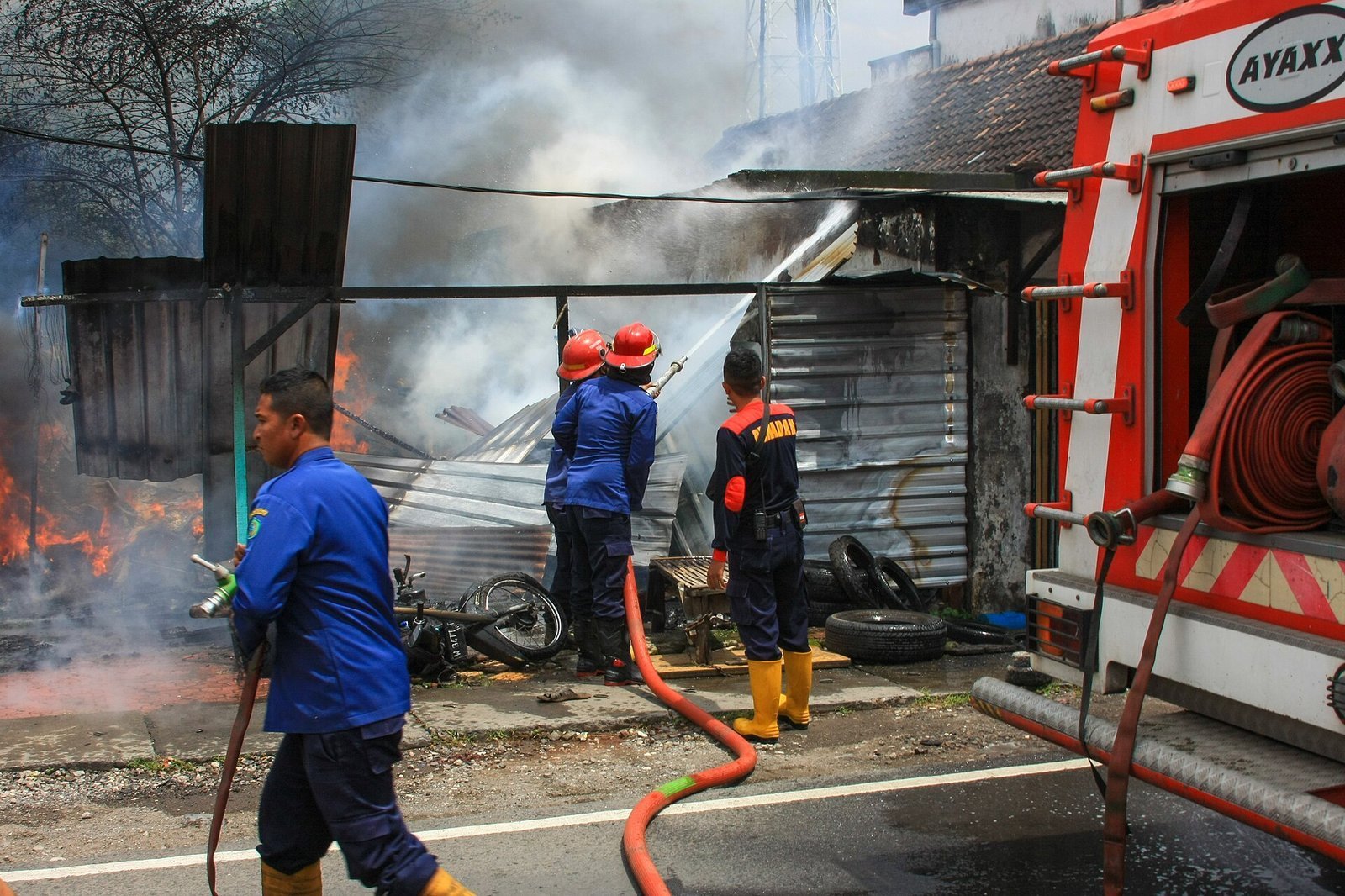
In less than two weeks, three warehouses in Java caught fire. On the evening of 6 November 2026, a Surabaya warehouse holding electronic equipment and machinery for laying subsea cables burned; the city fire service sent 16 appliances and knocked down the main fire at around 20:50 local time (Pratama, 2026). On the night of 17 November 2026, a complex of rattan raw material warehouses used by three businesses in Tegalwangi, Weru District, Cirebon Regency, burned with a provisional loss estimate of Rp1 billion (Adhitama, 2026). The next morning, 18 November 2026, a tobacco store in Ketanjung Village, Karanganyar District, Demak Regency, burned with material losses estimated at Rp50 million (Ma'arif, 2026). No deaths or injuries were reported.
The question for warehouse operators is the same: what does Indonesian regulation require, and how well does it match the way warehouses actually burn? We read the three most relevant instruments, Minister of Manpower Decree KEP.186/MEN/1999, Minister of Manpower and Transmigration Regulation PER.04/MEN/1980 and Government Regulation (GR) 16/2021, alongside National Fire Protection Association (NFPA) warehouse data and the NFPA 921 investigation framework.
What Has Been Reported
No official investigation report is available for any of the three fires, so what follows relies on press reports and fire officers' statements. In Surabaya, the city's head of fire operations said the provisional suspicion was a short circuit in the front area and that the exact cause still had to be confirmed (Pratama, 2026). In Cirebon, the newspaper reported a suspected electrical short circuit without attributing it to a named official. Flames were first seen at around 20:50, the Weru fire station got the report at around 21:03 and crews arrived at around 21:10. Before then, security staff and night guards tried portable extinguishers. The fire service called in other stations, cut the fire's path towards buildings to the south and west and protected a thinner store to the north-west (Adhitama, 2026).
In Demak, the report gives no cause. The call came in at around 06:30, and three appliances, units from Kudus Regency and an excavator were sent. The thick tobacco piles held embers at the bottom, so the excavator broke up and turned the piles, and cooling was still under way at midday (Ma'arif, 2026).
What the Data Show
We found no open Indonesian statistics on warehouse fires that record causes and protection, so the nearest benchmark is US data. For 2018 to 2022, the NFPA estimates an average of 1,508 warehouse structure fires a year, with US$323 million in direct property damage annually. Fires between midnight and 6 a.m. made up only 18% of incidents but 38% of the damage. Electrical distribution or lighting equipment was involved in 19% of fires and 22% of damage. Fires whose cause was still under investigation accounted for 20% of incidents but 53% of damage, and in 15% the cause remained undetermined after investigation (McGree, 2025).
The NFPA sprinkler report for 2020 to 2024 covers automatic protection. Sprinklers were present in 35% of reported warehouse fires. In fires large enough to activate them, sprinklers operated in 90% of cases and were effective in 97% of those, so they operated effectively in 87% overall. Of the failures to operate, 59% occurred because the system had been shut off. Where sprinklers operated but were ineffective, 42% involved water that did not reach the fire and 35% involved too little water (McGree, 2026). One caution: average loss per fire was higher in sprinklered warehouses, because a limited loss in a large facility with expensive contents can exceed a total loss in a small unsprinklered one (McGree, 2026).
The Legal Framework
Law No. 1 of 1970 on Work Safety sets safety requirements to, among other things, prevent, reduce and extinguish fires and provide a route to escape in a fire (Article 3(1)(b) and (d)) (Government of the Republic of Indonesia, 1970). KEP.186/MEN/1999 defines a workplace as any room or field, enclosed or open, where workers work or which they often enter for business purposes and where sources of hazard exist (Article 1(a)), so warehouses fall within it (Ministry of Manpower [Kemnaker], 1999).
The decree, on Fire Response Units in the Workplace, sets out the duties. Article 2 requires the employer to control every form of energy; provide detection, alarm, extinguishing and evacuation facilities; control smoke, heat and gas; form a fire response unit; hold regular drills; and keep a fire emergency plan for workplaces with more than 50 workers and/or with a medium or high fire hazard (Kemnaker, 1999). Article 4 sets five risk levels: light, medium I, medium II, medium III and high. Annex I places warehousing, with sawmilling and wood processing, in medium 3: workplaces with highly combustible materials in quantity that release high heat, so fire spreads quickly. Tobacco factories appear under both medium 2 and medium 3. The annex also links class to storage height: medium 1 covers stacks up to 2.5 metres and medium 2 stacks above 4 metres (Kemnaker, 1999).
The class shapes the unit. Article 6 requires at least 2 fire wardens for every 25 workers. A fire squad and a fire specialist safety expert (Ahli K3 spesialis penanggulangan kebakaran) are required for light and medium I workplaces with 300 or more workers, or for every medium II, medium III and high hazard workplace, which also need at least one unit coordinator per work unit. Under Article 7, fire wardens identify hazards, put out fires at the initial stage, direct evacuation and secure the scene (Kemnaker, 1999).
PER.04/MEN/1980 governs the tool used at that initial stage. Article 1 defines a portable extinguisher as a light device that one person can operate to put out a fire when it first starts. Extinguishers may be no more than 15 metres apart unless an inspector or safety expert decides otherwise (Article 4(5)); the top of the unit sits 1.2 metres above the floor (Article 8); every unit is inspected twice a year, at 6 and 12 months (Article 11); and pressure testing takes place at least every 5 years (Article 15) (Ministry of Manpower and Transmigration [Kemenakertrans], 1980).
On the building side, GR 16/2021 classifies buildings by, among other things, high, medium and low fire risk (Article 9(4)) and requires every building to be protected by a fire protection system that gives occupants time to escape (Article 30). The technical provisions cover passive protection, active protection (extinguishing, detection, alarm and communication, smoke control and a fire control centre) and fire management (Article 31). The building fitness inspection checks fire engine access, water supply, sprinklers, extinguishers, detection, alarms and the fire management unit (Article 220(5)), and owners or users carry out periodic inspections (Article 295) (Government of the Republic of Indonesia, 2021).
Where Rules Meet Reality
NFPA 921 guides investigators to establish the area of origin first and then test each cause hypothesis against the physical evidence using the scientific method; the 2024 edition adds guidance on investigator bias and expressions of certainty, and treats electrical damage interpretation separately (National Fire Protection Association [NFPA], 2024). Read against that framework, the "suspected short circuit" in Surabaya and Cirebon is an early hypothesis, and no cause has been announced in Demak. Warehouse fires still under investigation account for more than half of NFPA-recorded losses (McGree, 2025). In our view, waiting for official findings before drawing conclusions on cause is the sensible course.
What can be assessed now is how the fires developed. Rattan, wood and tobacco are porous organic materials that burn readily, and the medium 3 class fits the Cirebon report: crews saw thick smoke and a red glow on the way, and the fire threatened neighbouring buildings and the thinner store (Adhitama, 2026; Kemnaker, 1999). By the reported times, about 13 minutes passed between the first sighting of flames and the call reaching the fire service (Adhitama, 2026). We do not know what happened in that interval, but NFPA data show out-of-hours fires cause losses out of proportion to their number (McGree, 2025). In a warehouse empty at night, detection depends on whoever happens to see the fire.
Demak shows a different problem. A review of smouldering combustion describes flameless burning of porous fuels as the most persistent form of combustion, with peak temperatures of roughly 450 to 700 °C; it is hard to detect, needs far more water to extinguish and can turn back into flaming when it gets enough oxygen and heat (Santoso et al., 2019). Laboratory work at Universitas Indonesia on peat from Papua and South Sumatra found that a short water spray failed to put out smouldering, that fires reignited from heat stored in the core, and that full suppression took about 6 litres of water per kilogram of peat (Ramadhan et al., 2017). Both concern natural fuels, not stored tobacco, so applying them here is our interpretation, but the mechanism fits embers under a tobacco pile that were reached only after an excavator broke it apart (Ma'arif, 2026).
From a regulatory standpoint we see three gaps. First, many warehouses employ few people, and operators may assume two fire wardens satisfy the rule. KEP.186/MEN/1999 does not read that way: because warehousing is medium 3, the fire squad, the fire specialist safety expert, a coordinator per work unit and the emergency plan apply regardless of headcount (Kemnaker, 1999). Second, a portable extinguisher is by definition a tool for the start of a fire (Kemenakertrans, 1980). The Cirebon guards were right to reach for extinguishers first, but once stacks of rattan and wood are burning, what matters is how quickly the fire is detected, the fire service called and the fire contained. Third, having sprinklers is not the same as being protected. The most common failure is a system that has been shut off, and when sprinklers are ineffective the most common reason is water not reaching the fire (McGree, 2026). In our view this matters for dense, high stacks, where a fire inside or under a stack is shielded from water falling from above.
The evidence has limits. The NFPA data come from the United States, with different buildings, reporting systems and standards; the three fires are known only from early press reports; and we do not know what protection the three warehouses had.
Steps for Warehouse Operators
- Classify the warehouse under Annex I of KEP.186/MEN/1999 and, for warehousing, set up a fire squad, a fire specialist safety expert, a coordinator per work unit, regular drills and a fire emergency plan (Kemnaker, 1999).
- Manage storage. Limit stack heights, keep aisles that let crews reach the bottom of stacks, and keep goods clear of electrical panels and lights, which were involved in 19% of warehouse fires (McGree, 2025). Store flammable liquids such as thinner apart.
- Install and maintain extinguishers under PER.04/MEN/1980: no more than 15 metres apart, visible, inspected at 6 and 12 months and pressure tested at least every 5 years. Train night security staff to use them and call the fire service at once, not one or the other (Kemenakertrans, 1980).
- Make sure detection and alarms work when the building is empty, in line with GR 16/2021, and where sprinklers are installed, use a written procedure whenever the system is shut down for maintenance, the leading cause of failure (Government of the Republic of Indonesia, 2021; McGree, 2026).
- Include fire protection, fire engine access and water supply in the building's fitness and periodic inspections (Government of the Republic of Indonesia, 2021).
- For goods that can smoulder, plan to cool and break up stacks after the flames are out and watch for rekindling, since short water application has proved inadequate on porous fuels (Ramadhan et al., 2017).
- After an incident, secure the scene, document conditions before clean-up and wait for the investigation before concluding on cause, in line with NFPA 921 (NFPA, 2024).
A common belief needs correcting: that a warehouse with extinguishers is safe. The regulation treats them as an initial-stage tool; the fire response unit, detection, water supply and storage layout decide whether a fire stops at one stack.
How Nusa Safety Helps
Nusa Safety helps warehouse and factory operators map the gap between site conditions and these obligations. Through the fire and emergency safety audit (FESA), the Nusa Safety team reviews risk classification, extinguishers, detection and suppression, fire service access and fire response unit readiness, then sets out prioritised recommendations. For personnel, there is fire warden and fire squad training, with certification delivered together with licensed PJK3 partners, and emergency preparedness drills that test the sequence from finding a fire to calling the fire service.
Nusa Safety also supports building approval and SLF, and teams that want to investigate incidents systematically can take incident investigation and root cause analysis training. Nusa Safety issues only internal training certificates and does not hold a PJK3 licence. More information is available on the contact page.
This article is general information and is not legal or professional advice for any specific case.
References
- Adhitama, D. (2026, November 18). Kebakaran gudang rotan di Tegalwangi Cirebon, kerugian capai Rp1 miliar [Rattan warehouse fire in Tegalwangi, Cirebon, losses reach Rp1 billion]. Radar Cirebon. https://radarcirebon.disway.id/insiden-24-jam/read/236454/kebakaran-gudang-rotan-di-tegalwangi-cirebon-kerugian-capai-rp1-miliar
- Government of the Republic of Indonesia. (1970). Undang-Undang Nomor 1 Tahun 1970 tentang Keselamatan Kerja [Law No. 1 of 1970 on Work Safety]. State Gazette of the Republic of Indonesia 1970 No. 1. https://peraturan.go.id/files/UU0011970.pdf
- Government of the Republic of Indonesia. (2021). Peraturan Pemerintah Nomor 16 Tahun 2021 tentang Peraturan Pelaksanaan Undang-Undang Nomor 28 Tahun 2002 tentang Bangunan Gedung [Government Regulation No. 16 of 2021 implementing Law No. 28 of 2002 on Buildings]. State Gazette of the Republic of Indonesia 2021 No. 26. https://jdih.pkp.go.id/produk-hukum/file/pp-nomor-16-tahun-2021-tanpa-lampiran.pdf
- Ma'arif, S. (2026, November 19). Gudang tembakau di Demak terbakar, bara tersembunyi bikin damkar kerja ekstra [Tobacco warehouse in Demak burns, hidden embers make firefighters work harder]. Disway Jateng. https://jateng.disway.id/disway-muria/read/726430/gudang-tembakau-di-demak-terbakar-bara-tersembunyi-bikin-damkar-kerja-ekstra
- McGree, T. (2025). Warehouse structure fires. National Fire Protection Association. https://www.nfpa.org/education-and-research/research/nfpa-research/fire-statistical-reports/warehouse-structure-fires
- McGree, T. (2026). US experience with sprinklers. National Fire Protection Association. https://www.nfpa.org/education-and-research/research/nfpa-research/fire-statistical-reports/us-experience-with-sprinklers
- Ministry of Manpower. (1999). Keputusan Menteri Tenaga Kerja Nomor KEP.186/MEN/1999 tentang Unit Penanggulangan Kebakaran di Tempat Kerja [Minister of Manpower Decree No. KEP.186/MEN/1999 on Fire Response Units in the Workplace]. https://jdih.kemnaker.go.id/asset/data_puu/1999kmnaker186.pdf
- Ministry of Manpower and Transmigration. (1980). Peraturan Menteri Tenaga Kerja dan Transmigrasi Nomor PER.04/MEN/1980 tentang Syarat-Syarat Pemasangan dan Pemeliharaan Alat Pemadam Api Ringan [Regulation No. PER.04/MEN/1980 on the installation and maintenance of portable fire extinguishers]. https://damkar.dumaikota.go.id/assets/backend/dokumen/65feb0504346a.pdf
- National Fire Protection Association. (2024). NFPA 921: Guide for fire and explosion investigations (2024 ed.). https://www.nfpa.org/product/nfpa-921-guide/p0921code
- Pratama, W. (2026, November 6). Kerahkan 16 unit damkar, kebakaran gudang di Jalan Mastrip berhasil dipadamkan [16 fire units deployed, warehouse fire on Jalan Mastrip extinguished]. Suara Surabaya. https://www.suarasurabaya.net/kelanakota/2026/kerahkan-16-unit-damkar-kebakaran-gudang-di-jalan-mastrip-berhasil-dipadamkan/
- Ramadhan, M. L., Palamba, P., Imran, F. A., Kosasih, E. A., & Nugroho, Y. S. (2017). Experimental study of the effect of water spray on the spread of smoldering in Indonesian peat fires. Fire Safety Journal, 91, 671-679. https://doi.org/10.1016/j.firesaf.2017.04.012
- Santoso, M. A., Christensen, E. G., Yang, J., & Rein, G. (2019). Review of the transition from smouldering to flaming combustion in wildfires. Frontiers in Mechanical Engineering, 5, 49. https://doi.org/10.3389/fmech.2019.00049