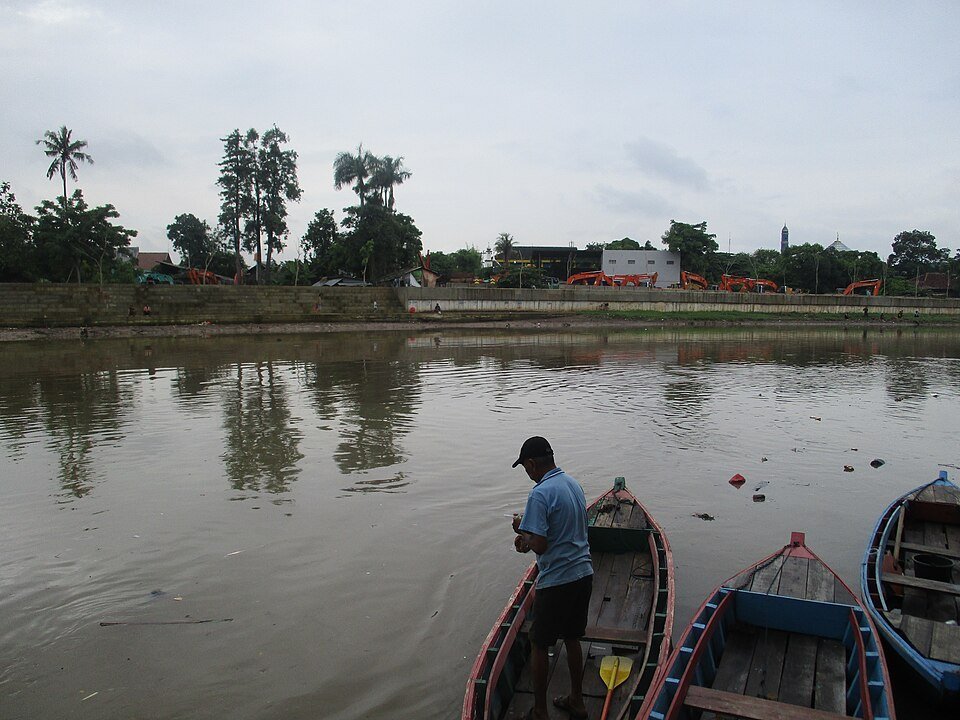
On Monday, 9 February 2026, a pesticide warehouse in a storage estate in Setu, South Tangerang, caught fire. According to the Ministry of Environment/Environmental Control Agency [KLH/BPLH] (2026), about 20 tonnes of cypermethrin and profenofos pesticides burned, and the leftover firefighting water, mixed with chemical residue, flowed into the Jeletreng, a tributary of the Cisadane River. Pollution was reported over about 22.5 km through South Tangerang, Tangerang City and Tangerang Regency, and common carp, baung catfish, pangasius, tilapia and suckermouth catfish were found dead.
The city government also reported difficulty entering the site to check the building's certificate of fitness for use and its environmental documents (Kompas TV, 2026). At the time, KLH/BPLH said it would investigate the case through laboratory tests and act in line with the law (KLH/BPLH, 2026). No official cause of the fire had been announced, so we do not discuss it here.
This review asks one question: what does the literature say about contaminated firewater, and what does it mean for fire protection at chemical warehouses?
What Is Known
The classic reference is the fire at a chemical store in Schweizerhalle, near Basel, Switzerland, on 1 November 1986. The 90 by 50 m building held about 1,250 tonnes of agrochemicals and intermediates, mostly organophosphate insecticides. It had originally been built to store machinery, so it lacked adequate smoke detection and sprinklers and had only one dividing wall (Giger, 2009).
Between 10,000 and 15,000 m3 of firewater flowed into the Rhine, much of it through a drain designed for clean cooling water. The site did have a sewer system that could be sealed for oil spills, but the seals were not closed that night, and the volume of water exceeded what the system could have held anyway. Eel deaths were recorded from the site to roughly 400 km downstream (Giger, 2009).
In their review of the environmental impact of fire, Martin et al. (2016) describe three pathways: smoke and its deposition, firefighting runoff carrying toxic material, and leaks from containers of hazardous materials damaged by fire. Firewater can carry the products stored in a building along with combustion products such as polycyclic aromatic hydrocarbons, volatile organic compounds, dioxins, metals and ammonia. If it is not contained and treated, it will find its way to the nearest watercourse.
These lessons were later written into rules. After 1986, Switzerland required retention basins for any firewater that might arise, and the chemical industry in the Rhine basin reduced or divided its stores and installed retention basins (Giger, 2009). The United Nations Economic Commission for Europe [UNECE] (2019) published guidance on managing and retaining firefighting water for governments, authorities and operators, covering how to size retention capacity, how to design and maintain it, and how to dispose of firewater after an incident.
The Dilemma
The literature is not fully settled on the best way to handle a chemical warehouse fire. At Schweizerhalle, one option was to let the store burn out while cooling neighbouring buildings. It was rejected because a nearby store held phosgene, which had to be kept from escaping, so the fire was put out as fast as possible with large volumes of water (Giger, 2009).
Martin et al. (2016) show the other side of that choice: smoke also pollutes the air, and its deposits fall onto soil and water. Letting a fire burn reduces firewater but adds to air pollution, while fast extinguishment saves buildings but creates runoff. The right call depends on what is stored, what lies around the site and what containment is available, so it has to be thought through long before a fire starts.
Evidence Gaps
We see three gaps. First, the strongest evidence comes from large European cases with full monitoring data, while data on similar events in Indonesia usually come only from official statements and news reports. Second, Martin et al. (2016) note that there is no agreed way to quantify the full environmental impact of a fire, which makes it hard to compare firefighting options in numbers. Third, in our search we did not find a national technical provision that specifically sets firewater retention capacity for chemical warehouses; this view is limited to the documents we reviewed and may change if we have missed one.
In our view, the South Tangerang case shows that success in fire protection at hazardous material stores cannot be judged only by whether the fire goes out. A good system also answers where the firewater will flow and how much can be held back before it reaches a river.
Practical Steps
- Map what is stored, in what quantity and where, and keep that list current, since inaccurate stock records hamper both firefighting and pollution response (Giger, 2009).
- Trace where water from the warehouse floor goes: storm drains, wastewater drains, or straight into ditches and rivers.
- Estimate the likely firewater volume and provide retention, such as bunds, tanks or drain closures that can be operated quickly, using the UNECE (2019) guidance as a reference.
- Separate flammable and toxic materials and limit the quantity held in any one compartment.
- Add a contaminated firewater scenario to the emergency plan, including who closes the drains and who calls the environment agency.
- Train with the local fire service so they know what is stored and what containment exists before an incident.
How Nusa Safety Helps
Nusa Safety helps warehouse and plant operators assess their fire protection readiness, including firewater flow paths and containment, through its Fire and Emergency Safety Audit (FESA). For sites that store large quantities of hazardous materials, the Nusa Safety team can support the preparation of a major hazard control document and run emergency preparedness drills that include a pollution scenario.
This article is general information and not legal or professional advice for any specific case.
References
- Giger, W. (2009). The Rhine red, the fish dead: The 1986 Schweizerhalle disaster, a retrospect and long-term impact assessment. Environmental Science and Pollution Research, 16(Suppl. 1), 98-111. https://doi.org/10.1007/s11356-009-0156-y
- Kementerian Lingkungan Hidup/Badan Pengendalian Lingkungan Hidup. (2026, February 11). KLH/BPLH periksa PT Biotek Saranatama, imbas kebakaran gudang pestisida yang cemari Sungai Cisadane [Ministry examines company after pesticide warehouse fire pollutes the Cisadane River] [Press release]. https://kemenlh.go.id/news/detail/klhbplh-periksa-pt-biotek-saranatama-imbas-kebakaran-gudang-pestisida-yang-cemari-sungai-cisadane
- Kompas TV. (2026, February 11). Sungai Cisadane diduga tercemar limbah kimia, DLH ambil sampel air untuk uji lab [Cisadane River suspected of chemical pollution, environment office takes water samples]. https://www.kompas.tv/regional/650079/sungai-cisadane-diduga-tercemar-limbah-kimia-dlh-ambil-sampel-air-untuk-uji-lab
- Martin, D., Tomida, M., & Meacham, B. (2016). Environmental impact of fire. Fire Science Reviews, 5, Article 5. https://doi.org/10.1186/s40038-016-0014-1
- United Nations Economic Commission for Europe. (2019). Safety guidelines and good practices for the management and retention of firefighting water. United Nations. https://www.un-ilibrary.org/economic-and-social-development/safety-guidelines-and-good-practices-for-the-management-and-retention-of-firefighting-water_e42f490a-en