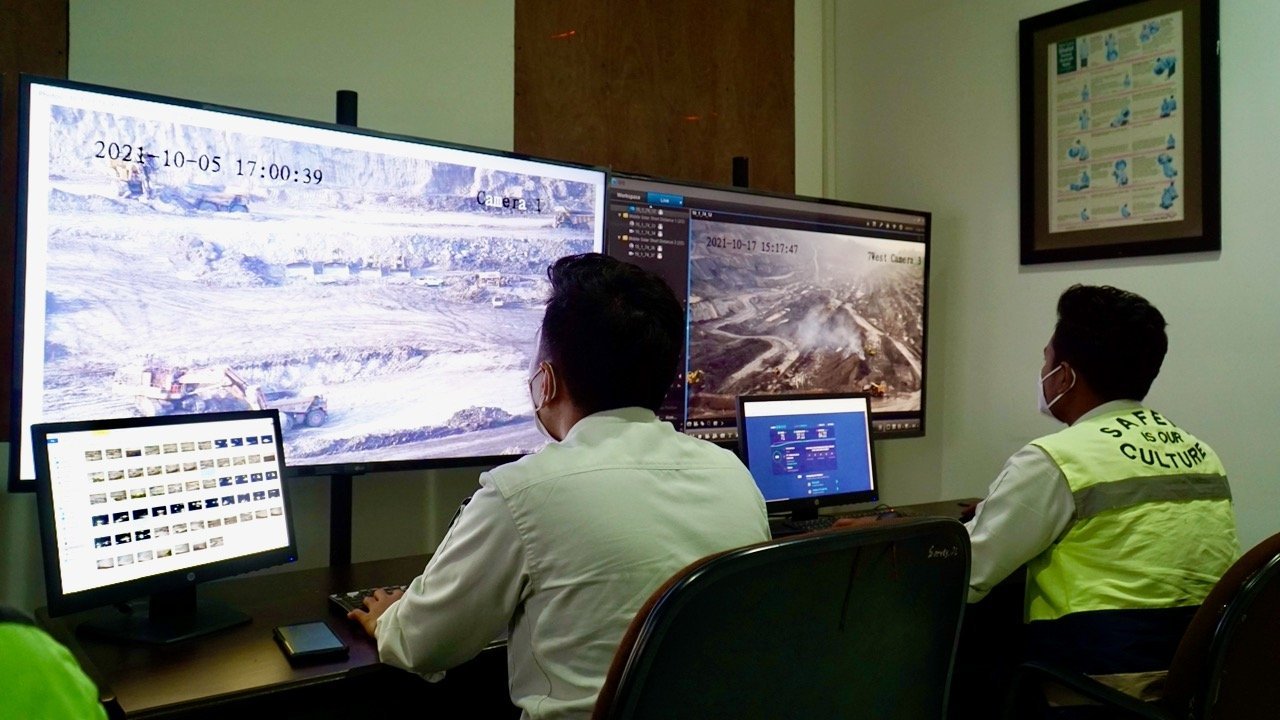
Indonesia recorded 319,224 work accident claims in 2025, of which 9,834 ended in death and 4,133 in functional or total disability, according to data presented by the Minister of Manpower in May 2026 (Zhafira, 2026). Against that background, cameras with artificial intelligence (AI) that recognise whether a worker is wearing personal protective equipment (PPE) are being offered to Indonesian companies. A domestic start-up said in a 2023 trade media report that its system reads CCTV feeds to check masks, helmets, safety glasses, vests, harnesses, gloves and safety shoes, and that several state-owned and private companies already use it, without publishing any accuracy figures (Barus, 2023). A global camera maker said in December 2025 that its AI analytics detect hazards proactively (Iskana, 2025). In mining, the Ministry of Energy and Mineral Resources reported a coal mine control room in East Kalimantan where CCTV feeds are analysed by AI to track people and heavy equipment in the pit, alongside in-cab cameras that look for driver fatigue (Kementerian Energi dan Sumber Daya Mineral [KESDM], 2023).
These are claims, not test results. The practical questions for an HSE manager are narrower: how often does such a camera catch a real violation on a real site, does it reduce injuries, and what does it mean for workers and their personal data? We look at two studies that measured detection accuracy outside the training images, one of them from Indonesia, and then read them against the hierarchy of controls and Law No. 27 of 2022 on Personal Data Protection.
Two Studies Reviewed
The first study comes from Universitas Borneo Tarakan in North Kalimantan. Langi and Fadllullah (2026) start from the observation that many construction workers remain reluctant to use PPE because of low awareness, work pressure and limited facilities. They trained a YOLOv8 object detector on 3,569 secondary images, split 60% for training, 20% for validation and 20% for testing, to recognise eight classes: wearing or not wearing a helmet, safety glasses, a vest and safety shoes. The model was then tested on 90 frames captured on the construction site of a faculty building on campus. Each frame held three, five or seven people, frames were taken every 30 seconds and repeated 30 times, and the authors describe the conditions as random lighting, viewing distances of 3 to 5 metres and moving workers (Langi & Fadllullah, 2026).
The second study, from City University of Hong Kong, asks what happens when the weather and light turn bad. Ding and Luo (2024) trained a standard YOLOv5 detector on two public construction PPE datasets, with 1,566 training images and 285 test images, to find workers, vests and helmets. They then tested it on 101 real-world images collected from the internet under five extreme conditions: low light, intense light, sand dust, fog and rain.
What the Numbers Show
On its own validation images, the Indonesian model reached a mean average precision (mAP) of 0.889. On the 90 site frames, overall precision was 0.935 and recall 0.806, with an F1 score of 0.862 (Langi & Fadllullah, 2026). Precision answers the question "when the camera raises an alarm, how often is it right?", while recall answers "of all the violations in view, how many did it catch?". For a safety camera, recall on the violation classes matters most, and here the averages hide a wide spread. Recall was 0.965 for workers without a vest and 0.891 for workers without a helmet, but only 0.673 for workers without safety glasses and 0.619 for workers without safety shoes (Langi & Fadllullah, 2026). Put simply, of every 100 workers without safety shoes in those frames, the model flagged about 62. The authors themselves conclude that 90 frames is not an adequate test set and that testing should cover more PPE types, conditions and body positions, such as sitting, standing and walking.
The Hong Kong results show how fragile a detector can be when conditions change. The baseline model scored an mAP at 0.5 overlap of 0.832 on the ordinary test images, but 0.502 on the real-world extreme images. For vests alone, average precision fell from 0.812 to 0.388. The style-transfer model lifted the overall score on the extreme images to 0.612, and two other detector families, Faster R-CNN and SSD, showed similar sharp declines (Ding & Luo, 2024). An earlier study that reported precision and recall of about 0.96 tested its model on 54 images and checked its video performance only qualitatively, on a single video file (Delhi et al., 2020).
Where Evidence Stops
The Indonesian field test covers one site, 90 frames and viewing distances of 3 to 5 metres. The extreme-condition set comes from internet images, not from a camera installed on a site and left running through a wet season. Neither study measured accuracy per worker per shift, at distances beyond those tested, or across camera angles and occlusion by scaffolding and machinery.
More importantly, neither study measured safety outcomes. A systematic review of computer vision for PPE compliance concluded that, despite strong research interest, practice has revealed barriers that limit wider use, including industry-specific challenges, environmental variation, computing costs, employee identification and identity management, and ethical and cybersecurity concerns (Vukicevic et al., 2024). In our own search on 18 November 2026, we found no peer-reviewed field study that measured injuries, or even sustained PPE compliance, before and after an AI camera was installed, with a comparison group. The figures in marketing case studies we saw had no control group and no published method, so we do not treat them as evidence.
There is, however, evidence about what monitoring does to people. A meta-analysis of 70 independent samples and 233 effect sizes found that electronic monitoring slightly lowered job satisfaction (r = -0.10), slightly raised stress (r = 0.11), had no relationship with performance (r = -0.01) and a small positive relationship with counterproductive work behaviour (r = 0.09), and that laboratory studies probably underestimate these effects in the field (Siegel et al., 2022). These studies were not about safety cameras, so the effect may differ, but they warn against assuming that being watched makes people work better. On acceptance, a survey of 220 construction practitioners found that perceived usefulness, ease of use and cost savings raised the intention to use intelligent surveillance, while perceived privacy risk lowered it (Lu & Deng, 2022). The respondents were practitioners in general, not frontline workers, whose views may be less favourable.
Monitoring Is Not Control
The hierarchy of controls ranks elimination, substitution and engineering controls above administrative controls and PPE because they control exposure without depending on people. PPE can be effective only when workers use it correctly and consistently, administrative controls and PPE require significant ongoing effort by workers and supervisors, and employers should not rely on PPE alone when other effective options exist (National Institute for Occupational Safety and Health [NIOSH], 2024). In our analysis, a camera that checks helmets is an administrative layer placed on top of the weakest control. It does not stop a tool from falling off an unguarded slab edge; it only reports that the person underneath was not wearing a helmet. A site that spends its safety budget on PPE analytics before fitting toe boards, debris nets or exclusion zones has its priorities inverted.
Indonesian regulation points the same way. Minister of Manpower and Transmigration Regulation No. PER.08/MEN/VII/2010 on Personal Protective Equipment requires employers to provide PPE free of charge that meets the Indonesian National Standard (SNI) or applicable standards (Article 2), requires workers and anyone entering the workplace to use it according to the hazard and risk (Article 6(1)), and gives workers the right to object to work when the PPE provided does not meet requirements (Article 6(2)) (Kementerian Tenaga Kerja dan Transmigrasi [Kemenakertrans], 2010). Article 7 requires employers to manage PPE as a cycle: identifying needs, selecting PPE suited to the hazard and to the comfort of workers, training, use, maintenance and storage, disposal, guidance, inspection, and evaluation and reporting (Kemenakertrans, 2010). A camera touches only the inspection step. It cannot tell whether workers skip safety glasses because they fog up in humid heat, or whether the shoes in the store are the wrong sizes. In our view, those are the questions that decide whether compliance improves.
There is also a statistical trap. Precision measured on a test set where researchers chose a mix of compliant and non-compliant workers says little about how many alarms will be false on a site where most people already comply, because, for the same detector, the share of false alarms among all alarms rises as real violations become rarer. In our view, a steady stream of false alarms also risks teaching supervisors to ignore them.
Video as Personal Data
Video of identifiable workers is personal data. Law No. 27 of 2022 defines personal data as data about a person who is identified or identifiable, alone or combined with other information, directly or indirectly (Article 1 point 1). Biometric data is listed as specific personal data (Article 4(2)(b)), and the elucidation describes biometric data as data on physical, physiological or behavioural characteristics that allow unique identification, such as facial images (Pemerintah Republik Indonesia, 2022). Processing must follow principles that include limited and specific collection, use according to purpose, accuracy, security, informing people of the purpose, and deletion after the retention period (Article 16(2)), and every controller must have a legal basis for processing (Article 20) (Pemerintah Republik Indonesia, 2022).
The provision most relevant to AI cameras is Article 34. A controller must carry out a data protection impact assessment when processing carries a high potential risk, and the listed examples include automated decision-making with legal or similarly significant effects, processing of specific personal data, large-scale processing, systematic evaluation, scoring or monitoring of data subjects, and the use of new technology (Pemerintah Republik Indonesia, 2022). Our reading is that a system which links PPE alerts to named workers, especially through face recognition, or which feeds alerts into warnings or pay, meets several of these criteria at once. Article 17, which requires notices and prohibits identification for visual data devices in public places and public service facilities, may also apply where cameras overlook public roads or shared areas. The two-year adjustment period in Article 74 ended in October 2024, so these duties already apply (Pemerintah Republik Indonesia, 2022). Questions about a specific installation should go to a lawyer.
Before Buying a Camera
The evidence supports a staged approach rather than a ban or a blanket roll-out.
- Start with the hazard register. List the hazards the PPE rule is meant to address and check whether elimination, engineering or segregation can be improved first, as the hierarchy of controls requires (NIOSH, 2024).
- Ask the supplier for per-class precision and recall on your own site, by violation type, at your camera distances and in rain, glare and low light. A single accuracy figure from a brochure is not enough, given how much detection drops in poor conditions (Ding & Luo, 2024).
- Run a pilot in which a person checks a random sample of frames against the camera's output, and count missed violations, not only false alarms.
- Decide in writing what an alert triggers. We recommend coaching and fixing causes such as fit, comfort, availability and heat, in line with PPE management under PER.08/MEN/VII/2010, rather than automatic sanctions (Kemenakertrans, 2010).
- Complete a data protection impact assessment before installation, set the legal basis, signage, retention period and access rights, and avoid face recognition unless there is a clear, documented need (Pemerintah Republik Indonesia, 2022).
- Involve workers and the occupational safety and health committee (P2K3) from selection onward, since privacy concerns reduce acceptance (Lu & Deng, 2022).
- Measure what matters. Compare injuries, near misses and observed compliance before and after, ideally against an area without cameras, and review the decision after an agreed period.
A common belief is that an AI camera can replace field supervision. In our reading of the evidence, it works best as a tool for supervisors who still walk the site, talk to workers and fix the conditions that make PPE hard to wear.
How Nusa Safety Helps
Nusa Safety helps companies assess digital safety tools before they buy them and design them around risk rather than around the device. Through HSE digitalisation, the team maps the inspection and observation workflow, defines the indicators to be measured, and includes data handling notes on access rights and worker personal data. Where a company needs its own platform, custom HSSE software can bring inspections, observations and corrective actions into one place with role-based access. To make sure the hazards are controlled before they are monitored, Nusa Safety also offers engineering studies and risk assessments and the risk assessment and JSA workshop.
Nusa Safety issues internal training certificates only; legal questions on personal data are referred to a lawyer. Further information is available through the contact page.
This article is general information and not legal or professional advice for any specific case.
References
- Barus, K. (2023, July 11). Teknologi canggih AI ini cegah kecelakaan kerja di industri, buatan negri! [This advanced AI prevents workplace accidents in industry, made in Indonesia]. Industry.co.id. https://www.industry.co.id/read/123316/teknologi-canggih-ai-ini-cegah-kecelakaan-kerja-di-industri-buatan-negri
- Delhi, V. S. K., Sankarlal, R., & Thomas, A. (2020). Detection of personal protective equipment (PPE) compliance on construction site using computer vision based deep learning techniques. Frontiers in Built Environment, 6, 136. https://doi.org/10.3389/fbuil.2020.00136
- Ding, Y., & Luo, X. (2024). Personal protective equipment detection in extreme construction conditions. In Computing in Civil Engineering 2023 (pp. 672-679). American Society of Civil Engineers. https://doi.org/10.1061/9780784485248.081
- Iskana, F. R. (2025, December 18). Axis Communication kembangkan sistem pemantauan berbasis AI untuk cegah kecelakaan kerja [Axis Communication develops an AI-based monitoring system to prevent workplace accidents]. IDX Channel. https://www.idxchannel.com/technology/axis-communication-kembangkan-sistem-pemantauan-berbasis-ai-untuk-cegah-kecelakaan-kerja
- Kementerian Energi dan Sumber Daya Mineral. (2023, December 7). Teknologi kecerdasan buatan tingkatkan keselamatan dan produktivitas tambang batubara [Artificial intelligence improves safety and productivity in coal mining] (Press release No. 606.Pers/04/SJI/2023). https://www.esdm.go.id/id/media-center/arsip-berita/teknologi-kecerdasan-buatan-tingkatkan-keselamatan-dan-produktivitas-tambang-batubara
- Kementerian Tenaga Kerja dan Transmigrasi. (2010). Peraturan Menteri Tenaga Kerja dan Transmigrasi Nomor PER.08/MEN/VII/2010 tentang Alat Pelindung Diri [Minister of Manpower and Transmigration Regulation No. PER.08/MEN/VII/2010 on Personal Protective Equipment]. https://jdih.kemnaker.go.id/peraturan/detail/158/peraturan-menteri-nomor-per-08-men-vii-2010
- Langi, N. M. R., & Fadllullah, A. (2026). Sistem deep-learning YOLOv8 untuk deteksi penggunaan APD secara real-time [A YOLOv8 deep-learning system for real-time detection of PPE use]. JISKA (Jurnal Informatika Sunan Kalijaga), 11(1), 44-55. https://doi.org/10.14421/jiska.5051
- Lu, Y., & Deng, Y. (2022). What drives construction practitioners' acceptance of intelligent surveillance systems? An extended technology acceptance model. Buildings, 12(2), 104. https://doi.org/10.3390/buildings12020104
- National Institute for Occupational Safety and Health. (2024). Hierarchy of controls. Centers for Disease Control and Prevention. https://www.cdc.gov/niosh/hierarchy-of-controls/about/index.html
- Pemerintah Republik Indonesia. (2022). Undang-Undang Nomor 27 Tahun 2022 tentang Pelindungan Data Pribadi [Law No. 27 of 2022 on personal data protection]. Lembaran Negara Republik Indonesia Tahun 2022 Nomor 196. https://peraturan.bpk.go.id/Details/229798/uu-no-27-tahun-2022
- Siegel, R., König, C. J., & Lazar, V. (2022). The impact of electronic monitoring on employees' job satisfaction, stress, performance, and counterproductive work behavior: A meta-analysis. Computers in Human Behavior Reports, 8, 100227. https://doi.org/10.1016/j.chbr.2022.100227
- Vukicevic, A. M., Petrovic, M., Milosevic, P., Peulic, A., Jovanovic, K., & Novakovic, A. (2024). A systematic review of computer vision-based personal protective equipment compliance in industry practice: Advancements, challenges and future directions. Artificial Intelligence Review, 57(12), 319. https://doi.org/10.1007/s10462-024-10978-x
- Zhafira, A. N. (2026, May 22). Menaker tegaskan BPJS Ketenagakerjaan menjadi penggerak utama K3 [The Minister of Manpower affirms BPJS Ketenagakerjaan as the main driver of OHS]. ANTARA Megapolitan. https://megapolitan.antaranews.com/berita/531057/menaker-tegaskan-bpjs-ketenagakerjaan-menjadi-penggerak-utama-k3