

Around midday on Friday 6 November 2026, fire broke out at the electric fan factory of PT Desen Nusantara Anugerah on Jalan Raya Pasar Kemis, Tangerang Regency, Banten. The head of the regency's disaster management agency (BPBD), which runs the fire service, said most of the fire was out by about 04.00 WIB the next morning, roughly 16 hours later, and confirmed that nobody was killed or injured (Rapika, 2026). Workers ran from the building as firefighters arrived amid thick black smoke (Beritasatu.com, 2026). The cause is still unconfirmed.
Within hours a video circulated claiming a short circuit. This article answers six questions, separating reported facts from claims, applying the origin-and-cause reasoning of NFPA 921, and ending with a checklist for plastics and electrical goods plants in Tangerang. We do not assign a cause or judge anyone. Several things went well: everyone got out, the fire service kept reinforcing its response, and the company supplied water tankers (Rapika, 2026).
What Is Known?
BPBD received the report at about 11.15 WIB. The Pasar Kemis fire post commander said the fire first appeared in the second-floor fan-blade store and spread quickly through combustible material, citing company security staff for the starting point (Saepulloh, 2026; CNN Indonesia, 2026). A security guard who saw smoke on the second floor found flames bursting from the room's door when he went to check (Nazwa, 2026). Firefighters were hampered by a distant water source and strong wind (Saepulloh, 2026). The building has three storeys; the second and third were worst hit, and their debris blocked access to the ground floor, leaving fire buried in rubble. Nearby homes were unaffected (Rapika, 2026).
The account of the cause evolved. At midday BPBD said it was still being examined (Ikhsanudin, 2026). That evening the post commander cited a provisional short circuit, as heard from company management (Hidayat, 2026b). The BPBD head later relayed information about a short circuit in the blade store, adding that the exact cause still needed confirming (Rapika, 2026), and said the closed room helped the fire spread (Nazwa, 2026). As of 7 November we found no police statement, loss estimate or labour inspectorate response.
The video above, from a local Tangerang news account, is captioned as showing a short circuit (aboutsinjay, 2026). It shows a warehouse with a red steel roof structure, stacked cartons, people filming, and a bright light that looks like sparks near the roof framing. The caption is the account's claim; the clip cannot show when the sparks began or whether this is the second-floor blade store named by BPBD.
Sources differ on several points:
- Timing: smoke was seen at about 11.10 WIB (Nazwa, 2026), the report was received at 11.15 WIB (CNN Indonesia, 2026) or about 11.21 WIB (Ikhsanudin, 2026), and an employee called the 112 emergency line at 11.20 WIB (Kabar6.com, 2026).
- Resources: 8 units and 35 personnel (Ikhsanudin, 2026), 8 units and 50 personnel (Saepulloh, 2026), 11 vehicles and 65 personnel in total including army district support (Hidayat, 2026b), and 10 units and 52 personnel (Rapika, 2026).
- Duration: one outlet wrote that the fire was out at 14.00 WIB (Nazwa, 2026), while others reported it still blazing at 14.20 WIB (CNN Indonesia, 2026) and mostly out only at 04.00 WIB the next day (Rapika, 2026).
- Names: the village appears as Gelam Jaya or Kutajaya, the company as Desen or Desan, Anugerah or Anugrah.
Our reading is that personnel figures grew with reinforcements and that duration figures mix "under control" with "extinguished". We rely on the BPBD head's latest statement of 7 November.
More Coverage
- Beritasatu.com, "Pabrik Kipas Angin di Tangerang Terbakar, Karyawan Panik Berhamburan", 6 November 2026: beritasatu.com
- detikNews, "Pabrik Kipas Angin di Tangerang Kebakaran, Asap Hitam Membubung", 6 November 2026, with video from BPBD: news.detik.com
- TangerangNews, "Kebakaran Pabrik Kipas Angin di Tangerang Dipicu Korsleting Listrik", 6 November 2026: tangerangnews.com
- Kompas.com, "Kebakaran Pabrik Kipas Angin di Tangerang Padam setelah 16 Jam Terbakar", 7 November 2026: kompas.com
Really a Short Circuit?
That cannot be said yet. NFPA 921 applies the scientific method to fire investigation: investigators establish the area of origin, then test each cause hypothesis against physical evidence, witness accounts and data (National Fire Protection Association [NFPA], 2024). A cause is assigned only when the first fuel ignited, the ignition source and the sequence linking them are supported by evidence; otherwise it is undetermined (NFPA, 2024). What exists so far is second-hand, passed from security staff and management to the fire service and then the media.
The social media video does not settle it either. Electrical arcing also happens when fire heat destroys the insulation of live cables, so an arc mark shows only that heat reached the insulation at that point. Icove et al. (2021, p. 65) note that no valid laboratory technique can tell an arc that caused a fire from one that was its victim, and that without video no one can say when an arc occurred. A short clip cannot show whether the sparks were the first event or the result of fire elsewhere. Arc sites also cluster where fuel load or ventilation is heavy, which is not always the area of origin (Icove et al., 2021).
Within those limits, we see three working hypotheses for investigators to test. They are not findings:
- A fault in the store's fixed installation, such as a loose terminal, an undersized conductor or damaged insulation. An Indonesian literature review lists short circuits, overloads, installations that do not follow PUIL, and inadequate MCB, earth-leakage and earthing protection as common causes of electrical fires (Saputra, 2026). This fits the BPBD account and can be tested against the panel, the store's circuit protection and load data.
- Temporary wiring, lighting or equipment in the roof space. The video shows light near the roof framing, and arcs can generally ignite light, low-density fuels such as cartons (Icove et al., 2021). The hypothesis falls away if the sparks were a result of the fire.
- A non-electrical source. Factory fires in Tangerang Regency in early 2026 were attributed to short circuits, overheated machines and sparks, among others (Hidayat, 2026a); such sources must be ruled out with evidence.
What can settle the question is CCTV footage, the original video with its timestamp, first-witness accounts, the protective devices and conductor remains on the store's circuits, and maintenance records. NFPA 921 also rejects assigning a cause simply because no other ignition source was found (NFPA, 2024).
Electrical Fires: How Common?
Jakarta fire and rescue service (Gulkarmat) data for January to August 2026 record 649 of 1,216 fires, or 53.37%, with a suspected electrical cause; industrial buildings were only 25 incidents, or 2.06% (Suciatiningrum, 2026). In Tangerang Regency, BPBD counted 20 factory fires from January to 30 June 2026 with losses of about Rp33 billion, with some workers sent home on full pay (Hidayat, 2026a).
The Gulkarmat categories are suspected causes recorded at the scene, not forensic findings, and cover Jakarta, not Tangerang, whose figures are not broken down by cause. The safe conclusion, in our view, is that electricity is the most frequently recorded suspected cause and deserves priority in inspections, but the numbers cannot establish the cause of any single fire.
Why Did It Spread?
This part rests more firmly on facts. The fire service cited a large amount of combustible material in the blade store (CNN Indonesia, 2026). One online outlet added that styrofoam and a lot of plastic were present, which official sources have not confirmed (FBINews, 2026). The type of plastic used for the blades was not reported.
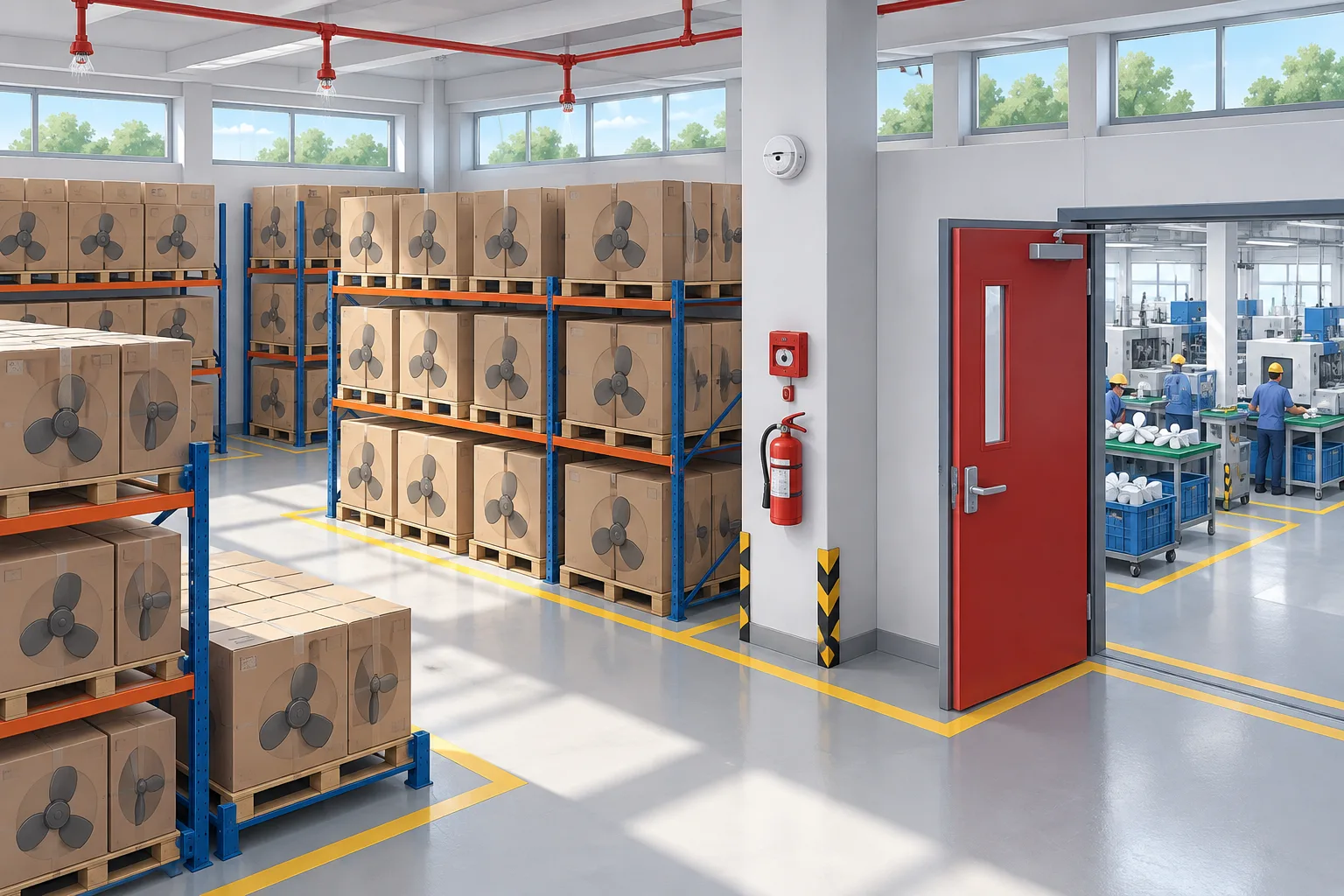
KEP.186/MEN/1999 places plastic goods factories and warehousing in the moderate III fire hazard class, workplaces with much readily combustible material where fire releases high heat and spreads fast, while electronics factories sit in moderate I (Departemen Tenaga Kerja [Depnaker], 1999, Appendix I). In our view a fan factory with a store of plastic components is closer to moderate III than to the electronics group. That class requires a fire response team and a fire safety specialist regardless of headcount (Depnaker, 1999, Article 6). For sprinkler design, NFPA 13 separates Class I to IV commodities from Group A plastics, which include common polymers such as polypropylene, polystyrene and ABS and call for more demanding protection, including when packed in cartons (NFPA, 2025).
Three other factors made matters worse: the store was on an upper floor, the room was closed, and firefighting water was far away (Nazwa, 2026; Saepulloh, 2026). Flames bursting out when the door was opened suggest, in our reading, that the fire grew unseen in a closed room, so whether that store had automatic detection is an important question. The collapse of the second and third floors then left fire buried in rubble (Rapika, 2026). We found no information on whether the building had sprinklers, detectors or hydrants, so we do not assess their performance.
What the Law Requires
Law No. 1 of 1970 on Work Safety provides for safety requirements to prevent, reduce and extinguish fires, provide escape routes, and prevent exposure to dangerous electric current (Article 3(1)(b), (d) and (q)) (Republik Indonesia, 1970).
Minister of Manpower Regulation No. 12 of 2015 on electrical safety in the workplace requires employers to implement electrical OSH (Article 2), aiming among other things at an installation that keeps the building and its contents safe (Article 3(b)). Installations above 50 V AC must follow standards including SNI (Articles 4 and 5) and be maintained by an electrical OSH expert or technician at the company or at a licensed OSH service company, PJK3 (Article 6). Periodic inspection is required at least once a year and periodic testing at least once every five years (Article 11) (Kementerian Ketenagakerjaan [Kemnaker], 2015a). Article 10, as amended by Regulation No. 33 of 2015, requires inspection and testing before handover, after changes or repairs, and periodically (Kemnaker, 2015b). The provisions on specialist electrical labour inspectors in Article 1(13) and Article 10(1) were later revoked by Minister of Manpower Regulation No. 11 of 2026 on labour inspection procedures (Article 53) (Kemnaker, 2026a). The current national installation standard is PUIL 2020 (SNI 0225:2020) (Badan Standardisasi Nasional, 2020).
On fire, KEP.186/MEN/1999 requires control of every form of energy, detection, alarm, extinguishing and evacuation facilities, smoke and heat control, a fire response unit, regular drills, and a fire emergency plan where there are more than 50 workers or a moderate or high hazard (Depnaker, 1999, Article 2). Portable extinguishers must be inspected twice a year and spaced no more than 15 m apart (Departemen Tenaga Kerja dan Transmigrasi, 1980, Articles 4 and 11), and automatic fire alarms tested weekly, monthly and annually (Depnaker, 1983, Articles 57 to 60). The audit criteria of Government Regulation No. 50 of 2012 on OSH management systems call for scheduled facility inspection, maintenance records, competent personnel and periodically tested alarms (items 6.5.1 to 6.5.4 and 6.7.6) (Pemerintah Republik Indonesia, 2012).
After the event, a fire must be reported in writing to the manpower office within 2 x 24 hours even when nobody is hurt (Depnaker, 1998, Article 2(2)(b) and Article 4). Regulation No. 11 of 2026, as amended by Regulation No. 15 of 2026, allows special inspections prompted by media reports (Article 22(1)), makes work accidents and severe damage grounds for special testing of OSH objects, with inspectors able to tape and seal the scene (Article 42), and voids the OSH compliance certificate after a work accident or severe damage (Article 45(8)) (Kemnaker, 2026a, 2026b). In our view, the electrical installation and fire protection in the surviving parts of the building should be inspected and retested before they are relied on again.
What Should Plants Check?
The BPBD head urged businesses to inspect electrical installations routinely, keep extinguishers available and review building safety systems (Nazwa, 2026). For plastics, electrical goods and warehousing sites, that means:
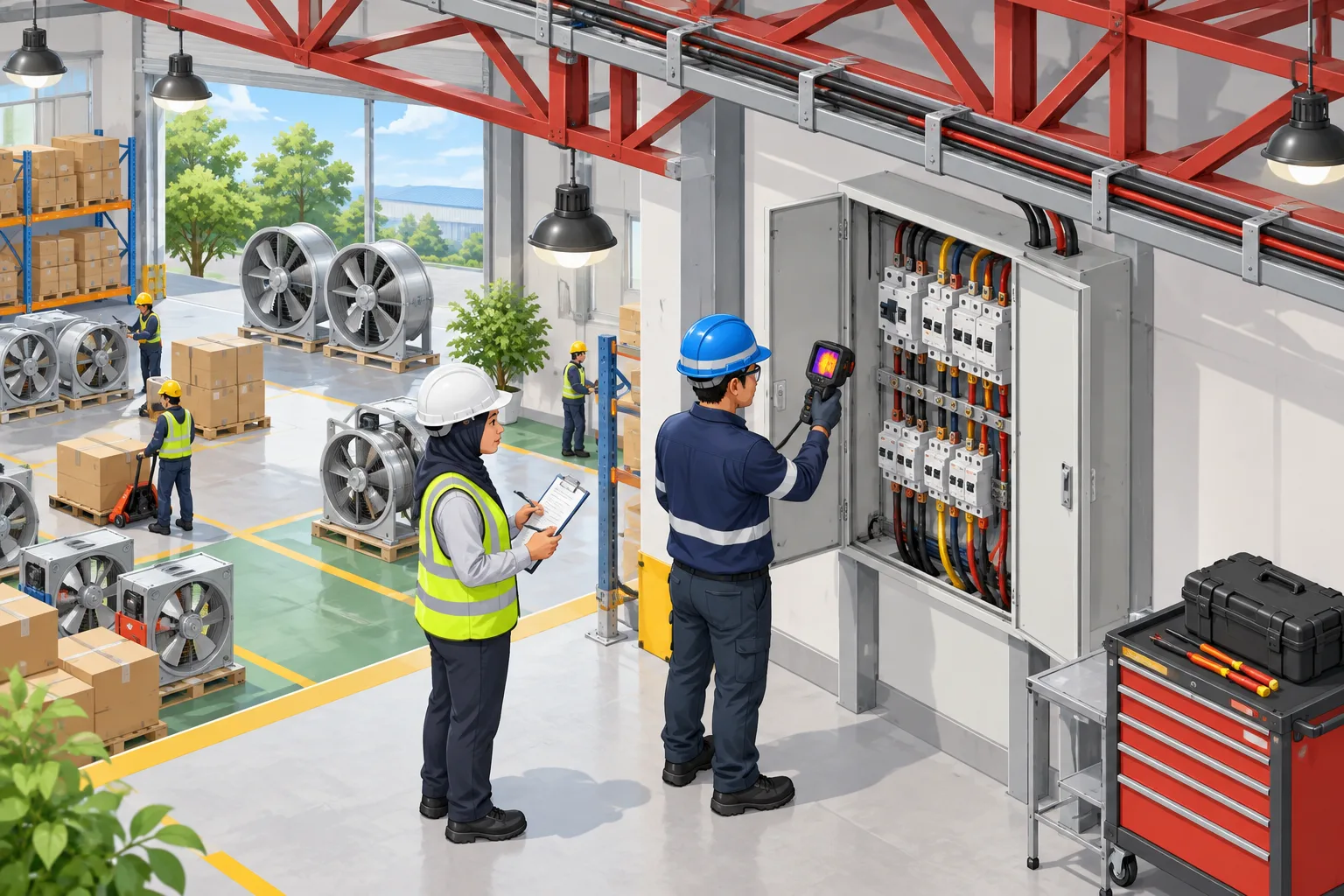
Electrical:
- Infrared thermography of panels, MCCBs, contactors and terminals under normal load. A study of an industrial installation found hot spots that called for checking cable lugs and terminal tightness (Setiawan et al., 2024).
- Protection coordination checked against actual load. An evaluation of a building against PUIL 2020 found main conductors and MCCBs no longer matched to load current, even though the branch circuits complied (Kurniawan, 2026).
- Cables, lighting and temporary connections in roof spaces above stored goods.
- Annual inspection and five-yearly testing by an electrical OSH expert or PJK3, with records kept, especially after new machines or layout changes (Kemnaker, 2015a; Pemerintah Republik Indonesia, 2012).
Fire protection:
- Reclassification of each area under Appendix I of KEP.186/MEN/1999 and matching fire response team arrangements (Depnaker, 1999).
- Detector and alarm coverage that reaches upper-floor stores and roof voids, with test records (Depnaker, 1983).
- Sprinkler design matched to the plastic type, packaging and storage height, with clearance between the top of storage and the sprinkler heads (NFPA, 2025).
- Separation of plastic component stores from production areas, with fire doors that are never wedged open.
- An on-site firefighting water supply, since a distant water source hampered the fire service here (Saepulloh, 2026).
- Correctly spaced and inspected extinguishers, escape routes from upper floors, and regular drills (Departemen Tenaga Kerja dan Transmigrasi, 1980; Depnaker, 1999).
One belief needs correcting: that good MCBs are enough. They trip on overcurrent and short circuits, but a loose connection can overheat at normal current, and once a plastics store is burning, the loss depends on fire load, early detection, sprinklers and water. Electrical inspection and fire protection review are best done together.
How Nusa Safety Helps
Nusa Safety, as a third party, can help through a fire and emergency safety audit (FESA) that assesses fire risk by area, the condition of detectors, alarms, sprinklers, hydrants and extinguishers, and evacuation readiness, and through an electrical system assessment covering thermography, earthing, protection coordination and compliance with PUIL 2020. The team also runs electrical safety training, emergency preparedness and drills, and fire brigade programmes matched to a site's fire hazard class.
Nusa Safety issues only internal training certificates. It is not a PJK3 and does not issue OSH licences, Ministry of Manpower or BNSP certificates, or statutory inspection and testing results; licensed inspection and testing is carried out with licensed PJK3 partners and the competent authorities. To discuss your site, use the contact page.
This article is general information and not legal or professional advice for any specific case.
References
- aboutsinjay. (2026, November 6). Video detik-detik diduga penyebab terjadi kebakaran di pabrik kipas angin [Footage of the moments of the suspected cause of the fan factory fire] [Video]. Instagram. https://www.instagram.com/reel/DfZ2yF6oZyh/
- abouttng. (2026, November 6). Kebakaran dilaporkan melanda sebuah pabrik kipas angin di Bumi Indah, Pasar Kemis [Fire reported at a fan factory in Bumi Indah, Pasar Kemis] [Photo and video post]. Instagram. https://www.instagram.com/p/DfY8J5oGs7G/
- Badan Standardisasi Nasional. (2020). Persyaratan umum instalasi listrik 2020 (PUIL 2020) (SNI 0225:2020) [General requirements for electrical installations 2020]. Badan Standardisasi Nasional.
- Beritasatu.com. (2026, November 6). Pabrik kipas angin di Tangerang terbakar, karyawan panik berhamburan [Fan factory in Tangerang on fire, panicked workers flee]. https://www.beritasatu.com/banten/3039177/pabrik-kipas-angin-di-tangerang-terbakar-karyawan-panik-berhamburan
- CNN Indonesia. (2026, November 6). Pabrik kipas angin di Pasar Kemis Tangerang terbakar [Fan factory in Pasar Kemis, Tangerang, on fire]. https://www.cnnindonesia.com/nasional/20261106154715-20-1424167/pabrik-kipas-angin-di-pasar-kemis-tangerang-terbakar
- Departemen Tenaga Kerja. (1983). Peraturan Menteri Tenaga Kerja Nomor PER.02/MEN/1983 tentang Instalasi Alarm Kebakaran Automatik [Minister of Manpower Regulation No. PER.02/MEN/1983 on automatic fire alarm installations]. https://betterwork.org/wp-content/uploads/781-3-Per-02_MEN_1983-Tentang-Instalasi-Alarm-Kebakaran-Automatik.pdf
- Departemen Tenaga Kerja. (1998). Peraturan Menteri Tenaga Kerja Nomor PER.03/MEN/1998 tentang Tata Cara Pelaporan dan Pemeriksaan Kecelakaan [Minister of Manpower Regulation No. PER.03/MEN/1998 on procedures for reporting and investigating accidents]. https://jdih.kemnaker.go.id/peraturan/detail/2214/peraturan-menteri-tenaga-kerja-nomor-3-tahun-1998
- Departemen Tenaga Kerja. (1999). Keputusan Menteri Tenaga Kerja Nomor KEP.186/MEN/1999 tentang Unit Penanggulangan Kebakaran di Tempat Kerja [Minister of Manpower Decree No. KEP.186/MEN/1999 on fire response units in the workplace]. https://jdih.kemnaker.go.id/peraturan/detail/3122/keputusan-menteri-tenaga-kerja-nomor-186-tahun-1999
- Departemen Tenaga Kerja dan Transmigrasi. (1980). Peraturan Menteri Tenaga Kerja dan Transmigrasi Nomor PER.04/MEN/1980 tentang Syarat-syarat Pemasangan dan Pemeliharaan Alat Pemadam Api Ringan [Regulation No. PER.04/MEN/1980 on installation and maintenance of portable fire extinguishers]. https://www.its.ac.id/burb/wp-content/uploads/sites/106/2023/07/PER.04-1980-APAR.pdf
- FBINews. (2026, November 6). Kebakaran hebat lalap pabrik kipas angin di Pasar Kemis, satu bangunan roboh [Major fire engulfs fan factory in Pasar Kemis, one building collapses]. https://www.fbinews.net/2026/11/kebakaran-hebat-lalap-pabrik-kipas.html
- Hidayat, M. Y. (2026a, July 1). 20 pabrik di Kabupaten Tangerang terbakar, kerugian capai Rp33 miliar [20 factories in Tangerang Regency burned, losses reach Rp33 billion]. TangerangNews. https://www.tangerangnews.com/kabupaten-tangerang/read/58869/20-Pabrik-di-Kabupaten-Tangerang-Terbakar-Kerugian-Capai-Rp33-Miliar
- Hidayat, M. Y. (2026b, November 6). Kebakaran pabrik kipas angin di Tangerang dipicu korsleting listrik [Tangerang fan factory fire triggered by a short circuit]. TangerangNews. https://www.tangerangnews.com/kabupaten-tangerang/read/60250/Kebakaran-Pabrik-Kipas-Angin-di-Tangerang-Dipicu-Korsleting-Listrik
- Icove, D. J., Buc, E. C., Goodson, M. E., & May, T. R. (2021). State of the arc (mapping). Journal of the National Academy of Forensic Engineers, 38(1), 63-75. https://doi.org/10.51501/jotnafe.v38i1.127
- Ikhsanudin, A. (2026, November 6). Pabrik kipas angin di Tangerang kebakaran, asap hitam membubung [Fan factory in Tangerang on fire, black smoke rises]. detikNews. https://news.detik.com/berita/d-8741192/pabrik-kipas-angin-di-tangerang-kebakaran-asap-hitam-membubung
- Kabar6.com. (2026, November 6). Pabrik kipas di Pasar Kemis kebakaran [Fan factory in Pasar Kemis on fire]. https://kabar6.com/pabrik-kipas-di-pasar-kemis-kebakaran/
- Kementerian Ketenagakerjaan Republik Indonesia. (2015a). Peraturan Menteri Ketenagakerjaan Nomor 12 Tahun 2015 tentang Keselamatan dan Kesehatan Kerja Listrik di Tempat Kerja [Minister of Manpower Regulation No. 12 of 2015 on electrical occupational safety and health in the workplace]. Berita Negara Republik Indonesia Tahun 2015 Nomor 540. https://jdih.kemnaker.go.id/peraturan/detail/610/peraturan-menteri-nomor-12-tahun-2015
- Kementerian Ketenagakerjaan Republik Indonesia. (2015b). Peraturan Menteri Ketenagakerjaan Nomor 33 Tahun 2015 tentang Perubahan atas Peraturan Menteri Ketenagakerjaan Nomor 12 Tahun 2015 [Minister of Manpower Regulation No. 33 of 2015 amending Regulation No. 12 of 2015]. Berita Negara Republik Indonesia Tahun 2015 Nomor 1535. https://jdih.kemnaker.go.id/peraturan/detail/1156/peraturan-menteri-nomor-33-tahun-2015
- Kementerian Ketenagakerjaan Republik Indonesia. (2026a). Peraturan Menteri Ketenagakerjaan Nomor 11 Tahun 2026 tentang Tata Cara Pengawasan Ketenagakerjaan [Minister of Manpower Regulation No. 11 of 2026 on labour inspection procedures]. Berita Negara Republik Indonesia Tahun 2026 Nomor 438. https://jdih.kemnaker.go.id/peraturan/detail/3070/peraturan-menteri-ketenagakerjaan-nomor-11-tahun-2026
- Kementerian Ketenagakerjaan Republik Indonesia. (2026b). Peraturan Menteri Ketenagakerjaan Nomor 15 Tahun 2026 tentang Perubahan atas Peraturan Menteri Ketenagakerjaan Nomor 11 Tahun 2026 [Minister of Manpower Regulation No. 15 of 2026 amending Regulation No. 11 of 2026]. Berita Negara Republik Indonesia Tahun 2026 Nomor 681. https://jdih.kemnaker.go.id/peraturan/detail/3109/peraturan-menteri-ketenagakerjaan-nomor-15-tahun-2026
- Kurniawan, R. E. (2026). Analisis sistem instalasi listrik Gedung Universitas Mayasari Bakti [Analysis of the electrical installation of the Mayasari Bakti University building]. E-JOINT (Electronica and Electrical Journal of Innovation Technology), 7(1), 17-23. https://doi.org/10.35970/kdwr6d91
- Nazwa. (2026, November 6). Pabrik kipas angin di Tangerang terbakar hebat, api padam setelah tiga jam [Major fire at Tangerang fan factory, put out after three hours]. Semartara.news. https://semartara.news/pabrik-kipas-angin-di-tangerang-terbakar-hebat-api-padam-setelah-tiga-jam/
- National Fire Protection Association. (2024). NFPA 921: Guide for fire and explosion investigations (2024 ed.). https://www.nfpa.org/codes-and-standards/nfpa-921-standard-development/921
- National Fire Protection Association. (2025). NFPA 13: Standard for the installation of sprinkler systems (2025 ed.). https://www.nfpa.org/codes-and-standards/nfpa-13-standard-development/13
- Pemerintah Republik Indonesia. (2012). Peraturan Pemerintah Nomor 50 Tahun 2012 tentang Penerapan Sistem Manajemen Keselamatan dan Kesehatan Kerja [Government Regulation No. 50 of 2012 on the implementation of OSH management systems]. Lembaran Negara Republik Indonesia Tahun 2012 Nomor 100. https://jdih.kemnaker.go.id/peraturan/detail/58/peraturan-pemerintah-nomor-50-tahun-2012
- Rapika, N. A. (2026, November 7). Kebakaran pabrik kipas angin di Tangerang padam setelah 16 jam terbakar [Tangerang fan factory fire out after burning for 16 hours]. Kompas.com. https://megapolitan.kompas.com/read/2026/11/07/11452511/kebakaran-pabrik-kipas-angin-di-tangerang-padam-setelah-16-jam-terbakar
- Republik Indonesia. (1970). Undang-Undang Nomor 1 Tahun 1970 tentang Keselamatan Kerja [Law No. 1 of 1970 on work safety]. Lembaran Negara Republik Indonesia Tahun 1970 Nomor 1. https://jdih.kemnaker.go.id/peraturan/detail/49/undang-undang-nomor-1-tahun-1970
- Saepulloh. (2026, November 6). Pabrik kipas angin di Pasar Kemis terbakar, satu bangunan roboh [Fan factory in Pasar Kemis on fire, one building collapses]. BantenNews.co.id. https://www.bantennews.co.id/pabrik-kipas-angin-di-pasar-kemis-terbakar-satu-bangunan-roboh/
- Saputra, M. W. A. (2026). Implementasi sistem proteksi instalasi listrik untuk mengurangi risiko kebakaran di pemukiman padat penduduk: Literatur review [Electrical installation protection to reduce fire risk in dense settlements: A literature review]. IDENTIFIKASI: Jurnal Ilmiah Keselamatan Kesehatan Kerja dan Lindungan Lingkungan, 12(2), 815-822. https://doi.org/10.36277/identifikasi.v12i2.1370
- Setiawan, A. W., Suminto, & Solihin, L. (2024). Analisis thermal instalasi capacitor bank 575 kVar menggunakan metode infrared thermography [Thermal analysis of a 575 kVAr capacitor bank installation using infrared thermography]. EPIC Journal of Electrical Power Instrumentation and Control, 7(1), 98-107. https://doi.org/10.32493/epic.v7i1.39660
- Suciatiningrum, D. (2026, September 22). Jakarta membara, kasus kebakaran tembus 1.216 hingga Agustus 2026 [Jakarta ablaze: fires reach 1,216 by August 2026]. IDN Times. https://www.idntimes.com/news/indonesia/jakarta-membara-kasus-kebakaran-tembus-1-216-hingga-agustus-2026-00-481xk-1qcgvh

