
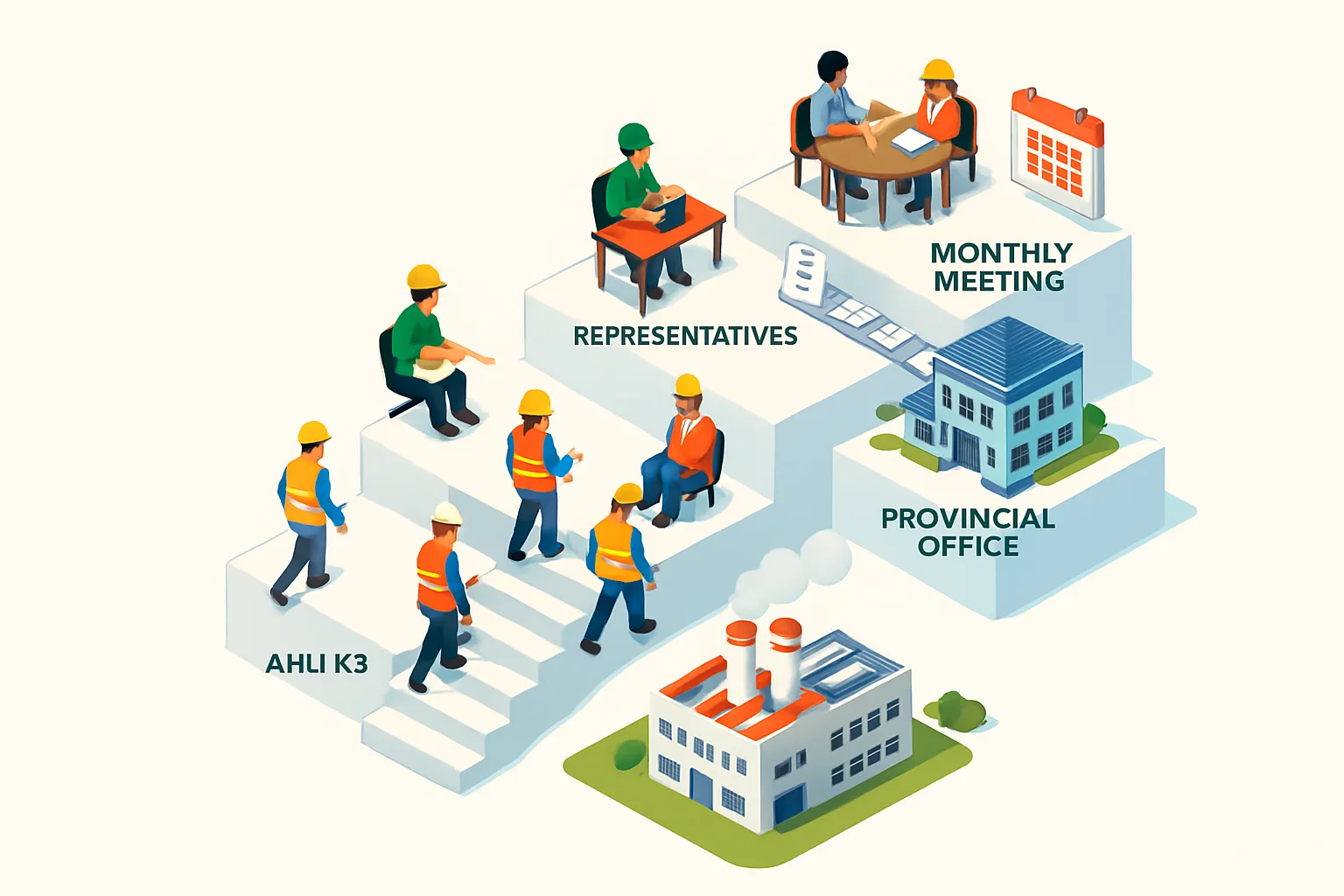
The P2K3, short for Panitia Pembina Keselamatan dan Kesehatan Kerja, is Indonesia's statutory workplace safety and health committee. For almost four decades it was governed by a 1987 ministerial regulation. Since 19 November 2025 it is governed by Minister of Manpower Regulation No. 13 of 2025 (Permenaker 13/2025), which revoked PER.04/MEN/1987 in Article 16.
The new rules are more specific. They set minimum membership numbers, move ratification to the provincial manpower office, put short deadlines on changes, and switch reporting to an electronic system every six months. For an HR director or plant manager in a foreign-owned company, this article explains what you must set up, in the order we recommend doing it. If you only need the summary of changes, see our note on what changed from the 1987 rules.
Who must form a P2K3
Article 3 paragraph (1) requires the employer and/or the pengurus (the person who leads the workplace) to form a P2K3. Article 3 paragraph (2) applies this to every workplace or company that:
- employs at least 100 workers, or
- has a high risk level.
The two tests are alternatives. A 40-person chemical plant can be caught by the risk test, and a 300-person office by the headcount test. Article 3 paragraph (3) states that the high risk level follows the rules on business licensing, which today means Government Regulation No. 28 of 2025 (PP 28/2025) on risk-based licensing. In practice, check the risk level recorded for your business activities (KBLI) in OSS, and treat a high rating as a trigger.
The underlying legal basis is Law No. 1 of 1970 on Work Safety, Article 10, which gives the Minister the power to form safety committees at workplaces.
Who sits on the committee
Article 5 sets the structure: a chair, a secretary and members.
- Chair. The chair is the top leader or the pengurus of the workplace or company (Article 5 paragraph (2)). This should be someone with real authority over budget and operations, often the president director or plant manager.
- Secretary. The secretary is an Ahli K3 (OHS expert) who has been appointed in accordance with the regulations (Article 5 paragraph (3)). Ahli K3 appointments are made under PER.02/MEN/1992 on the written request of the pengurus.
- Members. Members represent the two elements of the committee set out in Article 4, the workers and the employer and/or pengurus. In practice, drawing members from the units that handle OHS, human resources and production gives the committee reach into daily operations.
Article 6 requires a balance between the employer side and the worker side and sets minimum numbers:
- at least 3 employer representatives and 3 worker representatives for a high-risk workplace with up to 100 workers;
- at least 6 employer representatives and 6 worker representatives for a workplace with at least 100 workers.
For foreign-owned companies, two points matter. First, the regulation defines the chair by position, as the top leader or pengurus of the workplace or company. If an expatriate president director will chair the committee, confirm with the provincial manpower office that the proposed structure will be accepted. Second, worker representatives should be genuine representatives. Where there is a trade union, involving it in the nomination is good practice and strengthens the committee's credibility.
How the committee is ratified
Under Article 7, the P2K3 is determined by the Minister, and in practice by the head of the provincial manpower office (Kepala Dinas Daerah Provinsi) on the proposal of the employer or pengurus. Article 7 paragraph (3) lists what the application must include, submitted in writing or electronically:

- the proposed membership with an organisation chart;
- a copy of the Ahli K3 appointment decree;
- a description of duties and responsibilities for each member.
Once the provincial office has verified that the documents are complete and correct, it issues the determination, with the description of duties attached, within 5 working days (Article 7). The determination remains valid as long as the membership does not change.
Note the practical consequence: you cannot submit the P2K3 before you have an appointed Ahli K3. Start the Ahli K3 process first.
When the committee changes
Article 8 separates two kinds of change.
- A change of chair and/or secretary requires a renewed determination. The application goes to the provincial office no later than 2 working days after the change (Article 8 paragraph (5)), with the old determination, the proposed new structure and, if the secretary changes, a copy of the new Ahli K3 appointment (Article 8 paragraph (6)).
- A change of ordinary members is decided by the P2K3 chair and notified to the provincial office (Article 8 paragraphs (3) and (4)).
Two working days is short. When an Ahli K3 resigns with a one-month notice period, start the replacement and the paperwork during the notice period, not after the last day.
What the committee must actually do
Article 9 sets out the committee's duties and functions. At their core is giving advice and considerations to the employer or pengurus on OHS matters, supported by a list of more specific tasks that the committee should map against its own programme.
The regulation also requires a work programme and activity plan that fits actual conditions at the workplace. A useful programme normally covers an inventory of OHS problems, hazard identification, inspection of OHS implementation, and analysis of accident and occupational disease data, followed by advice to management.
Whatever minimum the regulation sets, a monthly meeting remains good practice and is what most SMK3 auditors expect to see in minutes. An Indonesian study at one company found that the P2K3 did not meet every month and that members held the role on top of other duties without OHS expertise, which weakened its effect (Sinaga et al., 2019). Our experience in manufacturing matches this.
Reporting every six months
Article 11 requires the P2K3 chair to report the committee's activities to the head of the provincial manpower office, with a copy to the Minister, once every six months or at any time when needed. The report is submitted electronically through the information system managed by the Ministry of Manpower.
Article 15 requires that information system to be established within one year from the date the regulation was promulgated, which was 19 November 2025. Until the system is operating in your province, ask the provincial office how it wants reports to be submitted, and keep proof of submission.
Guidance, supervision and sanctions
The provincial manpower office provides guidance on forming the P2K3 and carrying out its duties (Article 12), and labour inspectors supervise compliance (Article 13). The regulation also contains provisions on sanctions for employers or pengurus that do not meet their obligations. A missing or dormant P2K3 is also a finding in an SMK3 assessment, so the cost of neglect shows up in more than one place. If you receive an inspection note on this point, an advocate should advise on legal exposure, while a consultant can help close the technical gap.
A setup sequence that works
- Confirm the trigger for each workplace: headcount and risk level. Record the conclusion and the basis.
- Secure an appointed Ahli K3 for each workplace that needs a P2K3. If no one on staff holds the appointment, plan training and certification through an authorised provider, then the appointment request under PER.02/MEN/1992.
- Nominate members to meet the Article 6 minimums, with real worker representatives and members from OHS, HR and production.
- Write duties and responsibilities for each member. Keep them specific: who runs inspections, who analyses incidents, who follows up corrective actions.
- Submit the application to the provincial manpower office with the Article 7 attachments.
- Build the work programme required by the regulation and link it to your SMK3 or ISO 45001 objectives.
- Set the reporting calendar for the six-month report under Article 11 and a trigger for the 2 working day change notice under Article 8.

Common mistakes
- Appointing a P2K3 secretary who is not an appointed Ahli K3, or whose appointment was issued to a previous employer.
- Filling the worker side with supervisors who report to the chair, which defeats the balance in Article 6.
- Assuming that one committee covers a group with several workplaces in different provinces, without confirming with each provincial office how the obligation applies to each workplace.
- Minutes in English only, which the provincial office and inspectors may not accept.
- Leaving the change notice until the next six-month report.
How we can help
Nusa Safety helps employers set up and run their P2K3: confirming the trigger, preparing the application package, coaching chairs and secretaries, building the work programme and setting up HSSE application modules for minutes, inspections and corrective actions. Ahli K3 training and certification are arranged through licensed partners. See our general OHS expert (AK3 Umum) programme or contact us for a short review of your current committee.
This article is general information based on Permenaker 13/2025 as we understood it on the date of publication. It is not legal advice.
References
- Republik Indonesia. (1970). Undang-Undang Nomor 1 Tahun 1970 tentang Keselamatan Kerja. https://peraturan.go.id/files/UU0011970.pdf
- Republik Indonesia. (2025). Peraturan Pemerintah Nomor 28 Tahun 2025 tentang Penyelenggaraan Perizinan Berusaha Berbasis Risiko. https://peraturan.bpk.go.id/Details/319773
- Kementerian Tenaga Kerja Republik Indonesia. (1992). Peraturan Menteri Tenaga Kerja Nomor PER.02/MEN/1992 tentang Tata Cara Penunjukan, Kewajiban dan Wewenang Ahli Keselamatan dan Kesehatan Kerja. https://jdih.kemnaker.go.id/peraturan/detail/242/peraturan-menteri-ketenagakerjaan-nomor-2-tahun-1992
- Kementerian Ketenagakerjaan Republik Indonesia. (2025). Peraturan Menteri Ketenagakerjaan Nomor 13 Tahun 2025 tentang Panitia Pembina Keselamatan dan Kesehatan Kerja. https://jdih.kemnaker.go.id/peraturan/detail/2788/peraturan-menteri-ketenagakerjaan-nomor-13-tahun-2025
- Kementerian Ketenagakerjaan Republik Indonesia. (2025). Risalah pembahasan rancangan Peraturan Menteri Ketenagakerjaan tentang Panitia Pembina Keselamatan dan Kesehatan Kerja [Dokumen PDF]. JDIH Kemnaker. https://jdih.kemnaker.go.id/asset/data_puu/Risalah%20Pembahasan%20Rpermen%20P2K3.pdf
- Sinaga, L., Kurniawan, B., & Wahyuni, I. (2019). Pengaruh rangkap jabatan terhadap efektivitas kinerja P2K3 dalam upaya peningkatan keselamatan dan kesehatan kerja di PT X. Jurnal Kesehatan Masyarakat, 7(3). https://ejournal3.undip.ac.id/index.php/jkm/article/view/25791
