Abstract
Environmental enforcement in Indonesia relies heavily on numbers that facilities produce themselves: wastewater test results, stack emission measurements, and data from continuous monitoring systems. These numbers can support a claim of compliance or be used against the facility in administrative, civil, or criminal proceedings, and their weight depends on whether the way they were produced can be checked. This article explains a method for producing monitoring data that can be scientifically defended, written for environmental officers, auditors, and students who need a structured reference. It is a methods explainer based on a document review of Indonesian laws and ministerial regulations, a Supreme Court regulation, international standards and agency guidance, and peer-reviewed studies, searched on the web on 31 October 2026. The method is organised into six linked steps: a written sampling plan, testing by an accredited and registered laboratory, a documented chain of custody, calibration with quality assurance and quality control, continuous monitoring under the SPARING and CEMS rules, and controlled data management with record retention. A generic, clearly hypothetical example shows how the steps connect at one wastewater outfall. The review finds that Indonesian regulation already recognises electronic and scientific evidence, while the procedural detail that makes data defensible sits mostly in standards and technical guidance. The method has limits: it shows that data are reliable, not that a facility complies, and it cannot replace legal advice.
Keywords: environmental enforcement, monitoring data, scientific evidence, chain of custody, continuous emission monitoring
Introduction
Indonesia's Law No. 32 of 2009 on Environmental Protection and Management, amended in part by Law No. 6 of 2023 on Job Creation, gives environmental inspectors the authority to monitor, request information, copy documents and records, enter premises, and take samples (Republik Indonesia, 2009, 2023). Government Regulation No. 22 of 2021 sets out the operational rules, including a ladder of five administrative sanctions that runs from a written warning to revocation of the business licence (Pemerintah Republik Indonesia, 2021). In 2026 the supervision procedure was reissued as Regulation No. 6 of 2026 of the Minister of Environment and Head of the Environmental Control Agency, which took effect on 15 June 2026 and replaced Regulation No. 14 of 2024 (Kementerian Lingkungan Hidup/Badan Pengendalian Lingkungan Hidup [KLH], 2026b).
In September 2025 the ministry reported that it had supervised 921 companies or activities where violations were found, imposed administrative sanctions on 845, pursued 39 criminal cases, and settled 18 through environmental dispute mechanisms, an approach it calls multidoor enforcement (KLH, 2025). In each route, what happened at the outfall or the stack is usually answered with measurement data.
Two studies suggest why the method of producing data matters. In China, reported particulate concentrations rose by 35 percent immediately after air quality monitoring stations were automated, which the authors read as evidence that earlier, manually handled data had been under-reported (Greenstone et al., 2022). In the United States, air quality was found to be worse on days when the intermittent federal monitoring schedule did not take samples (Zou, 2021). Both concern ambient air, but they show that data can be shaped by who handles them and when sampling takes place.
Indonesian legal literature points in the same direction. Supreme Court Regulation No. 1 of 2023 on Guidelines for Adjudicating Environmental Cases contains a definition of scientific evidence in Article 1 point 16 and, according to summaries published on the Court's official channels, asks judges to consider the accuracy of methods and the validity of sampling procedures, including laboratory accreditation (Mahkamah Agung Republik Indonesia [MA], 2023). National scholarship has argued that scientific evidence in environmental cases needs a firmer basis (Mumpuni, 2024). The practical gap is that the legal, standards, and technical requirements are rarely set out together as one procedure.
This article aims to describe a step-by-step method by which a facility can produce and keep environmental monitoring data that are scientifically defensible as evidence in Indonesian environmental enforcement.
Methods
This is a methods explainer built from a narrative document review, without new measurements or interviews. All searches were run on 31 October 2026 through a general web search engine. Queries were directed at the BPK legal database (peraturan.bpk.go.id), peraturan.go.id, the ministry website (kemenlh.go.id), Supreme Court news channels, university journal portals indexed in Garuda, publisher pages of international journals, and the US Environmental Protection Agency (EPA) website. Direct access to several government legal databases was blocked by the network used for this work, so some regulatory content was verified through search-result extracts of official copies and consistent secondary summaries. In those cases the text limits the claim to what could be confirmed.

Search terms, in Indonesian and English, included: Permen LH 6 2026 pengawasan; SPARING P.93 2018; Permen LHK 13 2021 SISPEK CEMS; laboratorium lingkungan akreditasi ISO/IEC 17025; Perma 1 2023 bukti ilmiah; UU 32 2009 Pasal 96; UU ITE Pasal 5; chain of custody environmental samples; CEMS quality assurance; and monitoring data automation.
The year range was 2002 to 2026. Older documents were kept only where they remain the current reference, such as US EPA guidance and the Eurachem guide on measurement uncertainty. Included were Indonesian laws and regulations in force, peer-reviewed articles, international standards, and official agency guidance or press releases; news was used only for context. No screening counts were recorded or are reported.
Results and Discussion
Defensible Monitoring Data
Indonesian law already gives room for monitoring data to be used as evidence. Article 96 of Law No. 32 of 2009 lists the evidence admissible in environmental criminal cases as witness and expert testimony, documents, indications, statements of the accused, and other evidence, which its elucidation extends to information stored electronically, optically, or magnetically (Republik Indonesia, 2009). The Electronic Information and Transactions Law states in Article 5 that electronic information, electronic documents, and their printouts are valid legal evidence, and Article 6 provides that, where a law requires information to be in written or original form, electronic information is considered valid insofar as it can be accessed, displayed, its integrity guaranteed, and accounted for (Republik Indonesia, 2008, 2024).
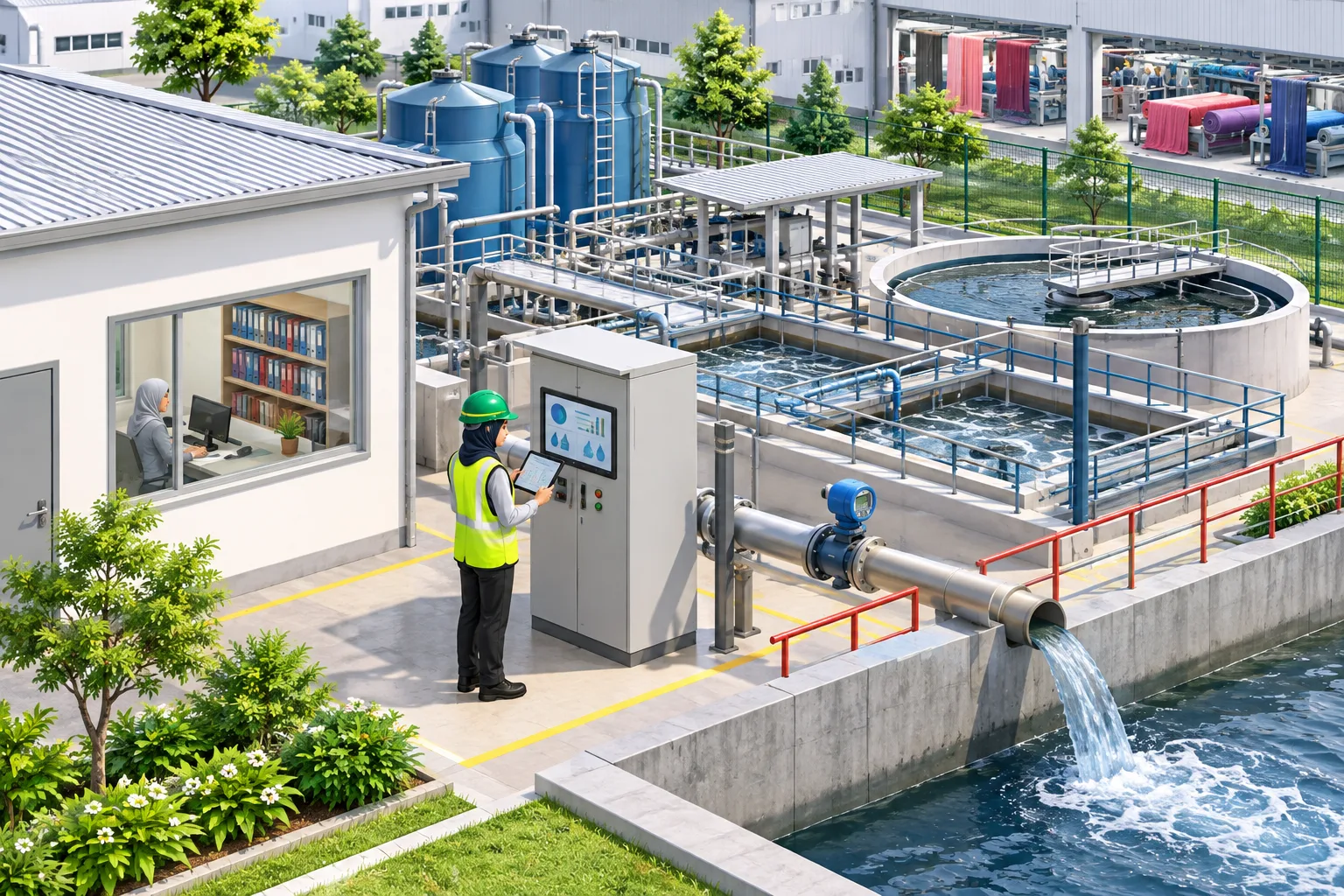
In the author's interpretation, these provisions shift the question from whether data can be used to whether they can be trusted. A result is defensible when another competent party can trace where and when the sample was taken, who handled it, which method and instrument measured it, how the instrument was checked, what uncertainty applies, and whether the record has changed since. The six steps below follow that traceability.
Sampling Plan
The first step is a written sampling plan that states the purpose of monitoring, the parameters, the sampling points, the frequency, the sample type, and the acceptance criteria for data quality. US EPA guidance on quality assurance project plans organises such plans into four groups of elements: project management, data generation and acquisition, assessment and oversight, and data validation and usability (U.S. Environmental Protection Agency [EPA], 2002). Parameters and frequencies should come from the facility's environmental and technical approvals, which define what it must measure.
Timing matters too. Given that pollution was lower on scheduled monitoring days (Zou, 2021), the author's interpretation is that samples taken only on predictable dates say less about normal operation unless operating conditions at the time of sampling are also recorded.
Accredited Laboratory Testing
The second step is testing by a laboratory whose competence can be demonstrated. ISO/IEC 17025:2017 sets requirements for testing laboratories, including clauses on sampling (7.3), handling of test items (7.4), technical records (7.5), evaluation of measurement uncertainty (7.6), ensuring the validity of results (7.7), and control of data and information management (7.11) (International Organization for Standardization [ISO] & International Electrotechnical Commission [IEC], 2017). Under the previous Indonesian regulation on environmental laboratories, an environmental laboratory was one holding an accreditation certificate for environmental parameters and a ministry registration, with competence assessed against ISO/IEC 17025 and environmental requirements (Agusni, 2024). That regulation has been replaced by Regulation No. 4 of 2026 on Environmental Laboratories, which covers accreditation and registration requirements, application procedures, supervision, and reporting (KLH, 2026a). The facility should check that the laboratory's accreditation scope from the National Accreditation Committee (KAN) and its registration cover each parameter and method used.
Chain of Custody
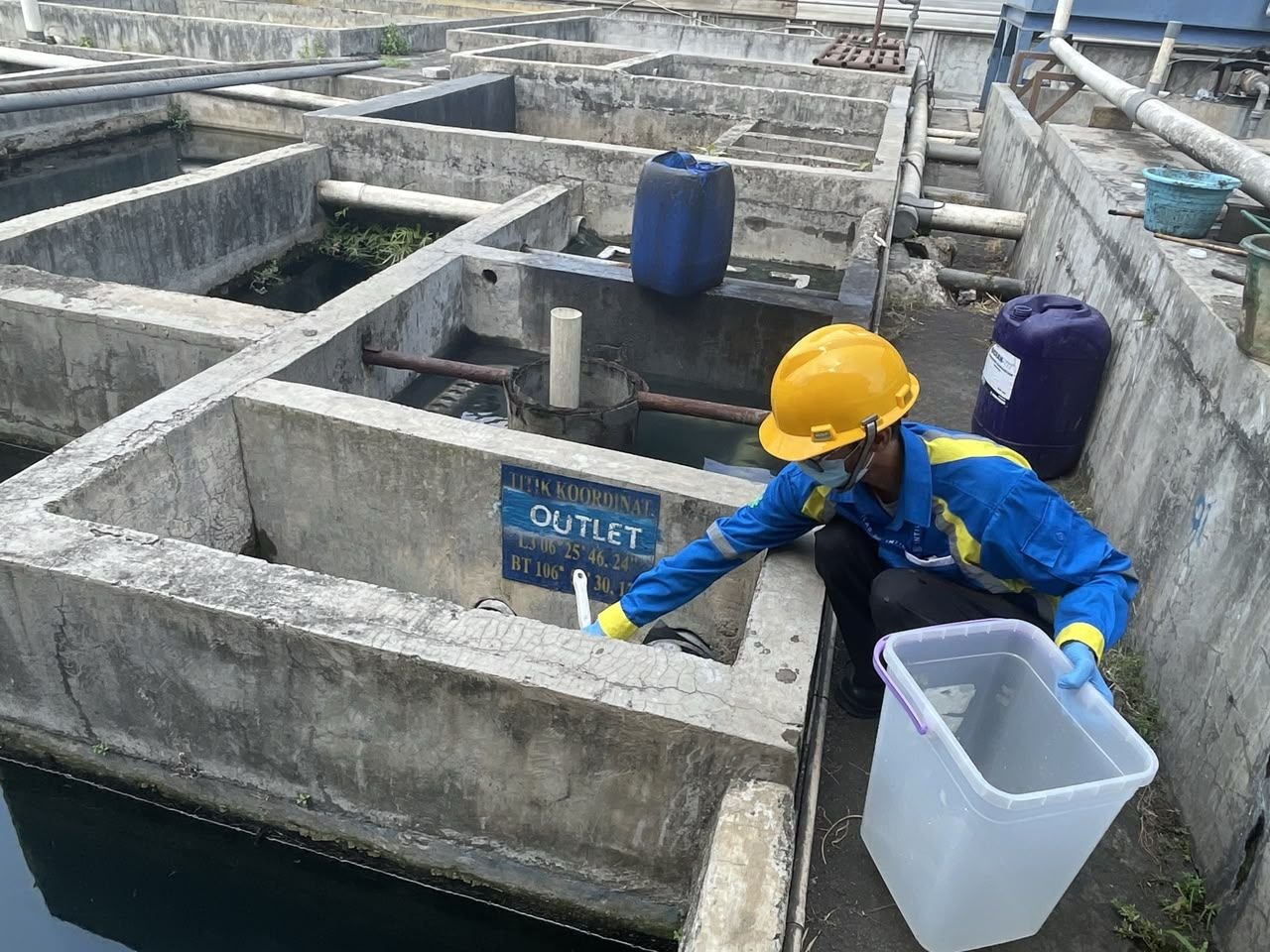
The third step is a chain of custody, the documented record of who held a sample from collection to analysis. The EPA field sampler guidance treats custody of both samples and data as a defined procedure, using custody seals and chain-of-custody records that move with the samples (EPA, 2020). ISO/IEC 17025:2017 places the receiving laboratory's duties in its clauses on handling of test items and technical records (ISO & IEC, 2017). A practical minimum record covers the sample identifier, location, date and time, sampler, preservation, seal number, and each transfer with signatures. A gap does not prove that a sample was altered, but it gives the opposing party a reason to question it.
Calibration and QA/QC
The fourth step is calibration with routine quality assurance and quality control. For continuous gas analysers, the US regulation in Appendix F to 40 CFR Part 60 offers a detailed example: calibration drift is checked at two concentration levels at least daily, the analyser must be adjusted when drift exceeds twice the specification, data are out of control when drift exceeds four times the specification, and a relative accuracy test audit is required at least once every four calendar quarters, with cylinder gas audits allowed in up to three of the four quarters (EPA, 2023). They are cited only as an example of a structured QA regime, not as Indonesian thresholds.
For laboratory results, measurement uncertainty is the link between a number and a compliance decision. The Eurachem and CITAC guide explains how to estimate uncertainty and how to judge compliance with a limit when a result lies close to it (Ellison & Williams, 2012).
Continuous Monitoring Systems
The fifth step covers systems that measure without interruption. For wastewater, Ministerial Regulation P.93 of 2018, amended by P.80 of 2019, requires certain businesses to install and operate continuous, online wastewater monitoring, known as SPARING, and to carry out manual monitoring for parameters or points not monitored continuously (Kementerian Lingkungan Hidup dan Kehutanan [KLHK], 2018, 2019). For stack emissions, Regulation No. 13 of 2021 requires every business obliged to use a continuous emission monitoring system (CEMS) to integrate its data into the national industrial emission monitoring information system, SISPEK, and was issued under Article 203 paragraph (6) of Government Regulation No. 22 of 2021 (KLHK, 2021).
Continuous data reduce the gaps left by intermittent sampling (Greenstone et al., 2022), but they do not remove the need for laboratory checks. A study at one Indonesian facility compared SPARING readings with standard laboratory methods over seven repetitions and found no significant difference for pH, TSS, COD, and ammonia (Indryastuti et al., 2022). Because this came from one site and a short series, periodic comparison at each facility remains necessary.
Data Management and Retention
The sixth step is control of records. ISO/IEC 17025:2017 requires laboratories to control data and information management systems and to retain technical records (ISO & IEC, 2017). In the author's interpretation, the integrity test in Article 6 of the Electronic Information and Transactions Law (Republik Indonesia, 2008) suggests three practices: keep raw data separate from calculated results, log every correction with its reason and author, and store reports in a form that can still be displayed years later. Regulation No. 6 of 2026 is reported to organise supervision into routine and incidental tracks (InfoSAWIT, 2026), and either can bring a request for past records. Retention periods should follow the facility's permits; this review found no single verified period for all monitoring data.
Illustrative Application
This example is hypothetical; it describes no real company, and its numbers only show how the steps connect.
A facility discharges treated wastewater through one outfall fitted with SPARING. Its sampling plan lists the parameters and monthly grab sampling required by its permits. On the sampling day the sampler takes a sample at pukul 10.15, records the time, seals the bottle, and completes the custody form; the SPARING reading for the same minute is exported with its timestamp. The sample goes to a laboratory whose accreditation and registration scope covers COD. Assume the laboratory reports 92 mg/L and the SPARING reading was 80 mg/L. The relative difference is (92 - 80) / 92, or about 13 percent.
Whether 13 percent is acceptable must be judged against the criterion in the applicable regulation, method, or the facility's quality plan, together with the laboratory's stated uncertainty. What the procedure provides is a file: time-matched records, the custody form, the laboratory's scope, the sensor's last calibration, and a written explanation of the difference with any corrective action. In the author's interpretation, this file, rather than any single number, is what makes the data defensible.
Limits of the Method
The method shows that data are reliable; it does not show that a facility complies, and a well-documented result above a quality standard remains a violation. The US QA figures are examples from another jurisdiction. Scientific defensibility is also only one part of how a court or authority weighs evidence, alongside procedural law and the assessment of experts (MA, 2023).
Limitations
This review relied on web search results and could not open the full official text of several regulations, including Regulation No. 6 of 2026 and Regulation No. 4 of 2026. Some content, including the routine and incidental supervision tracks under Regulation No. 6 of 2026 and the court's approach to sampling validity under Supreme Court Regulation No. 1 of 2023, was therefore confirmed through secondary summaries. The peer-reviewed evidence on data manipulation concerns ambient air in China and the United States, so applying it to Indonesian facilities is an interpretation. The only Indonesian empirical study found on SPARING accuracy covered one facility. No interviews, site data, or court decisions were analysed.
Conclusions and Recommendations
Environmental monitoring data can serve as valid evidence in Indonesia because environmental and electronic information laws recognise electronic and scientific evidence, but whether a data set holds up depends on the method behind it. That method consists of six linked steps: a written sampling plan, accredited and registered laboratory testing, a chain of custody, calibration with QA/QC, continuous monitoring under the SPARING and CEMS rules, and controlled data management.
In practice, facilities can build one register of monitoring obligations from their approvals, check each laboratory's scope against the parameters tested, use a custody form for every sample, compare continuous readings with laboratory results at fixed intervals, and log every data correction. Further research should compare SPARING and CEMS data with reference methods across many Indonesian facilities, analyse how published court decisions have weighed monitoring data, and assess the first year of Regulation No. 6 of 2026.
Support for an obligations register and evidence file is described under Environmental Compliance and PROPER, record testing under ISO gap assessment and internal audit, and time-stamped records under HSE digitalisation; approvals and laboratory accreditation are issued only by the competent authorities.
This article is general information and not legal or professional advice for any specific case.
References
- Agusni, A. (2024). Standardisasi LHK: Peningkatan kualitas laboratorium, pendampingan dan pemantauan pengujian parameter lingkungan dan registrasi laboratorium. Majalah STANDAR, 3(5). Badan Standardisasi Instrumen Lingkungan Hidup dan Kehutanan. https://majalah.bsilhk.menlhk.go.id/index.php/STANDAR/article/download/247/216/1225
- Ellison, S. L. R., & Williams, A. (Eds.). (2012). Eurachem/CITAC guide: Quantifying uncertainty in analytical measurement (3rd ed., CITAC Guide No. 4). Eurachem. https://www.eurachem.org/guides/quam
- Greenstone, M., He, G., Jia, R., & Liu, T. (2022). Can technology solve the principal-agent problem? Evidence from China's war on air pollution. American Economic Review: Insights, 4(1), 54-70. https://doi.org/10.1257/aeri.20200373
- Indryastuti, D. N., Iryani, A., & Fathurrahman, M. (2022). Comparison of analysis results of pH, TSS, COD and ammonia in industry wastewater with Sparing and SNI methods. Helium: Journal of Science and Applied Chemistry, 2(2), 53-57. https://doi.org/10.33751/helium.v2i2.6342
- InfoSAWIT. (2026, 6 Juli). Regulasi baru pengawasan lingkungan berlaku, industri sawit hadapi era kepatuhan yang lebih ketat. https://www.infosawit.com/2026/07/06/regulasi-baru-pengawasan-lingkungan-berlaku-industri-sawit-hadapi-era-kepatuhan-yang-lebih-ketat/
- International Organization for Standardization, & International Electrotechnical Commission. (2017). ISO/IEC 17025:2017 General requirements for the competence of testing and calibration laboratories. ISO.
- Kementerian Lingkungan Hidup dan Kehutanan. (2018). Peraturan Menteri Lingkungan Hidup dan Kehutanan Nomor P.93/MENLHK/SETJEN/KUM.1/8/2018 tentang Pemantauan Kualitas Air Limbah secara Terus Menerus dan Dalam Jaringan bagi Usaha dan/atau Kegiatan. Berita Negara Republik Indonesia Tahun 2018 Nomor 1236. https://peraturan.go.id/files/bn1236-2018.pdf
- Kementerian Lingkungan Hidup dan Kehutanan. (2019). Peraturan Menteri Lingkungan Hidup dan Kehutanan Nomor P.80/MENLHK/SETJEN/KUM.1/10/2019 tentang Perubahan atas Peraturan Menteri Lingkungan Hidup dan Kehutanan Nomor P.93/MENLHK/SETJEN/KUM.1/8/2018 tentang Pemantauan Kualitas Air Limbah secara Terus Menerus dan Dalam Jaringan bagi Usaha dan/atau Kegiatan.
- Kementerian Lingkungan Hidup dan Kehutanan. (2021). Peraturan Menteri Lingkungan Hidup dan Kehutanan Nomor 13 Tahun 2021 tentang Sistem Informasi Pemantauan Emisi Industri secara Terus Menerus. Berita Negara Republik Indonesia Tahun 2021 Nomor 549. https://peraturan.bpk.go.id/Download/288590/Permen%20LHK%20Nomor%2013%20Tahun%202021.pdf
- Kementerian Lingkungan Hidup/Badan Pengendalian Lingkungan Hidup. (2025, 17 September). Menteri LH tegaskan komitmen penegakan hukum, awasi 921 perusahaan/kegiatan, jatuhkan sanksi tegas pelanggaran pengelolaan lingkungan [Siaran pers]. https://kemenlh.go.id/news/detail/menteri-lh-tegaskan-komitmen-penegakan-hukum-awasi-921-perusahaankegiatan-jatuhkan-sanksi-tegas-pelanggaran-pengelolaan-lingkungan
- Kementerian Lingkungan Hidup/Badan Pengendalian Lingkungan Hidup. (2026a). Peraturan Menteri Lingkungan Hidup/Kepala Badan Pengendalian Lingkungan Hidup Nomor 4 Tahun 2026 tentang Laboratorium Lingkungan Hidup. Berita Negara Republik Indonesia Tahun 2026 Nomor 356.
- Kementerian Lingkungan Hidup/Badan Pengendalian Lingkungan Hidup. (2026b). Peraturan Menteri Lingkungan Hidup/Kepala Badan Pengendalian Lingkungan Hidup Nomor 6 Tahun 2026 tentang Pengawasan dan Sanksi Administratif Bidang Lingkungan Hidup. https://peraturan.bpk.go.id/Details/351291/permen-lhbplh-no-6-tahun-2026
- Mahkamah Agung Republik Indonesia. (2023). Peraturan Mahkamah Agung Nomor 1 Tahun 2023 tentang Pedoman Mengadili Perkara Lingkungan Hidup. https://peraturan.bpk.go.id/Download/322187/PERMA%20NOMOR%201%20TAHUN%202023.pdf
- Mumpuni, N. W. R. (2024). Penggunaan bukti ilmiah dalam kasus lingkungan hidup: Membangun dasar yang kuat untuk perlindungan lingkungan. Literasi Hukum, 8(1). https://doi.org/10.31002/lh.v8i1.1447
- Pemerintah Republik Indonesia. (2021). Peraturan Pemerintah Nomor 22 Tahun 2021 tentang Penyelenggaraan Perlindungan dan Pengelolaan Lingkungan Hidup.
- Republik Indonesia. (2008). Undang-Undang Nomor 11 Tahun 2008 tentang Informasi dan Transaksi Elektronik.
- Republik Indonesia. (2009). Undang-Undang Nomor 32 Tahun 2009 tentang Perlindungan dan Pengelolaan Lingkungan Hidup.
- Republik Indonesia. (2023). Undang-Undang Nomor 6 Tahun 2023 tentang Penetapan Peraturan Pemerintah Pengganti Undang-Undang Nomor 2 Tahun 2022 tentang Cipta Kerja menjadi Undang-Undang.
- Republik Indonesia. (2024). Undang-Undang Nomor 1 Tahun 2024 tentang Perubahan Kedua atas Undang-Undang Nomor 11 Tahun 2008 tentang Informasi dan Transaksi Elektronik.
- U.S. Environmental Protection Agency. (2002). Guidance for quality assurance project plans (EPA QA/G-5, EPA/240/R-02/009). https://www.epa.gov/sites/production/files/2015-06/documents/g5-final.pdf
- U.S. Environmental Protection Agency. (2020). Contract Laboratory Program guidance for field samplers (OLEM 9240.0-51, EPA 540-R-20-005). https://www.epa.gov/sites/default/files/2021-03/documents/samplers_guide_clp_guidance_for_field_samplers_november_2020.pdf
- U.S. Environmental Protection Agency. (2023). Appendix F to Part 60, Procedure 1: Quality assurance requirements for gas continuous emission monitoring systems used for compliance determination [Reference copy]. https://www.epa.gov/system/files/documents/2023-10/procedure-1-2023pdf_0.pdf
- Zou, E. Y. (2021). Unwatched pollution: The effect of intermittent monitoring on air quality. American Economic Review, 111(7), 2101-2126. https://doi.org/10.1257/aer.20181346