Abstract
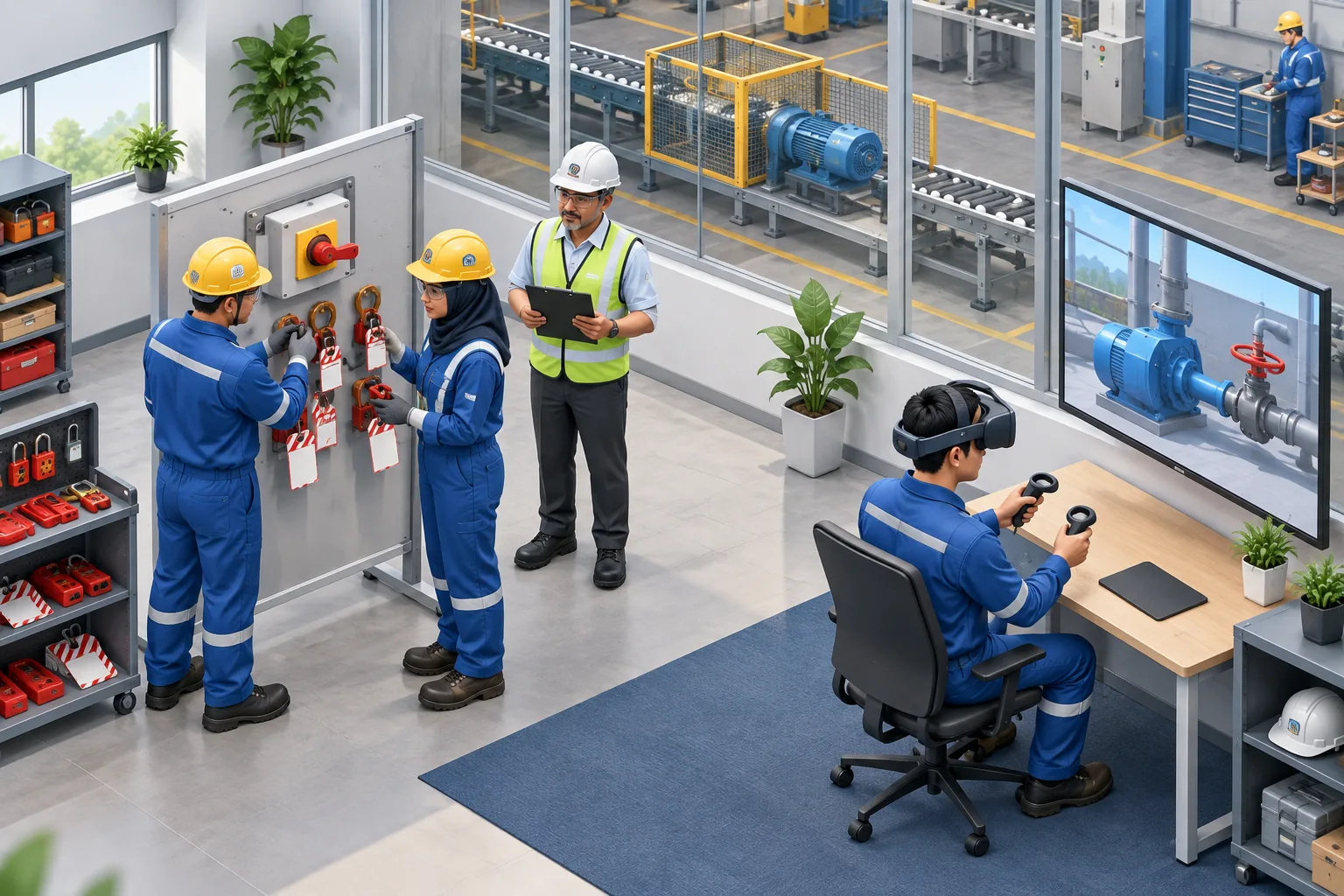
Immersive virtual reality (VR) is increasingly offered for safety training, including training in hazardous energy control through lockout/tagout (LOTO), and purchasing decisions often rest on vendor case reports rather than controlled research. This article critically appraises the evidence on one practical question: does immersive VR produce better learning and safety-relevant outcomes than conventional training, and how far do such findings apply to LOTO? Three key studies identified through web searches on 1 November 2026 were appraised: two experiments comparing immersive VR with PowerPoint training, a three-arm experiment comparing immersive VR, desktop VR and a printed manual for laboratory safety, and a meta-analysis of 52 VR safety training studies. Meta-analyses of training methods and Indonesian studies on LOTO practice provided context. No peer-reviewed controlled trial of VR training specific to LOTO was found. VR did not consistently improve immediate knowledge compared with conventional media, while advantages appeared in transfer tasks, enjoyment and pooled knowledge outcomes. Samples were small, participants were mostly students or apprentices, follow-up was short, and behaviour at work was not measured. The author concludes that VR is a reasonable component of LOTO training when it adds practice of steps that cannot safely be rehearsed on live equipment, but its effect on field practice remains unproven and should be verified locally.
Keywords: lockout/tagout, virtual reality, safety training, hazardous energy control, critical appraisal
Introduction
Research on occupational safety training has indicated for two decades that the way training is delivered matters. A meta-analysis of 95 studies found that, as methods moved from lectures, pamphlets and videos towards methods requiring active participation, knowledge acquisition increased and accidents, illnesses and injuries decreased (Burke et al., 2006). A later meta-analysis of 113 studies added that hands-on or simulation training was considerably more effective than lecture-based or web-based training when the severity of the hazardous event or exposure was high, but performed comparably when severity was low (Burke et al., 2011).
Uncontrolled release of hazardous energy during servicing and maintenance is a high-severity hazard in that sense. The United States Occupational Safety and Health Administration estimates that compliance with its lockout/tagout standard prevents about 120 fatalities and 50,000 injuries each year (Occupational Safety and Health Administration [OSHA], 2022). The standard requires each authorised employee to be trained in recognising the applicable energy sources, the type and magnitude of the energy, and the means of isolation and control, and requires retraining when a periodic inspection reveals deviations in an employee's knowledge or use of the procedures (OSHA, 1989). In Indonesia, Article 9 paragraph (3) of Law Number 1 of 1970 on Work Safety obliges management to provide guidance and training to all workers under its direction in accident prevention (Republik Indonesia, 1970).
Indonesian studies suggest that LOTO practice is often incomplete. Among mechanics in the plant department of a mining company, the application of LOTO was associated with behavioural factors (Hapsari & Ardyanto, 2014). An analysis of LOTO failure incidents at a power plant with the Systematic Cause Analysis Technique traced the failures to individual, job and management factors and proposed revising the LOTO procedure and the supervisors' job description (Dewi & Zebua, 2018).
Immersive VR is promoted as a way to make such training more engaging without exposing trainees to live energy, and an Indonesian systematic literature review concluded that several studies show VR to be among the most effective training methods currently available (Pribadi et al., 2023). The difficulty is that the underlying studies vary widely in design and outcomes, and evidence specific to LOTO is thin. This article aims to critically appraise three key empirical studies on immersive VR safety training and to assess how far their findings can guide the design and evaluation of LOTO training in Indonesian workplaces.
Methods
This is a critical appraisal of a small number of key studies, not a systematic review. All searches were carried out on 1 November 2026 with a general web search engine. Attempts to open full texts in university repositories and to query the Crossref service were blocked by the network used for this work, so information on each study was taken from abstracts, publisher and repository records, and search summaries; the full texts were not read. Bibliographic databases such as Scopus, Web of Science and PubMed were not queried directly.
Search terms included virtual reality lockout tagout training, VR LOTO effectiveness study, immersive virtual reality PowerPoint safety training, virtual reality safety training meta-analysis, penerapan LOTO and pelatihan K3 realitas virtual. Sources from 2006 to 2026 were considered.
Key studies had to be published in a peer-reviewed journal in 2016 or later, compare immersive VR with at least one conventional medium for safety content or synthesise such comparisons quantitatively, and report design, sample and outcomes in the accessible record. Vendor case studies and preprints were excluded. One university paper on VR training for LOTO maintenance was found, but its accessible record described only the study protocol and a preliminary evaluation. Each key study was examined for its design, participants, outcomes and timing, results, weaknesses and relevance to LOTO. The number of records screened was not recorded and is not reported.
Results and Discussion
Studies Appraised
Three studies met the criteria. The first reported two experiments comparing safety training in immersive VR with a PowerPoint presentation containing vivid film scenes, measuring risk perception, learning and risky choices (Leder et al., 2019). The second compared an immersive VR laboratory safety simulation, the same simulation on a desktop computer and a conventional safety manual, measuring enjoyment, motivation, self-efficacy, a retention test and two transfer tests in a physical laboratory (Makransky, Borre-Gude, et al., 2019). The third reviewed 52 articles published between 2013 and 2021 on VR safety training outside medicine and the military and reported two meta-analyses (Scorgie et al., 2024). None concerns LOTO; this absence is itself a finding of the search.

Design and Samples
The first Leder experiment involved 53 apprentices; the second involved 68 participants, attempted a replication and assessed effects after six months (Leder et al., 2019). The Makransky experiment involved 105 first-year engineering students in three conditions (Makransky, Borre-Gude, et al., 2019). By the author's calculation, this gives on average about 26 to 35 participants per condition, which is small for detecting moderate differences. In the meta-analysis, only 9.6 percent of included studies explicitly used a theory to develop their VR applications and only 36 percent reported long-term retention (Scorgie et al., 2024). The pooled effect sizes were not available in the records consulted.
Main Results
On knowledge, the experiments and the meta-analysis diverge. In the first Leder experiment, the medium affected change in risk perception and risky decisions but not learning, and these effects did not replicate in the second experiment (Leder et al., 2019). The authors concluded that the cost of immersive VR did not appear justified because the cheaper PowerPoint training with vivid film scenes did not perform significantly worse (Leder et al., 2019).
In the Makransky experiment, the groups did not differ on the immediate retention test. The immersive VR group outperformed the text group on both transfer tests in a physical laboratory, d = 0.54 and d = 0.57, and on enjoyment, d = 1.44, whereas the desktop group outperformed the text group on one transfer test, d = 0.63, but not the other, d = 0.11 (Makransky, Borre-Gude, et al., 2019).
The meta-analysis concluded that VR safety training outperforms traditional training in knowledge acquisition and retention (Scorgie et al., 2024). Against this, an experiment by Makransky and Mayer with another co-author, using a science laboratory simulation rather than safety content, found that immersive VR increased presence, d = 1.30, but produced less learning, d = 0.80, and higher cognitive load, d = 0.59, than the desktop version among 52 students (Makransky, Terkildsen, et al., 2019).
In the author's interpretation, these results are reconcilable. Immersion alone does not reliably add knowledge and can add cognitive load. Advantages appear when knowledge must be applied to a practical task, which fits the earlier finding that the benefit of engaging training depends on active practice and hazard severity (Burke et al., 2011). The pooled advantage may partly reflect comparisons in which VR also added practice that the control condition lacked, but the records consulted do not allow this to be tested.
Methodological Weaknesses
Four weaknesses limit generalisation. Participants were students or apprentices, not experienced maintenance technicians whose existing habits are part of the LOTO problem (Hapsari & Ardyanto, 2014). Outcomes were measured soon after training, and only the second Leder experiment followed participants for six months (Leder et al., 2019). Comparison conditions differed: vivid film scenes in one study and a printed manual in the other, so conventional training does not mean the same thing across studies. Finally, none of the studies measured observed behaviour at work or injuries, the outcomes that matter most for hazardous energy. The meta-analysis inherits these weaknesses, and the records consulted do not show whether publication bias was assessed.
Relevance to LOTO
The OSHA standard defines what LOTO training must achieve: recognition of energy sources, understanding of energy type and magnitude, and knowledge of isolation methods (OSHA, 1989). The closest analogue in the appraised evidence is the transfer test in which trainees applied safety procedures to problems in a real laboratory (Makransky, Borre-Gude, et al., 2019). This cautiously supports using simulation to rehearse a sequence of steps in context, which in LOTO means identifying every energy source, isolating, applying locks and tags, releasing stored energy and verifying isolation before work begins (OSHA, 1989). In the author's view, this is where simulation offers something a classroom cannot, because these steps cannot be practised with real errors on live equipment.
Two findings set limits. VR did not consistently outperform well-designed conventional training on knowledge, so a VR module will not correct a weak curriculum (Leder et al., 2019). The Indonesian studies traced LOTO failures to procedures, supervisory roles and behaviour, not only to individual knowledge (Dewi & Zebua, 2018), and a training medium does not change those conditions. Equipment design also matters: ISO 14118:2017 specifies designed-in means of isolation, locking and energy dissipation to prevent unexpected start-up, which determine how easy correct isolation is in practice (International Organization for Standardization [ISO], 2017).
Limitations
The full texts of the appraised studies were not read, so randomisation, attrition and statistical analysis could not be checked. The three key studies were selected purposively and no formal risk-of-bias tool was applied. The search used a general web search engine with English and Indonesian terms only, so a controlled trial of VR for LOTO may exist in databases that were not searched. The Indonesian LOTO studies are single-site, and one is more than ten years old. The findings concern immersive VR and may apply differently to desktop 3D simulations or to programmes that combine simulation with hands-on practice.
Conclusions and Recommendations
The appraised evidence does not show that immersive VR consistently produces better safety knowledge than well-designed conventional training, although it shows advantages in applying procedures to practical problems and in motivation. No peer-reviewed controlled trial specific to LOTO was found, so the findings guide LOTO training only by analogy, and the effect of any VR programme on field practice remains to be demonstrated.
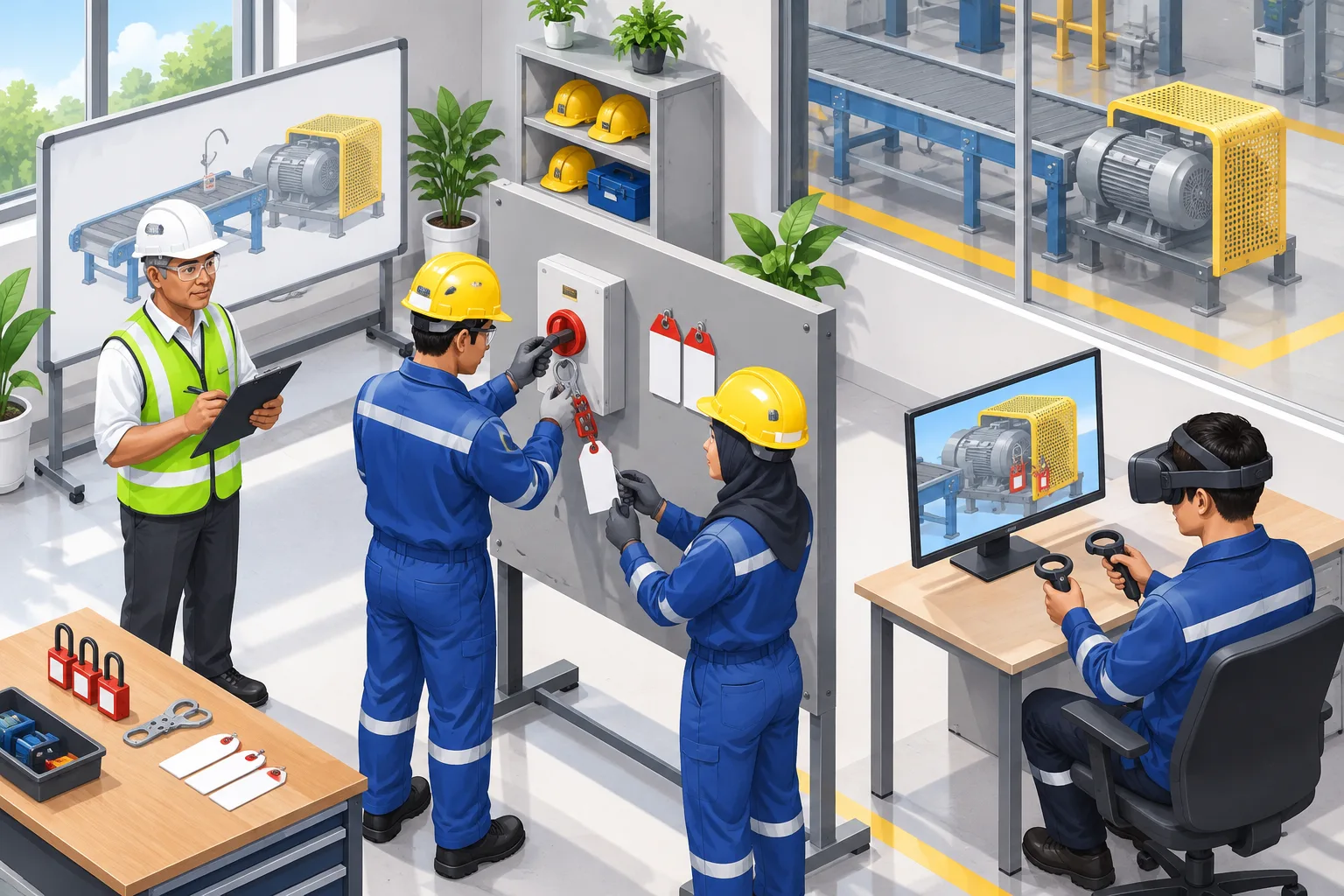
For organisations planning LOTO training, the author suggests the following:
- Write learning objectives against the required elements, namely energy source recognition, energy type and magnitude, isolation, release of stored energy and verification, before choosing a medium.
- Use simulation for sequences and decisions that cannot be practised safely on live equipment, and keep hands-on practice with physical locks, tags and verification.
- Evaluate training through transfer tasks and field observation of real isolations, and use periodic inspection findings to trigger retraining, rather than relying on satisfaction scores or vendor reports.
- Address procedures, supervisory roles and equipment design alongside training.
Further research should compare simulation combined with hands-on practice against hands-on practice alone among Indonesian maintenance workers, measure observed LOTO compliance over at least six months, and report effect sizes, costs and the learning theory behind the simulation.
Nusa Safety develops a first-person 3D LOTO Simulator and other digital safety simulators. This appraisal is not an evaluation of those products, and on the evidence above their effect, like that of any simulation, should be measured in the user's own workplace.
This article is general information and not legal or professional advice for any specific case.
References
- Burke, M. J., Salvador, R. O., Smith-Crowe, K., Chan-Serafin, S., Smith, A., & Sonesh, S. (2011). The dread factor: How hazards and safety training influence learning and performance. Journal of Applied Psychology, 96(1), 46-70. https://doi.org/10.1037/a0021838
- Burke, M. J., Sarpy, S. A., Smith-Crowe, K., Chan-Serafin, S., Salvador, R. O., & Islam, G. (2006). Relative effectiveness of worker safety and health training methods. American Journal of Public Health, 96(2), 315-324. https://doi.org/10.2105/AJPH.2004.059840
- Dewi, L. T., & Zebua, E. S. (2018). Investigation of lockout/tagout procedure failure in machine maintenance process. Jurnal Teknik Industri, 20(2), 135-140. https://doi.org/10.9744/jti.20.2.135-140
- Hapsari, A., & Ardyanto, Y. D. (2014). Analisis faktor yang berhubungan dengan penerapan lock out tag out (LOTO) pada mekanik di plant department. The Indonesian Journal of Occupational Safety and Health, 3(1), 1-13.
- International Organization for Standardization. (2017). ISO 14118:2017 Safety of machinery: Prevention of unexpected start-up. ISO.
- Leder, J., Horlitz, T., Puschmann, P., Wittstock, V., & Schütz, A. (2019). Comparing immersive virtual reality and PowerPoint as methods for delivering safety training. Safety Science, 111, 271-286. https://doi.org/10.1016/j.ssci.2018.07.021
- Makransky, G., Borre-Gude, S., & Mayer, R. E. (2019). Motivational and cognitive benefits of training in immersive virtual reality based on multiple assessments. Journal of Computer Assisted Learning, 35(6), 691-707. https://doi.org/10.1111/jcal.12375
- Makransky, G., Terkildsen, T. S., & Mayer, R. E. (2019). Adding immersive virtual reality to a science lab simulation causes more presence but less learning. Learning and Instruction, 60, 225-236. https://doi.org/10.1016/j.learninstruc.2017.12.007
- Occupational Safety and Health Administration. (1989). The control of hazardous energy (lockout/tagout), 29 C.F.R. § 1910.147 (as amended). https://www.osha.gov/laws-regs/regulations/standardnumber/1910/1910.147
- Occupational Safety and Health Administration. (2022). Lockout/tagout (Fact sheet OSHA FS-3529). https://www.osha.gov/sites/default/files/publications/OSHAFS3529.pdf
- Pribadi, A. P., Jaladara, V., Silalahi, C. D. A. B., & Rizqi, Y. M. (2023). Application of digital simulation for training purposes through virtual reality in the workplace. The Indonesian Journal of Occupational Safety and Health, 12(3), 457-464. https://e-journal.unair.ac.id/IJOSH/article/view/43682
- Republik Indonesia. (1970). Undang-Undang Nomor 1 Tahun 1970 tentang Keselamatan Kerja. Lembaran Negara Republik Indonesia Tahun 1970 Nomor 1.
- Scorgie, D., Feng, Z., Paes, D., Parisi, F., Yiu, T. W., & Lovreglio, R. (2024). Virtual reality for safety training: A systematic literature review and meta-analysis. Safety Science, 171, 106372. https://doi.org/10.1016/j.ssci.2023.106372