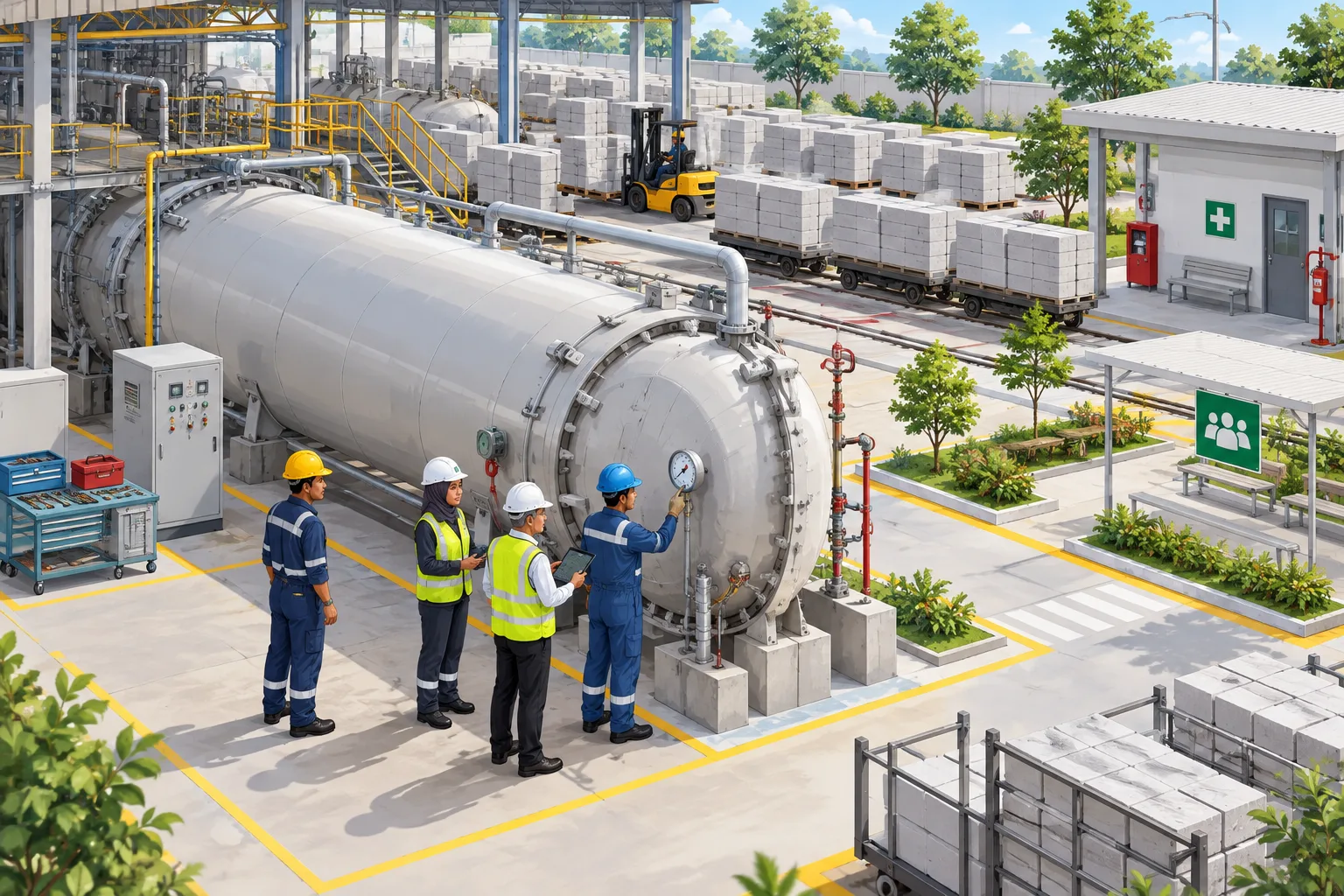
Picture yourself as the night shift team leader at a lightweight concrete block plant on the north coast of East Java, just after midnight. Grey slurry is rising slowly in its moulds, a thin plume of steam escapes from a pipe joint near the autoclave, and a few operators walk between the trolleys, fighting the drowsiness that always arrives at that hour. The night feels ordinary to you, because the same work has run hundreds of times without trouble.
In the early hours of Thursday, 17 September 2026, at around 00.30 local time, a night like that came to a stop at a block plant in Warukulon village, Pucuk district, Lamongan regency. An explosion followed by fire struck the production area of PT Superior Prima Sukses, maker of the Blesscon brand of lightweight blocks, while the night shift was at work. Seven workers were caught up in it, and national media reported that five of them died over the following days.
We offer our condolences to the families of those workers, and to the colleagues who must walk back onto the same factory floor. This article does not guess at the cause of the explosion, since the official investigation is still running, and it does not look for someone to blame. The question it asks sits closer to your own desk, namely what other organisations can check, starting this week.
What Was Reported
Early reports from Lamongan police, carried by detikJatim and iNews, said one worker died at the scene and six others suffered burns. Tirto and TIMES Indonesia reported that a vessel on a piece of production equipment exploded in an area described as the settling room, and that flames and heat then spread around it. Several outlets reported that some of the injured were later referred to hospitals in Surabaya.
On 18 September, Lamongan police said the death toll had risen to four, with three workers still in treatment, as reported by ANTARA and Kompas.com. Five days later, Kompas.com reported that the toll had risen again, to five of the seven night shift workers who were affected. Some local outlets published different figures along the way, so this article uses the police numbers quoted by national media.
The head of the Lamongan police criminal investigation unit, AKP Adimas Firmansyah, said the cause of the explosion could not yet be determined, as quoted by Kompas.com. Police examined the scene, brought in the East Java police forensic laboratory, and had questioned 16 witnesses, according to ANTARA. About ten days after the event, Duta.co reported that police had not yet named any suspect.
Labour inspectors from the East Java manpower office, Disnakertrans Jatim, also examined the occupational safety side of the case. Speaking to TIMES Indonesia, inspector Nurainiyah Silvia Indriani said her office could not yet say whether procedures had been breached or technical negligence had occurred before the examination was complete. The head of the Lamongan manpower office, M. Zamroni, said an initial check had found that the company had standard operating procedures in place, according to the same outlet.
The company's HR manager said the company was supporting victims and their families and leaving the investigation to the police, as reported by beritajatim.com. BPJS Ketenagakerjaan, the national workers' social security agency, paid benefits together with the company, because every victim was a registered participant. At the time of writing, six weeks after the event, we had found no official announcement of final findings from either the police or Disnakertrans Jatim.
What the Rules Say
Law No. 1 of 1970 on Work Safety places the duty for safety on the pengurus, the person who runs the workplace, including the duty to report accidents. Government Regulation 50 of 2012 makes SMK3, Indonesia's national safety management system, mandatory for companies with at least 100 workers or with a high hazard potential. Manpower Minister Regulation 37 of 2016 covers pressure vessels and storage tanks, including periodic examination and testing known as riksa uji, and the competence of operators. Ministerial Decree KEP.187/MEN/1999 sets out how hazardous chemicals must be controlled at work.
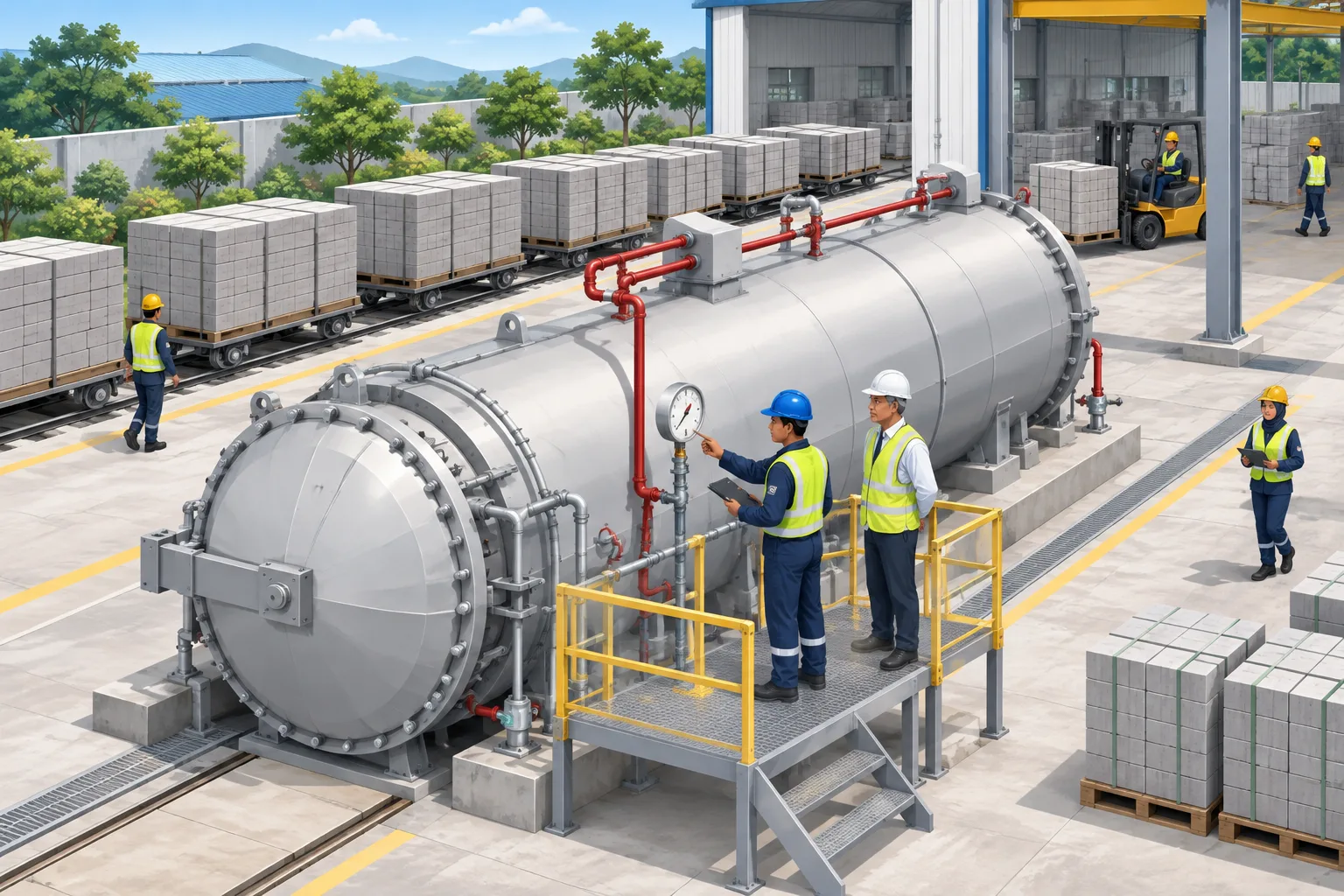
An AAC plant, short for autoclaved aerated concrete, touches nearly every one of those rules at once. Narayanan and Ramamurthy (2000) explain that a slurry of sand, cement and lime is dosed with aluminium powder, which reacts and releases hydrogen gas so the mix rises and becomes porous. Once the blocks are firm enough, they are cured in an autoclave, a long vessel filled with high pressure steam for many hours.
This article does not link the process to the cause in Lamongan, and simply notes that one AAC floor holds several kinds of hazardous energy, each needing its own controls.
A Systems Lens
Reason (1997) described latent conditions as holes in an organisation's defences, created by design, maintenance and scheduling decisions made long before an event. Leveson (2011) treats accidents as a control problem, where safety constraints are no longer enforced by the layers of control above the work, such as supervisors, management and regulators. Both views push investigators to ask about the system, instead of stopping at the last action of one operator.
A police investigation and a learning investigation work like an insurance assessor and a mechanic looking at the same car after a crash. The assessor wants to know who pays for the damage, while the mechanic wants to know which bolt needs replacing so that the next car does not end up the same way. Your organisation can start working like the mechanic without waiting for the assessor's verdict in Lamongan.
People in Harm's Way
The facts reported so far show that seven workers were within reach of one release of energy at the same moment. The U.S. Chemical Safety and Hazard Investigation Board, or CSB (2007), found that the 15 workers killed at the BP Texas City refinery in 2005 were in or near temporary office trailers placed close to a process unit. Since then, asking how many people truly need to be in a hazardous zone, and at what hours, has become a standard part of facility siting reviews.
Paper and Real Work
The initial finding by the Lamongan manpower office that procedures existed answers one important question, which is that the documents were there. Systems investigators usually go on to ask other things, such as whether a procedure covers abnormal conditions, who checks the pressure equipment, and how changes in materials or machine settings are managed. The answers for Lamongan belong to the official investigators, while you can put the same questions to your own team tonight.
The Quiet Hours
The explosion happened at around half past midnight, when the number of people on site and in support offices is usually at its lowest. For burn injuries, the first minutes at the scene and during transport to hospital matter a great deal for the chances of recovery. WHO (2023) stresses first aid for burns that starts with cooling the wound under cool running water, followed by medical care as quickly as possible.
Back on Shift
Back to you, the team leader who was walking between the trolleys at midnight. None of the steps below needs to wait for the forensic results from Lamongan, and most can begin with a short meeting and one walk around the plant.
- Map every source of hazardous energy on the production floor, including pressurised steam, heat and reactive materials, and write its controls beside each one.
- Check that every pressure vessel, including autoclaves and their supporting tanks, holds a current riksa uji certificate issued by an authorised party.
- Count how many workers stand near hazardous equipment on each shift, and move any task that does not need to be done inside that zone.
- Store and handle reactive materials as their safety data sheets require, with proper containers, ventilation and clear separation from ignition sources.
- Test your procedures against abnormal conditions, such as a jammed machine, rising pressure or a change of raw material, because that is where procedures often go silent.
- Train the night shift in burn first aid and evacuation, including a referral route to a hospital that is able to treat serious burns.
- Share lessons from incidents elsewhere in the industry at a toolbox meeting, the short briefing before work, without naming victims and without hunting for scapegoats.
Drupsteen and Guldenmund (2014) warn that organisations often stop at the report and the action list, while learning only happens once the way work is done actually changes. The test is simple enough, so ask what is different on your production floor a month after reading about Lamongan.
Where We Can Help
A HAZID study helps a team map energy sources and hazard scenarios along a production line, and a HAZOP and LOPA study tests the protective layers around pressurised parts of the process. A Process Safety Management Review looks at how asset integrity, management of change and procedures connect on the ground. For pressure equipment, statutory inspection (riksa uji) and boiler and pressure vessel operator training are delivered together with licensed PJK3 partners.
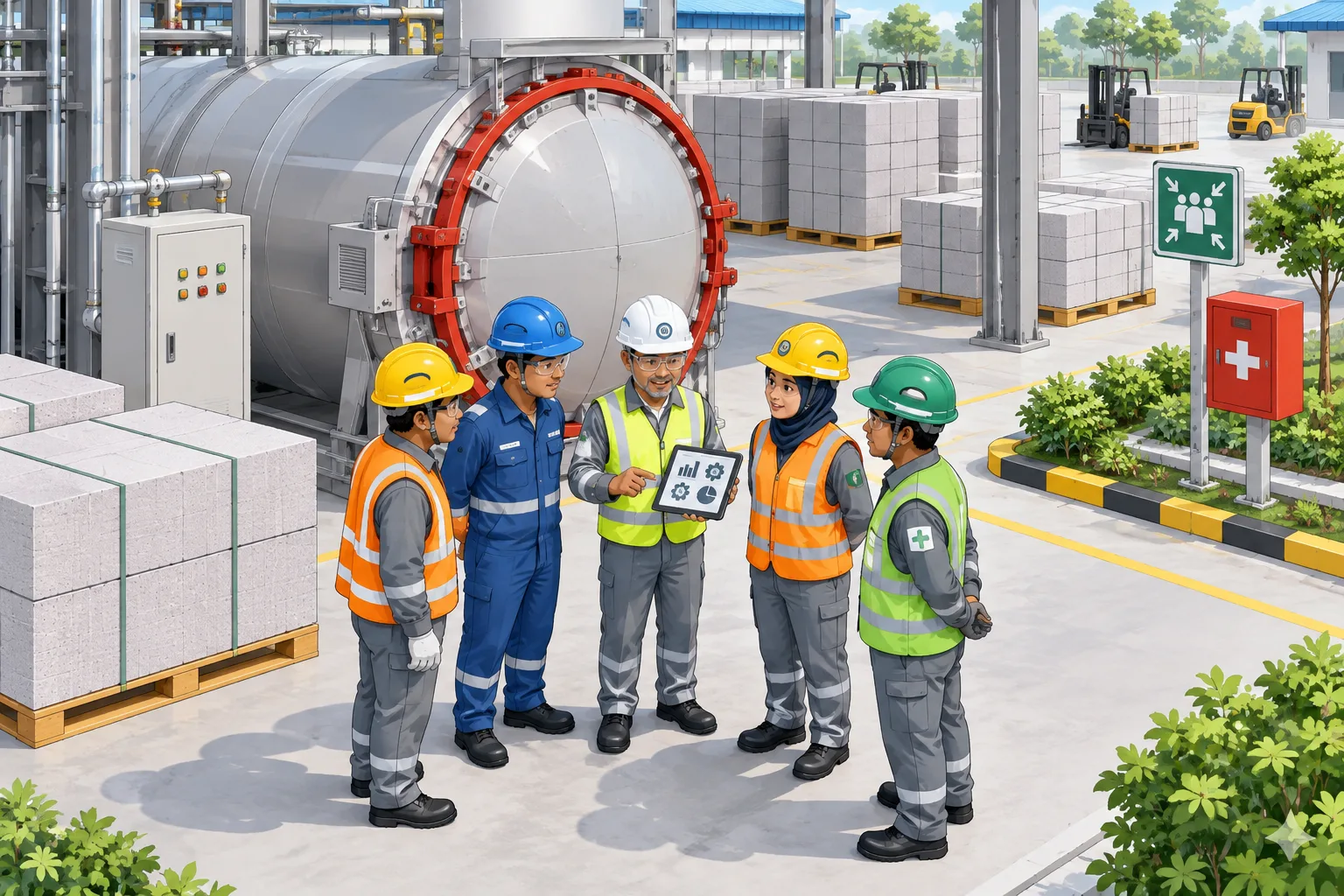
Emergency Preparedness and Drills and First Aider Certification (P3K) prepare a night shift crew for the first minutes after an event. Training in Incident Investigation and RCA equips teams to investigate with a systems view, instead of stopping at individual error.
APEX Risk brings HAZID, HAZOP and the corrective action register into one place, while PSM Simulator lets operators practise their response to abnormal process conditions. Hazard Report collects hazard reports from workers by phone, including from night shift crews who rarely meet management in person. Nusa Safety does not issue certificates and does not hold a PJK3 licence, so all certified programmes run together with licensed PJK3 partners, and you are welcome to contact us to discuss the needs of a specific plant.
Before the Dawn
The investigation in Lamongan is still under way, and the public does not yet know what set off the explosion in that settling room. Five families have lost someone they love, and the official answer, when it comes, will matter to them and to the whole lightweight block industry.
At your own plant, the next night shift will begin in a few hours with the same slurry, the same steam and the same trolleys. Before dawn, you can stand in front of the autoclave with your crew, count who really needs to be there, and ask what each of them would do the moment the pressure starts to climb.
This article is general information and does not constitute legal advice, so please consult a qualified lawyer on how specific regulations apply to your organisation.
References
- ANTARA Jawa Timur. (2026, September). Polres Lamongan sebut korban tewas kebakaran pabrik jadi empat orang. ANTARA News. https://jatim.antaranews.com/berita/1099848/polres-lamongan-sebut-korban-tewas-kebakaran-pabrik-jadi-empat-orang
- ANTARA Jawa Timur. (2026, September). Polisi periksa 16 saksi terkait ledakan pabrik bata ringan Lamongan. ANTARA News. https://jatim.antaranews.com/berita/1100912/polisi-periksa-16-saksi-terkait-ledakan-pabrik-bata-ringan-lamongan
- beritajatim.com. (2026, September). Korban jiwa ledakan pabrik Blesscon Lamongan kini jadi empat orang, ini langkah manajemen. https://beritajatim.com/korban-jiwa-ledakan-pabrik-blesscon-lamongan-kini-jadi-empat-orang-ini-langkah-manajemen
- beritajatim.com. (2026, September). BPJS Ketenagakerjaan dan perusahaan salurkan santunan korban ledakan pabrik Blesscon Lamongan. https://beritajatim.com/bpjs-ketenagakerjaan-dan-perusahaan-salurkan-santunan-korban-ledakan-pabrik-blesscon-lamongan
- detikJatim. (2026, September). Korban meninggal pabrik bata ringan di Lamongan jadi 4 orang. detik.com. https://www.detik.com/jatim/berita/d-8668208/korban-meninggal-pabrik-bata-ringan-di-lamongan-jadi-4-orang
- Drupsteen, L., & Guldenmund, F. W. (2014). What is learning? A review of the safety literature to define learning from incidents, accidents and disasters. Journal of Contingencies and Crisis Management, 22(2), 81-96.
- Duta.co. (2026, September). 10 hari ledakan maut pabrik Blesscon Lamongan, polisi belum tetapkan tersangka. https://duta.co/10-hari-ledakan-maut-pabrik-blesscon-lamongan-polisi-belum-tetapkan-tersangka
- iNews Jatim. (2026, September). Ledakan pabrik bata ringan di Lamongan, 1 pekerja tewas dan 6 luka bakar. iNews.id. https://jatim.inews.id/amp/berita/ledakan-pabrik-bata-ringan-di-lamongan-1-pekerja-tewas-dan-6-luka-bakar
- Keputusan Menteri Tenaga Kerja Nomor KEP.187/MEN/1999 tentang Pengendalian Bahan Kimia Berbahaya di Tempat Kerja.
- Kompas.com. (2026, 18 September). Selidiki ledakan pabrik bata ringan Lamongan yang tewaskan 4 pekerja, polisi libatkan Bidlabfor. https://surabaya.kompas.com/read/2026/09/18/172307178/selidiki-ledakan-pabrik-bata-ringan-lamongan-yang-tewaskan-4-pekerja-polisi
- Kompas.com. (2026, 23 September). Korban tewas ledakan pabrik bata ringan di Lamongan bertambah jadi 5 orang, 16 saksi diperiksa. https://surabaya.kompas.com/read/2026/09/23/061354478/korban-tewas-ledakan-pabrik-bata-ringan-di-lamongan-bertambah-jadi-5-orang
- Leveson, N. G. (2011). Engineering a safer world: Systems thinking applied to safety. MIT Press.
- Narayanan, N., & Ramamurthy, K. (2000). Structure and properties of aerated concrete: A review. Cement and Concrete Composites, 22(5), 321-329.
- Peraturan Menteri Ketenagakerjaan Nomor 37 Tahun 2016 tentang Keselamatan dan Kesehatan Kerja Bejana Tekanan dan Tangki Timbun.
- Peraturan Pemerintah Nomor 50 Tahun 2012 tentang Penerapan Sistem Manajemen Keselamatan dan Kesehatan Kerja.
- Reason, J. (1997). Managing the risks of organizational accidents. Ashgate.
- TIMES Indonesia. (2026, September). Tragedi pabrik Blesscon Lamongan: Menguak misteri ledakan perenggut 4 nyawa. https://timesindonesia.co.id/peristiwa-daerah/609242/tragedi-pabrik-blesscon-lamongan-menguak-misteri-ledakan-perenggut-4-nyawa
- Tirto.id. (2026, September). Kronologi ledakan di pabrik Blesscon Lamongan: 4 orang tewas. https://tirto.id/kronologi-ledakan-di-pabrik-blesscon-lamongan-4-orang-tewas-hC2Y
- U.S. Chemical Safety and Hazard Investigation Board. (2007). Investigation report: Refinery explosion and fire, BP Texas City, Texas, March 23, 2005 (Report No. 2005-04-I-TX). https://www.csb.gov/bp-america-refinery-explosion/
- Undang-Undang Nomor 1 Tahun 1970 tentang Keselamatan Kerja.
- World Health Organization. (2023). Burns [Fact sheet]. https://www.who.int/news-room/fact-sheets/detail/burns