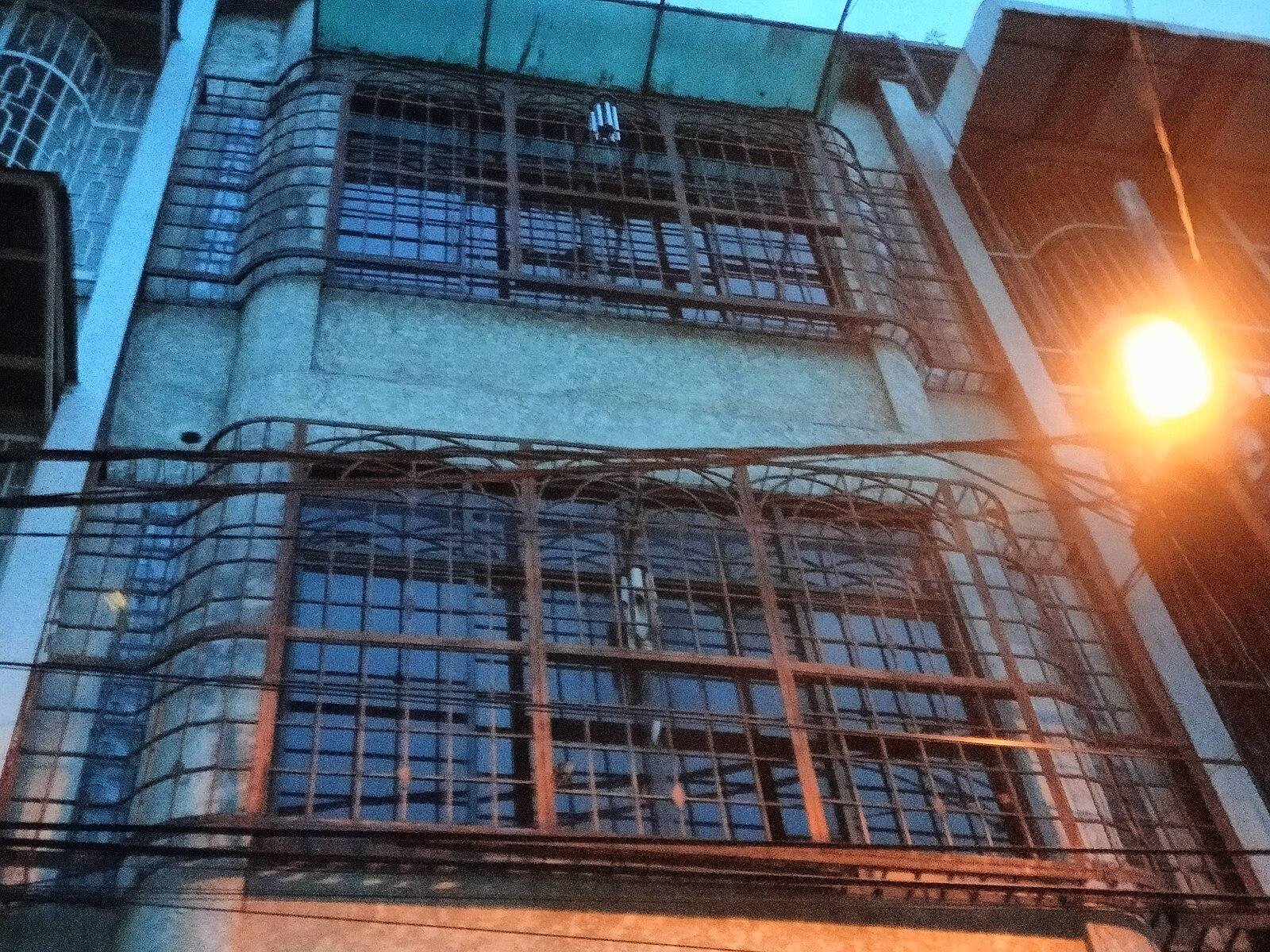
On the morning of Monday 9 February 2026, a worker painting the outside wall of a shophouse in Notosuman, Solo, fell from the third floor. According to the police's initial account, his paint roller pole, about 3.5 m long, is suspected of touching a power line near the building, after which he was shocked and lost his balance (detikJateng, 2026). On Wednesday 29 July 2026, two similar events were reported on the same day. In Blitar, a worker plastering a second-floor wall of a house under construction died; police initially suspected he touched a power cable above the building (Radio Republik Indonesia [RRI], 2026). In Musi Rawas, South Sumatra, a worker fixing a steel roof frame on a roadside building was reported in critical condition after a suspected shock from a power cable near the building (detikSumbagsel, 2026).
No official investigation reports on these events are available, and the reports do not state the voltage class of the lines, so the press term "high voltage" may not match the technical class (SUTT). We therefore treat every cause here as a hypothesis. The pattern is clear enough: non-electrical workers at height near overhead lines, often holding something long. This article analyses the clearance rules, their gaps and how workplaces can close them.
A Recurring Pattern
The 2026 events are not isolated. At about 03.30 WIB on 23 April 2025, three internet provider workers died while erecting a wifi pole in Cibinong, Bogor. The local PLN unit said the provider had not coordinated with it and then secured the pole, which stood close to a medium-voltage overhead line (SUTM) (Metro TV News, 2025). On 19 November 2025, a billboard installer in Tegal died, and police stated that the cause was electric shock (detikJateng, 2025).
Data from abroad show the same pattern. An analysis of 1,019 electrical deaths among US construction workers from 1992 to 1998 found that, among non-electrical workers, contact with overhead power lines was the main cause of death (McCann et al., 2003). Brenner and Cawley (2015) examined 552 overhead power line deaths recorded by OSHA from 2000 to 2011; 68% involved incidental contact during work not usually associated with the lines. The most common path was a tool or object being handled, such as hand tools, metal ladders, scaffolds and aluminium siding (34%), followed by direct contact with a conductor (28%). Painters, carpenters and roofers were among the ten occupations with the most deaths. The most frequent recorded voltages were 6 to 9.99 kV (36% of all cases) and 10 to 23 kV (19%), the distribution range (Brenner & Cawley, 2015). In Indonesia, PLN's primary distribution voltages are 20 kV, 12 kV and 6 kV, with 20 kV the one being expanded (Hariswanda & Anshory, 2024).
A review of 93 NIOSH and state fatality investigation reports on landscaping and tree care workers found electrocution from power lines to be the most frequent event (18.3%) (Kearney et al., 2024). In an Iranian burns centre, overhead cables were the most common cause of electrical injury, and construction workers the main group at risk (Salehi et al., 2022). A 2026 forensic case report from Brazil describes a 51-year-old painter who died while painting a commercial facade with an aluminium pole that was within 170 cm of a high-voltage line; the findings pointed to electrocution by an arc without direct contact (Cançado & Cristofoletti, 2026). Locally, an FMEA of PLN right-of-way maintenance rated shock while cutting trees near lines as high risk, citing insufficient safe distance, protective equipment and knowledge (Firdausy & Widada, 2025).
The Right-of-Way Rule
The current reference is Minister of Energy and Mineral Resources Regulation No. 13 of 2025 on the right-of-way of transmission lines and compensation for land, buildings and plants beneath it. Article 1 defines the right-of-way (ruang bebas) as the space around and along the conductors that no object may enter, for the safety of people and the security of operation, and defines a transmission line as an overhead line with a nominal voltage above 35 kV (Kementerian Energi dan Sumber Daya Mineral [Kementerian ESDM], 2025).
Three provisions matter here. First, Article 2(1) makes the right-of-way and minimum clearances binding not only on the network owner, but also on the holders of rights over land and buildings beneath the line and on members of the public active around the right-of-way. Second, Article 3(5) prohibits, among other things, buildings that enter the right-of-way, poking at or touching conductors, and other activities that may enter it. Third, Annex II sets the minimum vertical clearance from the conductor to the highest or nearest point of buildings and bridges at 4.5 m for 66 kV lines, 5.0 m for 150 kV, 7.0 m for 275 kV and 9.0 m for 500 kV (Kementerian ESDM, 2025).
For distribution lines, Article 2(5) states that overhead line types not covered by the regulation must meet right-of-way and minimum clearance requirements based on Indonesian National Standards (SNI), and the duty is placed on the network owner (Kementerian ESDM, 2025). On our reading, the medium-voltage (SUTM) and low-voltage (SUTR) lines that run past houses and shophouses fall outside its tables.
Duties at Work
Minister of Manpower Regulation No. 12 of 2015 on electrical occupational safety and health requires employers and managers to implement electrical OSH (Article 2), including to protect workers and other people in the workplace from electrical hazards (Article 3). It covers activities above 50 volts AC (Article 4(2)) and requires electrical standards, including SNI and international standards, to be followed (Article 5) (Kementerian Ketenagakerjaan [Kemnaker], 2015).
Minister of Public Works and Housing Regulation No. 10 of 2021 on construction safety management systems (SMKK) requires contractors to apply a construction safety analysis (AKK) to high and medium risk work and special work. Article 26(2) lists work at height above 1.80 m and work involving electrical voltage as special work, and Article 27 makes the AKK part of the requirements for a work permit (Kementerian Pekerjaan Umum dan Perumahan Rakyat [Kementerian PUPR], 2021).
For installation owners, Minister of Energy and Mineral Resources Regulation No. 10 of 2021 on electricity safety requires the person responsible for electricity safety to report accidents, dangerous occurrences, operating failures and disturbances affecting the public: a brief report within 4 hours, an update within 24 hours and a full report within 14 calendar days (Article 36) (Kementerian ESDM, 2021).
The OSHA Benchmark
Two US OSHA rules express clearance from the worker's and tool's point of view. For work near overhead lines, 29 CFR 1910.333 requires the lines to be de-energised and grounded, or other protective measures such as guarding, isolating or insulating to be provided, before work starts. An unqualified person working in an elevated position must be positioned so that neither the person nor the longest conductive object they may contact can come closer than 305 cm to a line of 50 kV or less to ground, plus 10 cm for every 10 kV above that. Objects without an insulating rating for the voltage involved are considered conductive (Occupational Safety and Health Administration [OSHA], 2025a).
For cranes in construction, 29 CFR 1926.1408 requires the employer to define the work zone and check whether the equipment, load line or load could come closer than 20 feet (about 6.1 m) to a power line. The Table A minimum clearance is 10 feet (3.05 m) up to 50 kV and 15 feet (4.6 m) over 50 to 200 kV. Measures include a planning meeting, non-conductive tag lines, a warning line and at least one further measure such as a dedicated spotter or proximity alarm. Where the Table A option is used, the utility must provide voltage information within two working days of a request (OSHA, 2025b). NFPA 70E applies similar logic through its limited approach boundary, which unqualified persons may cross only when escorted by a qualified person (National Fire Protection Association [NFPA], 2024).
Four Gaps We See
Read through approach boundaries and the hierarchy of controls (International Organization for Standardization [ISO], 2018), the rules leave four gaps.
The first concerns what is measured. Annex II measures from a conductor to a static building, but a worker on it adds reach: body, arms and tools. As an illustration, a 3.5 m pole like the one reported in Solo would use 3.5 m of the 4.5 m clearance for a 66 kV line, leaving 1.0 m before body height and arm swing. Under the OSHA logic, the tip of the pole must stay 3.05 m from a line of up to 50 kV, so a worker who can swing a 3.5 m pole in any direction would need to stand about 6.5 m from the conductor. This is our calculation, not an Indonesian requirement: building clearance is not working clearance.
The second concerns scope. Deaths concentrate at distribution voltages (Brenner & Cawley, 2015), while the figures in Regulation 13/2025 cover only lines above 35 kV. For distribution, the regulation points to SNI and places the duty on the network owner (Kementerian ESDM, 2025). We could not access that standard, so we quote no SUTM or SUTR figures here. In practice, a painter in front of a shophouse can hardly know the applicable figure without asking PLN.
The third concerns who must act. Article 2(1) names members of the public active around the right-of-way, but it does not say who must assess the distance before work begins (Kementerian ESDM, 2025). Regulation 12/2015 places electrical OSH duties on employers and managers (Kemnaker, 2015). Regulation 10/2021 on SMKK provides the AKK and work permit, but only for contractors in construction work (Kementerian PUPR, 2021). The reports do not say whether the work in Solo, Blitar or Musi Rawas was contracted with safety documents, so we cannot judge whether those rules applied. Nor did we find, in the regulations we read, an equivalent of the 1926.1408 duty on utilities to supply voltage information.
The fourth concerns data. Energy Ministry Regulation 10/2021 requires accidents and dangerous occurrences to be reported (Kementerian ESDM, 2021), but we found no public national summary. The Indonesian picture still depends on news reports, often single-sourced, so annual numbers cannot yet be counted.
Within those limits, three mechanisms deserve examination, and we treat none as the cause. The first is contact between a tool, object or body and a conductor, the two most common paths in the OSHA data (Brenner & Cawley, 2015). The second is an arc to a tool that approaches without touching, as in the Brazilian case (Cançado & Cristofoletti, 2026). The third is a fall caused by the shock, as initially suspected in Solo (detikJateng, 2026), so electrical and fall injuries must be prevented together.
Steps Before Going Up
The steps below follow the hierarchy of controls, starting with removing the hazard (ISO, 2018).
- Map first. Before facade, roof, signage or pole work, record every overhead line within reach of scaffolds, ladders and fully extended lifting equipment.
- Ask PLN to de-energise. An outage or rerouting removes the hazard, and 1910.333 requires de-energising and grounding, or other protective measures, arranged with the operator before work starts (OSHA, 2025a). Ask also for the line's voltage and safe distance.
- Cover the line. Where an outage is impossible, ask the operator to fit insulating covers or barriers (OSHA, 2025a).
- Set a no-approach zone. As a practical reference, we suggest at least 3.05 m between a line of up to 50 kV and the tip of the longest conductive object, as in 1910.333, not merely the worker's body (OSHA, 2025a). Mark it with tape or signs.
- Change the tools. Use non-conductive poles and ladders but keep the distance, since objects without an insulating rating are considered conductive (OSHA, 2025a).
- Use a permit and a spotter. Include work near overhead lines in the AKK and work permit (Kementerian PUPR, 2021). For cranes and boom trucks, hold a planning meeting, use non-conductive tag lines and assign a dedicated spotter (OSHA, 2025b).
- Protect against falls. Because a shock can end in a fall, combine electrical controls with fall protection; work at height above 1.80 m is already classed as special work under SMKK (Kementerian PUPR, 2021).
- Train non-electrical workers. Construction research has long recommended basic electrical safety training for them (McCann et al., 2003).
A distance that is enough for a building is not necessarily enough for the people working on it. In our view, every overhead line should be treated as live until its operator says otherwise.
How Nusa Safety Helps
Nusa Safety helps companies, building managers and contractors plan for overhead line hazards. Through the risk assessment and JSA workshop, the Nusa Safety team trains supervisors to map tool reach and no-approach zones, while permit-to-work procedures for work near power lines can be written through technical guidelines and SOP development. For installations on company premises, an electrical system assessment reviews their condition for internal decisions.
Electrical safety programmes for experts and technicians and custom training modules for non-electrical workers are also available. Nusa Safety issues only internal training certificates, does not hold a PJK3 licence, and runs certified programmes and mandatory inspection and testing with licensed partners. De-energising and protecting the network remain matters for PLN as operator.
This article is general information and not legal or professional advice for any specific case.
References
- Brenner, B., & Cawley, J. C. (2015). Occupations most at-risk in fatal overhead power line incidents: Using OSHA data to get a better understanding. In 2015 IEEE IAS Electrical Safety Workshop (pp. 1-6). IEEE. https://doi.org/10.1109/ESW.2015.7094939
- Cançado, D. F. D., & Cristofoletti, M. (2026). The invisible current: Diagnosing a fatal near-contact electrocution by high-voltage electrical arc. The American Journal of Forensic Medicine and Pathology, 47(3), 303-306. https://doi.org/10.1097/PAF.0000000000001115
- detikJateng. (2025, November 19). Pekerja asal Brebes tewas tersengat listrik saat pasang baliho di Tegal [Worker from Brebes dies of electric shock while installing a billboard in Tegal]. detik.com. https://www.detik.com/jateng/berita/d-8218713/pekerja-asal-brebes-tewas-tersengat-listrik-saat-pasang-baliho-di-tegal
- detikJateng. (2026, February 9). Pekerja jatuh dari lantai 3 ruko di Notosuman Solo, diduga akibat tersetrum [Worker falls from the third floor of a shophouse in Notosuman, Solo, suspected electric shock]. detik.com. https://www.detik.com/jateng/berita/d-8347868/pekerja-jatuh-dari-lantai-3-ruko-di-notosuman-solo-diduga-akibat-tersetrum
- detikSumbagsel. (2026, July 29). Pekerja bangunan di Musi Rawas kritis usai kesetrum [Construction worker in Musi Rawas critical after electric shock]. detik.com. https://www.detik.com/sumbagsel/berita/d-8595654/pekerja-bangunan-di-musi-rawas-kritis-usai-kesetrum
- Firdausy, H. A., & Widada, D. (2025). Analisis risiko keselamatan pada pekerja layanan teknik ROW menggunakan HIRARC dan FMEA [Safety risk analysis of right-of-way technical service workers using HIRARC and FMEA]. JATRI: Jurnal Teknik Industri, 3(1), 46-58. https://e-journals2.unmul.ac.id/index.php/jatri/article/view/2585
- Hariswanda, Y., & Anshory, I. (2024). Pemeliharaan preventif sebagai kunci untuk distribusi listrik yang andal di Indonesia [Preventive maintenance as a key to reliable power distribution in Indonesia]. Procedia of Engineering and Life Science, 7, 658-664. https://pels.umsida.ac.id/index.php/PELS/article/view/1536
- International Organization for Standardization. (2018). ISO 45001:2018 Occupational health and safety management systems: Requirements with guidance for use. https://www.iso.org/standard/63787.html
- Kearney, G. D., Romano, N., & Doub, A. (2024). Fatal injuries among landscaping and tree care workers: Insights from NIOSH and state-based FACE reports. Journal of Safety Research, 91, 393-400. https://doi.org/10.1016/j.jsr.2024.10.005
- Kementerian Energi dan Sumber Daya Mineral. (2021). Peraturan Menteri Energi dan Sumber Daya Mineral Nomor 10 Tahun 2021 tentang Keselamatan Ketenagalistrikan [Minister of Energy and Mineral Resources Regulation No. 10 of 2021 on Electricity Safety]. Berita Negara Republik Indonesia Tahun 2021 Nomor 538. https://jdih.esdm.go.id/dokumen/view?id=2153
- Kementerian Energi dan Sumber Daya Mineral. (2025). Peraturan Menteri Energi dan Sumber Daya Mineral Nomor 13 Tahun 2025 tentang Ruang Bebas Jaringan Transmisi Tenaga Listrik dan Kompensasi atas Tanah, Bangunan, dan/atau Tanaman yang Berada di Bawah Ruang Bebas Jaringan Transmisi Tenaga Listrik [Minister of Energy and Mineral Resources Regulation No. 13 of 2025 on the right-of-way of electricity transmission lines and compensation for land, buildings and plants beneath it]. Berita Negara Republik Indonesia Tahun 2025 Nomor 295. https://jdih.esdm.go.id/dokumen/view?id=2575
- Kementerian Ketenagakerjaan. (2015). Peraturan Menteri Ketenagakerjaan Nomor 12 Tahun 2015 tentang Keselamatan dan Kesehatan Kerja Listrik di Tempat Kerja [Minister of Manpower Regulation No. 12 of 2015 on Electrical Occupational Safety and Health in the Workplace]. Berita Negara Republik Indonesia Tahun 2015 Nomor 540. https://pasal.id/peraturan/permen/permenaker-no-12-tahun-2015
- Kementerian Pekerjaan Umum dan Perumahan Rakyat. (2021). Peraturan Menteri Pekerjaan Umum dan Perumahan Rakyat Nomor 10 Tahun 2021 tentang Pedoman Sistem Manajemen Keselamatan Konstruksi [Minister of Public Works and Housing Regulation No. 10 of 2021 on Guidelines for Construction Safety Management Systems]. https://pasal.id/peraturan/permen/permen-pupr-no-10-tahun-2021
- McCann, M., Hunting, K. L., Murawski, J., Chowdhury, R., & Welch, L. (2003). Causes of electrical deaths and injuries among construction workers. American Journal of Industrial Medicine, 43(4), 398-406. https://doi.org/10.1002/ajim.10198
- Metro TV News. (2025, April 24). 3 pekerja provider wifi di Bogor tewas tersengat listrik [Three internet provider workers in Bogor killed by electric shock]. metrotvnews.com. https://www.metrotvnews.com/read/KdZCjW05-3-pekerja-provider-wifi-di-bogor-tewas-tersengat-listrik
- National Fire Protection Association. (2024). NFPA 70E: Standard for electrical safety in the workplace (2024 ed.). https://catalog.nfpa.org/NFPA-70E-Standard-for-Electrical-Safety-in-the-Workplace-P1197.aspx
- Occupational Safety and Health Administration. (2025a). 29 CFR 1910.333 Selection and use of work practices. Electronic Code of Federal Regulations. https://www.ecfr.gov/current/title-29/section-1910.333
- Occupational Safety and Health Administration. (2025b). 29 CFR 1926.1408 Power line safety (up to 350 kV), equipment operations. Electronic Code of Federal Regulations. https://www.ecfr.gov/current/title-29/section-1926.1408
- Radio Republik Indonesia. (2026, July 30). Pekerja bangunan tewas diduga tersengat listrik saat plester rumah di Kota Blitar [Construction worker dies of suspected electric shock while plastering a house in Blitar]. rri.co.id. https://rri.co.id/malang/regional/2610835/pekerja-bangunan-tewas-diduga-tersengat-listrik-saat-plester-rumah-di-kota-blitar
- Salehi, S. H., Sadat Azad, Y., Bagheri, T., Ghadimi, T., Rahbar, A., Ehyaei, P., & Momeni, M. (2022). Epidemiology of occupational electrical injuries. Journal of Burn Care & Research, 43(2), 399-402. https://doi.org/10.1093/jbcr/irab171