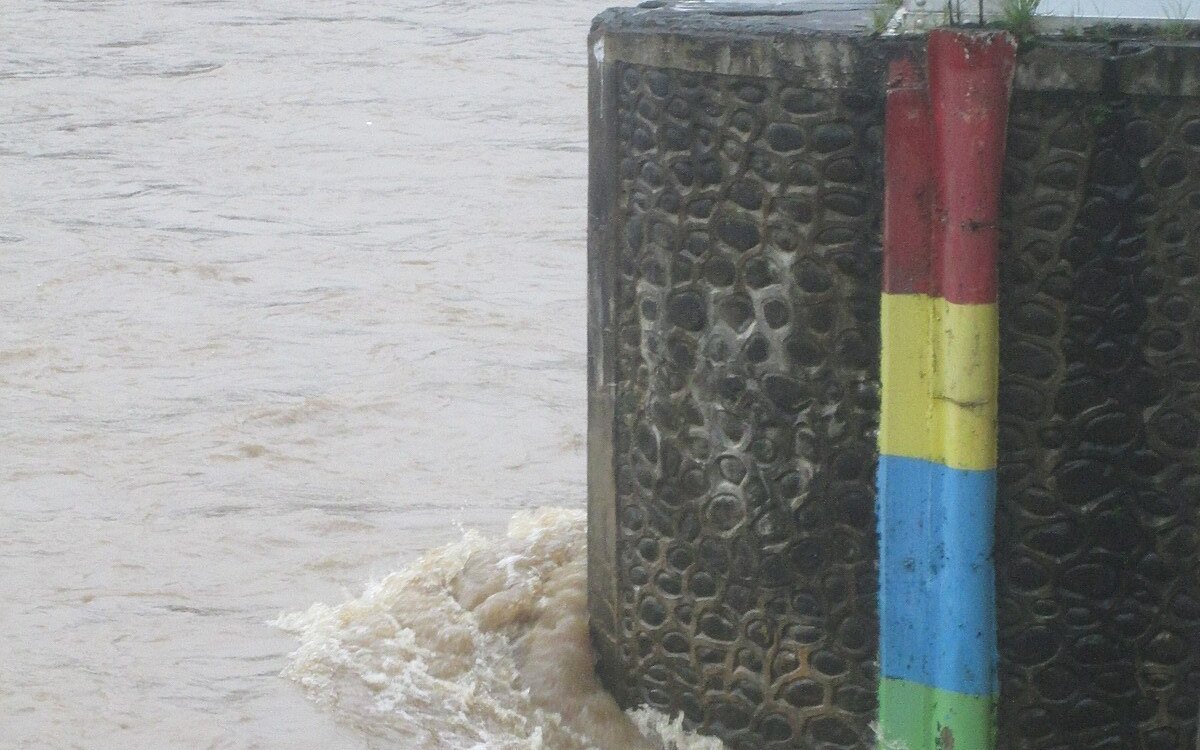
On 30 October 2026, the head of the National Disaster Management Agency (BNPB) signed Circular Letter No. 4 of 2026 on preparedness for the 2026/2027 rainy season, addressed to governors, regents and mayors. It asks them to map areas prone to hydrometeorological disasters, monitor weather information and early warnings from the Meteorology, Climatology and Geophysics Agency (BMKG), make sure warnings reach the public, and keep disaster command posts running 24 hours a day (Luxiana, 2026). On 9 November, BNPB reported floods in 12 regencies and cities between 24 October and 8 November. Five regencies, with 22 sub-districts and 11,404 households, still needed attention, and BNPB had mapped 3 sub-districts at Awas status and 74 at Siaga status in 6 provinces up to 11 November (Kementerian Sekretariat Negara [Kemensetneg], 2026).
The peak has not arrived yet. BMKG expects the rainy season to peak in December 2026 in 155 seasonal zones, or 36.94% of Indonesia's land area, in January 2027 in 162 zones (25.68%) and in February 2027 in 190 zones (16.79%) (Sandi, 2026).
The circular speaks to regional governments. A factory, warehouse or project site receives the same warnings but no instruction on what to do with them. This article sets out a method for that gap: a trigger action response plan (TARP) for floods, in which official warnings become pre-agreed levels tied to actions, owners and lead times.
What Warnings Already Say
BMKG's daily rainfall warnings use three levels. Waspada covers moderate to heavy rain that may cause pooling, river overflow and landslides that disrupt daily activity. Siaga covers heavy to very heavy rain, with possible floods, flash floods and landslides that significantly affect activity, public services and infrastructure. Awas covers very heavy to extreme rain, with impacts that may halt public services, badly damage infrastructure and endanger public safety (Nita, 2026).
These are impact-based warnings. The World Meteorological Organization (WMO) guidelines describe a shift from forecasting what the weather will be to what it will do (World Meteorological Organization [WMO], 2015). In practice, a warning level comes from an impact risk matrix that combines the likelihood of an event with the severity of its impact (Jenkins et al., 2022). Conventional warning systems predict the magnitude, location and timing of a hazard but rarely estimate damage or service disruption, which impact forecasts add for decision makers (Merz et al., 2020). In Greater Jakarta, a prototype combined a flood risk map weighted by the analytic hierarchy process with ensemble rainfall forecasts; rainfall carried the largest weight, about 25%, and the authors report that forecast flood potential matched observed events in their verification (Dhuha et al., 2024).
BNPB adds a second layer: alert status by sub-district (Kemensetneg, 2026).
How Levels Are Chosen
In a pre-registered online task run from November 2020 to January 2021, 89 BMKG forecasters and 7 disaster management stakeholders assigned warning levels, on a scale of one to four, to 43 heavy rainfall impacts taken from BMKG's impact table. Choices broadly matched the table, but the Indonesian sample tended to under-warn. For severe impacts, only 12% received the highest level as the median, and the closure of low-lying bridges, which the table rates as severe and therefore red, received a median yellow warning. The authors warn that under-warning can mean threats are not taken seriously enough, and recommend that warning thresholds be monitored regularly wherever impact-based warnings are used (Jenkins et al., 2022). The task was hypothetical, Indonesian stakeholder recruitment fell short of the planned minimum of 30, and the data were collected in 2020 and 2021, so the result does not show how warnings are issued today.
On the workplace side, Government Regulation No. 50 of 2012 on implementing occupational safety and health management systems (SMK3) requires employers, when carrying out their OSH plan, to address emergencies from accidents and industrial disasters, and emergency planning and recovery (Article 11(2) points g and h). Its audit criteria ask that potential emergencies inside and/or outside the workplace be identified and procedures documented (criterion 6.7.1), that procedures be tested and reviewed routinely (6.7.2), that workers and designated emergency officers be trained (6.7.3 and 6.7.4), and that recovery procedures for workers and damaged equipment be in place (6.9.1) (Pemerintah Republik Indonesia, 2012). Globally, the Sendai Framework puts preparedness for effective response among its four priorities, and its Target G calls for wider access to multi-hazard early warning systems (United Nations Office for Disaster Risk Reduction [UNDRR], 2015).
The Trigger Principle
On our reading, the regulation asks for emergency procedures but does not say how an external warning should move a workplace from normal operation to response. That link is what a TARP provides. A planning guideline from New South Wales, Australia, defines a TARP as a plan to stop a threat escalating or occurring by identifying precursors (triggers), assigning a hierarchy of alarms (trigger levels) to each, and specifying responses when a level is breached. TARPs should be tabulated, name the responsible role, be easy for operational staff to understand, and report every exceedance and the action taken (NSW Department of Planning and Environment, 2022). The tool comes from mining, but the structure suits floods.
Humanitarian work on forecast-based action explains how to choose triggers. Coughlan de Perez et al. (2015) argue that a warning becomes action only when three things are in place: a list of worthwhile actions, funds ready to pay for them, and a designated party with procedures that give it the mandate to act. Actions that cannot be finished within the lead time of a forecast are dropped, and high-regret actions should not be triggered by a small rise in likelihood. Each trigger produces hits, false alarms and misses, so organisations must decide in advance how often they are willing to act in vain (Coughlan de Perez et al., 2015). In a flood pilot in Uganda, the team first defined a danger level, then matched each action's implementation time to the lead time of the forecast that triggers it, and set an action lifetime so that an action is not re-triggered while it still protects. Disaster managers accepted acting in vain about half the time for the three selected actions, while evacuation was dropped because about a quarter of respondents were unwilling to evacuate in vain at all (Coughlan de Perez et al., 2016).
Read with the forecaster study, this matters. A site that waits for an Awas warning before acting relies on the level that, at least in that hypothetical task, was used most sparingly for severe impacts (Jenkins et al., 2022). We therefore see more value in tying cheap, reversible actions to Waspada and Siaga, and reserving costly actions for later, more certain triggers, including what the site itself observes.
Building the Plan
The method has six steps.
- Define the danger level for the site in impact terms, not rainfall. Examples are water at the lowest loading dock, an impassable access road or a flooded ground-floor electrical room. A business impact analysis under ISO 22301 helps here, because it identifies prioritised activities, their dependencies and how long disruption can be tolerated (International Organization for Standardization [ISO], 2019). Use the site's own flood history and the hazard maps that the circular asks regions to analyse and share (Luxiana, 2026).
- List candidate actions. For each, record how long it takes, what it costs, what acting in vain costs, and how long it protects (Coughlan de Perez et al., 2016).
- Match actions to triggers by lead time. Seasonal outlooks give months, BMKG impact-based warnings give days, and the site's rain gauge, a water level post upstream or water on the premises gives hours or minutes. An action whose implementation time exceeds the lead time of its trigger must move to an earlier trigger or be dropped (Coughlan de Perez et al., 2015).
- Assign each level a responsible role with authority to act without waiting for a meeting, consistent with the duty to designate and train emergency officers (Pemerintah Republik Indonesia, 2012).
- Set stand-down and recovery criteria: when a level is lowered, who checks the site before work resumes, and how workers and damaged equipment are restored (Pemerintah Republik Indonesia, 2012).
- Test, log and review. Drill the plan before the peak, record every trigger with its outcome as a hit, false alarm or miss, and adjust thresholds each season (Coughlan de Perez et al., 2015; NSW Department of Planning and Environment, 2022).
A Worked Illustration
The example below is hypothetical, for a warehouse in a flood-prone industrial area; levels and figures show the logic, not recommended thresholds.
- Level 0, seasonal, from now until the peak: clear drains, test pumps and the generator, move stock off the lowest racks and update contact lists. The action lifetime is the whole season.
- Level 1, Waspada for the regency, or Siaga forecast for the coming days: check fuel, stage flood barriers, brief shift supervisors and reschedule inbound deliveries. These actions are cheap and easily reversed.
- Level 2, Siaga or Awas for the sub-district on the day, or the site's rain gauge or upstream water level passing a threshold the company has set from its own records: raise high-value stock, move forklifts and chargers to higher ground, and release non-essential staff while roads are still open.
- Level 3, water entering the site, the access road cut or a BPBD evacuation order: stop operations, isolate ground-level circuits under procedure, evacuate to the assembly point and complete a headcount.
- Stand-down: re-enter only after inspection, and have electrical equipment checked before it is re-energised.
The cost of false alarms decides which level an action belongs to. Simplifying the inequality in Coughlan de Perez et al. (2015) by ignoring the extra cost of undoing an action, an action is worth triggering when the share of triggers followed by flooding at the site exceeds the ratio of the action's cost to the loss it prevents. In our illustration, raising stock costs Rp5 million in labour and prevents Rp200 million in damage, a ratio of 2.5%, so it is worthwhile even when only 1 trigger in 20 is followed by flooding. Shutting down a production line costs Rp150 million in lost output to protect Rp300 million in equipment, a ratio of 50%, so it needs a trigger that is followed by flooding at least half the time, typically a local observation. Decisions about people's safety, such as evacuation when water rises, should not be traded off this way; the authors note that not all consequences can be expressed in money (Coughlan de Perez et al., 2015).
Where It Falls Short
We found no peer-reviewed evaluation of flood TARPs at Indonesian workplaces. The forecast-based action studies come from humanitarian pilots, not factories (Coughlan de Perez et al., 2015, 2016). Warnings are issued by area, so the step down to a single site depends on the company's own observations, and thresholds built on a short local record are uncertain. Frequent false alarms also risk a cry-wolf effect, which is why outcomes must be logged (Coughlan de Perez et al., 2015). Finally, our link between a TARP and the SMK3 criteria is an interpretation, not wording found in the regulation.
Before the Peak
Three misconceptions are common. The first is that an evacuation plan is enough, when evacuation is only the last level and most avoidable loss is prevented before it. The second is waiting for Awas, which may come late for some severe impacts. The third is dismissing a regency-level warning as irrelevant to one site, when it is a reason to watch the site's own measurements more closely.
With the peak expected in December in the largest share of seasonal zones (Sandi, 2026), the coming weeks are the time to agree the site danger level, draft the trigger table with owners, connect the responsible roles to BMKG and BPBD channels, and run a tabletop exercise and a drill. A good test is whether each person on the roster can say what they do at each level without opening the document.
How Nusa Safety Helps
Nusa Safety helps factories, warehouses and project sites turn emergency plans into procedures that people can run under pressure. Through emergency preparedness and drills, the Nusa Safety team designs flood scenarios, tabletop exercises and drills with structured evaluation, while a fire and emergency safety audit (FESA) reviews the emergency response plan, organisation and evacuation as a whole. Trigger levels, roles and stand-down criteria can be written into a working procedure through technical guidelines and SOP development, and supervisors can map site-specific flood hazards in a risk assessment and JSA workshop.
Nusa Safety issues only internal training certificates, does not hold a PJK3 licence, and runs certified programmes with licensed partners. Official warnings and disaster status remain with BMKG, BNPB and regional disaster agencies.
This article is general information and not legal or professional advice for any specific case.
References
- Coughlan de Perez, E., van den Hurk, B., van Aalst, M. K., Amuron, I., Bamanya, D., Hauser, T., Jongman, B., Lopez, A., Mason, S., Mendler de Suarez, J., Pappenberger, F., Rueth, A., Stephens, E., Suarez, P., Wagemaker, J., & Zsoter, E. (2016). Action-based flood forecasting for triggering humanitarian action. Hydrology and Earth System Sciences, 20(9), 3549-3560. https://doi.org/10.5194/hess-20-3549-2016
- Coughlan de Perez, E., van den Hurk, B., van Aalst, M. K., Jongman, B., Klose, T., & Suarez, P. (2015). Forecast-based financing: An approach for catalyzing humanitarian action based on extreme weather and climate forecasts. Natural Hazards and Earth System Sciences, 15(4), 895-904. https://doi.org/10.5194/nhess-15-895-2015
- Dhuha, M. A. S., Saputra, A. H., Kristianto, A., & Mulya, A. (2024). Impact-based forecasting (IBF) untuk mendukung manajemen risiko banjir di kawasan Jabodetabek [Impact-based forecasting to support flood risk management in Greater Jakarta]. Jurnal Ilmu Lingkungan, 22(5), 1159-1173. https://doi.org/10.14710/jil.22.5.1159-1173
- International Organization for Standardization. (2019). ISO 22301:2019 Security and resilience: Business continuity management systems: Requirements. https://www.iso.org/standard/75106.html
- Jenkins, S. C., Putra, A. W., Ayuliana, S., Novikarany, R., Khalid, N. M., Che Mamat, C. S. N., Moron, L. A., Monteverde, M. C. A., Cayanan, E. O., Beckett, R., & Harris, A. J. L. (2022). Investigating the decision thresholds for impact-based warnings in South East Asia. International Journal of Disaster Risk Reduction, 76, 103021. https://doi.org/10.1016/j.ijdrr.2022.103021
- Kementerian Sekretariat Negara. (2026, November 9). Presiden Prabowo perintahkan penambahan peralatan darurat, perkuat kesiapan nasional tanggap bencana [President Prabowo orders more emergency equipment to strengthen national disaster readiness]. https://setneg.go.id/baca/index/presiden_prabowo_perintahkan_penambahan_peralatan_darurat_perkuat_kesiapan_nasional_tanggap_bencana
- Luxiana, K. M. (2026, November 2). BNPB minta kepala daerah siaga hadapi potensi banjir-longsor saat musim hujan [BNPB asks regional heads to stand ready for floods and landslides in the rainy season]. detikNews. https://news.detik.com/berita/d-8734095/bnpb-minta-kepala-daerah-siaga-hadapi-potensi-banjir-longsor-saat-musim-hujan
- Merz, B., Kuhlicke, C., Kunz, M., Pittore, M., Babeyko, A., Bresch, D. N., Domeisen, D. I. V., Feser, F., Koszalka, I., Kreibich, H., Pantillon, F., Parolai, S., Pinto, J. G., Punge, H. J., Rivalta, E., Schröter, K., Strehlow, K., Weisse, R., & Wurpts, A. (2020). Impact forecasting to support emergency management of natural hazards. Reviews of Geophysics, 58(4), e2020RG000704. https://doi.org/10.1029/2020RG000704
- Nita, D. (2026, August 6). Peringatan dini cuaca hari ini 6 Agustus 2026, sejumlah wilayah berpotensi diguyur hujan lebat [Weather warning for 6 August 2026: several areas may see heavy rain]. Kompas TV. https://www.kompas.tv/info-publik/684104/peringatan-dini-cuaca-hari-ini-6-agustus-2026-sejumlah-wilayah-berpotensi-diguyur-hujan-lebat
- NSW Department of Planning and Environment. (2022). Extraction plan guideline. https://www.planning.nsw.gov.au/sites/default/files/2023-03/extraction-plan-guideline.pdf
- Pemerintah Republik Indonesia. (2012). Peraturan Pemerintah Nomor 50 Tahun 2012 tentang Penerapan Sistem Manajemen Keselamatan dan Kesehatan Kerja [Government Regulation No. 50 of 2012 on implementing occupational safety and health management systems]. https://peraturan.bpk.go.id/Details/5263/pp-no-50-tahun-2012
- Sandi, F. (2026, September 26). BMKG ungkap awal dan puncak musim hujan di RI [BMKG reveals the onset and peak of the rainy season in Indonesia]. CNBC Indonesia. https://www.cnbcindonesia.com/tech/20260925201019-37-771072/bmkg-ungkap-awal-dan-puncak-musim-hujan-di-ri
- United Nations Office for Disaster Risk Reduction. (2015). Sendai Framework for Disaster Risk Reduction 2015-2030. https://www.undrr.org/publication/sendai-framework-disaster-risk-reduction-2015-2030
- World Meteorological Organization. (2015). WMO guidelines on multi-hazard impact-based forecast and warning services (WMO-No. 1150). https://www.preventionweb.net/publication/wmo-guidelines-multi-hazard-impact-based-forecast-and-warning-services