
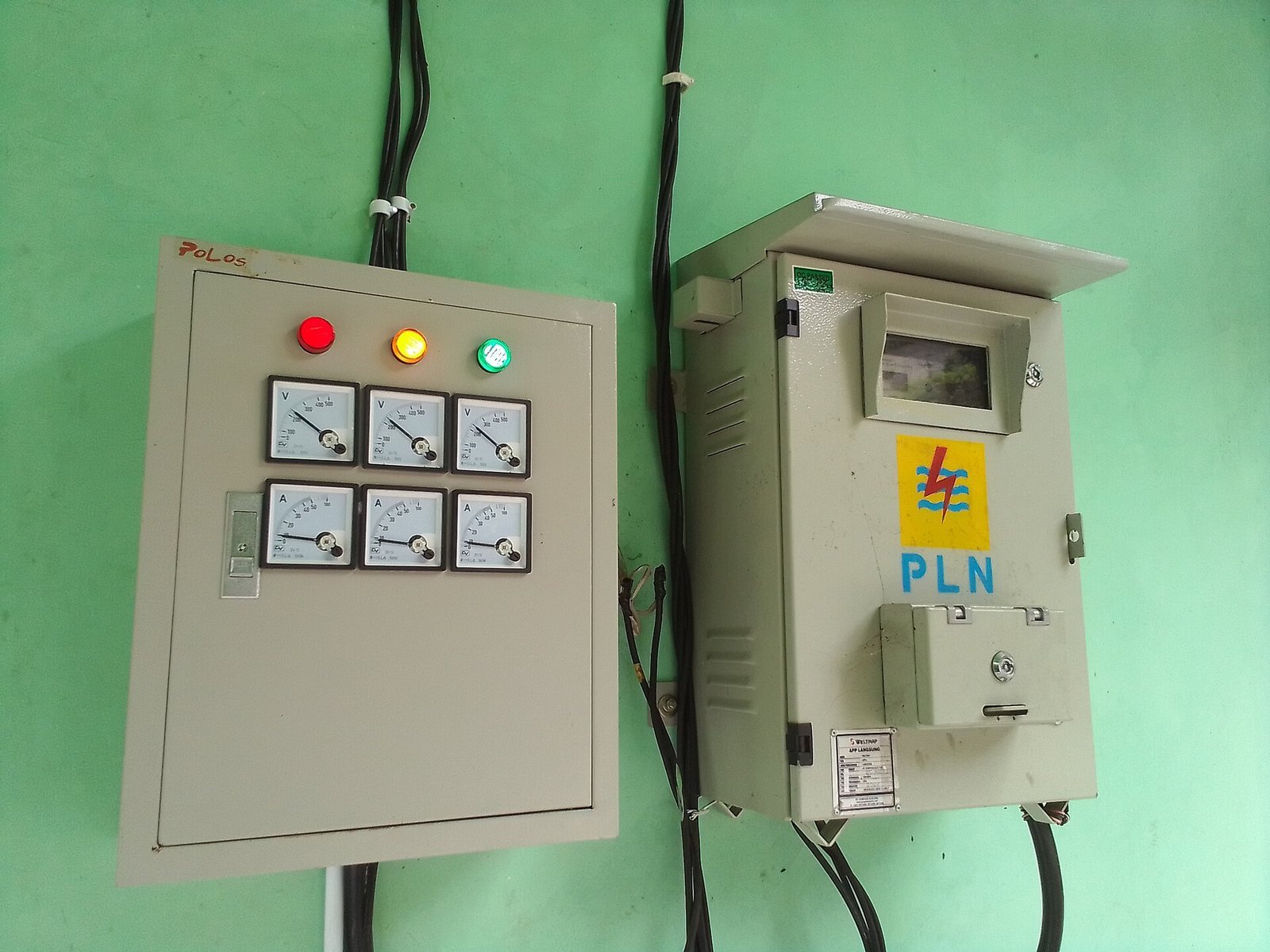
The Jakarta Fire and Rescue Agency (Gulkarmat) recorded that 61.12 percent of fires between January and August 2024 were caused by electrical short circuits. The acting governor presented the figure on 18 September 2024 and asked residents to use electrical products that meet the Indonesian National Standard (SNI) and to maintain and upgrade their installations regularly (Prabowo, 2024). Two months later, on 8 November 2024, a fire in a residential area of Papanggo, Tanjung Priok, which officers said was triggered by a short circuit, killed four people (Berita Jakarta, 2024).
The Jakarta figure covers every type of building, not only workplaces. The same pattern still matters for factories, warehouses and office buildings whose panels run around the clock. This article explains one method for finding hot spots before they become fires, infrared thermography of electrical panels: the concept, the steps, a worked example and the limits.
Why Heat Matters
Short circuits seldom arrive without warning. Loose connections, worn or oxidised contacts and unbalanced phase loads raise resistance at particular points, and those points heat up first. A thermal camera records the infrared radiation from equipment surfaces and shows it as a temperature map, without contact with live parts. A review by Ukiwe et al. (2023) concluded that the heat produced while equipment operates is what makes infrared thermography usable for monitoring electrical power equipment, and noted that the cost of high-resolution cameras still limits wider use.
In Indonesia, Minister of Manpower Regulation No. 12 of 2015 on Electrical Occupational Safety and Health in the Workplace covers electrical safety from planning, installation, use, modification and maintenance through to inspection and testing (Kementerian Ketenagakerjaan [Kemnaker], 2015). Internationally, the 2023 edition of NFPA 70B was issued as a standard for electrical equipment maintenance, replacing its earlier status as a recommended practice (National Fire Protection Association [NFPA], 2023). We read that change of status as a signal that condition-based maintenance, thermal inspection included, is now treated as a programme requirement rather than an option.
The Inspection Steps
This is the sequence we suggest for companies starting out:
- List the panels and rank them: main switchboards, motor control centres, panels near combustible materials and panels with a history of problems come first.
- Schedule scans while equipment runs at normal load, and record the current on each phase and the room temperature, because heat from a poor connection only shows when current flows.
- Make sure panels are opened only by authorised electrical personnel, under a safe work procedure and with PPE matched to the shock and arc flash risk.
- Compare like components under similar load, for example the R, S and T terminals on the same breaker. A difference between phases is usually easier to interpret than an absolute temperature.
- Grade the findings against priority levels the company sets, assign an owner and a repair deadline, then rescan after the repair.
- Keep the thermal image next to a normal photograph, the load reading and the panel location so that trends can be followed year on year.
A Worked Example
Picture a three-phase distribution panel in a packaging materials warehouse. With the three phases carrying almost the same current, the outgoing S-phase terminal on one breaker appears much brighter than R and T. Because the currents are similar, the extra heat more likely comes from the connection than from the load. A sensible response is to plan a shutdown, inspect and tighten the connection to the manufacturer's specification, replace damaged parts and rescan at a similar load to confirm that the difference has gone. This example is our illustration, not a real case.
If, on the other hand, all three phases are warm but one phase carries far more current, the problem lies more in how the load is shared. The answer then is rebalancing the load, not tightening bolts.
Limits of the Method
Thermography only sees surfaces. Components behind covers, joints inside enclosed busbars and shiny metal surfaces can all produce misleading readings. Results also depend on the load during the scan and on the skill of the person interpreting them. The method therefore does not replace the inspection and testing of electrical installations required under Regulation 12/2015 (Kemnaker, 2015). In our view, thermography works best as a filter that shows which panels should be opened and tested first.
The Gulkarmat figure also needs careful reading. The 61.12 percent is the agency's summary of causes, presented without a breakdown by building type (Prabowo, 2024). We cannot tell how much of it happened in workplaces. What can be said is that short circuits remain the most common recorded cause, and a large part of that risk can be reduced through measured maintenance.
How Nusa Safety Helps
Nusa Safety helps companies review their fire protection readiness and the ignition sources in their electrical installations through FESA, the fire and emergency safety audit, and checks the condition of panels and installations through its electrical system assessment. The findings can be used to build a maintenance schedule and a list of repair priorities.
This article is general information and is not legal or professional advice for any specific case.
References
- Berita Jakarta. (2024, November 8). Fire in Papanggo kills four people. Jakarta Provincial Government. https://m.beritajakarta.id/en/read/56949/fire-in-papanggo-kills-four-people
- Kementerian Ketenagakerjaan Republik Indonesia. (2015). Peraturan Menteri Ketenagakerjaan Nomor 12 Tahun 2015 tentang Keselamatan dan Kesehatan Kerja Listrik di Tempat Kerja [Minister of Manpower Regulation No. 12 of 2015 on electrical occupational safety and health in the workplace]. Berita Negara Republik Indonesia Tahun 2015 Nomor 540. https://jdih.kemnaker.go.id/peraturan/detail/610/peraturan-menteri-ketenagakerjaan-nomor-12-tahun-2015
- National Fire Protection Association. (2023). NFPA 70B: Standard for electrical equipment maintenance (2023 ed.). NFPA. https://catalog.nfpa.org/NFPA-70B-Recommended-Practice-for-Electrical-Equipment-Maintenance-P1196.aspx
- Prabowo, K. W. (2024, September 19). 61,12% kebakaran karena korsleting, Heru minta masyarakat gunakan listrik SNI [61.12% of fires caused by short circuits, Heru asks residents to use SNI electrical products]. Metrotvnews.com. https://www.metrotvnews.com/read/k8oC68Vv-61-12-kebakaran-karena-korsleting-heru-minta-masyarakat-gunakan-listrik-sni
- Ukiwe, E. K., Adeshina, S. A., & Tsado, J. (2023). Techniques of infrared thermography for condition monitoring of electrical power equipment. Journal of Electrical Systems and Information Technology, 10, 49. https://doi.org/10.1186/s43067-023-00115-z

