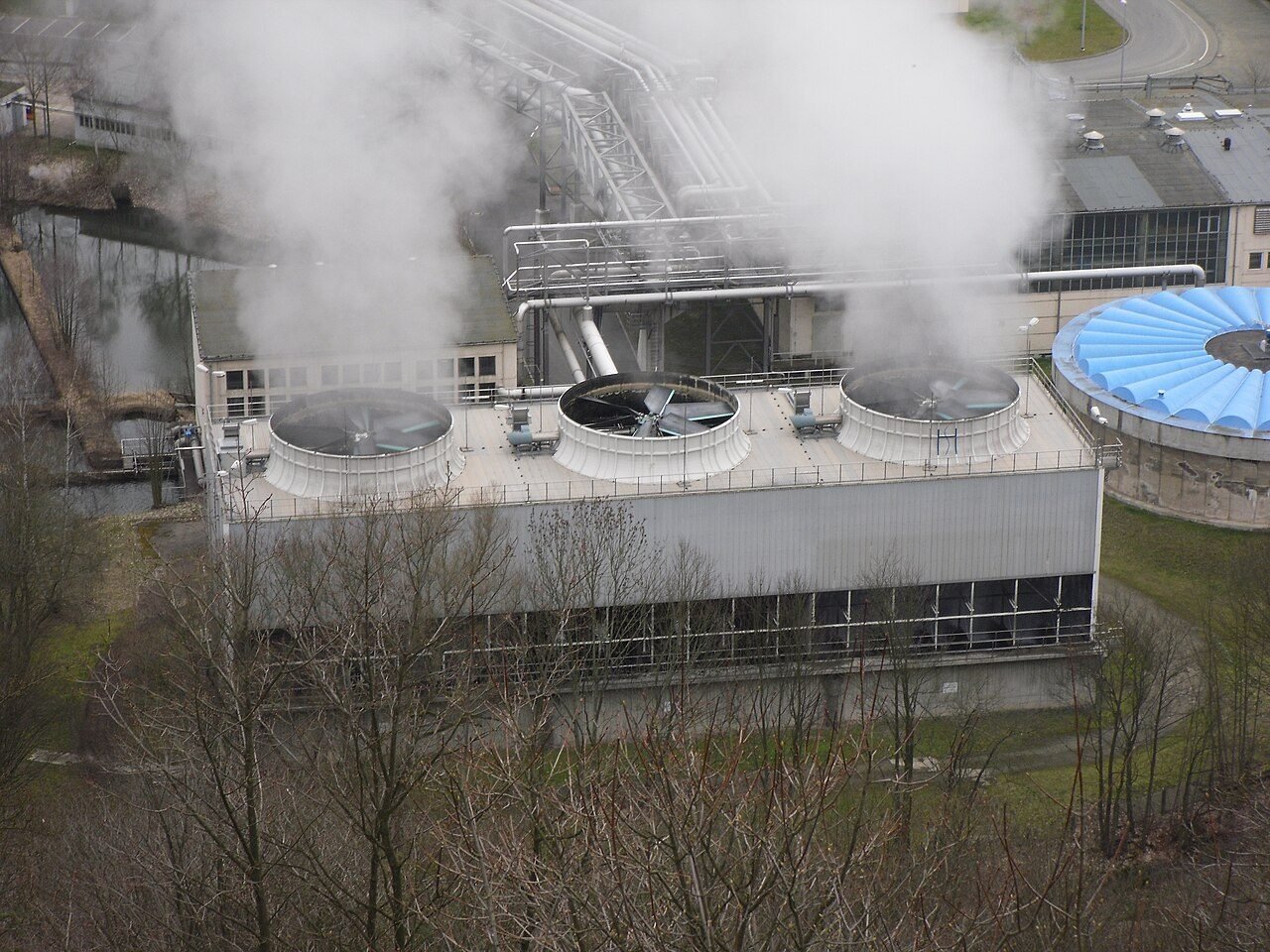
On the evening of Tuesday, 3 November 2026, fire broke out in a cooling tower unit at the PT OKI Pulp & Paper Mills plant in Air Sugihan district, Ogan Komering Ilir (OKI) regency, South Sumatra. Police and the company both reported no deaths or injuries (TBNews Polda Sumsel, 2026; Aryanti, 2026). The mill was in a scheduled maintenance shutdown at the time, and according to the company's disclosure to Indonesia's Financial Services Authority (OJK) and the Indonesia Stock Exchange on 6 November, the production schedule was not affected (Aryanti, 2026). The cause has not been determined. The company's Health, Safety, and Environment (HSE) team is investigating together with the OKI district police and the Air Sugihan sub-district police (TBNews Polda Sumsel, 2026).
No official investigation report exists yet, so this article does not name a cause. We separate what has been reported from what is still unknown, then compare the reported facts with engineering guidance and incident records on how cooling towers catch fire, particularly during maintenance. The result is a set of hypotheses for investigators to test, not a finding. The outcome so far also deserves recognition: nobody was hurt, workers near the tower were moved away as the fire grew, and the company's own fire brigade handled the response (Erfizal, 2026).
What Was Reported
According to the police release, the fire in the cooling tower area in Bukit Batu village was noticed at about 21:30 WIB and put out by the in-house fire brigade at about 02:00 WIB the following day, with cooling-down continuing into the morning. Losses were still being assessed, and preliminary information indicated that the area was undergoing maintenance work by a third party during the shutdown (TBNews Polda Sumsel, 2026; Apriadi, 2026). The company said the plant's assets are insured and that a standby cooling tower unit has been prepared (Aryanti, 2026).
Several details differ between sources:
- Start time: about 20:00 WIB according to the company (Sumeks.co, 2026; Aryanti, 2026), about 21:30 WIB according to the police ("Kronologi Kebakaran," 2026).
- End time: the company said the fire was under control by about 22:00 WIB (Aryanti, 2026), while the police said it was extinguished at about 02:00 WIB (TBNews Polda Sumsel, 2026).
- Village: Bukit Batu in the police release and the company disclosure, Sungai Baung in some media reports (Sumeks.co, 2026; SuaraSumsel.id, 2026).
- Unit: one outlet noted early information that mentioned the recovery boiler area or the cooling tower, before the company's statements pointed to the cooling tower (SuaraSumsel.id, 2026). A company statement quoted elsewhere refers to "Cooling Tower RB 1" (Sumeks.co, 2026).
The time differences may reflect the gap between when flames were seen and when the report reached police, and between "under control" and "extinguished". That is our interpretation; only alarm records, fire brigade logs, and camera footage can settle it. We read "RB 1" as possibly the name of a tower serving recovery boiler 1, which could explain the early reports, but no source describes an event inside the boiler. Media also noted that any link between the maintenance work and the fire has yet to be established (SuaraSumsel.id, 2026). We do not name the contractor and do not assign fault to anyone.
Why Cooling Towers Burn
Cooling towers are often seen as low-hazard because they "only" handle water (Center for Chemical Process Safety [CCPS], 2025). FM Global's loss prevention data sheet on cooling towers (Data Sheet 1-6, the April 2017 revision we consulted) shows otherwise. Combustible fill, where heat exchange takes place, is the most serious fire potential in a tower, and wood has largely given way to PVC, polypropylene, polyethylene, and polystyrene. Fill is wet in service but dries out when the tower is shut down; plastic dries faster than wood, and during a shutdown all combustible fill is dry enough to burn (FM Global, 2017).
The ignition sources FM Global (2017) lists include welding or cutting, smoking, overheated bearings, electrical failures, stacks and incinerators, and lightning as the primary natural cause. Cooling water can also carry ignitable liquids from a leaking heat exchanger into the tower. The data sheet recommends deluge sprinklers under the fan deck at a minimum density of 20 mm/min for counterflow towers with combustible fill and fan deck, instructions for the emergency team on starting water flow if fire occurs during a shutdown, alternatives to hot work on the tower, and a contingency plan for cooling capacity. NFPA 214, 2026 edition, sets requirements for protecting cooling towers of combustible construction or with combustible fill (National Fire Protection Association [NFPA], 2026).
The Maintenance Pattern
The French government's ARIA industrial accident database holds several similar cooling tower fires. Five records we reviewed:
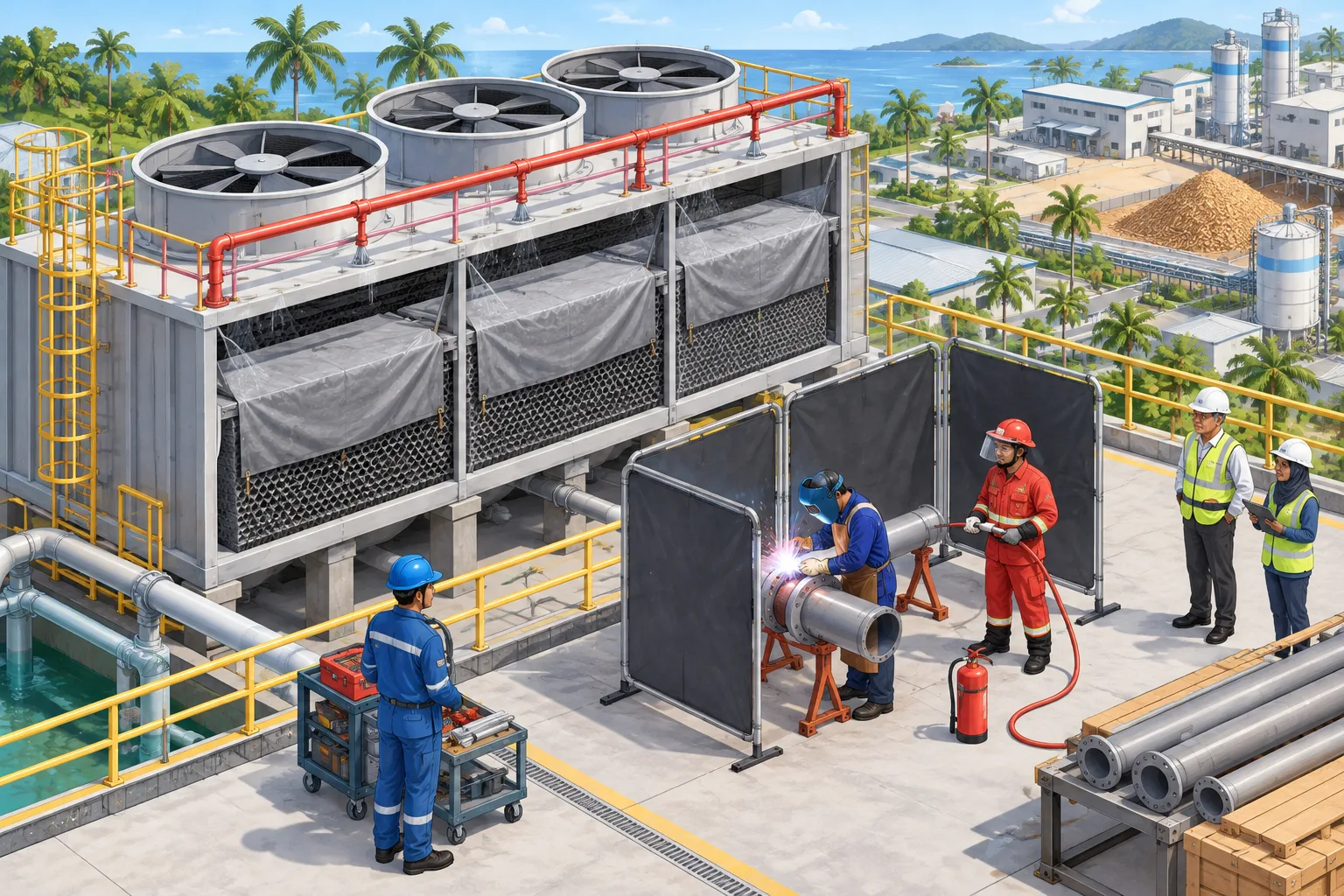
- Veauche, 2001: a contractor cut bolts with a torch while dismantling an out-of-service tower. The fire inside grew with the tower's natural draught, a portable extinguisher was useless because the burning parts could not be reached, and the tower turned out to contain plastic, unlike the site's other towers (Bureau d'Analyse des Risques et Pollutions Industriels [BARPI], n.d.-a).
- Sandouville, 2006: during a shutdown, fire broke out 48 hours after plastic packing was replaced. A subcontractor had switched from bolting to welding without telling the operator, so no hot work permit was issued; more than half of the 10 tower units were damaged (BARPI, n.d.-b).
- Neuves-Maisons, 2007: fill ignited during repair of a leaking water pipe and spread to two other cells; welding was the suspected trigger (BARPI, n.d.-c).
- Bazancourt, 2018: contractor workers welded roof plates while the plastic packing was still in place and left 30 minutes later, before smoke was noticed. Heat from the welding had reached the packing, a hazard the risk analysis had not identified (BARPI, n.d.-d).
- Artenay, 2024: during demolition, molten metal from torch cutting landed on the plastic packing. The hot work permit did not mention combustibles inside the tower, and five people were affected, one with a burn to the arm (BARPI, n.d.-e).
In Indonesia, a new cooling tower at a sugar mill in Mojokerto, East Java, caught fire in April 2016 while third-party workers were welding; its plastic elements and hoses burned while the steel frame survived, and police had not concluded on the cause at the time (Budianto, 2016).
The pattern is consistent: the tower is not in normal service, a contractor is doing hot work, the risk assessment or permit misses the plastic inside, and fire can appear after the work has ended. The UK HSE's permit-to-work guidance warns that supervision can be diluted in busy periods such as plant shutdowns, when one person controls too many permits (Health and Safety Executive [HSE], 2005). Indonesian studies show hot work permits are familiar but unevenly applied: 58% of 50 maintenance workers at a pulp and paper mill in Serang showed high implementation (Lestari et al., 2018), and at a paper plant in East Java the gaps lay in documentation, PPE, and rewards and sanctions (Rinawati, 2018).
Four Working Hypotheses
A science-based fire investigation, as guided by NFPA 921, rests on determining the origin and cause of the fire and testing them against physical evidence (NFPA, 2024). The core questions are which material burned first and what ignited it, and public information cannot yet answer them. What we can do is weigh documented mechanisms against the known facts:
- Hot work on or near the tower. Sparks, molten metal, or heat conducted through steel plate can ignite dry fill or drift eliminators, sometimes after a delay (FM Global, 2017; BARPI, n.d.-d). The shutdown and the reported maintenance work fit this mechanism. Unknown are whether any hot work took place that day, what the tower is made of, and what the permits said. No source mentions welding, so this hypothesis fits the pattern best but has no case-specific evidence yet.
- Electrical or mechanical failure. Temporary cables and lighting, fan motors, bearings, or heaters in a drained basin are recorded ignition sources (FM Global, 2017), and can be checked against energy isolation records and temporary installations.
- Ignitable liquid in the cooling water. A heat exchanger leak carried process liquid into a new tower cell at an Indian refinery in 2013 when water was first introduced (CCPS, 2025). In our view this is less likely while circulation is stopped, but it still needs to be ruled out with evidence.
- External sources. Lightning and sparks from stacks are recorded causes (FM Global, 2017) and can be checked against BMKG lightning data and nearby operating records.
A fire lasting several hours, as the police account suggests, is consistent with dry plastic fill: the interior is hard to reach, the draught feeds the fire, and suppression depends on water that may be shut off during a shutdown (BARPI, n.d.-a; FM Global, 2017). We do not know whether this tower had a deluge system or what state it was in. Other limits apply: the chronology comes from releases and media in the first hours, and the French cases were selected for their similarity, so they are not a frequency statistic.
Indonesian Regulatory Frame
Law No. 1 of 1970 on Work Safety sets safety requirements to prevent, reduce, and extinguish fires and to provide means of escape (Article 3(1)(b) and (d)), and obliges managers to report every accident (Article 11) (Republik Indonesia, 1970). Minister of Manpower Regulation No. PER.03/MEN/1998 on accident reporting and investigation counts fire as a reportable accident and requires a written report within 2 x 24 hours (Article 2(2)(b) and Article 4), even with no casualties (Departemen Tenaga Kerja [Depnaker], 1998).
Ministerial Decree No. KEP.186/MEN/1999 on workplace fire response units requires control of all forms of energy, detection, alarm, suppression and evacuation facilities, a fire response unit, regular drills, and a fire emergency plan that includes procedures for work related to fire prevention (Article 2) (Depnaker, 1999). In our reading, that covers hot work during shutdowns.
The audit criteria in Annex II of Government Regulation No. 50 of 2012 on OHS management systems (SMK3) include a permit system for high-risk tasks (6.1.5), lockout (6.5.8), safety of people near equipment under maintenance (6.5.9), sign-off that equipment is safe after maintenance (6.5.10), hazard identification in contract review (3.2), contractor briefings (12.4.1), emergency preparedness (6.7), and investigation reports covering causes, consequences, recommendations, and a schedule for corrective action (8.3.3) (Pemerintah Republik Indonesia, 2012).
Minister of Manpower Regulation No. 11 of 2026 on labour inspection procedures, as amended by Regulation No. 15 of 2026, allows special inspections triggered by media reports (Article 22(1)), makes work accidents and serious damage grounds for special testing of K3 objects, with possible inspector tape and seals (Article 42), and voids a certificate of compliance after a work accident or serious damage (Article 45(8)) (Kementerian Ketenagakerjaan [Kemnaker], 2026a, 2026b). Fire protection installations seriously damaged in an event like this should, in our view, be retested before they are relied on again.
For comparison, the US OSHA standard requires combustibles to be moved at least 35 feet (10.7 m) from welding or protected, a fire watch for at least half an hour after the work, and management to inform contractors of flammable materials they may not know about (Occupational Safety and Health Administration [OSHA], 2026).
Questions for Investigators
We suggest the joint investigation examine:
- The point of origin, the tower's construction materials, and whether they were dry or wetted at the time.
- A timeline built from alarms, fire brigade logs, radio, and cameras, to resolve the 20:00 versus 21:30 WIB gap.
- Every permit active in and around the tower, including hot work, energy isolation, and temporary electrics, and any change of work method made without review.
- Fire watch and post-work checks: who, for how long, and when the area was last inspected.
- The status of deluge, heat detection, and water supply during the shutdown.
- Contractor briefings on combustibles inside the tower and the permit supervision load.
- The contents of cooling water lines and lightning data around the site.
- The parts of the emergency response that worked, so they are kept.
For Other Plants
Pulp and paper mills, petrochemical plants, refineries, and power stations with plastic- or wood-filled towers can check the following before their next shutdown:
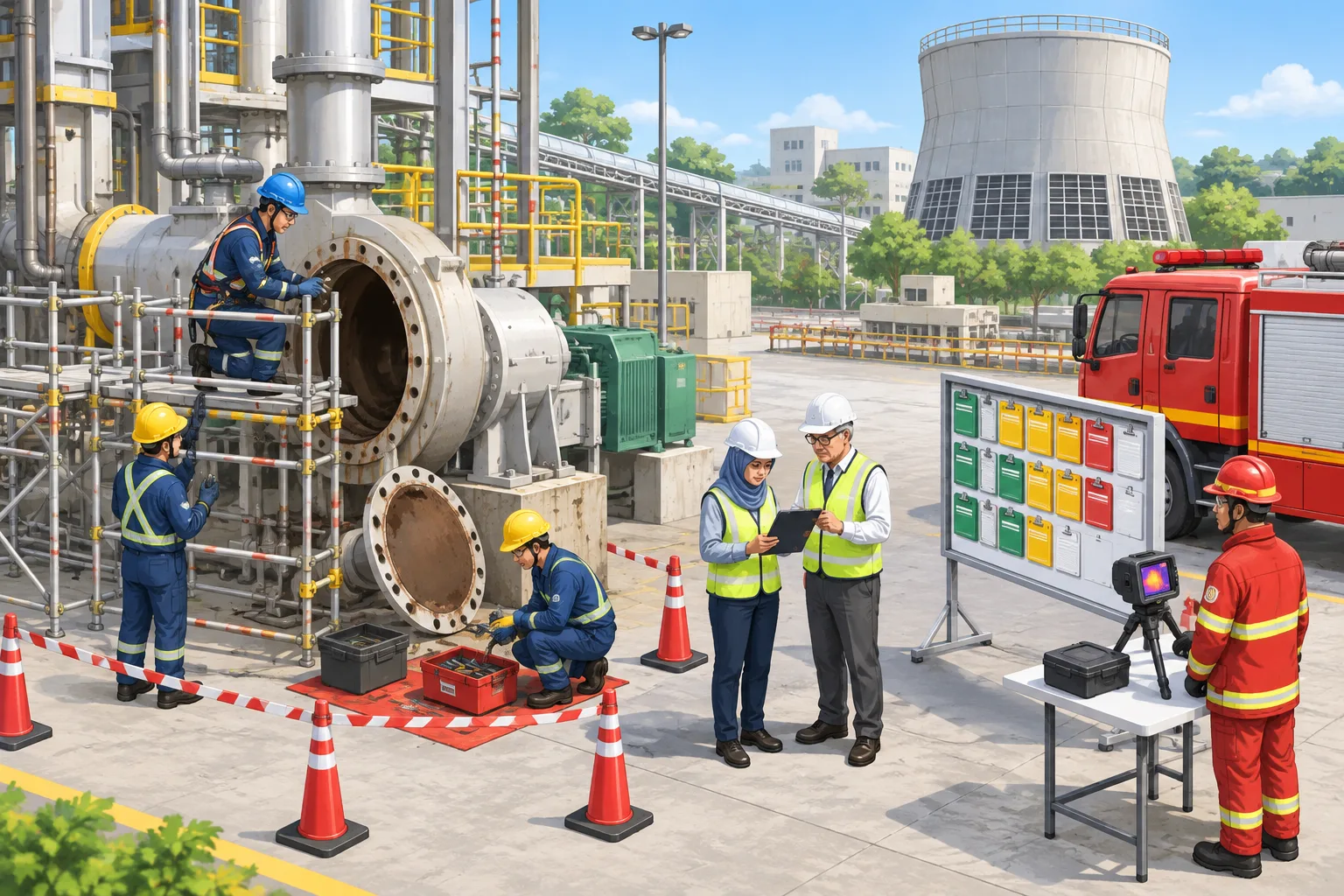
- List the materials in each tower and post signs that the fill is combustible, as the Artenay operator did (BARPI, n.d.-e).
- Treat hot work on or near a tower as high-risk work, prefer bolting or cold cutting, and remove or shield the packing when welding cannot be avoided (FM Global, 2017; BARPI, n.d.-d).
- Re-review the permit whenever the work method changes (BARPI, n.d.-b).
- Extend the fire watch beyond half an hour and recheck with a thermal camera, since fire may only show after the workers have left (OSHA, 2026; BARPI, n.d.-b, n.d.-d).
- Keep deluge and charged hoses available during the shutdown or provide a substitute, and train the brigade to get water onto a dry tower (FM Global, 2017).
- Limit permits per supervisor or add supervisors during shutdowns (HSE, 2005), and brief contractors specifically on the fill hazard (Pemerintah Republik Indonesia, 2012; OSHA, 2026).
- Put a written cooling capacity contingency in place (FM Global, 2017), as the company did in this case (Aryanti, 2026).
- Report every fire within 2 x 24 hours, including those without casualties (Depnaker, 1998).
The belief worth correcting is that a cooling tower is safe because it is wet. When the plant stops, it can become one of the driest and most combustible structures on site.
How Nusa Safety Helps
As a third party, Nusa Safety can support companies through a fire and emergency safety audit (FESA) covering cooling tower fill hazards, protection during shutdowns, and fire brigade readiness; SOP and technical guideline development for hot work permits and changes of work method; and an HSE and CSMS audit of contractor management ahead of a shutdown. The Nusa Safety team also runs incident investigation and RCA training focused on evidence gathering and root causes without blaming individuals.
Nusa Safety issues internal training certificates only, is not a PJK3, and does not issue K3 licences or Kemnaker or BNSP certificates; licensed matters are handled with licensed partners and the relevant authorities. To discuss your needs, please contact the Nusa Safety team.
This article is general information and not legal or professional advice for any specific case.
References
- Apriadi, N. (2026, 4 November). Kebakaran cooling tower PT OKI Pulp and Paper Mills berlangsung hingga dini hari, polisi dan HSE turun selidiki penyebabnya [OKI Pulp and Paper Mills cooling tower fire burned until early morning; police and HSE investigate]. Ketik. https://ketik.com/palembang/daerah/kebakaran-cooling-tower-pt-oki-pulp-and-paper-mills-berlangsung-hingga-dini-hari-polisi-dan-hse-turun-selidiki-penyebabnya
- Aryanti, M. (2026, 6 November). Pabrik Sinar Mas terbakar, begini dampak ke operasional [Sinar Mas mill fire and its operational impact]. Warta Ekonomi. https://wartaekonomi.co.id/read646095/pabrik-sinar-mas-terbakar-begini-dampak-ke-operasional
- Budianto, E. E. (2016, 25 April). Mesin pendingin PG Gempolkrep terbakar diduga dipicu percikan las listrik [Gempolkrep sugar mill cooling tower fire suspected to be caused by welding sparks]. detikNews. https://news.detik.com/berita-jawa-timur/d-3196029/mesin-pendingin-pg-gempolkrep-terbakar-diduga-dipicu-percikan-las-listrik
- Bureau d'Analyse des Risques et Pollutions Industriels. (n.d.-a). ARIA No. 20385 [Fire during dismantling of an out-of-service cooling tower at a glassworks, Veauche, France, 23 April 2001]. Base de données ARIA, Ministère de la Transition écologique. https://www.aria.developpement-durable.gouv.fr/accident/20385_en/?lang=en
- Bureau d'Analyse des Risques et Pollutions Industriels. (n.d.-b). Fire on damp cooling towers (ARIA No. 32695, Sandouville, France, 13 December 2006). Base de données ARIA, Ministère de la Transition écologique. https://www.aria.developpement-durable.gouv.fr/accident/32695_en/?lang=en
- Bureau d'Analyse des Risques et Pollutions Industriels. (n.d.-c). ARIA No. 34107 [Cooling tower fire during pipe repair at a steelworks, Neuves-Maisons, France, 23 May 2007]. Base de données ARIA, Ministère de la Transition écologique. https://www.aria.developpement-durable.gouv.fr/accident/34107_en/?lang=en
- Bureau d'Analyse des Risques et Pollutions Industriels. (n.d.-d). Fire in a cooling tower at a food-processing plant (ARIA No. 52146, Bazancourt, France, 27 June 2018). Base de données ARIA, Ministère de la Transition écologique. https://www.aria.developpement-durable.gouv.fr/accident/52146_en/?lang=en
- Bureau d'Analyse des Risques et Pollutions Industriels. (n.d.-e). Incendie sur une TAR dans une sucrerie (ARIA No. 61623, Artenay, France, 6 February 2024) [Fire on a cooling tower at a sugar plant]. Base de données ARIA, Ministère de la Transition écologique. https://www.aria.developpement-durable.gouv.fr/accident/61623/
- Center for Chemical Process Safety. (2025). Refinery cooling tower explosion and fire. Process Safety Beacon, October 2025. American Institute of Chemical Engineers. https://ccps.aiche.org/sites/default/files/ccps-beacon/202510BeaconEnglish.pdf
- Departemen Tenaga Kerja. (1998). Peraturan Menteri Tenaga Kerja Nomor PER.03/MEN/1998 tentang Tata Cara Pelaporan dan Pemeriksaan Kecelakaan [Minister of Manpower Regulation No. PER.03/MEN/1998 on procedures for reporting and investigating accidents]. https://jdih.kemnaker.go.id/peraturan/detail/2214/peraturan-menteri-tenaga-kerja-nomor-3-tahun-1998
- Departemen Tenaga Kerja. (1999). Keputusan Menteri Tenaga Kerja Nomor KEP.186/MEN/1999 tentang Unit Penanggulangan Kebakaran di Tempat Kerja [Minister of Manpower Decree No. KEP.186/MEN/1999 on fire response units in the workplace]. https://jdih.kemnaker.go.id/peraturan/detail/3122/keputusan-menteri-tenaga-kerja-nomor-186-tahun-1999
- Erfizal, R. (2026, 4 November). Kebakaran cooling tower pabrik OKI Pulp terjadi saat maintenance [OKI Pulp mill cooling tower fire occurred during maintenance]. IDN Times Sumsel. https://sumsel.idntimes.com/news/sumatra-selatan/kebakaran-cooling-tower-pabrik-oki-pulp-terjadi-saat-maintenance-00-pbgds-ldjqz9
- FM Global. (2017). Cooling towers (Property Loss Prevention Data Sheet 1-6; January 2001, interim revision April 2017). Factory Mutual Insurance Company. https://hinarratives.com/wp-content/uploads/sites/176/2021/11/Cooling-Towers.pdf
- Health and Safety Executive. (2005). Guidance on permit-to-work systems: A guide for the petroleum, chemical and allied industries (HSG250). HSE Books. https://www.hse.gov.uk/pubns/books/hsg250.htm
- Kementerian Ketenagakerjaan Republik Indonesia. (2026a). Peraturan Menteri Ketenagakerjaan Nomor 11 Tahun 2026 tentang Tata Cara Pengawasan Ketenagakerjaan [Minister of Manpower Regulation No. 11 of 2026 on labour inspection procedures]. Berita Negara Republik Indonesia Tahun 2026 Nomor 438. https://jdih.kemnaker.go.id/peraturan/detail/3070/peraturan-menteri-ketenagakerjaan-nomor-11-tahun-2026
- Kementerian Ketenagakerjaan Republik Indonesia. (2026b). Peraturan Menteri Ketenagakerjaan Nomor 15 Tahun 2026 tentang Perubahan atas Peraturan Menteri Ketenagakerjaan Nomor 11 Tahun 2026 tentang Tata Cara Pengawasan Ketenagakerjaan [Minister of Manpower Regulation No. 15 of 2026 amending Regulation No. 11 of 2026]. Berita Negara Republik Indonesia Tahun 2026 Nomor 681. https://jdih.kemnaker.go.id/peraturan/detail/3109/peraturan-menteri-ketenagakerjaan-nomor-15-tahun-2026
- Kronologi kebakaran di pabrik kertas Ogan Komering Ilir [Chronology of the fire at the Ogan Komering Ilir paper mill]. (2026, 4 November). Liputan6.com. https://www.liputan6.com/regional/read/8328156/kronologi-kebakaran-di-pabrik-kertas-ogan-komering-ilir
- Lestari, F. A., Kusuma, A. N., & Pertiwi, W. E. (2018). Implementasi hot work permit system sebagai upaya pencegahan kecelakaan kerja [Implementation of a hot work permit system to prevent work accidents]. Faletehan Health Journal, 5(1), 10-18. https://doi.org/10.33746/fhj.v5i1.3
- National Fire Protection Association. (2024). NFPA 921: Guide for fire and explosion investigations (2024 ed.). https://www.nfpa.org/codes-and-standards/nfpa-921-standard-development/921
- National Fire Protection Association. (2026). NFPA 214: Standard on water-cooling towers (2026 ed.). https://www.nfpa.org/codes-and-standards/nfpa-214-standard-development/214
- Occupational Safety and Health Administration. (2026). Welding, cutting, and brazing: General requirements, 29 C.F.R. § 1910.252. Electronic Code of Federal Regulations. https://www.ecfr.gov/current/title-29/subtitle-B/chapter-XVII/part-1910/subpart-Q/section-1910.252
- Pemerintah Republik Indonesia. (2012). Peraturan Pemerintah Nomor 50 Tahun 2012 tentang Penerapan Sistem Manajemen Keselamatan dan Kesehatan Kerja [Government Regulation No. 50 of 2012 on the implementation of occupational safety and health management systems]. Lembaran Negara Republik Indonesia Tahun 2012 Nomor 100. https://jdih.kemnaker.go.id/peraturan/detail/58/peraturan-pemerintah-nomor-50-tahun-2012
- Republik Indonesia. (1970). Undang-Undang Nomor 1 Tahun 1970 tentang Keselamatan Kerja [Law No. 1 of 1970 on work safety]. Lembaran Negara Republik Indonesia Tahun 1970 Nomor 1. https://jdih.kemnaker.go.id/peraturan/detail/49/undang-undang-nomor-1-tahun-1970
- Rinawati, S. (2018). Level of safe behavior with the implementation of hot work permit approach in PT BBB East Java. Journal of Vocational Health Studies, 1(3), 89-96. https://doi.org/10.20473/jvhs.v1.i3.2018.89-96
- SuaraSumsel.id. (2026, 4 November). Kebakaran pabrik OKI Pulp & Paper berlangsung 4 jam, ratusan karyawan berhamburan, ini faktanya [OKI Pulp & Paper mill fire lasted 4 hours as hundreds of employees fled: the facts]. https://sumsel.suara.com/read/2026/11/04/181832/kebakaran-pabrik-oki-pulp-paper-berlangsung-4-jam-ratusan-karyawan-berhamburan-ini-faktanya
- Sumeks.co. (2026, 4 November). Api berhasil dipadamkan, kebakaran cooling tower PT OKI Pulp and Paper Mills di OKI [Fire extinguished at the PT OKI Pulp and Paper Mills cooling tower]. https://sumeks.disway.id/sumsel/read/800431/api-berhasil-dipadamkan-kebakaran-cooling-tower-pt-oki-pulp-and-paper-mills-di-oki
- TBNews Polda Sumsel. (2026, 4 November). Kebakaran cooling tower PT OKI Pulp and Paper Mills, Polres OKI bersama HSE selidiki penyebabnya [OKI Pulp and Paper Mills cooling tower fire: OKI police and HSE investigate the cause]. Tribrata News Polda Sumatera Selatan. https://tribratanews.sumsel.polri.go.id/berita/kebakaran-cooling-tower-pt-oki-pulp-and-paper-mills-polres-oki-bersama-hse-selidiki-penyebabnya