
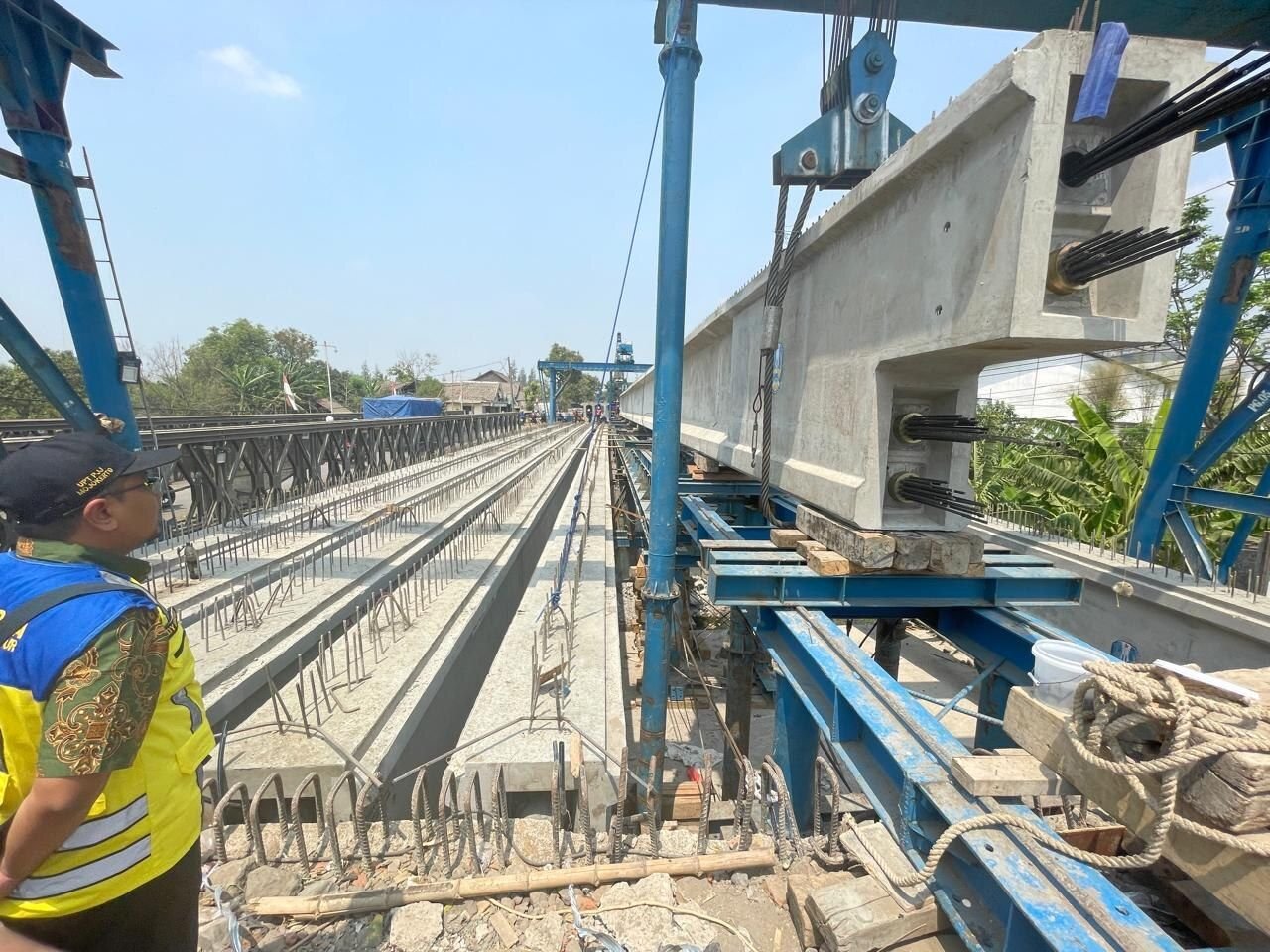
From 2011 to 2017, US fatal injury statistics recorded 297 deaths involving cranes, an average of 42 a year. Of these, 154 involved a worker struck by an object or equipment, 91 a falling object, and in 79 cases the object fell from a crane or was put in motion by one (Bureau of Labor Statistics [BLS], 2019). Indonesia's Ministry of Manpower recorded 462,241 work accident cases in 2024 (Kementerian Ketenagakerjaan [Kemnaker], 2025), but the open dataset does not break them down by type of equipment, so the share involving lifting operations is not known.
Between the crane hook and the load sits a chain of slings, shackles and fittings, which Indonesian regulation calls lifting accessories (alat bantu angkat dan angkut). This gear is cheap, moves between projects and wears quickly, so deciding when it must come out of service is a safety decision made on site every day.
This article analyses the discard rules for lifting accessories in Minister of Manpower Regulation No. 8 of 2020 on Occupational Safety and Health of Lifting and Conveying Equipment (Permenaker 8/2020). We read the official text from the ministry's legal database on 7 November 2026 and compared it clause by clause with the US OSHA rules on slings and crane wire rope, the UK Lifting Operations and Lifting Equipment Regulations 1998 (LOLER), and ISO 4309:2017 on crane wire rope discard, then tested the comparison against research and published sling failure analyses. We found no official investigation report of a 2026 lifting accident in Indonesia to use as a case.
The Legal Basis
Permenaker 8/2020 was enacted on 8 June 2020 and promulgated on 12 June 2020. Article 2 requires employers to apply OHS requirements to lifting and conveying equipment and accessories in line with the regulation and/or national or international standards (Kemnaker, 2020), so ASME, ISO or manufacturer criteria can fill gaps.
Article 124 covers slings, spreader bars, lifting beams, personnel baskets, nets and fittings such as shackles, swivels, eyebolts, master links and clamps. Each item must be marked with its safe working load and built with a safety factor of at least 5, except chain slings (Article 125). The rigger must inspect each accessory before use, use is recorded in a log book with inspection and test dates, and gear is maintained to the manufacturer's manual, stored away from heat, liquids and hazardous substances, and destroyed once deformed, discoloured, defective or damaged (Article 126). Use is also prohibited when wind speed exceeds 38 km/h, and gear must not be dragged (Article 127) (Kemnaker, 2020).
Riggers need a competency certificate and an OHS licence (Article 157), valid for five years and only while the holder works for the company that applied for it (Articles 162 and 163) (Kemnaker, 2020).
Article 53 of Minister of Manpower Regulation No. 11 of 2026 on Labour Inspection Procedures has since revoked Article 1 point 5, Article 141(4) and Article 173(3) of Permenaker 8/2020, on specialist inspectors and on who performs inspection and testing, and Article 54 requires OHS certificate rules to be aligned (Kemnaker, 2026a). That regulation was in turn amended by Minister of Manpower Regulation No. 15 of 2026 (Kemnaker, 2026b). Under Permenaker 11/2026, an OHS compliance certificate ceases to be valid after a work accident, serious damage or a change to the equipment (Article 45(8)), and a work accident is one of the grounds for a special test (Article 42(2)) (Kemnaker, 2026a). The technical discard criteria for lifting accessories in Permenaker 8/2020 were not revoked.
Discard Limits in Numbers
Permenaker 8/2020 sets fairly detailed discard limits for each type of accessory (Kemnaker, 2020):
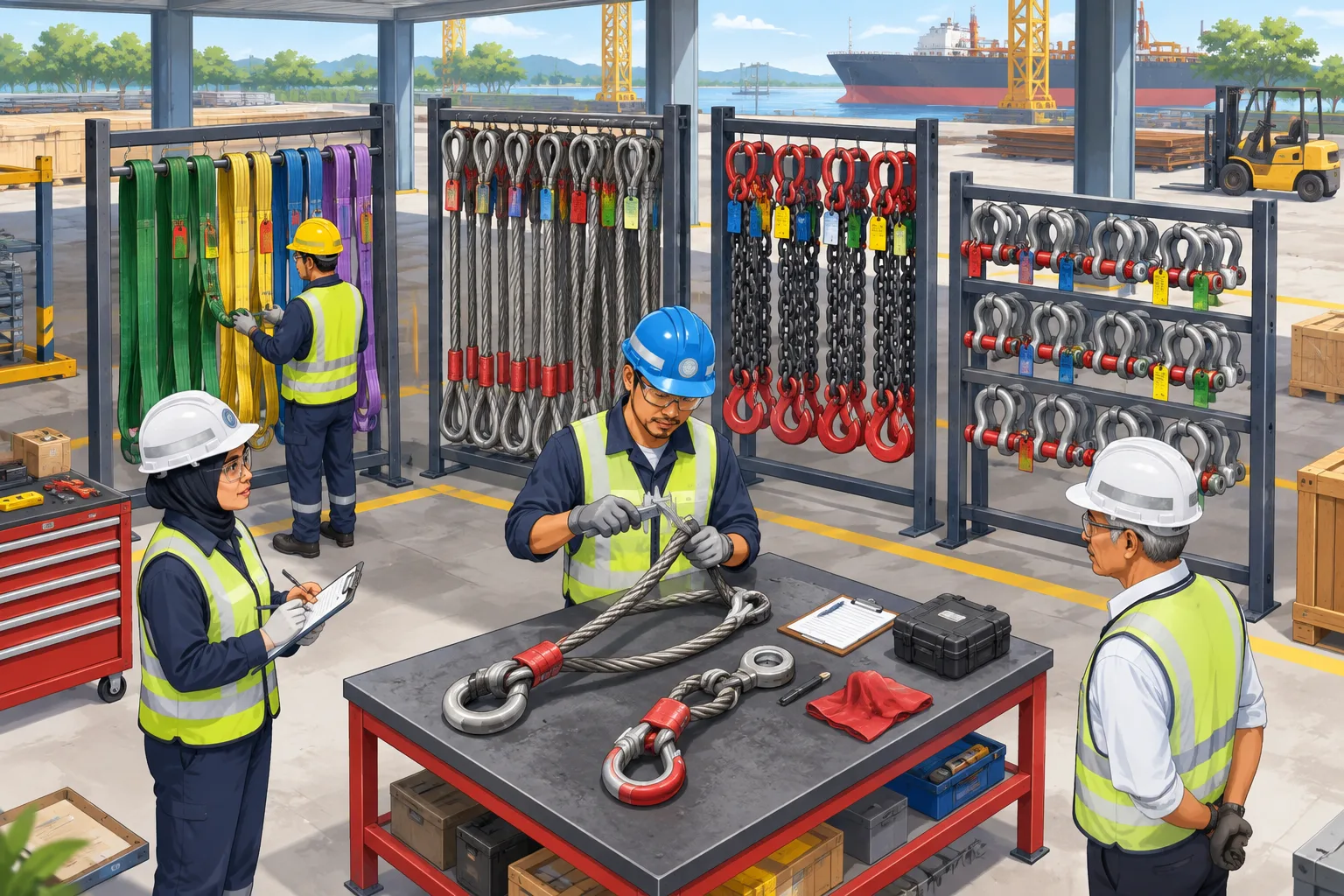
- Wire rope slings (Article 131): safety factor of at least 5; diameter loss of no more than 5 percent; no knotting or twisting; out of service when bent, kinked, frayed or stripped, when wear or corrosion reaches 12 percent for 6x7 construction over a 50 cm length (15 percent for triangular strand rope), at 5 or more broken wires in one strand and/or 10 or more spread over several strands, at temperatures above 204°C or below minus 40°C, and when sockets or clamps are damaged.
- Chain slings (Article 132): safety factor of at least 4; link elongation of no more than 5 percent; interlink wear of no more than 10 percent of the original diameter; no hammering, twisting, knotting, dropping or shock loading.
- Webbing slings (Article 133): out of service when discoloured, torn, with broken stitching, abraded, holed or melted, after fire or acid exposure, or above 90°C.
- Synthetic fibre rope slings (Article 134): diameter loss of no more than 10 percent.
- Fittings such as shackles, turnbuckles, swivels, eyebolts, master links and clamps (Article 139): out of service at a 10 percent change from original dimensions, deformation, thread damage, cracks or corrosion, and they must be destroyed.
For cranes, hooks must have a safety latch and must not be used once a dimension is reduced by more than 10 percent or the throat opening grows by more than 5 percent (Article 37). Crane wire rope is inspected at first installation, before every operation and once a week, and is discarded at 4 broken wires in one strand or 12 distributed for fixed cranes, and 3 in one strand or 6 distributed for mobile cranes (Article 33) (Kemnaker, 2020).
Statutory testing is first, periodic, special or repeat (Article 174), and accessories are static load tested at 150 to 200 percent of the safe working load. Cranes receive their first periodic test within two years of the first test and then yearly, while accessories are tested at least once a year (Articles 175 and 176) (Kemnaker, 2020).
International Benchmarks
The OSHA sling standard requires a competent person to inspect slings and attachments each day before use. Wire rope slings are removed at ten randomly distributed broken wires in one rope lay (the length of one full strand turn) or five in one strand in one rope lay, at wear of one third of outside wire diameter, and for kinking, crushing or bird caging. Fibre core wire rope slings are retired after exposure above 200°F, and nylon and polyester web slings are limited to 180°F. Hooks opened more than 15 percent or twisted more than 10 degrees are removed, and alloy steel chain slings need a recorded thorough inspection at least every 12 months (Occupational Safety and Health Administration [OSHA], 2026a). In construction, rigging equipment is inspected before use on each shift (OSHA, 2026b).
For crane wire rope in construction, OSHA requires a shift inspection, a documented monthly inspection and a thorough annual inspection by a qualified person that covers normally hidden sections, with a broken wire limit for running ropes of six distributed wires in one rope lay or three in one strand (OSHA, 2026c).
Under LOLER, lifting accessories and equipment for lifting people need a thorough examination at least every six months, other lifting equipment every twelve months, or intervals set by an examination scheme, with inspections in between where appropriate (United Kingdom, 1998). ISO 4309:2017 gives more detailed discard criteria for crane wire ropes, including diameter decrease, corrosion, multi-layer drums and the combined effect of several defects at one point (International Organization for Standardization [ISO], 2017).
Where Gaps Remain
On the whole, Permenaker 8/2020 is not looser than the benchmarks. Its broken wire limit for mobile cranes matches OSHA's for running ropes, its 5 percent hook throat limit is far stricter than OSHA's 15 percent, and its weekly crane rope check is more frequent than OSHA's monthly one (Kemnaker, 2020; OSHA, 2026a, 2026c). The gaps lie in drafting and inspection intervals.
First, Article 131(4)(c) on broken wires in slings gives no reference length such as OSHA's rope lay, and ties the limit to "mobile lifting cranes" (Kemnaker, 2020). Read literally, a sling used on a fixed crane or hoist has no clear broken wire limit. Our reading is that the limit should apply to every wire rope sling, measured over one rope lay as in OSHA (2026a).
Second, Permenaker uses a single 204°C limit for all wire rope slings. In OSHA, the equivalent 400°F applies only to slings without a fibre core, while fibre core slings are retired above 200°F, roughly 93°C by our conversion (OSHA, 2026a). A fibre core sling used near a furnace could pass the Indonesian text with a damaged core.
Third, the statutory interval for accessories is a year, against six months under LOLER (Kemnaker, 2020; United Kingdom, 1998). Between tests, Permenaker relies on the rigger's pre-use check and the log book, with no documented interim inspection by a competent person like OSHA's periodic chain sling inspection (OSHA, 2026a). For slings used many times a day in humid, dusty conditions, we consider a twelve-month gap too long without structured interim inspections.
Fourth, passing a proof load test does not prove that a sling is sound. Zaky et al. (2025) analysed the failure of a 2.5-inch wire rope sling that had been in service for 17 years. It passed a load test to 69.1 tonnes three months earlier, then broke at the ferrule while lifting a steel panel of about 19 tonnes. The wires inside the ferrule were badly corroded, the sling was often stored outdoors, there was no retirement age, routine visual inspections missed the corrosion, and the lifting method overloaded the rigging without a critical lift plan (Zaky et al., 2025). It is a single case with no stated location, but it shows the limits of visual checks and proof testing.
Thin as it is, Indonesian evidence points the same way. A statutory inspection of a tower crane found a hook whose safety latch had been replaced by welding to the hook body (Pinto & Sukwadi, 2025), even though Article 37 requires hooks to have a safety latch (Kemnaker, 2020). An FMEA of a 2018 onshore facility project in Madura ranked dropped objects during crane lifts as the highest risk, with a risk priority number of 490, and a broken sling or steel rope as the most frequent cause (Fatullah, 2022). A review of 203 crane accidents in China from 2011 to 2022 identified overlapping parallel operations and insufficient safety management as key factors (Zhao et al., 2025), so better hardware alone is not enough.
The evidence has limits. The BLS data are American and end in 2017, the Indonesian studies cover one project or one machine, and Indonesia does not publish lifting accident statistics by cause. The assessment above is our interpretation, not a measurement of how well the regulation works.
Practical Steps
We drew the following steps from the provisions and evidence above:
- Keep a register of lifting accessories with a unique ID, safe working load, manufacturer's certificate, date into service, statutory test results and inspection history, as an extension of the log book required by Article 126 (Kemnaker, 2020).
- Give licensed riggers a checklist with the numeric limits of Articles 131 to 134, 139 and 37, plus callipers and a hook throat gauge.
- Fill the gap between statutory tests with documented thorough inspections by a competent person, for example every three to six months for heavily used slings or slings in corrosive environments, following the logic of LOLER and OSHA's periodic inspection (United Kingdom, 1998; OSHA, 2026a).
- Apply temperature limits by core type and the manufacturer's instructions, not only the 204°C figure, for slings used near heat sources (OSHA, 2026a).
- Set an age and condition policy for older slings: inspect terminations and ferrules closely, store slings on covered racks as Article 126 requires, and do not treat a proof load certificate as the only evidence of fitness (Zaky et al., 2025).
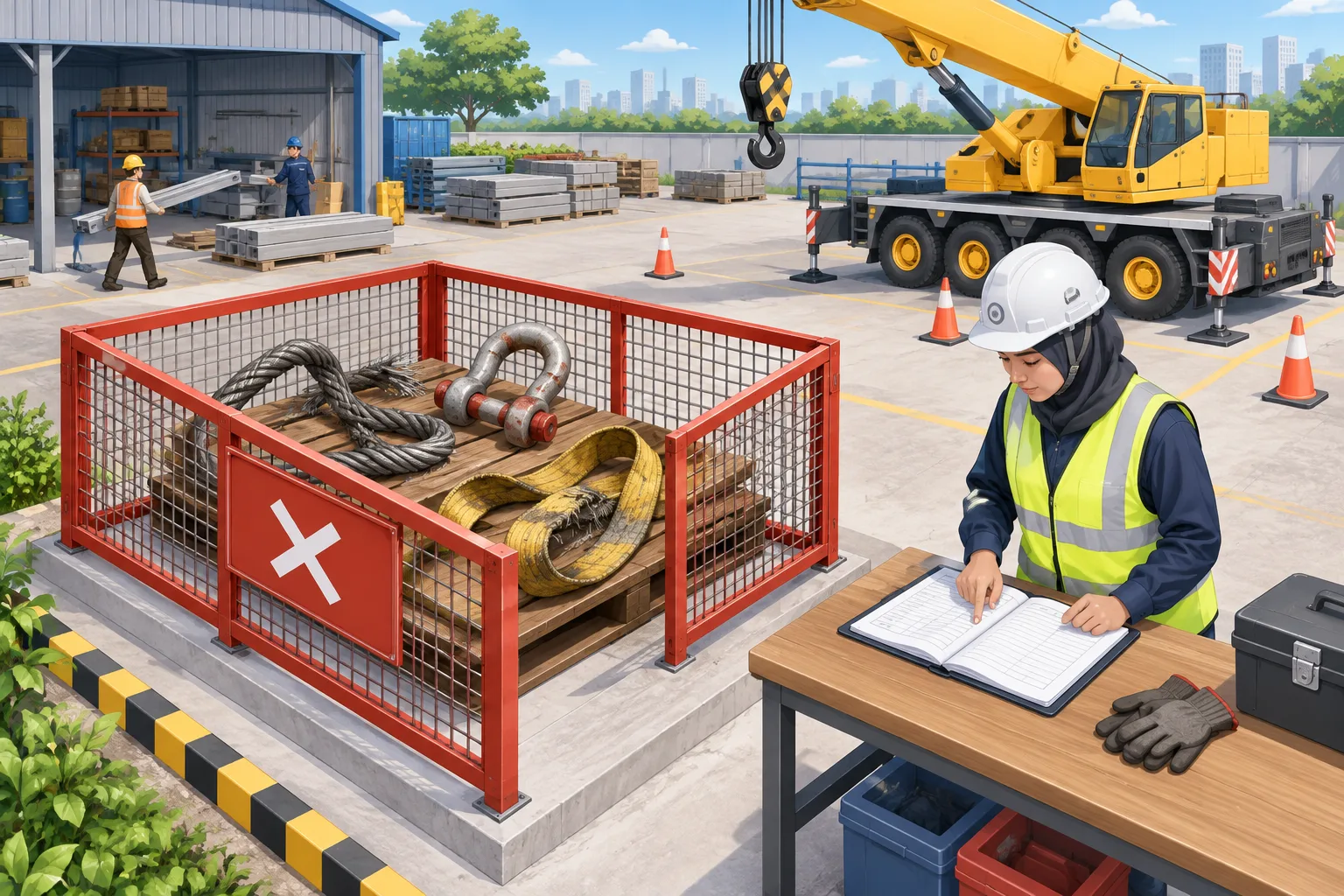
- Quarantine and destroy rejected gear with a written record (Articles 126 and 139), and prohibit welding or field modification of hooks and fittings (Kemnaker, 2020; Pinto & Sukwadi, 2025).
- Prepare a written lift plan for non-routine lifts or loads of uncertain weight, including a stop limit if the load exceeds the estimate (Zaky et al., 2025).
- After an accident, serious damage or a change to lifting equipment, treat the existing OHS certificate as no longer valid and request a special test (Kemnaker, 2026a).
A compliance sticker on the crane does not mean every sling in the store is safe: a statutory test captures one day, while wear and corrosion accumulate every day.
How Nusa Safety Helps
Through the lifting equipment operator and rigger programme, the Nusa Safety team prepares operators and riggers with a licensed PJK3 partner so they understand discard criteria and how to check them; OHS licences are issued by the authorities, and Nusa Safety only issues internal training certificates. For statutory equipment inspection, Nusa Safety builds the register and schedule, prepares the technical file, and coordinates the licensed PJK3 partner and the follow-up of findings; Nusa Safety is not a PJK3 and does not issue OHS certificates.
Inspection, quarantine and lift planning procedures can be written through technical guidelines and SOP development, and lifting hazards can be mapped with site teams in a risk assessment and JSA workshop. The Nusa Safety team can be reached through the contact page.
This article is general information and not legal or professional advice for any specific case.
References
- Bureau of Labor Statistics. (2019). Fatal occupational injuries involving cranes [Fact sheet]. U.S. Department of Labor. https://www.bls.gov/iif/factsheets/fatal-occupational-injuries-cranes-2011-17.htm
- Fatullah, F. (2022). Analisa risiko kecelakaan kerja dengan menggunakan metode FMEA (failure mode and effect analysis) [Work accident risk analysis using the FMEA method]. Jurnal Techlink, 4(1), 19-29. https://doi.org/10.59134/jtnk.v4i1.62
- International Organization for Standardization. (2017). Cranes - Wire ropes - Care and maintenance, inspection and discard (ISO Standard No. 4309:2017). https://www.evs.ee/en/iso-4309-2017
- Kementerian Ketenagakerjaan Republik Indonesia. (2020). Peraturan Menteri Ketenagakerjaan Nomor 8 Tahun 2020 tentang Keselamatan dan Kesehatan Kerja Pesawat Angkat dan Pesawat Angkut [Minister of Manpower Regulation No. 8 of 2020 on Occupational Safety and Health of Lifting and Conveying Equipment]. Berita Negara Republik Indonesia Tahun 2020 Nomor 609. https://jdih.kemnaker.go.id/peraturan/detail/1668/peraturan-menteri-ketenagakerjaan-nomor-8-tahun-2020
- Kementerian Ketenagakerjaan Republik Indonesia. (2025). Kasus kecelakaan kerja tahun 2024 [Work accident cases in 2024] [Data set]. Portal Satu Data Indonesia. https://data.go.id/dataset/dataset/kasus-kecelakaan-kerja-tahun-2024
- Kementerian Ketenagakerjaan Republik Indonesia. (2026a). Peraturan Menteri Ketenagakerjaan Nomor 11 Tahun 2026 tentang Tata Cara Pengawasan Ketenagakerjaan [Minister of Manpower Regulation No. 11 of 2026 on Labour Inspection Procedures]. Berita Negara Republik Indonesia Tahun 2026 Nomor 438. https://jdih.kemnaker.go.id/peraturan/detail/3070/peraturan-menteri-ketenagakerjaan-nomor-11-tahun-2026
- Kementerian Ketenagakerjaan Republik Indonesia. (2026b). Peraturan Menteri Ketenagakerjaan Nomor 15 Tahun 2026 tentang Perubahan atas Peraturan Menteri Ketenagakerjaan Nomor 11 Tahun 2026 tentang Tata Cara Pengawasan Ketenagakerjaan [Minister of Manpower Regulation No. 15 of 2026 amending Regulation No. 11 of 2026 on Labour Inspection Procedures]. Berita Negara Republik Indonesia Tahun 2026 Nomor 681. https://jdih.kemnaker.go.id/peraturan/detail/3109/peraturan-menteri-ketenagakerjaan-nomor-15-tahun-2026
- Occupational Safety and Health Administration. (2026a). Slings, 29 C.F.R. § 1910.184. Electronic Code of Federal Regulations. https://www.ecfr.gov/current/title-29/subtitle-B/chapter-XVII/part-1910/subpart-N/section-1910.184
- Occupational Safety and Health Administration. (2026b). Rigging equipment for material handling, 29 C.F.R. § 1926.251. Electronic Code of Federal Regulations. https://www.ecfr.gov/current/title-29/subtitle-B/chapter-XVII/part-1926/subpart-H/section-1926.251
- Occupational Safety and Health Administration. (2026c). Wire rope: Inspection, 29 C.F.R. § 1926.1413. Electronic Code of Federal Regulations. https://www.ecfr.gov/current/title-29/subtitle-B/chapter-XVII/part-1926/subpart-CC/section-1926.1413
- Pinto, G. P. M., & Sukwadi, R. (2025). Pemeriksaan dan pengujian pesawat angkat angkut jenis tower crane [Inspection and testing of tower cranes]. Jurnal Praktik Keinsinyuran, 2(5), 597-605. https://doi.org/10.25170/jpk.v2i05.7347
- United Kingdom. (1998). The Lifting Operations and Lifting Equipment Regulations 1998 (SI 1998/2307), regulation 9. https://www.legislation.gov.uk/uksi/1998/2307/regulation/9
- Zaky, A., Pratesa, Y., & Mudaryoto, J. W. (2025). Wire rope sling failure analysis: Technical root causes, investigation methodology critique, and lessons for lifting safety and organizational learning. Recent in Engineering Science and Technology, 3(3), 1-24. https://doi.org/10.59511/riestech.v3i3.111
- Zhao, J., Cui, H., Hu, Z., Kang, R., Li, J., & Zhang, J. (2025). Intelligent identification of causative factors and construction of accident chain for crane operation. Scientific Reports, 16, 1886. https://doi.org/10.1038/s41598-025-31469-1

