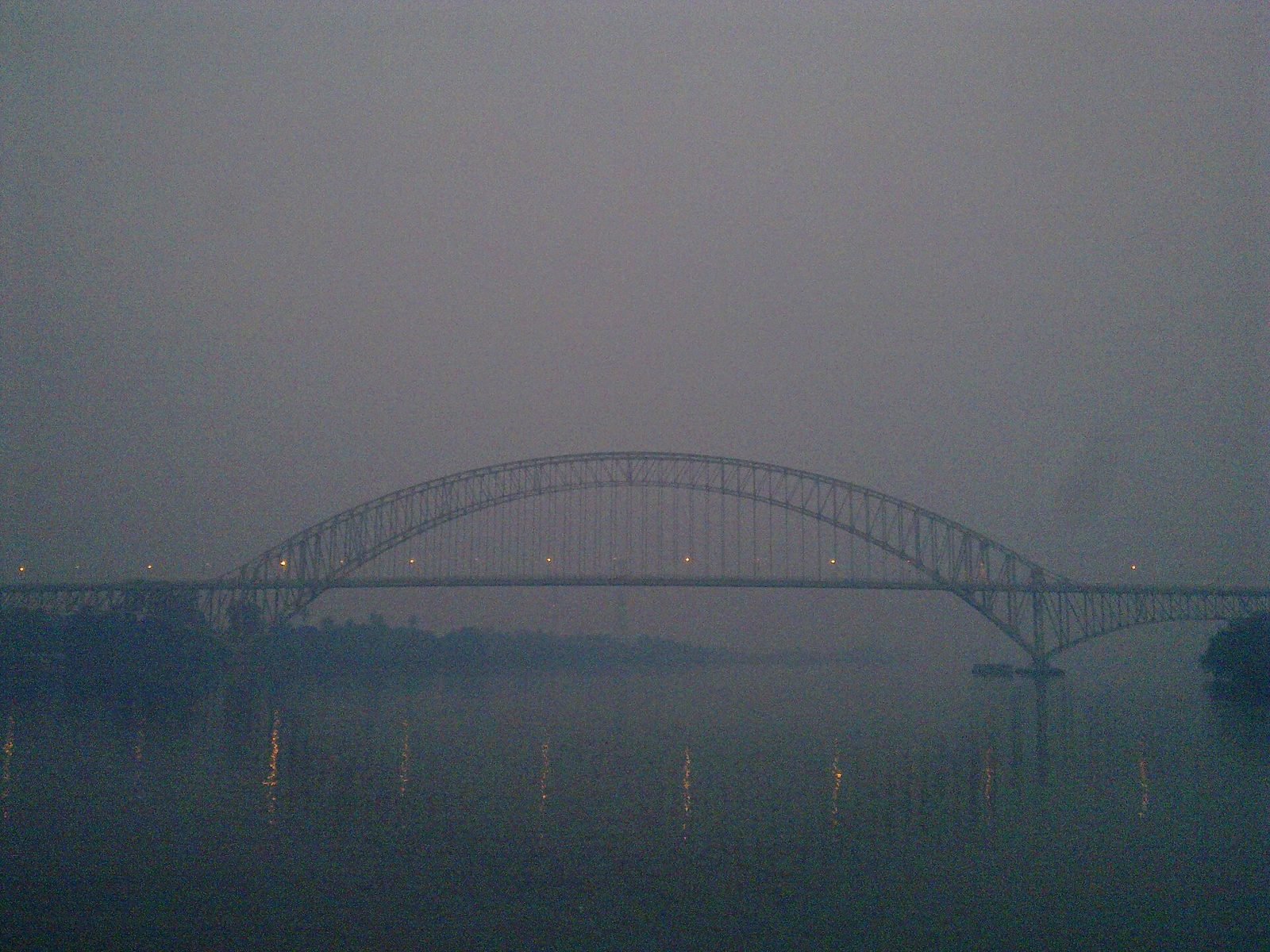
Indonesia's Meteorology, Climatology and Geophysics Agency (BMKG) counted 4,900 hotspots across the country up to 28 July 2026, mostly in West Kalimantan, Riau, South Papua, Aceh and East Kalimantan. BMKG expects the risk of forest and land fires to peak in August and September 2026, with the affected area widening across Riau, South Sumatra, Jambi, West Kalimantan, Central Kalimantan and South Papua (Roshali, 2026). For companies operating in these provinces, the problem does not stop at the fire line on a concession. Smoke drifts into offices, plants, warehouses and workers' homes, often for weeks.
Emergency plans usually treat haze as a health and visibility problem. A question asked less often is how much haze reduces the available workforce, and for how long. This review reads two studies that help answer it: a labour economics study of the 1997 forest fires and a modelling study of the health impact of the 2015 haze.
Two Studies Reviewed
Kim, Manley and Radoias used Indonesia's 1997 forest fires as a natural experiment. Their data came from the Indonesia Family Life Survey (IFLS), a household panel survey representative of more than 80 percent of the Indonesian population. The outcome was weekly working hours. Pollution exposure was measured with a satellite aerosol index for September to November 1997, and working hours in 1993 served as a control for each person's starting point. Medium-term effects were read from working hours in 2000 and long-term effects from 2007.
Higher exposure reduced working hours in both periods, and the medium-term effect was larger than the long-term one. The researchers also traced the channels. In the long term, workers' own health appeared to be the only channel at work. In the medium term, the most important channel was caring for dependants, with adults cutting their hours to look after family members (Kim et al., 2017).
Koplitz and colleagues examined the haze of September and October 2015, when El Niño and a positive Indian Ocean Dipole set the stage for massive fires in Sumatra and Kalimantan. Using the GEOS-Chem chemical transport model and fire emission inventories, they estimated that the 2015 haze caused 100,300 excess deaths across Indonesia, Malaysia and Singapore, more than double the toll of a comparable event under similar weather in 2006. Much of the increase came from fires in South Sumatra Province (Koplitz et al., 2016).
Limits of the Evidence
Both studies have limits worth keeping in mind. IFLS working hours are self-reported, exposure was measured at area level, and the 1997 fires were an extreme event, so the size of the effect may differ in a milder haze season. The study also did not separate workers by sector or job type. The Koplitz estimate is a model result for the whole population. It assumes that smoke travelled along similar paths in 2015 and 2006, and it does not measure illness or lost workdays directly.
Meaning for Workplaces
In our reading, Kim et al. (2017) move haze from a short-term health issue to a business continuity issue. There are two ways a workforce shrinks. The first, workers falling ill, is easy to picture and usually already sits in emergency plans. The second, workers staying home to care for a sick child or relative, is counted far less often, yet in that study it was the channel that mattered most in the medium term. An effect still visible ten years later also suggests that the cost of haze does not end when the sky clears.
The scale of harm in the Koplitz study shows why exposure should be controlled from the start of the season rather than after complaints begin. As a benchmark when reading local monitoring data, the 2021 WHO air quality guidelines set a 24-hour mean for PM2.5 of 15 µg/m³ (World Health Organization [WHO], 2021). That figure is a health guideline, not an occupational limit, but it is useful for setting alert levels.
Practical Steps
- Set data-based triggers. Track hotspots and air quality daily, and link on-site PM2.5 levels to agreed actions, such as limiting heavy outdoor work.
- Prepare rooms with filtered air for rest breaks and for tasks that can move indoors.
- Provide particulate respirators and check that they seal on the face. Indonesia's Minister of Manpower and Transmigration Regulation No. PER.08/MEN/VII/2010 on Personal Protective Equipment requires employers to provide PPE to workers free of charge and lists respiratory protection as one of its types (Kementerian Tenaga Kerja dan Transmigrasi [Kemenakertrans], 2010). Fit decides the result: tests of masks sold in Beijing found average inward leakage of 3 to 68 percent when worn by volunteers, and only one type averaged below 10 percent (Cherrie et al., 2018).
- Add absence for caregiving to the business continuity plan, for example flexible arrangements for workers with young children and a list of stand-ins for critical posts.
- Keep up health surveillance after the haze season, especially for workers with respiratory complaints.
Nusa Safety can help companies build a haze season preparedness plan, from scenarios and action triggers to drills, through Emergency Preparedness & Drills, and can examine operational disruption scenarios through Engineering Studies & Risk Assessments. Nusa Safety issues internal training certificates only and is not a PJK3. To discuss the needs of a specific site, please contact the Nusa Safety team.
This article is general information and not legal or professional advice for any specific case.
References
- Cherrie, J. W., Apsley, A., Cowie, H., Steinle, S., Mueller, W., Lin, C., Horwell, C. J., Sleeuwenhoek, A., & Loh, M. (2018). Effectiveness of face masks used to protect Beijing residents against particulate air pollution. Occupational and Environmental Medicine, 75(6), 446-452. https://doi.org/10.1136/oemed-2017-104765
- Kementerian Tenaga Kerja dan Transmigrasi. (2010). Peraturan Menteri Tenaga Kerja dan Transmigrasi Nomor PER.08/MEN/VII/2010 tentang Alat Pelindung Diri [Minister of Manpower and Transmigration Regulation No. PER.08/MEN/VII/2010 on Personal Protective Equipment]. https://jdih.kemnaker.go.id/peraturan/detail/158/peraturan-menteri-nomor-per-08-men-vii-2010
- Kim, Y., Manley, J., & Radoias, V. (2017). Medium- and long-term consequences of pollution on labor supply: Evidence from Indonesia. IZA Journal of Labor Economics, 6, Article 5. https://doi.org/10.1186/s40172-017-0055-2
- Koplitz, S. N., Mickley, L. J., Marlier, M. E., Buonocore, J. J., Kim, P. S., Liu, T., Sulprizio, M. P., DeFries, R. S., Jacob, D. J., Schwartz, J., Pongsiri, M., & Myers, S. S. (2016). Public health impacts of the severe haze in Equatorial Asia in September-October 2015 - Demonstration of a new framework for informing fire management strategies to reduce downwind smoke exposure. Environmental Research Letters, 11(9), 094023. https://doi.org/10.1088/1748-9326/11/9/094023
- Roshali, R. R. (2026, July 30). BMKG deteksi 4.900 titik panas, 6 wilayah RI terancam karhutla [BMKG detects 4,900 hotspots, 6 regions at risk of forest and land fires]. iNews.id. https://www.inews.id/news/nasional/bmkg-deteksi-4900-titik-panas-6-wilayah-ri-terancam-karhutla
- World Health Organization. (2021). WHO global air quality guidelines - Particulate matter (PM2.5 and PM10), ozone, nitrogen dioxide, sulfur dioxide and carbon monoxide. https://www.who.int/publications/i/item/9789240034228