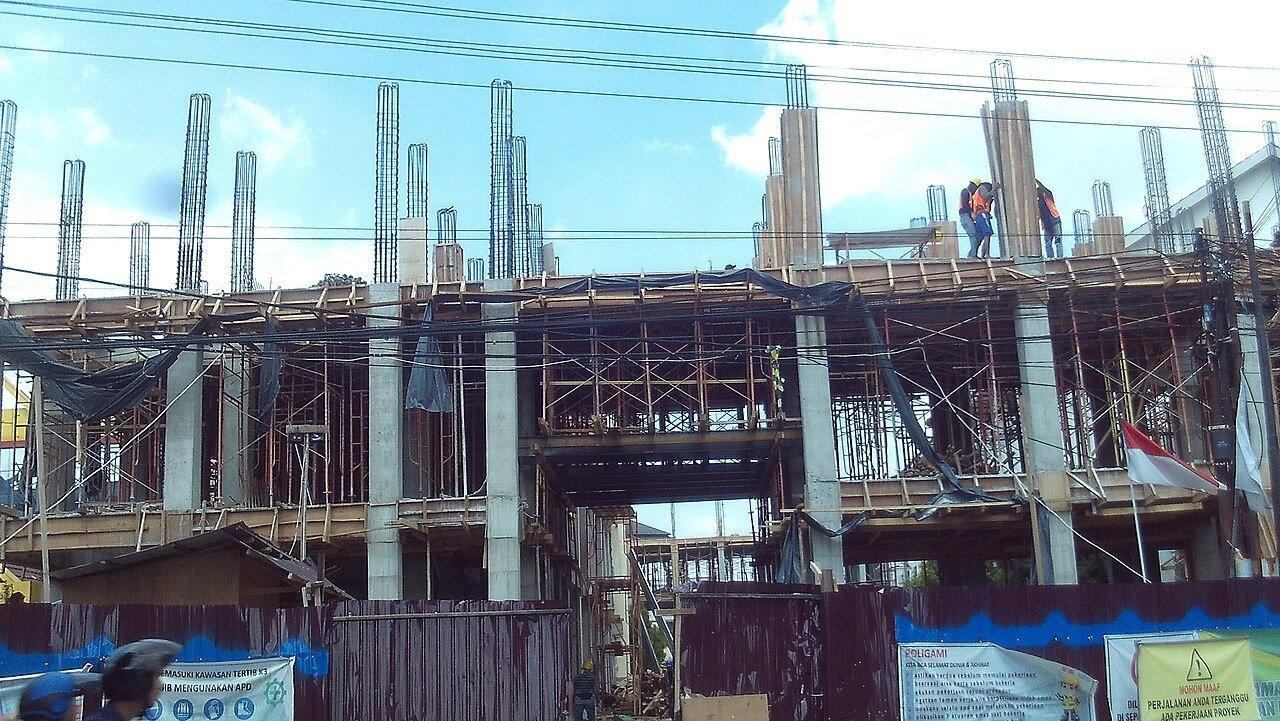
On 3 April 2026, four workers died and three others suffered breathing difficulties after going down into a 3 metre deep clean water tank on the ground floor of a multi-storey building project in Jagakarsa, South Jakarta. Police said the victims ran out of oxygen and collapsed one after another as each tried to help the others (Azhar, 2026). Six months later, on 6 October 2026, the 4 metre wall of a house foundation trench in Watukumpul, Pemalang, collapsed and buried two of the three workers standing at the bottom (iNews.id, 2026).
We compiled six incidents between April and October 2026 that were reported in the media and confirmed by the police, rescue services or the national disaster agency (BNPB). Together they killed at least 12 workers. The compilation is not official data and is almost certainly incomplete. For comparison, BPJS Ketenagakerjaan data processed by the Ministry of Manpower recorded 319,382 work accident cases in 2025, of which only 3,595 came from construction services membership (Muhamad, 2026), or about 1.1 percent by our calculation.
This article answers six questions that come up most often when such incidents occur on houses, boarding houses, shops or school renovations. For every incident we mention, no official investigation report is available yet, so we draw no conclusion about causes.
What Do We Know?
The facts reported by the sources so far are these:
- Jagakarsa, South Jakarta, 3 April 2026: workers were asked to drain a clean water tank on the ground floor of a multi-storey building project; four died and three were treated for breathing difficulties. Police were still examining which gas had been inhaled (Azhar, 2026).
- Cipayung, East Jakarta, 9 July 2026: on a water pipeline project owned by a regional state enterprise, a worker fainted halfway down the ladder into a culvert, and two colleagues who went to help also collapsed. All three died. The fire and rescue service received the report at 09.49 and completed the confined space rescue at 11.55 local time (Mulyana, 2026).
- Jatinangor, Sumedang, 10 July 2026: a retaining wall about 8 metres high collapsed during foundation excavation for a boarding house. Of the eight workers on site, one died and one was injured; police asked for construction to stop until the cause was known (Tim detikJabar, 2026).
- Laweyan, Solo, 23 September 2026: the rear wall of a shop fell during demolition at around 11.25 and killed one worker (Sunaryo, 2026).
- Watukumpul, Pemalang, 6 October 2026: five workers were continuing a house foundation excavation, three at the bottom and two above. The trench wall collapsed, killing two, while one managed to escape (iNews.id, 2026). BNPB said soil from the side of the trench moved suddenly and the ground nearby had cracked, so responders held it back temporarily with timber beams (Jannah, 2026).
- Kedungdung, Sampang, 21 October 2026: the upper frame of a public primary school classroom collapsed during demolition in a renovation project and struck a worker, who died the next day. Sampang district police said the case was still under investigation (Koran Madura, 2026).
The pattern in this list is simple: two incidents in enclosed spaces holding water or drainage, two in trenches, and two during demolition. Three incidents killed more than one person. Everything else, including technical causes and responsibility, awaits the investigations.
Does SMKK Apply?
OHS duties on small projects do not rest on SMKK alone. Law No. 1 of 1970 on Work Safety applies to any workplace where houses, buildings or other structures are built, repaired, maintained, cleaned or demolished, including drains and preparatory work (Article 2(2)(c)) (Republik Indonesia, 1970). A boarding house, a shop or a classroom being demolished falls within it.
Law No. 2 of 2017 on Construction Services adds a second layer. It defines the service user as the owner or principal who uses construction services (Article 1 point 5), and in every construction undertaking the user and the provider must meet the security, safety, health and sustainability standard and must approve, among other things, the technical plan and execution of demolition (Article 59(1) and (2)) (Republik Indonesia, 2017). Breaches carry administrative sanctions (Article 96). Sole proprietors may only take on work that is low risk, simple in technology and low in cost (Article 21).
Minister of Public Works and Housing Regulation No. 10 of 2021 on construction safety management system (SMKK) guidelines carries this down: every service user and provider in a construction undertaking must apply SMKK (Article 2(1)) (Kementerian Pekerjaan Umum dan Perumahan Rakyat [Kementerian PUPR], 2021). Read literally, even a boarding house owner who contracts out the building work is a service user. In practice, the SMKK toolkit of bid safety plans, personnel evaluation and safety costs in the owner's estimate is designed around procurement (Articles 13 and 21) (Kementerian PUPR, 2021), so in our assessment it rarely reaches private projects built on a verbal agreement with a foreman. Legal questions about a specific case should still go to an advocate.
Is the Risk Small?
Regulation 10/2021 divides construction safety risk into small, medium and large. Small risk work is, among other criteria, rated low hazard in the construction safety plan (RKK), has an owner's estimate up to IDR 10 billion, employs fewer than 25 people and/or uses simple technology; where work meets criteria at more than one level, the higher level applies (Article 34) (Kementerian PUPR, 2021). Small risk work procured directly needs only a simplified RKK containing at least a safety policy, PPE procurement, simple hazard identification, signage and an inspection schedule (Article 14).
Article 26 adds an important brake. A construction safety analysis (AKK) applies to large and/or medium risk work and to special work, whose list includes hot work, lifting, confined spaces, night work, work above 1.80 metres, scaffolding, energised electrical work and excavation (Kementerian PUPR, 2021). The wording can be read in more than one way; we read it as two separate groups, which means a foundation trench on a small project still needs an AKK. Demolition is not named in that list, but the list is a minimum.
Mapping the six incidents onto Article 26, four fall into special work categories: two excavations and two confined spaces. The other two are demolition. In our view the weak point is not a lack of rules but how risk levels are understood on site. Contract value and headcount are easy to measure, while the hazard of a 4 metre trench does not change because the contract is small. A trench wall does not read the contract.
Why Several Victims?
In both enclosed space incidents, the second and third victims were workers who went in to help (Azhar, 2026; Mulyana, 2026). A study of work-related confined space deaths across several industrialised countries found that no more than 17 percent of victims were rescuers, that rescuer deaths were overwhelmingly caused by toxic atmospheres, and that most followed hurried, ad hoc rescue attempts (Selman et al., 2018). The same study noted that official figures are probably too low because authorities rarely record incidents as confined space events.
Confined space rescue should be planned before anyone enters, with as few rescuers going in as possible and hazards reduced first (Selman et al., 2019). In Indonesia, Minister of Manpower Regulation No. 11 of 2023 on OHS in confined spaces requires atmospheric gas testing, continuous ventilation, communication, PPE and emergency rescue arrangements to be in place before an entry permit is issued (Article 8) (Kementerian Ketenagakerjaan [Kemnaker], 2023). A basement water tank is rarely thought of as a confined space, yet the definition covers any space a worker can enter that has restricted access and is not designed for continuous work (Article 1).
In trenches, the Pemalang incident shows three people at the bottom at the same time (iNews.id, 2026). The 1986 construction OHS guideline requires soil stability to be tested by a competent person before digging, and trench walls that threaten workers to be battered back, shored or shielded (items 10.1.1 and 10.2.1) (Menteri Tenaga Kerja dan Menteri Pekerjaan Umum, 1986). We make no judgement on whether these measures were in place at any site, because the investigation findings are not public.
What Does Research Say?
Evidence on small projects in Indonesia remains thin. A qualitative study in Australia found that small construction businesses tend to accept risk fatalistically as an unavoidable part of the job, and therefore lean on individual rather than technological controls (Lingard & Holmes, 2001). An evaluation of a mosque project in Bandung with 45 workers found that OHS awareness and knowledge were not yet optimal and that safety equipment was limited (Fadilah & Johari, 2026). Neither study examined fatal incidents, and both contexts differ from a house or boarding house project.
The hierarchy of controls in ISO 45001:2018 puts elimination, substitution and engineering controls above administrative controls and PPE (International Organization for Standardization [ISO], 2018). In a trench or a demolition, a helmet and boots do not hold back falling soil or masonry. The controls that work sit at the top: sloping or shoring the trench, demolishing from the top down, and keeping people out of a tank until the air has been tested.
We also note the limits of the data. Construction cases in the BPJS data cover registered projects only (Muhamad, 2026), while the Watukumpul trench collapse was reported by BNPB as a landslide event (Jannah, 2026). The same incident may be recorded by the police, by BNPB, or not at all as a construction work accident. The 1.1 percent figure above therefore says more about scheme coverage than about the real level of risk.
What About Social Security?
Minister of Manpower Regulation No. 5 of 2021 requires every construction employer to register its workers in the work accident and death benefit programmes; where the work is handed to a contractor, the contractor registers them (Article 66) (Kemnaker, 2021). A construction employer can be an individual, and so can a construction service user (Article 1). Day labourers on a boarding house or shop project are therefore still entitled to protection.
In our assessment, the gap lies in registration per project. On projects run on a verbal agreement there is often no document that triggers registration, leaving workers' families dependent on the goodwill of the owner or foreman when an accident happens.
What Can Be Done?
One belief worth correcting is that PPE is enough on a small project. We drew the following steps from the regulations and guidance above:
- Before work starts, list the project's hazardous tasks: any trench deeper than knee height, demolition, tanks or drains, work above 1.80 metres and electrical work. That list decides who must check the work before it begins, whatever the contract value (Kementerian PUPR, 2021).
- For excavation, have a competent person assess soil stability, slope or shore the sides, keep spoil, materials and machinery away from the edge, and re-inspect after heavy rain or a break of more than one day (items 10.1.1, 10.1.6, 10.1.23, 10.1.24 and 10.2.1) (Menteri Tenaga Kerja dan Menteri Pekerjaan Umum, 1986).
- For demolition, inspect the structure and secure unstable parts, isolate power and water, fence off the danger zone, take walls down from the top, course by course, and keep workers at a safe distance when a wall is pushed over (items 14.1, 14.2.5, 14.5.2 and 14.5.4) (Menteri Tenaga Kerja dan Menteri Pekerjaan Umum, 1986).
- Treat tanks, culverts and wells as confined spaces: test the air before anyone enters, ventilate, post an attendant outside and plan rescue from outside. The 1986 guideline already bars entry into drains or underground spaces until they have been tested free of dangerous gases (item 10.1.18) (Menteri Tenaga Kerja dan Menteri Pekerjaan Umum, 1986), and rescuers should not go in without breathing apparatus and a lifeline (Kemnaker, 2023; Selman et al., 2019).
- Register project workers in the work accident and death benefit programmes before work starts (Kemnaker, 2021).
- Building owners should put the split of OHS responsibilities in writing with the contractor or foreman, including who has authority to stop the work.
How Nusa Safety Helps
As a third party, the Nusa Safety team can help contractors and project owners prepare hazard identification and safety analyses for excavation, demolition and confined spaces through the risk assessment and JSA workshop and engineering studies and risk assessments, write short work instructions for foremen through SOP and technical guideline development, and verify contractors' OHS practice in the field through an HSE and CSMS audit. Certified confined space entry training is delivered with licensed PJK3 partners; Nusa Safety itself issues only internal training certificates and does not hold a PJK3 licence.
This article is general information and is not legal or professional advice for any specific case.
References
- Azhar, M. S. (2026, April 7). 4 pekerja bangunan tewas di Jaksel, polisi: Sesak napas [Four building workers die in South Jakarta, police: Asphyxiation]. Metrotvnews.com. https://www.metrotvnews.com/read/b7WCmxeQ-4-pekerja-bangunan-tewas-di-jaksel-polisi-sesak-napas
- Fadilah, L. A., & Johari, G. J. (2026). Evaluasi sistem manajemen keselamatan kesehatan kerja dalam pembangunan Masjid Eco 2 Daarut Tauhiid Bandung [Evaluation of the OHS management system in the construction of the Eco 2 Daarut Tauhiid Mosque, Bandung]. Jurnal Konstruksi, 24(1). https://doi.org/10.33364/konstruksi/v.24-1.1990
- iNews.id. (2026, October 7). Kronologi 2 pekerja bangunan tewas tertimbun longsoran tebing 4 meter di Pemalang [How two building workers were buried by a 4 metre trench wall collapse in Pemalang]. https://jateng.inews.id/amp/berita/kronologi-2-pekerja-bangunan-tewas-tertimbun-longsoran-tebing-4-meter-di-pemalang
- International Organization for Standardization. (2018). ISO 45001:2018 Occupational health and safety management systems, requirements with guidance for use. https://www.iso.org/standard/63787.html
- Jannah, R. (2026, October 8). Dua pekerja meninggal tertimbun longsor saat gali fondasi bangunan di Pekalongan [Two workers die when buried by soil while digging a building foundation]. NU Online. https://nu.or.id/daerah/dua-pekerja-meninggal-tertimbun-longsor-saat-gali-fondasi-bangunan-di-pekalongan-rHBgS
- Kementerian Ketenagakerjaan Republik Indonesia. (2021). Peraturan Menteri Ketenagakerjaan Nomor 5 Tahun 2021 tentang Tata Cara Penyelenggaraan Program Jaminan Kecelakaan Kerja, Jaminan Kematian, dan Jaminan Hari Tua [Minister of Manpower Regulation No. 5 of 2021 on procedures for the work accident, death and old age benefit programmes]. https://pasal.id/peraturan/permen/permenaker-no-5-tahun-2021
- Kementerian Ketenagakerjaan Republik Indonesia. (2023). Peraturan Menteri Ketenagakerjaan Nomor 11 Tahun 2023 tentang Keselamatan dan Kesehatan Kerja di Ruang Terbatas [Minister of Manpower Regulation No. 11 of 2023 on OHS in confined spaces]. https://pasal.id/peraturan/permen/permenaker-no-11-tahun-2023
- Kementerian Pekerjaan Umum dan Perumahan Rakyat. (2021). Peraturan Menteri Pekerjaan Umum dan Perumahan Rakyat Nomor 10 Tahun 2021 tentang Pedoman Sistem Manajemen Keselamatan Konstruksi [Minister of Public Works and Housing Regulation No. 10 of 2021 on construction safety management system guidelines]. https://pasal.id/peraturan/permen/permen-pupr-no-10-tahun-2021
- Koran Madura. (2026, October 28). Pekerja rehab SDN Komis I tewas tertimpa rangka bangunan [School renovation worker killed by collapsing building frame]. https://koranmadura.com/2026/10/pekerja-rehab-sdn-komis-i-tewas-tertimpa-rangka-bangunan/
- Lingard, H., & Holmes, N. (2001). Understandings of occupational health and safety risk control in small business construction firms: Barriers to implementing technological controls. Construction Management and Economics, 19(2), 217-226. https://doi.org/10.1080/01446190010002570
- Menteri Tenaga Kerja dan Menteri Pekerjaan Umum. (1986). Keputusan Bersama Menteri Tenaga Kerja dan Menteri Pekerjaan Umum Nomor Kep-174/MEN/1986 dan Nomor 104/KPTS/1986 tentang Keselamatan dan Kesehatan Kerja pada Tempat Kegiatan Konstruksi [Joint Decree of the Minister of Manpower and the Minister of Public Works on OHS at construction sites]. https://jdih.kemnaker.go.id/asset/data_puu/1986KB174.pdf
- Muhamad, N. (2026, April 13). Sebaran kasus kecelakaan kerja di RI 2025, Jatim terbanyak [Distribution of work accident cases in Indonesia in 2025]. Databoks, Katadata. https://databoks.katadata.co.id/ketenagakerjaan/statistik/69dc599b93235/sebaran-kasus-kecelakaan-kerja-di-ri-2025-jatim-terbanyak
- Mulyana, K. E. (2026, July 9). 3 pekerja tewas dalam gorong-gorong di Cipayung, diduga akibat gas beracun [Three workers die in a culvert in Cipayung, toxic gas suspected]. Kompas TV. https://www.kompas.tv/regional/679563/3-pekerja-tewas-dalam-gorong-gorong-di-cipayung-diduga-akibat-gas-beracun
- Republik Indonesia. (1970). Undang-Undang Nomor 1 Tahun 1970 tentang Keselamatan Kerja [Law No. 1 of 1970 on Work Safety]. Lembaran Negara Republik Indonesia Tahun 1970 Nomor 1. https://pasal.id/peraturan/uu/uu-no-1-tahun-1970
- Republik Indonesia. (2017). Undang-Undang Nomor 2 Tahun 2017 tentang Jasa Konstruksi [Law No. 2 of 2017 on Construction Services]. Lembaran Negara Republik Indonesia Tahun 2017 Nomor 11. https://pasal.id/peraturan/uu/uu-no-2-tahun-2017
- Selman, J., Spickett, J., Jansz, J., & Mullins, B. (2018). An investigation into the rate and mechanism of incident of work-related confined space fatalities. Safety Science, 109, 333-343. https://doi.org/10.1016/j.ssci.2018.06.014
- Selman, J., Spickett, J., Jansz, J., & Mullins, B. (2019). Confined space rescue: A proposed procedure to reduce the risks. Safety Science, 113, 78-90. https://doi.org/10.1016/j.ssci.2018.11.017
- Sunaryo, A. (2026, September 23). Detik-detik pekerja bangunan di Solo tewas tertimpa tembok [Building worker in Solo killed by a falling wall]. Merdeka.com. https://www.merdeka.com/peristiwa/read/8298202/detik-detik-pekerja-bangunan-di-solo-tewas-tertimpa-tembok
- Tim detikJabar. (2026, July 11). Petaka proyek kosan Jatinangor [Disaster at a Jatinangor boarding house project]. detikJabar. https://www.detik.com/jabar/berita/d-8568901/petaka-proyek-kosan-jatinangor