A fire swept through a row of shophouses and small businesses in Pulogadung, East Jakarta, at around 03.00 on 12 July 2026. Three people died and one was injured. Preliminary findings at the scene suggested the fire started from a short circuit at one of the socket outlets (Hafiez, 2026). As of this article's date, we have not found an official report on the confirmed cause. A month earlier, Jakarta's Deputy Governor said that almost 95 percent of fires in the city were triggered by electrical short circuits, based on a provincial government survey (Kusuma, 2026).
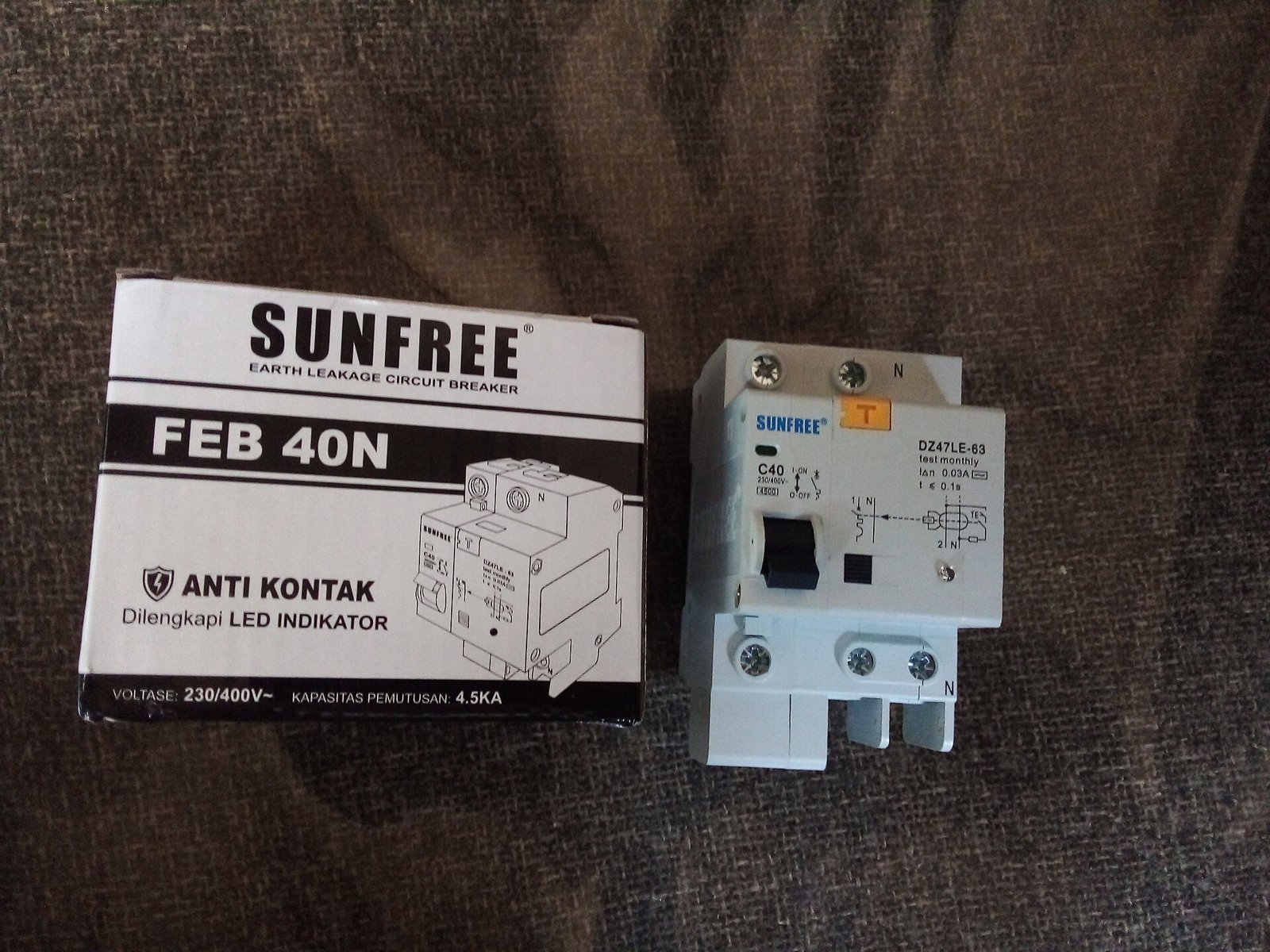
In June 2026, the Ministry of Energy and Mineral Resources (ESDM) said it was finalising a ministerial regulation to make residual current devices (RCDs, known in Indonesia as GPAS) mandatory in low-voltage installations. Under the draft, residual current breakers with overcurrent protection (RCBOs) are to replace miniature circuit breakers (MCBs), the requirement will be phased in, and its scope includes office buildings and markets. The draft was reported to be still in harmonisation (Candra, 2026).
This literature review follows one question: how far can residual current devices prevent electric shock and electrical fires at work?
What Is Known
An RCBO combines two functions. It monitors the balance of current in the phase and neutral conductors and disconnects the supply when a difference signals leakage to earth or to an equipment casing, and it also protects against overload and short circuit as an MCB does (Candra, 2026).
The first function bears directly on electric shock. An autopsy study of 386 electrocution deaths in Türkiye between 2015 and 2019 found that 53.89 percent happened at work and 47.41 percent involved low-voltage alternating current below 1,000 V. Electrical leakage was about 2.7 times more likely on wet floors than on dry ones, and the researchers recommended wide adoption of residual current devices (Doğan et al., 2026). In other words, everyday low-voltage installations accounted for almost half of the deaths in that study.
Evidence That Pulls Apart
For fires the picture is more complicated. Yang et al. (2016) place arc faults among the most important causes of electrical fires, typically triggered by loose cable connections, insulation worn by corrosion, age, bending or heat, and damaged equipment. Arc faults come in three types: series, parallel and ground. Because of arc impedance, series arc currents are usually lower than the rated load current, while parallel and ground arc currents are lower than short-circuit currents. According to Yang et al., such currents are not enough to trigger overcurrent protectors or ground fault interrupters, so neither can be relied on to protect circuits from arc faults.
The technological answer is the arc fault detection device, required in the United States through the National Electrical Code and covered internationally by IEC 62606 (Yang et al., 2016). These devices are not perfect either. A systematic review of 63 articles found that artificial intelligence improves detection accuracy and speed, but three major challenges remain: missed and false detections, limited application of neural networks, and a shortage of data (Tian et al., 2023).
Gaps in the Evidence
We see three gaps. First, the 95 percent figure for Jakarta comes from a survey and uses the short-circuit label (Kusuma, 2026), which does not separate mechanisms such as earth leakage, overload or arcing at connections. Without that separation, the share of fires that RCDs could prevent cannot be estimated. Second, the electrocution evidence we found comes from Türkiye (Doğan et al., 2026), and we found no evaluation of the effect of residual current requirements in Indonesia. Third, the arc fault evidence comes largely from laboratory testing and algorithm development (Tian et al., 2023; Yang et al., 2016), not from field evaluation in small commercial buildings such as shophouses.
On the evidence available, our assessment is as follows. A requirement for residual current devices deserves support, because its benefit for preventing electric shock has the strongest evidence and logic. For fires, the benefit is limited to faults that produce enough leakage current. A loose socket connection or a cable with damaged insulation can overheat without ever tripping an RCBO. The early findings on the Pulogadung fire (Hafiez, 2026) point to the kind of location that deserves inspection, but the actual cause awaits the official investigation.
Steps for Building Managers
Until the regulation is issued, managers of offices, warehouses, markets and shophouses can start with the following:
- Map circuits that lack residual current protection, prioritising wet areas, sockets for portable equipment and outdoor areas.
- Test installed RCDs regularly with their test button as the manufacturer instructs, and record the results.
- Inspect sockets, extension leads and panel terminals for loose connections, signs of heat and cracked insulation.
- Do not treat replacing MCBs with RCBOs as a substitute for inspecting the installation.
- Follow the issuance of the ESDM regulation on residual current devices and its phasing.
How Nusa Safety Helps
Nusa Safety helps companies assess electrical installations as a whole. Through the Electrical System Assessment, the Nusa Safety team checks the adequacy of protective devices, the condition of connections and hot spots in panels. The Fire and Emergency Safety Audit (FESA) links electrical risk with fire protection readiness, and technicians' competence can be built through electrical safety training, with official certification delivered together with licensed PJK3 partners. Nusa Safety issues internal training certificates only.
This article is general information and not legal or professional advice for any specific case.
References
- Candra. (2026, June 7). Pemerintah siapkan aturan wajib RCBO gantikan MCB. Listrik Indonesia. https://listrikindonesia.com/detail/20277/pemerintah-siapkan-aturan-wajib-rcbo-gantikan-mcb
- Doğan, M., Çoban, İ., Şahan, O., Üzün, İ., & Aksoy, M. E. (2026). Electrocution-related deaths in Türkiye: A 5-year autopsy-based forensic study of 386 cases with multimodal medicolegal evaluation. Journal of Forensic Sciences, 71(3), 1264-1274. https://doi.org/10.1111/1556-4029.70303
- Hafiez, F. A. (2026, July 12). Kebakaran ruko di Pulogadung mengakibatkan 3 orang tewas. Metrotvnews.com. https://www.metrotvnews.com/read/bmRCY0QL-kebakaran-ruko-di-pulogadung-mengakibatkan-3-orang-tewas
- Kusuma, A. I. (2026, June 2). Rano Karno ungkap 95 persen kebakaran Jakarta dipicu korsleting listrik. Kompas TV. https://www.kompas.tv/regional/672451/rano-karno-ungkap-95-persen-kebakaran-jakarta-dipicu-korsleting-listrik
- Tian, C., Xu, Z., Wang, L., & Liu, Y. (2023). Arc fault detection using artificial intelligence: Challenges and benefits. Mathematical Biosciences and Engineering, 20(7), 12404-12432. https://doi.org/10.3934/mbe.2023552
- Yang, K., Zhang, R., Yang, J., Liu, C., Chen, S., & Zhang, F. (2016). A novel arc fault detector for early detection of electrical fires. Sensors, 16(4), 500. https://doi.org/10.3390/s16040500