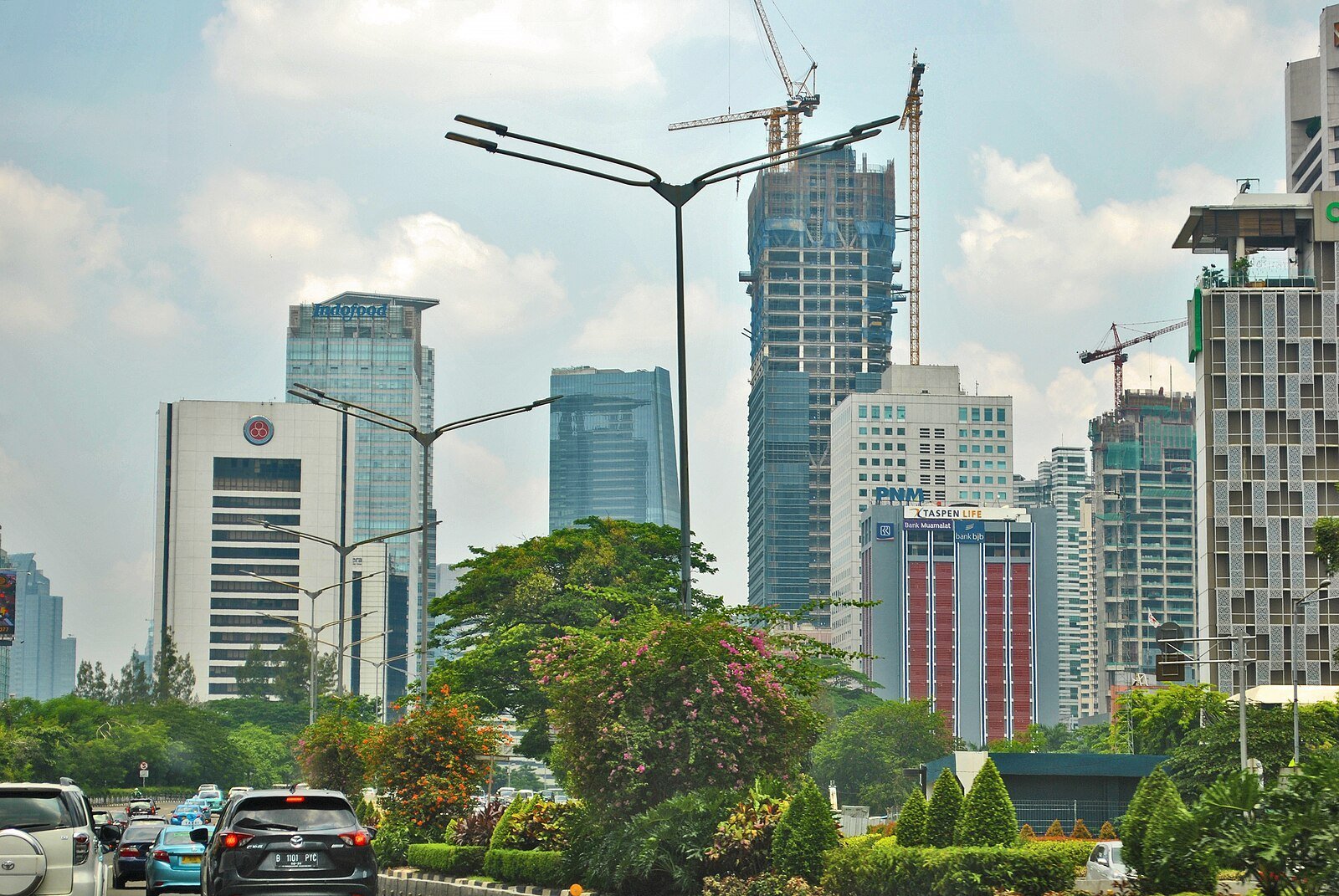
On Friday, 13 November 2026, at about 11.10 WIB, a tower crane at a hotel construction project in Mega Kuningan, Setiabudi, South Jakarta, broke and struck a worker. He was taken to hospital but could not be saved (Murti, 2026). Police brought in the national police forensic laboratory (Puslabfor) and halted work on the project (Naibaho, 2026b). Indonesia recorded 462,241 work accident cases in 2024, 0.92% among construction services participants, with no breakdown by equipment (Ministry of Manpower [MoM], 2025).
No official investigation report is available yet. We set out the timeline from official statements and credible media, then ask how a tower crane fails structurally and whether statutory inspection (riksa uji), procedures and personnel certification cost too much next to the loss from a collapse. Every cause named here is a working hypothesis from the engineering literature, not a finding about this event, and we make no judgement about any individual.
The Timeline So Far
On the day, the Jakarta Metropolitan Police spokesperson put the accident at about 11.25 WIB (Tim detikcom, 2026); the next day he gave 11.10 WIB: workers on the sixth floor were getting ready for their break and queuing for the hoist down when part of the tower crane suddenly broke and its material fell on one of them (Murti, 2026). The Setiabudi police chief said that "one of the cranes came loose and fell" and that the victim was probably last in the queue (Naibaho, 2026a).
A nearby worker heard a thunder-like rumble at about 11.00 WIB and saw the crane break; another filmed the red jib down but still attached at the base of the crane, with objects crushed beneath it (CNN Indonesia, 2026).
The caption was written while police were still counting and identifying victims (cnnindonesia, 2026); official statements since then report one worker killed (Murti, 2026; Rahayu, 2026).
On 14 November, the forensic team worked the site from 10.13 to about 16.00 WIB and loaded frayed, partly unravelled lengths of steel cable, steel bars and a scaffold onto a vehicle marked "Metallurgy Forensic" (Naibaho, 2026a). About 10 witnesses, including the contractor, had been questioned, the site was taped off, and work was stopped pending the results (Naibaho, 2026b). Police could not yet describe the damage found on the crane (Rahayu, 2026).
Jakarta's provincial government said its labour inspectors would summon the contractor, coordinate with police and the social security agency BPJS Ketenagakerjaan, and examine OSH compliance (Putri, 2026). The governor said human error and technical fault were both being examined and promised to publish the outcome (Rahayu, 2026).
As of 16 November, nothing had been reported on the crane's configuration (flat or luffing jib), whether it was lifting, climbing or idle, the wind, its inspection status or the operator's licence.
How Tower Cranes Fail
A SafeWork NSW review summarises an analysis for Britain's Health and Safety Executive (HSE) of 85 tower crane incidents from 1989 to 2009. Of the 57 with a known cause, 29 (51%) happened during erection, dismantling or extension of the crane, 15 (26%) in extreme weather, 6 (10%) through misuse, and the rest through structural, foundation or control system problems (Lingard et al., 2019). It also notes that 68.4% of fatal tower crane accidents in Korea from 2001 to 2011 occurred during installation or dismantling (Lingard et al., 2019). A review of 141 investigation reports in China from 2013 to 2018 found wrong actions by workers, inadequate training and inspection, low safety awareness and weak management to be critical causes (Zhang et al., 2020).
From this literature we draw six failure modes investigators commonly examine:
- Mast and slewing connections. Fractography and electron microscopy of collapsed tower cranes found the connecting bolts to be the most vulnerable parts and led the authors to recommend additional rules for checking their maintenance and safety (Kim & Choi, 2013).
- Fatigue cracking at welded joints in the jib, counter-jib or tower. In Semarang, a 1.5 m crack was found in the tower of a port crane after about four years of service, and finite element analysis concluded it was not fatigue under the design loads (Cahyono & Ariatedja, 2018). Telling fatigue from weld defects takes examination of the fracture, not assumption.
- Overload of the jib or counter-jib, including a disabled or uncalibrated load moment limiter. Permenaker 8/2020 requires electrically driven cranes to have an automatic limiter that stops hoisting when the load exceeds the permitted working load (Article 40(2)(c)), and tower cranes to carry a chart or device showing the balance between load position and counterweight (Article 47(1)(a)) (MoM, 2020).
- Failure of hoist or jib support ropes. Wire rope must be inspected at first installation, before each operation and once a week (Article 33(1)(c)) (MoM, 2020). On luffing-jib cranes, the working radius is changed by raising and lowering the jib (American Society of Mechanical Engineers [ASME], 2025); in our reading, failure of the ropes or ties that hold the jib could drop it while it stays pinned at the heel.
- Errors during climbing, erection or dismantling. In New York in 2008, a tie-in collar hung on polyester slings slipped while being fitted at the 18th floor, the mast lost lateral support and the crane fell, killing six workers and a member of the public (Occupational Safety and Health Administration [OSHA], 2008). In Seattle in 2019, nearly all mast pins and sleeves were removed early during dismantling, a gust above 45 miles per hour toppled the tower, and four people died (Washington State Department of Labor & Industries, 2019).
- Wind when the crane is out of service. HSE investigated catastrophic damage where the slew brake had not been released, so the jib could not weathervane, and found poor maintenance or driver confusion to be the usual causes (Smith, 2022). For luffing cranes, HSE also requires the jib to be parked at a safe out-of-service radius (Health and Safety Executive [HSE], 2014). Permenaker 8/2020 requires operators to stop crane operation when wind speed exceeds 38 km/h (Article 49(2)(g)) (MoM, 2020).
Reading the Early Evidence
In our view, the early evidence cannot yet separate most of these hypotheses. The report that the jib fell but stayed attached at the base of the crane (CNN Indonesia, 2026) fits a failure in the jib or its support better than a collapse of the whole tower, since in New York and Seattle the entire tower came down (OSHA, 2008; Washington State Department of Labor & Industries, 2019). But "base" could mean the jib heel or the tower foot.
The frayed wire rope (Naibaho, 2026a) says nothing yet about sequence: a rope that parted first and one torn as the jib fell can both look frayed. The rumble (CNN Indonesia, 2026) is an account of sound, not weather data, and we found no report of strong wind then. A break time does not prove the crane was idle.
Investigators usually examine fracture surfaces by fractography and electron microscopy (Kim & Choi, 2013), material and weld quality, bolt tightening records, limiter and anemometer logs, the erection or climbing procedure used, inspection history and personnel licences. Indonesian periodic testing covers documents, visual and dimensional checks, non-destructive testing of main components, function tests and load tests (Article 176(3)) (MoM, 2020). A study of one tower crane inspection found the hook safety latch had been replaced by welding it to the hook body (Pinto & Sukwadi, 2025), a modification visible only on close inspection.
ISO 12482:2014 gives a method for tracking a crane's actual duty against its design classification, but it does not apply to tower cranes other than permanently installed ones (International Organization for Standardization [ISO], 2014). For construction tower cranes that move between projects, structural life can only be followed through inspection history and owner records.
Counting Costs and Benefits
We keep official figures apart from illustrative ones.
Official figures first. Lifting equipment must be retested no later than 2 years after the first test and every year after that (Article 176(1)), and a first test is also required each time a crane is installed or assembled (Article 175(1)) (MoM, 2020). Operators, technicians and riggers must hold a competence certificate and an OSH licence (Article 140(3) and (4)), and the licence is valid for 5 years (Article 162(2)) (MoM, 2020). The non-tax state fee for inspecting and testing a crane is Rp300,000 per document, while an operator or rigger licence costs Rp120,000 per person for evaluation and Rp150,000 per document for issue (Government of the Republic of Indonesia, 2023). These are state fees; the price of PJK3 services, procedures and training is not published.
On the loss side, when a participant dies in a work accident the work accident benefit (JKK) pays a lump sum of 60% x 80 x monthly wage, or 48 months' wages, plus Rp10,000,000 funeral costs, Rp12,000,000 in periodic benefits and education grants for up to two children (Government of the Republic of Indonesia, 2019). Using Jakarta's 2026 minimum wage of Rp5,729,876 (Zahdomo, 2025), we calculate a lump sum of Rp275,034,048 and a maximum package of about Rp471 million if two children receive full grants. BPJS Ketenagakerjaan, not the contractor, pays this, and it is not a value of life.
A fatal accident may go straight to criminal enforcement (Article 9(2)(a)), trigger special testing under inspector's tape and seals (Article 42(2) and (4)), lead to a ban or work stoppage for equipment that fails (Article 45(4)), and void the existing OSH certificate (Article 45(8)) (MoM, 2026). Under the Criminal Code, negligence causing death carries up to 5 years in prison or a category V fine of Rp500,000,000 (Articles 474 and 79), increased by a third when committed in the course of a profession (Article 475) (Republic of Indonesia, 2023). The penalty clause in Article 15(2) of Law Number 1 of 1970 on Occupational Safety (Republic of Indonesia, 1970) must now be read with the adjustment of penalties outside the Criminal Code (Article II) (Republic of Indonesia, 2026).
At 2024 prices, one work fatality costs society £2,185,000, made up of £1,632,000 in human costs and £553,100 in financial costs, while the cost to employers per case is only £111,000 (HSE, 2026). By our calculation, employers bear about 5% of the total and human costs make up about 75%. A company-only analysis therefore understates the benefit of prevention.
The worked example below is not data from this event; all figures are hypothetical except the JKK package.
- Prevention cost (P) for one tower crane over a 24-month project: inspections Rp60 million; erection, climbing and dismantling procedures and lift plans Rp40 million; training and licensing three operators and riggers Rp45 million; routine bolt, limiter and anemometer checks Rp55 million. Total Rp200 million.
- Loss from one collapse with one fatality (C): crane replacement, dismantling and recovery Rp6 billion; damage to the structure and third parties Rp3.5 billion; a 60-day stoppage with fixed costs and delay damages of Rp175 million a day, or Rp10.5 billion; the JKK package of about Rp0.47 billion. Total about Rp20.5 billion, before legal, reputational, contract and insurance deductible costs.
The formula: expected net benefit = p x r x C - P, where p is the probability of a collapse during the project without the programme and r the share of that risk the programme removes. Break-even is at p = P / (r x C). With the figures above, C is about 102 times P. A programme that removed all the risk breaks even if it prevents one collapse in about 102 crane-projects; one that removed half the risk breaks even at one collapse in about 51.
The result is sensitive: two deaths and a 120-day stoppage raise C to about Rp31.4 billion and the ratio to about 157, a P of Rp100 million gives about 205, and a contract that grants a time extension without delay damages cuts C to about Rp10 billion and the ratio to about 50.
We found no open data on the probability of tower crane collapse per project in Indonesia, so we cannot say the threshold is exceeded. We still judge prevention costs reasonable, for four reasons. First, the state fee component is tiny: Rp300,000 for one inspection document against the JKK package for one death is roughly 1:1,570. Second, C in the example contains almost no human cost, which HSE puts at about 75% of the cost of a fatality. Third, one collapse on a dense urban site can kill more than one person, as the seven deaths in New York and four in Seattle show (OSHA, 2008; Washington State Department of Labor & Industries, 2019). Fourth, the same controls cut more frequent events such as falling objects during normal operation, a high-severity cluster (Lingard et al., 2019). Inspection and licensing are legal duties anyway, not investment choices.
Practical Prevention Steps
- Keep the manual, foundation calculations and tie-in design on site, and inspect every crane on each installation, hired ones included (MoM, 2020).
- Write erection, climbing and dismantling procedures per crane with one person in charge; Seattle shows why pins come out only for the section being lifted (Washington State Department of Labor & Industries, 2019).
- Torque-check mast and slewing ring bolts as the manual requires, record results and replace bolts as specified (Kim & Choi, 2013).
- Function-test limiters and the anemometer regularly and forbid bypassing them without written approval.
- Set a procedure for leaving the crane: slew brake released, luffing jib at a safe radius, and a check that buildings or other cranes do not block free slewing (HSE, 2014; Smith, 2022).
- Make sure operators hold a licence of the right class; class II crane operators are limited to towers up to 60 m and class III to 40 m (Article 165(4) and (5)) (MoM, 2020).
- Keep hoist queues and break areas out from under the jib path; in this event the victim was queuing for the hoist (Murti, 2026).
- After an accident or major damage, treat the existing OSH certificate as void and apply for special testing before the equipment is used again (MoM, 2026).
One belief needs correcting: an inspection sticker does not make a crane safe all year, because loose bolts, fatigue cracks and defeated limiters can appear between tests. Our earlier pieces on crane wind limits, lifting accessory discard criteria and the PBG, SLF, SLO and riksa uji compliance map complete this list.
How Nusa Safety Helps
As a third party, the Nusa Safety team can build a crane register and testing schedule and coordinate statutory equipment inspection with licensed PJK3 partners, including follow-up of findings. Operators and riggers can be prepared through operator and rigger training run with licensed partners, and procedures and lift plans developed through SOP and technical guideline development and a risk assessment and JSA workshop. Incident investigation and RCA training helps internal teams collect evidence properly.
Nusa Safety issues only internal training certificates. It is not a PJK3 and does not issue OSH licences, Ministry of Manpower or BNSP certificates, or statutory inspection certificates. To discuss your site, use the contact page.
This article is general information and not legal or professional advice for any specific case.
References
- American Society of Mechanical Engineers. (2025). ASME B30.3-2025: Tower cranes. https://www.asme.org/codes-standards/find-codes-standards/b30-3-tower-cranes
- Cahyono, H. A. R., & Ariatedja, J. B. (2018). Analisis fatigue pada slewing tower level luffing crane berbasis metode elemen hingga [Fatigue analysis of the slewing tower of a level luffing crane using the finite element method]. Jurnal Teknik ITS, 7(2). https://doi.org/10.12962/j23373539.v7i2.36215
- CNN Indonesia. (2026, November 13). Crane jatuh di kawasan Mega Kuningan Jaksel, dilaporkan ada korban [Crane falls in Mega Kuningan, South Jakarta, casualties reported]. https://www.cnnindonesia.com/nasional/20261113142916-12-1426856/crane-jatuh-di-kawasan-mega-kuningan-jaksel-dilaporkan-ada-korban
- cnnindonesia. (2026, November 13). Sebuah crane patah dan jatuh di lokasi proyek pembangunan hotel kawasan Jalan Lingkar Mega Kuningan, Setiabudi, Jakarta Selatan [A crane broke and fell at a hotel construction site on Jalan Lingkar Mega Kuningan, Setiabudi, South Jakarta] [Video]. Instagram. https://www.instagram.com/reel/DfryAd3Dr1E/
- Government of the Republic of Indonesia. (2019). Government Regulation Number 82 of 2019 amending Government Regulation Number 44 of 2015 on the work accident and death benefit programmes. State Gazette of 2019 Number 231. https://jdih.kemnaker.go.id/peraturan/detail/1631/peraturan-pemerintah-nomor-82-tahun-2019
- Government of the Republic of Indonesia. (2023). Government Regulation Number 41 of 2023 on the types and rates of non-tax state revenue applicable at the Ministry of Manpower. State Gazette of 2023 Number 106. https://jdih.kemnaker.go.id/peraturan/detail/2356/peraturan-pemerintah-nomor-41-tahun-2023
- Health and Safety Executive. (2014). Preventing catastrophic failure of luffing jib tower cranes in high winds (Safety alert FOD 2-2014). https://www.hse.gov.uk/safetybulletins/luffing-jib-tower-cranes.htm
- Health and Safety Executive. (2026). Appraisal values or 'unit costs'. https://www.hse.gov.uk/statistics/economics/eauappraisal.htm
- International Organization for Standardization. (2014). Cranes - Monitoring for crane design working period (ISO Standard No. 12482:2014). https://www.iso.org/standard/57481.html
- Kim, E. S., & Choi, S. K. (2013). Failure analysis of connecting bolts in collapsed tower crane. Fatigue & Fracture of Engineering Materials & Structures, 36(3), 228-241. https://doi.org/10.1111/j.1460-2695.2012.01716.x
- Lingard, H., Cooke, T., Harley, J., Pirzadeh, P., Zelic, G., Wilczynska, M., Wakefield, R., & Gharaie, E. (2019). Crane safety in construction: Technical report. SafeWork NSW and RMIT University. https://www.safework.nsw.gov.au/resource-library/whs-research/Crane-safety-in-construction-technical-report.pdf
- Ministry of Manpower of the Republic of Indonesia. (2020). Peraturan Menteri Ketenagakerjaan Nomor 8 Tahun 2020 tentang Keselamatan dan Kesehatan Kerja Pesawat Angkat dan Pesawat Angkut [Minister of Manpower Regulation No. 8 of 2020 on occupational safety and health of lifting and conveying equipment]. State Bulletin of 2020 Number 609. https://jdih.kemnaker.go.id/peraturan/detail/1668/peraturan-menteri-ketenagakerjaan-nomor-8-tahun-2020
- Ministry of Manpower of the Republic of Indonesia. (2025). Kasus kecelakaan kerja tahun 2024 [Work accident cases in 2024] [Data set]. Portal Satu Data Indonesia. https://data.go.id/dataset/dataset/kasus-kecelakaan-kerja-tahun-2024
- Ministry of Manpower of the Republic of Indonesia. (2026). Peraturan Menteri Ketenagakerjaan Nomor 11 Tahun 2026 tentang Tata Cara Pengawasan Ketenagakerjaan [Minister of Manpower Regulation No. 11 of 2026 on labour inspection procedures]. State Bulletin of 2026 Number 438. https://jdih.kemnaker.go.id/peraturan/detail/3070/peraturan-menteri-ketenagakerjaan-nomor-11-tahun-2026
- Murti, A. S. (2026, November 14). Kronologi tower crane patah di Mega Kuningan, satu pekerja tewas [Timeline of the Mega Kuningan tower crane failure, one worker killed]. Okezone News. https://news.okezone.com/read/2026/11/14/338/3253986/kronologi-tower-crane-patah-di-mega-kuningan-satu-pekerja-tewas
- Naibaho, R. (2026a, November 14). Puslabfor bawa sampel kabel sling baja dari TKP crane jatuh di Kuningan [Police forensic lab takes steel wire rope samples from the Kuningan crane site]. detikNews. https://news.detik.com/berita/d-8753092/puslabfor-bawa-sampel-kabel-sling-baja-dari-tkp-crane-jatuh-di-kuningan
- Naibaho, R. (2026b, November 15). Yang diketahui soal crane jatuh tewaskan pekerja di Kuningan Jaksel [What is known about the fatal crane fall in Kuningan, South Jakarta]. detikNews. https://news.detik.com/berita/d-8753511/yang-diketahui-soal-crane-jatuh-tewaskan-pekerja-di-kuningan-jaksel
- Occupational Safety and Health Administration. (2008). Investigation of the March 15, 2008 fatal tower crane collapse at 303 East 51st Street, New York, NY. U.S. Department of Labor. https://www.osha.gov/sites/default/files/2019-12/2008_r_02.pdf
- Pinto, G. P. M., & Sukwadi, R. (2025). Pemeriksaan dan pengujian pesawat angkat angkut jenis tower crane [Inspection and testing of tower crane lifting equipment]. Jurnal Praktik Keinsinyuran, 2(5), 597-605. https://doi.org/10.25170/jpk.v2i05.7347
- Putri, L. M. (2026, November 15). DKI tindak lanjuti kecelakaan kerja tower crane di Mega Kuningan [Jakarta follows up the Mega Kuningan tower crane work accident]. ANTARA. https://www.antaranews.com/berita/5855407/dki-tindak-lanjuti-kecelakaan-kerja-tower-crane-di-mega-kuningan
- Rahayu, I. R. S. (2026, November 15). Crane patah di Kuningan tewaskan pekerja, Pramono: Penyebab masih didalami [Crane failure in Kuningan kills worker, governor says cause still under investigation]. Kompas.com. https://megapolitan.kompas.com/read/2026/11/15/15213721/crane-patah-di-kuningan-tewaskan-pekerja-pramono-penyebab-masih-didalami
- Republic of Indonesia. (1970). Law Number 1 of 1970 on Occupational Safety. State Gazette of 1970 Number 1. https://jdih.kemnaker.go.id/peraturan/detail/49/undang-undang-nomor-1-tahun-1970
- Republic of Indonesia. (2023). Law Number 1 of 2023 on the Criminal Code. State Gazette of 2023 Number 1. https://pasal.id/peraturan/uu/uu-no-1-tahun-2023
- Republic of Indonesia. (2026). Law Number 1 of 2026 on the Adjustment of Criminal Penalties. https://pasal.id/peraturan/uu/uu-no-1-tahun-2026
- Smith, E. (2022). Mechanical assessment of tower crane slewing brakes (Research Report RR1172). Health and Safety Executive. https://www.hse.gov.uk/research/rrhtm/rr1172.htm
- Tim detikcom. (2026, November 14). 3 fakta crane jatuh di Kuningan tewaskan 1 orang [Three facts about the fatal crane fall in Kuningan]. detikNews. https://news.detik.com/berita/d-8752406/3-fakta-crane-jatuh-di-kuningan-tewaskan-1-orang
- Washington State Department of Labor & Industries. (2019, October 17). Labor & Industries cites three employers for multiple violations connected with fatal Seattle crane collapse. https://lni.wa.gov/news-events/article/19-027
- Zahdomo, R. (2025, December 27). UMP DKI Jakarta 2026 naik jadi Rp5,7 juta, begini penjelasan Pemprov soal protes buruh [Jakarta's 2026 minimum wage rises to Rp5.7 million; the provincial government responds to union protests]. JawaPos.com. https://www.jawapos.com/jabodetabek/2512270022/ump-dki-jakarta-2026-naik-jadi-rp-57-juta-begini-penjelasan-pemprov-soal-protes-buruh
- Zhang, X., Zhang, W., Jiang, L., & Zhao, T. (2020). Identification of critical causes of tower-crane accidents through system thinking and case analysis. Journal of Construction Engineering and Management, 146(7), 04020071. https://doi.org/10.1061/(ASCE)CO.1943-7862.0001860