
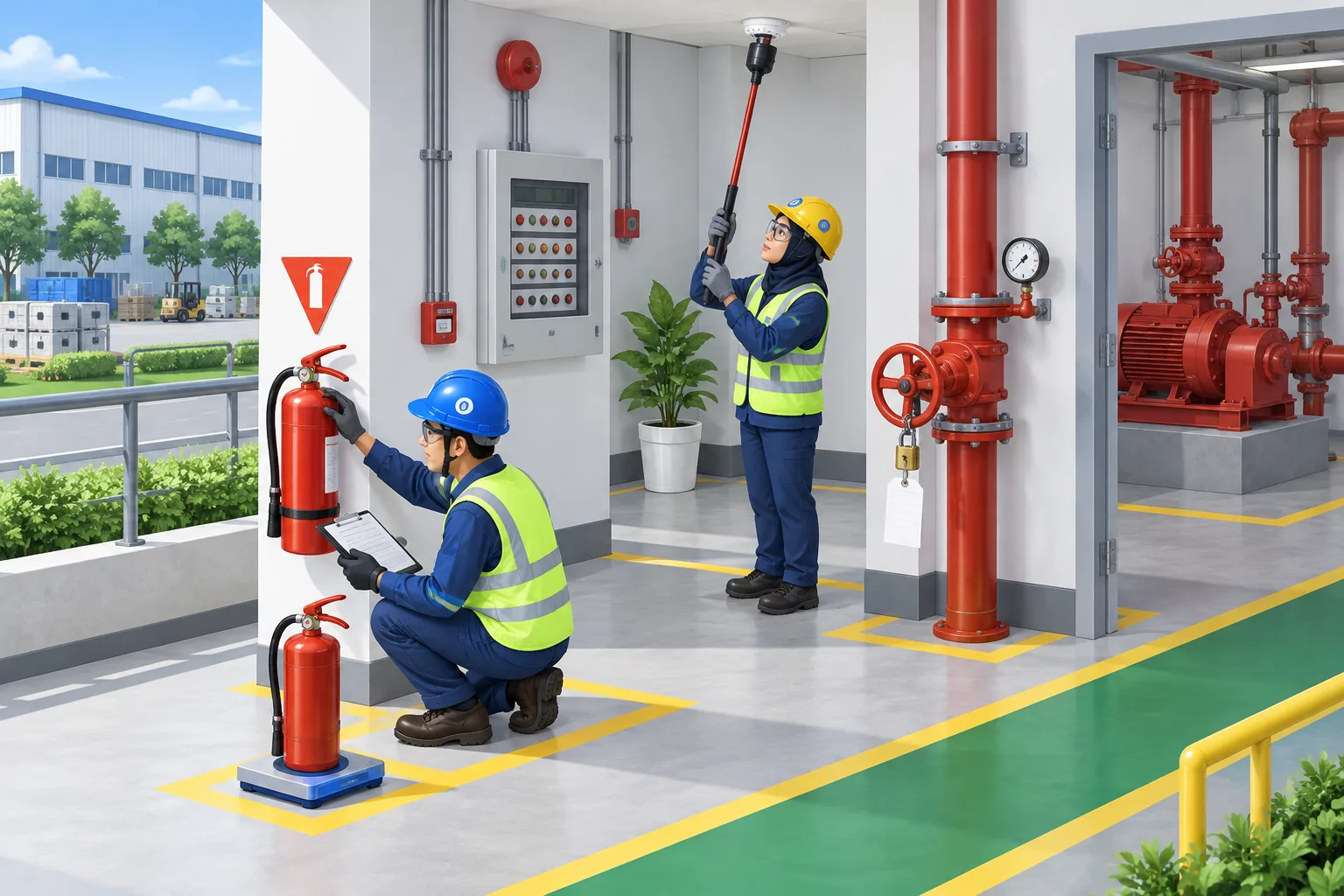
When an automatic fire protection system fails in a real fire, the cause is usually not a broken part. In the latest United States data, covering 2020 to 2024, sprinklers operated in 90 percent of structure fires large enough to activate them, and in the estimated 935 fires a year in which they did not operate, the system had been shut off in 59 percent of cases (McGree, 2026a, 2026b). A review of sprinkler effectiveness studies from several countries found the same pattern, with shut-off systems accounting for 33 to 100 percent of reported failures (Frank et al., 2013). Those numbers point to inspection, testing, maintenance and the way impairments are handled, rather than to hardware alone.
In Indonesia, the minimum routines for portable fire extinguishers (alat pemadam api ringan, APAR) and automatic fire alarms were set by ministerial regulations in 1980 and 1983, and the organisation responsible for them by a 1999 ministerial decree. Field studies still find gaps between those rules and practice. Below we answer six questions that commonly come up when fire protection records are reviewed at plants, warehouses and offices. The regulation texts were read from published copies hosted by Institut Teknologi Sepuluh Nopember, Better Work and the Dumai city fire service, because the official legal database could not be reached from our network on 3 November 2026.
When Are Extinguishers Checked?
Regulation of the Minister of Manpower and Transmigration No. PER.04/MEN/1980 on the Requirements for Installing and Maintaining Portable Fire Extinguishers requires every extinguisher to be inspected twice a year, as a 6-month inspection and a 12-month inspection, and any defect found must be repaired at once or the unit replaced (Departemen Tenaga Kerja dan Transmigrasi, 1980, Article 11). The 6-month inspection covers whether the cylinder is full, any loss of pressure, the condition of the cartridge and seal-piercing mechanism, the outside of the cylinder including handle and label, and a nozzle and hose free of blockage or cracks. Carbon dioxide units are weighed and refilled when they are 10 percent below the stated weight (Article 12). The 12-month inspection, for units that use a gas cartridge, adds opening the head to check the contents level, internal discharge tube, threads, gaskets, internal corrosion and the cartridge charge (Article 13).
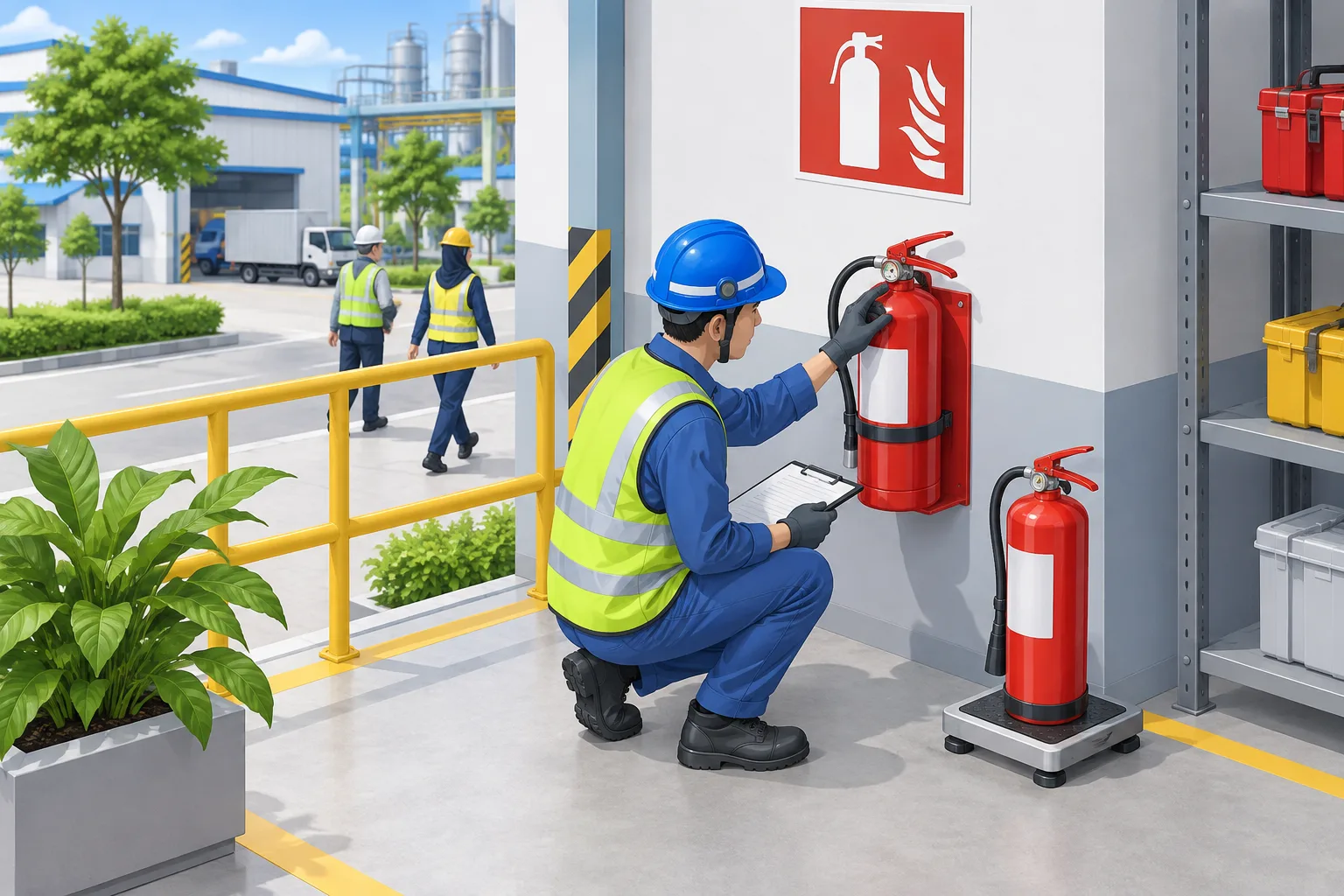
The same regulation sets the placement conditions that an inspection should also confirm: no more than 15 metres between units unless an inspector sets otherwise, a location sign 125 cm above the floor, the top of the unit at 1.2 m except for carbon dioxide and dry chemical units that may sit lower with at least 15 cm clearance, no locked brackets, and no installation where temperatures exceed 49°C or fall to minus 44°C unless the unit is built for it (Articles 4 and 6 to 9).
For comparison, the United States workplace rule requires a monthly visual inspection, an annual maintenance check with a written record, emptying and maintenance every 6 years for stored-pressure dry chemical units that carry a 12-year hydrostatic test, equivalent protection while a unit is out for service, and fire extinguisher education at hiring and annually (Occupational Safety and Health Administration [OSHA], 2002, paragraphs (e) and (g)). In our reading, PER.04/MEN/1980 remains the legal minimum in Indonesia. A short monthly walk-round of every unit goes beyond that minimum, and we return below to who is placed to do it.
When Are Refills Due?
Every extinguisher must be pressure tested at intervals of no more than 5 years and hold the test pressure for 30 seconds. Water and foam units are tested at 20 kg/cm2, and gas cartridges and stored-pressure cylinders at 1.5 times the working pressure or 20 kg/cm2, whichever is higher (Departemen Tenaga Kerja dan Transmigrasi, 1980, Article 15). Cylinders that cannot be pressure tested must be taken out of use 10 years after manufacture, the test date is stamped on a metal plate on the cylinder, and cylinders that are perforated or corroded must not be installed at all (Articles 5, 15 and 17).
Refilling intervals are listed in Appendix 3 of the regulation. A dry chemical unit with a gas cartridge is refilled every 2 years, a stored-pressure dry chemical unit every 5 years, and both are pressure tested every 5 years, while carbon dioxide units follow their own schedule in Article 15. The date of each refill is recorded on the cylinder body (Article 22).
Our interpretation is that a routine annual refill of every stored-pressure dry chemical unit, as practised at one site described below (Yuniati & Wahyuningsih, 2022), is more frequent than Appendix 3 requires. Earlier refilling should follow findings from the 6-month inspection, such as pressure loss or caked powder, so the inspection record carries more weight than the refill invoice. The Indonesian 5-year pressure test interval is also shorter than the 12 years that applies to some stored-pressure dry chemical units in the United States (OSHA, 2002).
What Alarm Tests Apply?
Regulation of the Minister of Manpower No. PER.02/MEN/1983 on Automatic Fire Alarm Installations requires maintenance and testing on a weekly, monthly and annual basis (Departemen Tenaga Kerja [Depnaker], 1983, Article 57). The weekly routine includes a simulated alarm, a check of the sounders, battery voltage and condition, and a check of the whole system, with results written in a logbook (Article 58). The monthly routine includes a simulated fire, indicator lamps, the emergency power supply, a fault condition test and the condition of the panel, again recorded (Article 59). The annual routine covers installation voltage and the condition of all detectors, with at least 20 percent of the detectors in each group tested so that every detector has been tested within 5 years (Article 60). The annual work may be done by a fire consultant or an organisation recognised by the directorate (Article 57), and the light source of optical beam detectors with continuous monitoring is replaced at least once a year (Article 73).
In our view, the 20 percent rule is the hardest part to evidence on paper. Showing that every detector was tested within 5 years requires a detector register by zone and a test history per device. A panel printout from a single annual visit is not enough.
Why Do Sprinklers Fail?
The NFPA supporting tables for 2020 to 2024 break down the 935 annual failures to operate as follows: system shut off 59 percent, manual intervention that defeated the system 15 percent, damaged components 13 percent, a system inappropriate for the type of fire 7 percent, and lack of maintenance including corrosion 6 percent (McGree, 2026b). In the 264 fires a year in which sprinklers operated but were ineffective, the most common problems were water that did not reach the fire (42 percent) and too little water discharged (35 percent). The shut-off share was also 59 percent in 2010 to 2014 (Ahrens, 2017), so the pattern held across both periods.
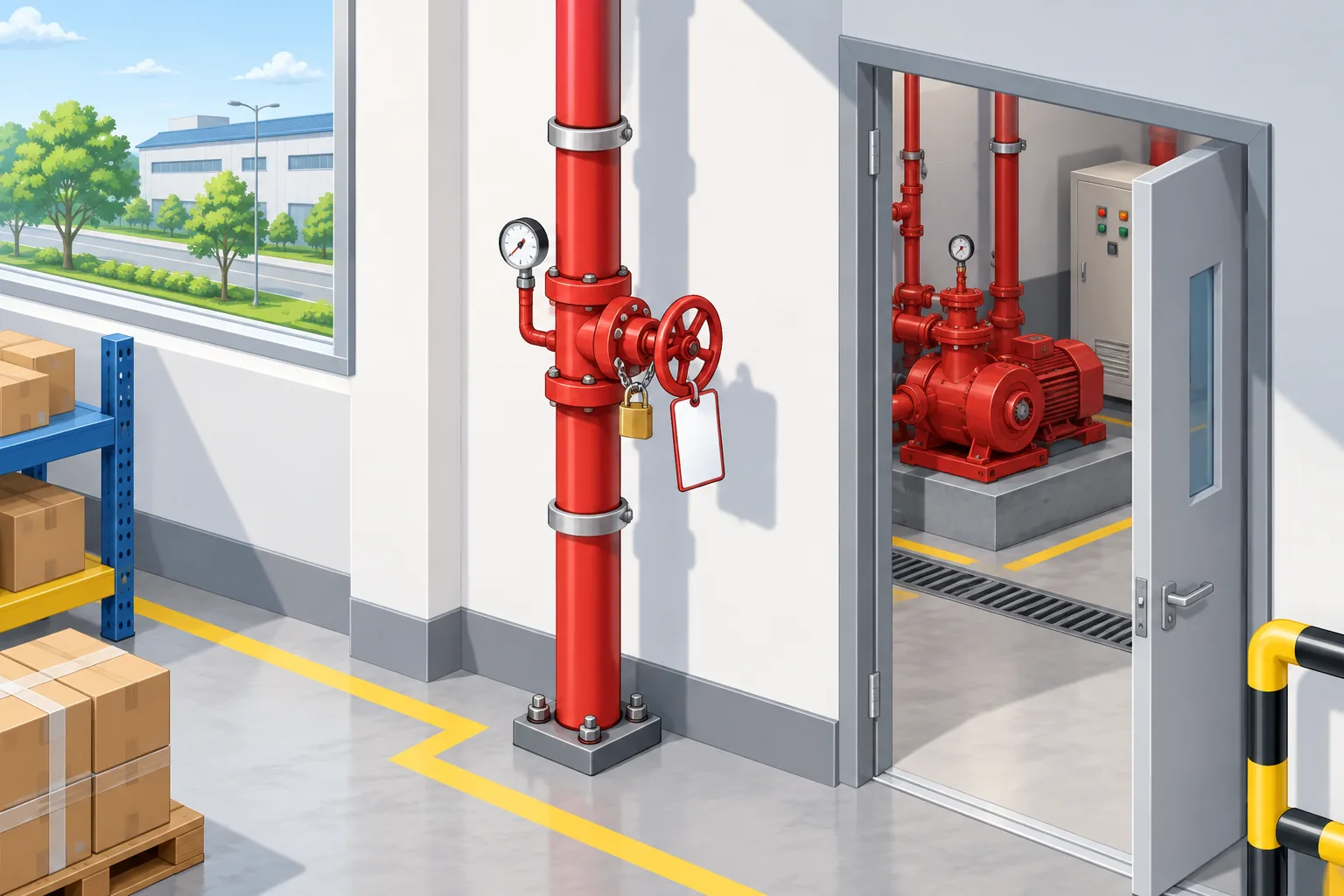
Frank et al. (2013) add two points. One component-based study in their review found system reliability most sensitive to the probability of an inadvertently closed valve and to the time between inspections, and the review lists changes in building use or hazard after design among the factors that shape sprinkler performance. NFPA refers users to NFPA 25 for the minimum inspection, testing and maintenance requirements of sprinkler systems (Ahrens, 2017).
These data come from fires reported to United States fire departments, with unknown entries allocated proportionally, and we are not aware of a comparable national dataset for Indonesia. The two Ministry of Manpower regulations above also do not cover sprinklers or hydrants. We therefore read the figures as a direction for priorities, not as a measure of Indonesian risk: confirm that every control valve is open and secured, manage every shut-off through a written impairment procedure that ends with a check that the system is back in service, and review sprinkler design whenever a storage height, commodity or occupancy changes.
Who Does the Checking?
Decree of the Minister of Manpower No. KEP.186/MEN/1999 on Fire Response Units in the Workplace makes management responsible for preventing, reducing and extinguishing fires, including providing detection, alarm, extinguishing and evacuation facilities, forming a fire response unit, and holding regular drills (Depnaker, 1999, Article 2). The fire response unit is defined as covering administration, hazard identification, and the inspection, maintenance and repair of fire protection systems (Article 1). Workplaces with more than 50 workers, or with medium or high fire risk, must keep an emergency plan that describes the type, maintenance and use of their fire protection facilities (Article 2).
The decree sets at least 2 fire wardens for every 25 workers. A fire squad and an OSH fire specialist (ahli K3 spesialis penanggulangan kebakaran) are required in low and medium I risk workplaces with 300 or more workers, and in every workplace classed as medium II, medium III or high risk (Article 6). Fire wardens are tasked with identifying and reporting fire hazards (Article 7), which in our view is where a monthly walk-round of extinguishers belongs, and maintaining fire protection facilities is listed as a task of the fire squad (Article 8). Under PER.04/MEN/1980, management is responsible for compliance, and the penalty refers to the Occupational Safety Law of 1970 with up to 3 months' confinement or a fine of up to Rp100,000 (Departemen Tenaga Kerja dan Transmigrasi, 1980, Articles 24 and 25). In our view, the small fine reflects the age of the law and says little about the actual consequences of a failed system.
What Do Studies Show?
The Indonesian field evaluations we found show a similar gap between equipment that exists and equipment that is managed. At a district health office in Brebes with 16 dry chemical extinguishers, type and condition matched PER.04/MEN/1980 fully, placement 78.57 percent, location signs 0 percent, user instructions 6.25 percent and maintenance 66.67 percent, giving an overall score of 58.6 percent (Yuniati & Wahyuningsih, 2022). Inspection frequency complied 0 percent because inspection was done only once a year, and 56.25 percent of units were at the wrong height, which the person in charge attributed to not knowing the rule. At a lubricant plant in Gresik, mounting height, sign height and maintenance did not meet the regulation (Wardana, 2019). In a hospital surgical building in Surabaya, installation generally did not meet the regulation, and halon and expired extinguishers were still found (Hambyah, 2017). Wider evaluations reported active protection compliance of 65.67 percent at a hotel in Jember (Savitri et al., 2022) and an 80 percent reliability score at a university building in Pekalongan, with conditions ranging from good to poor (Kumalasari et al., 2023).
These are single-site descriptive studies with their own checklists and scoring, so they cannot be pooled or treated as national figures. In our reading, most items that failed were records, signs, heights and inspection intervals, all of which depend on routine rather than on purchasing.
Practical Next Steps
The regulations already define what must be checked and how often for extinguishers and alarms, and the international data show that systems in real fires fail mostly through management, especially through shut-off valves. Based on the sources above, we suggest the following steps:
- Build one register of every extinguisher, alarm device and sprinkler valve, with location, type, last inspection, last refill and last pressure test.
- Align extinguisher inspections with Articles 11 to 13 of PER.04/MEN/1980 and use Appendix 3, not habit, to set refill dates.
- Keep weekly and monthly alarm logbooks and a zone-by-zone detector test history that shows 5-year coverage.
- Lock or supervise sprinkler control valves and run every shut-off through a written impairment procedure with a restoration check.
- Check that the number and training of fire wardens and the fire squad match Article 6 of KEP.186/MEN/1999.
An independent review of fire risk, protection systems and emergency readiness is the scope of our Fire and Emergency Safety Audit. Certified fire brigade training is run with licensed partners through the fire brigade certification programme, because Nusa Safety does not issue certificates or hold a PJK3 licence.
This article is general information and is not legal or professional advice for any specific case.
References
- Ahrens, M. (2017). U.S. experience with sprinklers. National Fire Protection Association.
- Departemen Tenaga Kerja. (1983). Peraturan Menteri Tenaga Kerja Nomor PER.02/MEN/1983 tentang Instalasi Alarm Kebakaran Automatik. https://betterwork.org/wp-content/uploads/781-3-Per-02_MEN_1983-Tentang-Instalasi-Alarm-Kebakaran-Automatik.pdf
- Departemen Tenaga Kerja. (1999). Keputusan Menteri Tenaga Kerja Nomor KEP.186/MEN/1999 tentang Unit Penanggulangan Kebakaran di Tempat Kerja. https://damkar.dumaikota.go.id/assets/backend/dokumen/66022ced5f0e6.pdf
- Departemen Tenaga Kerja dan Transmigrasi. (1980). Peraturan Menteri Tenaga Kerja dan Transmigrasi Nomor PER.04/MEN/1980 tentang Syarat-syarat Pemasangan dan Pemeliharaan Alat Pemadam Api Ringan. https://www.its.ac.id/burb/wp-content/uploads/sites/106/2023/07/PER.04-1980-APAR.pdf
- Frank, K., Gravestock, N., Spearpoint, M., & Fleischmann, C. (2013). A review of sprinkler system effectiveness studies. Fire Science Reviews, 2(1), 6. https://doi.org/10.1186/2193-0414-2-6
- Hambyah, R. F. (2017). Evaluasi pemasangan APAR dalam sistem tanggap darurat kebakaran di gedung bedah RSUD Dr. Soetomo Surabaya. The Indonesian Journal of Occupational Safety and Health, 5(1), 41-50. https://doi.org/10.20473/ijosh.v5i1.2016.41-50
- Kumalasari, D., Febriansyah, M. F., & Tisnawati, T. (2023). Evaluasi kondisi dan pemeliharaan utilitas sistem proteksi kebakaran aktif pada bangunan gedung (studi kasus Gedung F Universitas Pekalongan). Teknika, 18(2), 154-160. https://doi.org/10.26623/teknika.v18i2.7987
- McGree, T. (2026a). US experience with sprinklers. National Fire Protection Association. https://www.nfpa.org/education-and-research/research/nfpa-research/fire-statistical-reports/us-experience-with-sprinklers
- McGree, T. (2026b). US experience with sprinklers: Supporting tables. National Fire Protection Association. https://content.nfpa.org/-/media/Project/Storefront/Catalog/Files/Research/NFPA-Research/Suppression/ossprinklertables.pdf
- Occupational Safety and Health Administration. (2002). Portable fire extinguishers, 29 C.F.R. § 1910.157 (as last amended 7 November 2002; eCFR version accessed 3 November 2026). https://www.ecfr.gov/current/title-29/subtitle-B/chapter-XVII/part-1910/subpart-L/section-1910.157
- Savitri, R. N., Indrayani, R., & Akbar, K. A. (2022). Evaluasi sistem proteksi aktif dan sarana penyelamatan jiwa pada Hotel X di Kabupaten Jember. Jurnal Ilmu Kesehatan Masyarakat, 18(1), 10. https://doi.org/10.19184/ikesma.v18i1.22921
- Wardana, R. P. (2019). Evaluasi pemasangan dan pemeliharaan alat pemadam api ringan di Gresik. The Indonesian Journal of Occupational Safety and Health, 7(3), 261-272. https://doi.org/10.20473/ijosh.v7i3.2018.261-272
- Yuniati, N. K., & Wahyuningsih, A. S. (2022). Penerapan alat pemadam api ringan berdasarkan Permenakertrans No 04 Tahun 1980 di Dinas Kesehatan Kabupaten Brebes. Indonesian Journal of Public Health and Nutrition, 2(2), 201-207. https://doi.org/10.15294/ijphn.v2i2.53303
