
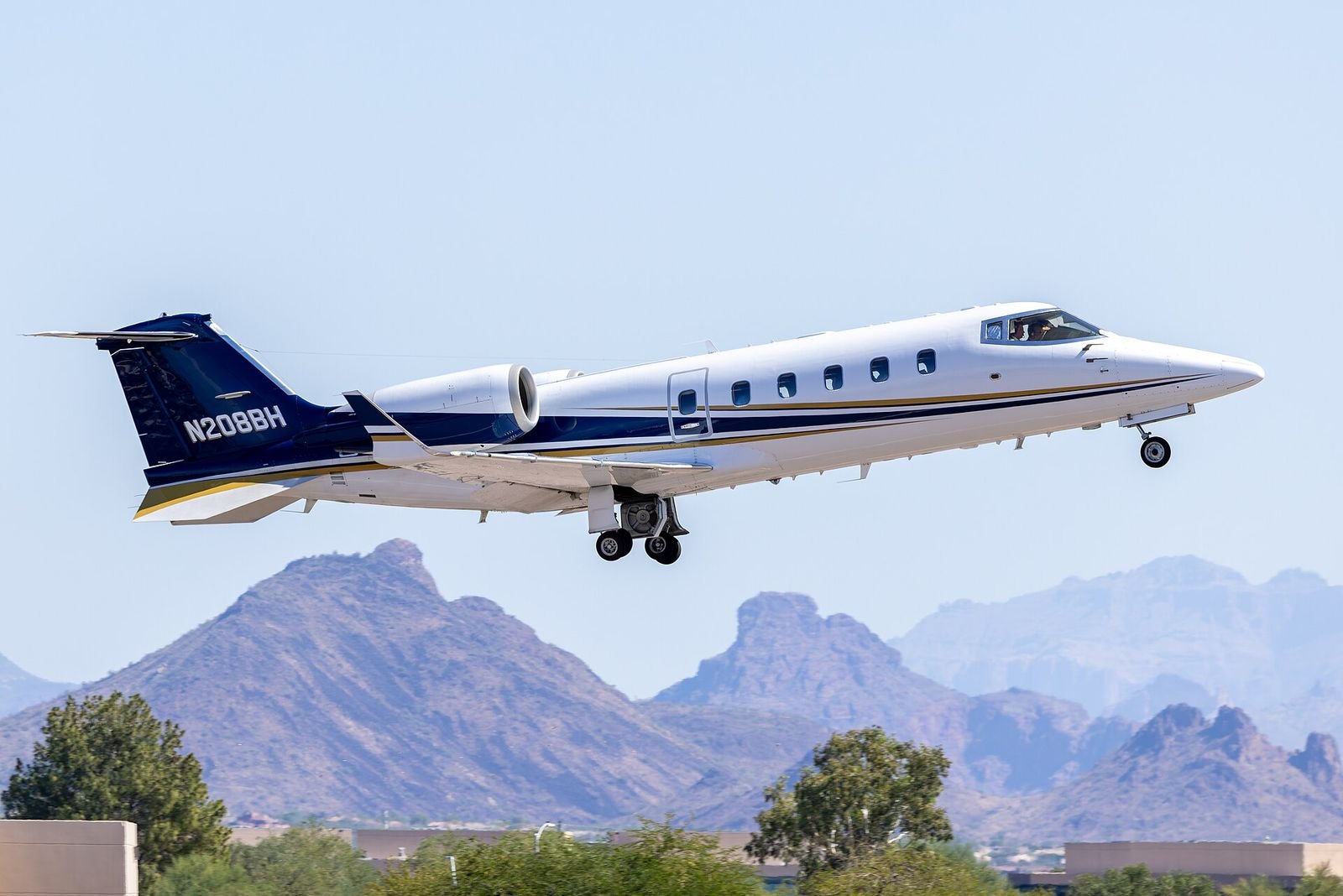
On Sunday 1 November 2026, a Learjet 60 business jet carrying 2 flight crew members and 7 passengers crashed in Palm Beach County, Florida, near Greenacres and Palm Springs, and all 9 people on board were killed (Sutton, 2026). The Federal Aviation Administration (FAA) said the jet had departed Austin-Bergstrom International Airport in Texas for North Eleuthera Airport in the Bahamas and came down at around 12:50 p.m. local time in a residential area, describing its information as preliminary (Romano, 2026). The National Transportation Safety Board (NTSB) said the flight was operated as a charter under Part 135 of the US aviation regulations (Warwick, 2026).
The NTSB briefed the media on 2 and 3 November and stressed that the probable cause would not be determined at the scene (National Transportation Safety Board [NTSB], 2026; CBS News Miami, 2026; Sutton, 2026). The board says its investigations generally take 12 to 24 months (NTSB, n.d.). No official report has been published and no cause has been established.
This case study reads the reported facts with aviation's own tools: ICAO Annex 13, the CAST/ICAO occurrence taxonomy, threat and error management and the science of high-altitude flight. We do not name the victims or judge the crew, and nothing below is a statement of cause.
What Investigators Reported
According to the NTSB briefing on 2 November, the jet left Austin at about 10:37 a.m. Eastern Time (Espy, 2026). At about 12:47 p.m., while working Miami Air Route Traffic Control Center, the crew reported light clear icing that they considered manageable, together with moderate turbulence. The aircraft was at 35,000 feet (about 10,700 m), the crew reported altitude deviations of about 700 feet (about 210 m), and the outside air temperature was given as minus 47 °C (Espy, 2026; Sutton, 2026). The crew then reported precipitation and asked to climb to 37,000 feet, and the controller approved the request.
Less than 30 seconds later, a transmission from the aircraft announced a descent, followed by a mayday call. At about 12:48 p.m. the crew reported that the aircraft was in an overspeed condition and descending, and later transmissions described a rapid loss of altitude (Espy, 2026). The NTSB placed the crash at about 12:51 p.m. (Sutton, 2026).
On 3 November, NTSB Board Member Tom Chapman said the elevator, the tail surface that controls pitch, had been found in 3 parts and that parts of the aircraft lay as far as 3.8 miles (about 6.1 km) from the impact site, which he described as an indication that the aircraft was likely breaking up before it reached the ground (CBS News Miami, 2026). Most of the left elevator was recovered, in pieces between 1.3 and 3.8 miles from the impact site (Daleo, 2026). It is still unclear when the surface detached, and investigators will try to determine whether its loss caused the loss of control or whether it came off during the overspeed ("Damaged Elevator Recovered," 2026). Other points from the briefings were:
- Weather at altitude is a major focus, and the NTSB had not confirmed whether the aircraft flew through an active thunderstorm (Sutton, 2026; Warwick, 2026).
- Maintenance records indicate that a cockpit voice recorder had been installed, but investigators had not confirmed that it remained on board (Sutton, 2026).
- About 20 NTSB investigators were deployed, including specialists in aircraft systems and structures, recorders, weather and air traffic control (Sutton, 2026).
- The NTSB will examine the history of the aircraft type for possible trends (Espy, 2026).
On the ground, the debris field measured roughly half a mile by four-tenths of a mile around ball fields, businesses and homes, and one person in a vehicle leaving the area suffered a leg injury (Sutton, 2026). About 600 residents of a nearby mobile home community were to be relocated and a section of Military Trail was closed (Romano, 2026), and the county was placed under a state of emergency (Espy, 2026).
Reading the Evidence
What Can Be Concluded
Annex 13 to the Chicago Convention states that the sole objective of an accident investigation is the prevention of future accidents and incidents, and that it is not the purpose of this activity to apportion blame or liability. It requires the investigating State to send a preliminary report to ICAO within 30 days, to publish the final report as soon as possible and, if possible, within 12 months, and otherwise to publish an interim statement on each anniversary of the occurrence (International Civil Aviation Organization [ICAO], 2024). The NTSB determines probable cause only at the end of that process (NTSB, n.d.).
At this stage the facts are a sequence of reported events, not an explanation. Recorder data, the wreckage examination and the weather reconstruction are still to come. The decisive open question is order: whether the elevator separation led to the upset or the upset and overspeed led to the separation ("Damaged Elevator Recovered," 2026). Each answer changes the meaning of every other fact, so any causal account offered today runs ahead of the evidence.
Classification Is Not Cause
Aviation codes occurrences with the taxonomy of the CAST/ICAO Common Taxonomy Team (CICTT), and one occurrence may carry several categories (CAST/ICAO Common Taxonomy Team [CICTT], 2021). From the briefings, plausible candidates are loss of control in flight (LOC-I), icing (ICE), which covers ice accumulating on aircraft surfaces and, in the 2021 edition, on sensors and antennae, and turbulence encounter (TURB) (CICTT, 2021). A system failure category could also apply, depending on the order of events. In our reading these codes describe what happened, not why, and any code applied now is provisional.
ICAO lists LOC-I among its 5 global high-risk categories and added TURB as one of 3 other global risk categories in its 2026 to 2028 safety plan (ICAO, 2025). In commercial aviation, IATA counted 60 fatal LOC-I accidents from 2009 through 2018, accounting for 2,462 of 4,075 fatalities, more than any other category (International Air Transport Association [IATA], 2019). For corporate jets worldwide, the Flight Safety Foundation, using Aviation Safety Network data, counted 37 fatal accidents in 2020 to 2024 and 13 in 2025, of which 4 were categorised as LOC-I, the worst year for corporate jet fatal accidents in at least 9 years (Flight Safety Foundation [FSF], 2026). These figures show the weight of the category, not a rate for the Learjet 60 or Part 135.
Threats on Record
Threat and error management (TEM) describes flight safety in terms of threats, errors and undesired aircraft states. Threats are events or errors that originate outside the crew's influence, add operational complexity and must be managed to keep safety margins, and environmental threats include weather such as thunderstorms, turbulence and icing (Maurino, 2005). ICAO built its line operations safety audit on this framework, observing normal flights to see how crews detect and manage threats (ICAO, 2002).
Applied only to the briefing record, TEM identifies 3 documented environmental threats at cruise: icing that the crew reported as light and manageable, moderate turbulence and precipitation, in air at minus 47 °C (Espy, 2026). The altitude deviations, the climb request and approval, the descent, the mayday and the overspeed are events on the timeline. TEM labels something a crew error or an undesired aircraft state only on evidence such as recorder data, and none has been released, so we identify no crew error. What TEM offers organisations is its point that organisational threats are latent and can be controlled at source by aviation organisations (Maurino, 2005): weather policy, training and scheduling are set before any flight departs.
Known Lines of Inquiry
The following mechanisms are known from aviation science and from NTSB practice in high-altitude upsets. They are lines of inquiry, not the cause of this crash.
- High-altitude aerodynamics. At high altitude a low indicated airspeed corresponds to a high Mach number, and an increase in weight or load factor raises the low-speed buffet speed and lowers the Mach buffet speed, narrowing the margin between them (Federal Aviation Administration [FAA], 2015a). Turbulence varies load factor, so it consumes a margin that is already narrow, and an overspeed is flight beyond the upper limit.
- Ice crystals and air data. Above about 25,000 feet clouds hold mostly ice particles, which return far less radar energy than rain and are hard to see on airborne radar (FAA, 2015b). More than 150 jet engine power-loss and damage events over 2 decades have been attributed to ice crystal icing near large convective systems (Haggerty et al., 2019). The Air France 447 investigation identified a temporary inconsistency between measured airspeeds, likely after ice crystals obstructed the pitot probes (Bureau d'Enquêtes et d'Analyses pour la sécurité de l'aviation civile [BEA], 2012), and the FAA later extended certification requirements for airspeed and angle of attack systems and engines to ice crystal conditions (FAA, 2014). This is a documented mechanism, not a parallel: the NTSB has said nothing about air data or engines here.
- Convective weather. FAA guidance states that airborne weather radar is for avoiding severe weather, not penetrating it (FAA, 2022), and whether convection was present on this route is still being established (Sutton, 2026).
- Upset and startle. FAA guidance treats startle and surprise as factors in recovery from unexpected upsets (FAA, 2017), and Landman et al. (2017) model how a mental frame that fails to adapt quickly degrades performance. Specialists examine such factors routinely, which implies no finding about this crew.
- In-flight breakup. Elevator pieces spread over miles are physical evidence of separation before impact; its timing is the open question ("Damaged Elevator Recovered," 2026).
The event facts come from early briefings, many relayed by media, and may change; the statistics describe broad fleets and the science describes mechanisms, not this flight.
Questions Before Chartering
Organisations that charter aircraft do not control the cockpit, but they choose the operator, set contract terms and prepare for the worst case. We suggest asking for evidence on these points.

- The operator's certificate. Confirm that the operator holds a valid air operator certificate and that the aircraft and planned operation fall within it.
- Safety management. The FAA now requires Part 135 operators to have a safety management system, with existing operators due to implement it and declare compliance by 28 May 2027 (FAA, 2024). Ask where the operator stands and how weather risk at cruise appears in its hazard register.
- Crew training records. Ask for recurrent upset prevention and recovery training consistent with FAA guidance (FAA, 2017), high-altitude training (FAA, 2015a) and icing training (FAA, 2015b).
- Weather decision policy. Ask for written criteria on convective weather, turbulence and icing, and for confirmation that crews may delay or divert without commercial pressure.
- Independent audits. The Basic Aviation Risk Standard program provides risk-based standards and audits used by the resource sector, humanitarian and government organisations to oversee contracted aviation (FSF, n.d.). IS-BAO registers business aircraft operators in 3 stages, from an established safety management system to one fully integrated with a sustained safety culture (International Business Aviation Council [IBAC], 2025). IOGP Report 691 sets out recommended practices for fixed-wing commercial air transport in 5 modules, from safety management systems to aircraft and equipment (International Association of Oil & Gas Producers [IOGP], 2023).
- Travel risk management. ISO 31030:2021 guides organisations on travel risk policy, assessment and treatment (International Organization for Standardization [ISO], 2021), which in practice includes an accurate manifest, next-of-kin contacts and a crisis plan.
A client cannot judge airworthiness, maintenance quality or crew proficiency; those need qualified aviation auditors and the authority, and the client's role is to require that evidence. Chartering also does not transfer the whole risk: ISO 31030 treats travel risk as risk to both the organisation and its travellers, with duty of care implications (ISO, 2021).
Beyond the Hangar
Two aviation habits transfer to other high-risk operations: learning from normal work, as LOSA does on routine flights (ICAO, 2002), and the Annex 13 separation of safety investigation from blame (ICAO, 2024), which keeps people willing to report. The 600 residents relocated in Palm Beach County (Romano, 2026) also show that emergency plans need to reach third parties beyond the site boundary.

How Nusa Safety Helps
Nusa Safety does not audit aviation operators; checks of certificates, airworthiness, crew training or BARS and IS-BAO status belong to qualified aviation auditors and the authority. Nusa Safety can support the client's side of the risk. Engineering studies and risk assessments and risk assessment and JSA workshops can help a company build a journey risk register and a list of evidence to request from operators, and emergency preparedness and drills let teams test their crisis response, from manifests to family communication.
Incident investigation and RCA training helps teams investigate their own incidents with recognised methods while keeping blame out of the analysis. Training that leads to a certificate is delivered with licensed PJK3 partners, and Nusa Safety does not issue certificates itself. To discuss your needs, please contact the Nusa Safety team.
This article is general information and is not legal or professional advice for any specific case.
References
- Bureau d'Enquêtes et d'Analyses pour la sécurité de l'aviation civile. (2012). Final report on the accident on 1st June 2009 to the Airbus A330-203 registered F-GZCP operated by Air France flight AF 447 Rio de Janeiro - Paris. https://www.faa.gov/sites/faa.gov/files/f-cp090601.en_.pdf
- CAST/ICAO Common Taxonomy Team. (2021). Aviation occurrence categories: Definitions and usage notes (Version 4.8). https://www.intlaviationstandards.org/Documents/OccurrenceCategoryDefinitions.pdf
- CBS News Miami. (2026, November 3). Pieces of jet that crashed in Palm Beach County found miles away from impact site, NTSB says. CBS News. https://www.cbsnews.com/miami/news/palm-beach-county-jet-crash-investigation-update/
- Daleo, J. (2026, November 3). NTSB recovers parts of crashed Learjet's elevator. FLYING. https://www.flyingmag.com/ntsb-recovers-parts-of-crashed-learjet-elevator/
- Damaged elevator recovered in Learjet crash investigation. (2026, November 4). Aviation International News. https://www.ainonline.com/aviation-news/business-aviation/2026-11-04/damaged-elevator-secured-learjet-crash-investigation
- Espy, J. (2026, November 2). Learjet may have broken apart before Florida deadly crash, NTSB says. FOX 13 Tampa Bay. https://www.fox13news.com/news/florida-learjet-broken-deadly-crash-ntsb
- Federal Aviation Administration. (2014). Airplane and engine certification requirements in supercooled large drop, mixed phase, and ice crystal icing conditions (Final rule). Federal Register, 79, 65507-65540. https://www.federalregister.gov/d/2014-25789
- Federal Aviation Administration. (2015a). Aircraft operations at altitudes above 25,000 feet mean sea level or Mach numbers greater than .75 (Advisory Circular 61-107B, Change 1). U.S. Department of Transportation. https://www.faa.gov/documentLibrary/media/Advisory_Circular/AC_61-107B_CHG_1_FAA.pdf
- Federal Aviation Administration. (2015b). Pilot guide: Flight in icing conditions (Advisory Circular 91-74B). U.S. Department of Transportation. https://www.faa.gov/documentLibrary/media/Advisory_Circular/AC_91-74B.pdf
- Federal Aviation Administration. (2017). Upset prevention and recovery training (Advisory Circular 120-111, Change 1). U.S. Department of Transportation. https://www.faa.gov/documentLibrary/media/Advisory_Circular/AC_120-111_CHG_1_Ed_Upd_3.pdf
- Federal Aviation Administration. (2022). Aviation weather handbook (FAA-H-8083-28). U.S. Department of Transportation. https://www.faa.gov/regulations_policies/handbooks_manuals/aviation
- Federal Aviation Administration. (2024). Safety management systems (Final rule). Federal Register, 89(82), 33068-33109. https://www.federalregister.gov/documents/2024/04/26/2024-08669/safety-management-systems
- Flight Safety Foundation. (2026). 2025 safety report. https://flightsafety.org/wp-content/uploads/2026/02/2025-Safety-Report-FINAL.pdf
- Flight Safety Foundation. (n.d.). The BAR Standards. Basic Aviation Risk Standard Program. https://flightsafety.org/bars/the-bar-standards-and-manuals/
- Haggerty, J., Defer, E., De Laat, A., Bedka, K., Moisselin, J.-M., Potts, R., Delanoë, J., Parol, F., Grandin, A., & Divito, S. (2019). Detecting clouds associated with jet engine ice crystal icing. Bulletin of the American Meteorological Society, 100(1), 31-40. https://doi.org/10.1175/BAMS-D-17-0252.1
- International Air Transport Association. (2019). Loss of control in-flight accident analysis report: 2009-2018 (2019 ed.). https://www.iata.org/contentassets/b6eb2adc248c484192101edd1ed36015/loc-i_2019.pdf
- International Association of Oil & Gas Producers. (2023). Fixed-wing commercial air transport recommended practices (IOGP Report 691). https://www.iogp.org/bookstore/product/fixed-wing-commercial-air-transport-recommended-practices/
- International Business Aviation Council. (2025). IS-BAO: International Standard for Business Aircraft Operations [Brochure]. https://ibac.org/assets/brochure-2025-1743686515.pdf
- International Civil Aviation Organization. (2002). Line operations safety audit (LOSA) (Doc 9803). https://store.icao.int/en/line-operations-safety-audit-losa-doc-9803
- International Civil Aviation Organization. (2024). Annex 13 to the Convention on International Civil Aviation: Aircraft accident and incident investigation (13th ed.). https://store.icao.int/en/annex-13-aircraft-accident-and-incident-investigation
- International Civil Aviation Organization. (2025). Global aviation safety plan, 2026-2028 edition (Doc 10004). https://www.icao.int/sites/default/files/safety/GASP/Documents/Doc.10004.2026-2028.GASP_.EN_.pdf
- International Organization for Standardization. (2021). ISO 31030:2021 Travel risk management: Guidance for organizations. https://www.iso.org/standard/54204.html
- Landman, A., Groen, E. L., van Paassen, M. M., Bronkhorst, A. W., & Mulder, M. (2017). Dealing with unexpected events on the flight deck: A conceptual model of startle and surprise. Human Factors, 59(8), 1161-1172. https://doi.org/10.1177/0018720817723428
- Maurino, D. (2005, April 18-20). Threat and error management (TEM) [Paper presentation]. Canadian Aviation Safety Seminar, Vancouver, BC, Canada. https://www.faa.gov/sites/faa.gov/files/about/initiatives/maintenance_hf/losa/maurino_%282005%29_tem.pdf
- National Transportation Safety Board. (2026, November 2). NTSB media briefing 1: Palm Beach County, FL Learjet 60 airplane crash (Nov. 2, 2026) [Video]. YouTube. https://www.youtube.com/watch?v=9utTZTQbKz8
- National Transportation Safety Board. (n.d.). The investigative process. https://www.ntsb.gov/investigations/process/Pages/default.aspx
- Romano, E. (2026, November 1). 9 dead after Learjet crash; shelters open for displaced residents. WPTV. https://www.wptv.com/news/region-c-palm-beach-county/greenacres/fiery-incident-reported-near-military-trail-and-10th-avenue
- Sutton, S. (2026, November 2). NTSB: Learjet 60 crew reported icing, turbulence shortly before deadly Palm Beach County crash. WFLX. https://www.wflx.com/2026/11/02/ntsb-hold-news-conference-1-pm-regarding-learjet-60-crash-palm-beach-county/
- Warwick, G. (2026, November 2). Icing, turbulence possible factors in fatal Learjet 60 crash. Aviation Week. https://aviationweek.com/business-aviation/safety-ops-regulation/icing-turbulence-possible-factors-fatal-learjet-60-crash

