
In many plants, hazardous waste only becomes a management issue when the collection truck is late or the temporary store starts to fill up. The rest of the time, the matter is treated as closed once the drums leave the gate and the handover form is signed. Between August and early October 2026, Indonesian regulators sent a different message: a generator's responsibility does not end at the gate, and waste must be traceable all the way to the final processor.
This article reviews the tightening of hazardous waste (limbah B3) oversight signalled by the Ministry of Environment and Environmental Control Agency (KLH/BPLH), what officials are focusing on, and the practical steps generators can take so that compliance can be demonstrated rather than merely asserted. It is written for operations, HSE and compliance managers, including those in foreign-invested companies who may be less familiar with the Indonesian reporting systems.
Background: duties that stay with the generator
The legal framework is not new. Law Number 32 of 2009 on Environmental Protection and Management, as amended by Law Number 6 of 2023, requires anyone who generates B3 waste to manage the waste they generate. Government Regulation Number 22 of 2021 sets out how environmental protection is administered, and Minister of Environment and Forestry Regulation Number 6 of 2021 lays down the procedures and technical requirements for each stage of management: reduction, storage, collection, transport, utilisation, treatment and landfilling. The same regulation recognises an electronic transport document for B3 waste known as Festronik. Reporting on B3 waste management is now submitted electronically through the ministry's SPEED system, which the Ministry of Health has also asked hospitals to use (Kementerian Kesehatan Republik Indonesia, 2026).
The framework turns on the chain of custody. A generator without its own treatment permit hands its waste to licensed third parties. A study at a pharmaceutical manufacturer illustrates the arrangement: the company had neither the permit nor the capability to treat its B3 waste, so it contracted licensed carriers and processors, while its daily generation rate determined the maximum storage period and whether its storage area was large enough (Pramestyawati et al., 2024). Handing waste to a contractor does not hand over all of the risk. When waste ends up in the wrong place, the first question from regulators and the public is usually where it came from.
There are also more specific duties. Indonesia ratified the Stockholm Convention on Persistent Organic Pollutants through Law Number 19 of 2009, and the management of polychlorinated biphenyls (PCBs), which can be present in older transformer oil and capacitors, is regulated by Minister of Environment and Forestry Regulation Number 29 of 2020. On the incentive side, PROPER, the national corporate environmental performance rating, now rests on Minister of Environment Regulation Number 7 of 2025, which replaced the earlier rule. According to Katadata (2026), assessment now includes field verification to check company reports against conditions on site, and the latest cycle covered 5,476 companies. In practice, the waste data a company reports is increasingly likely to be tested on the ground.
Current developments: traceability, mass balance and the threat of sanctions
The signals have come in quick succession. In mid-August 2026, Minister of Environment Jumhur Hidayat visited an integrated B3 waste management facility in Nambo, Bogor, and raised concerns about substandard handling by some businesses and transporters (Media Indonesia, 2026). According to Kompas.com (2026a), he emphasised three points: traceability, a waste mass balance, and consistent law enforcement. A mass balance means the quantity recorded at the source must match the quantity received by the licensed processor. The government also announced plans for a regulation requiring generators to contract with licensed waste management companies rather than directly with transporters, and floated a minimum and maximum price range for transport and treatment services to discourage price competition that pushes practice below standard (Media Indonesia, 2026). At the time of writing we had not found a number for any new regulation, so these points are best read as policy direction rather than obligations already in force.

The reporting data explains the focus on traceability. Kompas.com (2026b) reported that, according to KLH's SPEED data, only 10,958 of 146,751 healthcare facilities reported their B3 waste management for 2025. Of an estimated 190,656 tonnes of potential medical B3 waste, about 60,457 tonnes were recorded, leaving a gap of about 130,199 tonnes whose management is unclear. An expert quoted by the same outlet cautioned that unreported waste is not necessarily dumped, but that without data the pollution risk is hard to monitor (Kompas.com, 2026c). A Mongabay Indonesia (2026) report from South Kalimantan gives a concrete picture: bags of medical waste found by a roadside in Banjarbaru were traced to an independent health worker who said they had paid a collector, yet the waste's final destination was unclear. The case comes from healthcare, but the pattern is familiar in many industries: the invoice is paid, the paperwork exists, and the trail still breaks.
Industry has heard the same message. At a technical workshop on PCBs and B3 waste in Balikpapan on 29 September 2026, organised by PT Prasadha Pamunah Limbah Industri, the KLH/BPLH Director of B3 and Non-B3 Waste Management, Amsor, stressed that generators must know the characteristics of the waste they produce and keep their recording and reporting clear and transparent. According to ANTARA (2026a), he said a company's operating eligibility letter could be revoked if these duties are ignored. RRI (2026) reported that the Director of B3 Management, Firdaus Alim Damopolii, urged companies to amend their environmental approvals promptly where field practice no longer matches what was approved, and recalled Indonesia's target of completing PCB elimination by 2028 in line with its Stockholm Convention commitments.
Oversight is also active for other environmental media. In August 2026, KLH/BPLH temporarily sealed the discharge outlet of a factory in Mojokerto suspected of polluting the Porong River, after public complaints and sample results showing BOD, COD, total coliform, and oil and grease above the applicable standards (ANTARA, 2026b). That case concerns wastewater rather than B3 waste, and it was still at the stage of handling a suspected violation. The enforcement pattern, however, is the same: a complaint, verification with data, then action.
Recommendations: make compliance demonstrable
Start with inventory and characterisation
A register of B3 waste by source, showing waste code, characteristics, generation rate and point of generation, is the foundation for everything else. Infrequent streams such as expired chemicals, contaminated rags, spent batteries, empty chemical containers or transformer oil from maintenance work often slip out of the inventory. Sites still operating older transformers or capacitors should confirm the PCB status of that equipment and plan its handling well ahead of the 2028 target.
Run a monthly mass balance
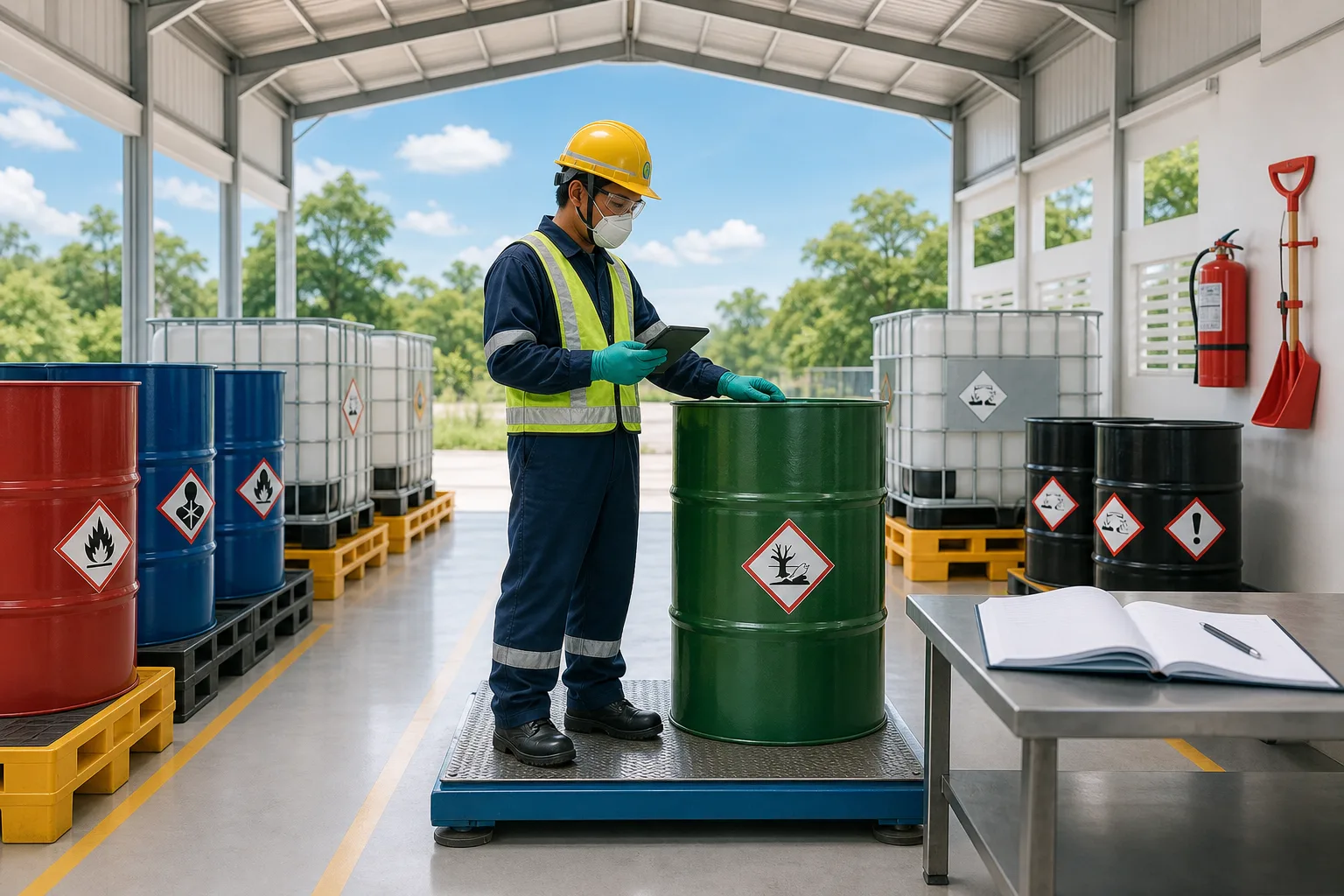
A simple balance compares waste generated, stored, handed over and received by the processor. An unexplained difference is a finding, not just a clerical error. Reconcile internal weighbridge or scale data with Festronik records and the processor's receipt evidence, set a tolerance, and name who must follow up each discrepancy.
Do due diligence on waste contractors
Check the licences of collectors, transporters and processors, including the waste types and capacities they are permitted to handle. Contracts should make responsibility clear through to final treatment, provide audit rights, and require evidence of treatment or utilisation. A service price far below the market deserves questions, which echoes the government's concern about competition that drives substandard practice. If the policy of contracting with licensed managers is formalised, companies that have already put their contracts in order will be better placed.
Keep environmental approvals aligned with practice
Changes in process, raw materials or capacity often change the type and amount of waste. Management of change procedures should include two simple questions: does this change affect B3 waste, and do the site's environmental and technical approvals still fit?
Treat the temporary store as a risk area
A B3 waste store is a safety area as well as an environmental one. Relevant hazards include spills, reactions between incompatible materials, fire and worker exposure. Labels and pictograms, segregation by characteristic, spill containment, ventilation, fire extinguishers and suitable PPE should be checked regularly. Spill response procedures need to be tested in drills as well as written down.
Set indicators and audit internally
Indicators such as on-time reporting, mass balance discrepancies, the age of waste in storage and inspection findings give early warning before an outside party finds the problem. An internal audit of the environmental management system, for example against ISO 14001:2015, can test whether these controls actually operate and whether corrective actions are closed.
How Nusa Safety can help
Our Environmental Compliance and PROPER service builds a register of obligations from your environmental approvals and applicable regulation, a monitoring and reporting calendar, and a review of hazardous waste and wastewater documentation. To embed those controls in a wider system, Integrated ISO Management Systems and ISO Gap Assessment and Internal Audit can be used to test the relevant ISO 14001 requirements. Procedures for storage, handover and spill response can be developed through Technical Guidelines and SOP Development and then tested through Emergency Preparedness and Drills.
On the digital side, HSE Digitalization helps move waste logbooks and mass balances from paper to dashboards, APEX Risk brings environmental risks into a corporate risk register, and AIRA helps assessors build BowTie diagrams for scenarios such as a spill in the waste store or waste that never reaches a licensed processor. Nusa Safety does not transport, collect or treat B3 waste, and does not issue certificates or approvals of any kind. Where a need calls for specific competencies or licences, such as preparing environmental documents or certified training, we deliver it together with licensed partners and our network of association experts. To discuss your situation, please contact us.
Conclusion
The 2026 tightening of B3 waste oversight does not introduce entirely new obligations. What has changed is the burden of proof: regulators want to see that waste is recorded at the source, balances with what processors receive, and is reported on time. For industry, the sensible response is to manage hazardous waste as a chain, with a complete inventory, a monthly mass balance, vetted contractors, current approvals and a safe store. Organisations that can show where their waste went will be better prepared for inspection. More to the point, they are less likely to become the unintended source of pollution.
This article is general information, not legal advice; for questions about how a particular regulation applies to your organisation, please consult a qualified Indonesian lawyer.
References
- ANTARA. (2026a, October 2). KLH minta industri perkuat penaatan aturan pengelolaan limbah B3. https://www.antaranews.com/berita/5768161/klh-minta-industri-perkuat-penaatan-aturan-pengelolaan-limbah-b3
- ANTARA. (2026b, August). KLH segel saluran limbah pabrik diduga cemarkan Sungai Porong Jatim. https://www.antaranews.com/berita/5715441/klh-segel-saluran-limbah-pabrik-diduga-cemarkan-sungai-porong-jatim
- International Organization for Standardization. (2015). ISO 14001:2015 Environmental management systems, requirements with guidance for use. ISO.
- Katadata. (2026). Daftar 39 perusahaan peraih penghargaan PROPER Emas KLH 2026. https://katadata.co.id/amp/ekonomi-hijau/investasi-hijau/69d50ef572e1f/daftar-39-perusahaan-peraih-penghargaan-proper-emas-klh-2026
- Kementerian Kesehatan Republik Indonesia. (2026). [Letter to hospital directors throughout Indonesia on reporting hazardous waste management through SPEED KLH/BPLH]. https://keslan.kemkes.go.id/unduhan/fileunduhan1781657987_109889.pdf
- Kompas.com. (2026a, August 14). Bisnis limbah B3 berpeluang tumbuh, KLH minta pengusaha patuh aturan. https://money.kompas.com/read/2026/08/14/090000426/bisnis-limbah-b3-berpeluang-tumbuh-klh-minta-pengusaha-patuh-aturan
- Kompas.com. (2026b, August 18). Penyedia fasilitas kesehatan belum laporkan pengelolaan 130.199 ton limbah B3 ke KLH. https://lestari.kompas.com/read/2026/08/18/074900986/penyedia-fasilitas-kesehatan-belum-laporkan-pengelolaan-130.199-ton-limbah
- Kompas.com. (2026c, August 19). 135.793 fasilitas kesehatan belum laporkan limbah B3, pakar ingatkan risiko pencemaran air. https://lestari.kompas.com/read/2026/08/19/093100786/135.793-fasilitas-kesehatan-belum-laporkan-limbah-b3-pakar-ingatkan-risiko
- Media Indonesia. (2026, August 13). Cegah pembuangan ilegal, KLH keluarkan aturan ketat limbah B3. https://mediaindonesia.com/humaniora/921568/cegah-pembuangan-ilegal-klh-keluarkan-aturan-ketat-limbah-b3
- Mongabay Indonesia. (2026, October 16). Karut marut tata kelola limbah medis di Kalimantan Selatan. https://mongabay.co.id/2026/10/16/karut-marut-tata-kelola-limbah-medis-di-kalimantan-selatan/
- Peraturan Menteri Lingkungan Hidup dan Kehutanan Nomor 6 Tahun 2021 tentang Tata Cara dan Persyaratan Pengelolaan Limbah Bahan Berbahaya dan Beracun.
- Peraturan Menteri Lingkungan Hidup dan Kehutanan Nomor 29 Tahun 2020 tentang Pengelolaan Polychlorinated Biphenyls.
- Peraturan Pemerintah Nomor 22 Tahun 2021 tentang Penyelenggaraan Perlindungan dan Pengelolaan Lingkungan Hidup.
- Pramestyawati, T. N., Fitriyani, F., & Afrianisa, R. D. (2024). Evaluasi pengelolaan limbah bahan berbahaya dan beracun (B3) di industri farmasi. Journal of Env. Engineering and Waste Management, 9(2). https://doi.org/10.33021/jenv.v9i2.4334
- RRI. (2026, October 2). KLH ingatkan industri patuhi tata kelola limbah B3. https://rri.co.id/nasional/2782633/klh-ingatkan-industri-patuhi-tata-kelola-limbah-b3
- Undang-Undang Nomor 6 Tahun 2023 tentang Penetapan Peraturan Pemerintah Pengganti Undang-Undang Nomor 2 Tahun 2022 tentang Cipta Kerja menjadi Undang-Undang.
- Undang-Undang Nomor 19 Tahun 2009 tentang Pengesahan Stockholm Convention on Persistent Organic Pollutants.
- Undang-Undang Nomor 32 Tahun 2009 tentang Perlindungan dan Pengelolaan Lingkungan Hidup.