
Indonesia's Meteorology, Climatology and Geophysics Agency forecast that the 2023/2024 rainy season would begin between October and December 2023 across most of the country, in 477 of 699 seasonal zones or 68.24 percent. The peak was expected in January and February 2024 in most areas, covering 385 seasonal zones or 55.08 percent (Badan Meteorologi, Klimatologi, dan Geofisika [BMKG], 2023).
For construction projects, these weeks are when foundation, drainage and pipe trenches are most often tested by water. This article compares three ways to protect workers inside an excavation, namely sloping, shoring and shielding, using criteria that can be applied on site.
Why Rain Matters
Rain soaking into the ground changes how a trench wall behaves. In a parametric study of homogeneous soil slopes, Rahardjo et al. (2007) found that soil properties and rainfall intensity were the primary factors controlling rain-induced instability, while the initial water table and slope geometry played a secondary role. They also found a threshold rainfall intensity that produced the lowest factor of safety for a given rainfall duration. The study concerns natural slopes rather than narrow trenches, so we use it to explain the mechanism, not as design figures.
Comparison Criteria
As a technical benchmark we use the excavation rules of the United States, because they are detailed and openly available, not because they bind projects in Indonesia. Under those rules, every worker in an excavation must be protected from cave-ins by an adequate protective system, except in excavations made entirely in stable rock, or less than 1.52 m deep where a competent person's examination shows no sign of a potential cave-in (Occupational Safety and Health Administration [OSHA], 2023b). Four criteria are used here: available space, design needs, resilience to rain and standing water, and worker exposure during installation.
Sloping and Benching
The trench walls are cut back to a slope or into steps. The simplest option is a slope no steeper than 1.5 horizontal to 1 vertical, or 34 degrees, which needs no soil classification. Steeper slopes are allowed when derived from soil classification, tabulated data or a design by a registered professional engineer (OSHA, 2023b).
Its strength is that nothing has to be installed and no one is exposed during installation. Its weakness is the wide footprint and large volume of excavation. In our assessment, the rainy-season risk is that a soil classification made when the ground was dry may no longer hold once the soil is saturated.
Shoring the Walls
Shoring holds the trench walls with timber or aluminium hydraulic struts. Designs follow standard tables, the manufacturer's tabulated data or an engineer's design, and deviation from the manufacturer's specifications requires written approval (OSHA, 2023b). It suits tight spaces beside roads or buildings. Its weaknesses are that workers can be exposed while installing and removing it, and that the extra load from saturated soil must already be accounted for in the design.
Shields and Trench Boxes
A shield, or trench box, does not stop the wall from collapsing; it protects the people inside. Shields must not be loaded beyond their design capacity, must be installed so they cannot shift under a sudden lateral load, and must not be occupied while being installed, removed or moved vertically. Digging up to 0.61 m below the bottom of a shield is allowed only if the shield is designed for the forces of the full trench depth (OSHA, 2023b). Its strength is speed along linear trenches such as pipelines. Its weakness is that anyone who steps outside the shield is exposed again.
Water and Inspection
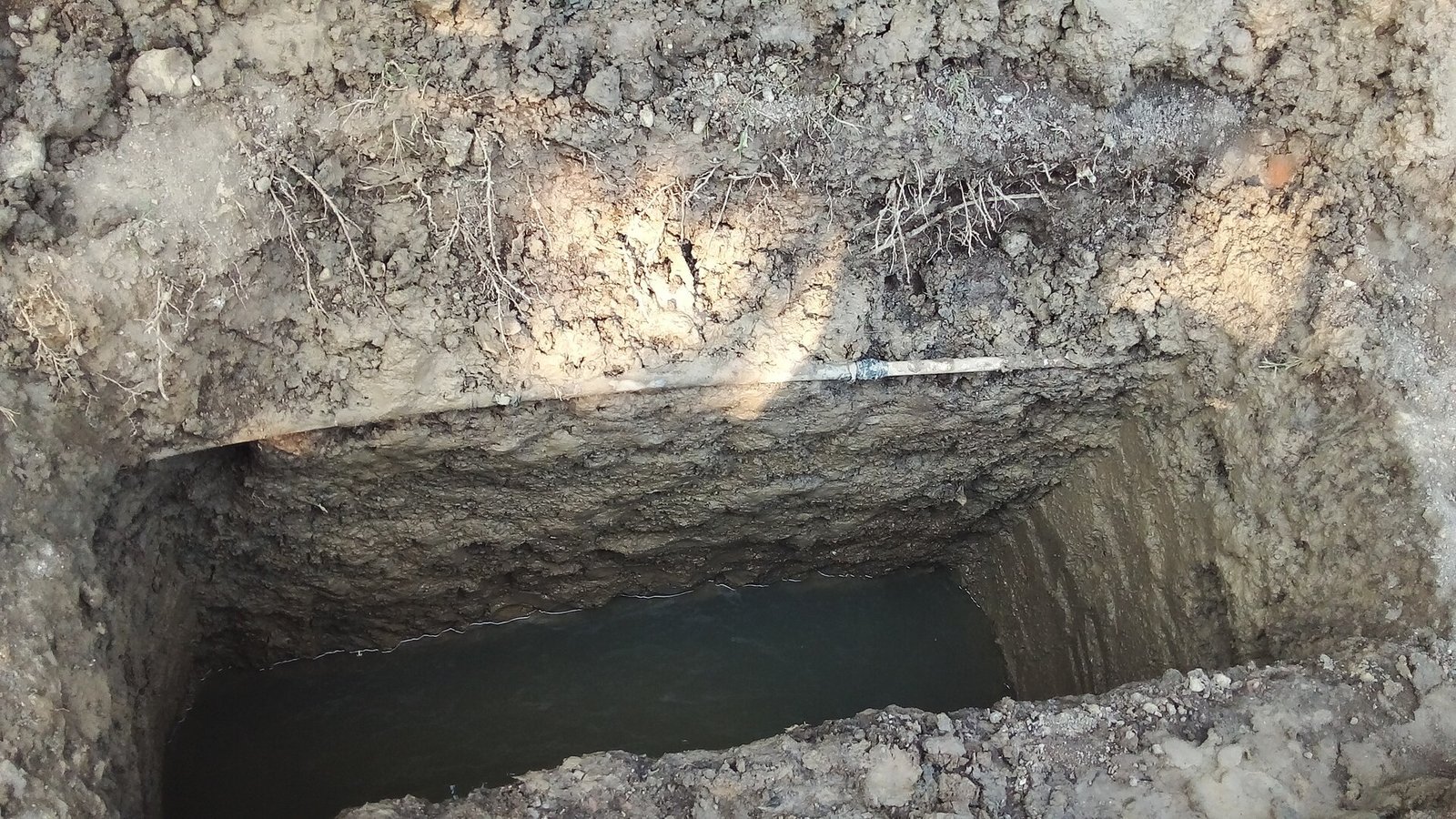
Whatever the system, two requirements decide matters in the rainy season. Workers must not work in excavations where water has accumulated or is accumulating unless adequate precautions are taken, such as special support or shield systems, water removal monitored by a competent person, or a safety harness and lifeline. The excavation, adjacent areas and protective systems must be inspected daily by a competent person before work starts, during the shift as needed, and after every rainstorm or other hazard-increasing event (OSHA, 2023a).
In Indonesia, a matching framework already exists. PUPR Regulation 10/2021 makes a Construction Safety Analysis (AKK) mandatory for medium-risk, large-risk and special work (Article 26), and makes the work method plan, the AKK and the inspection and test plan part of the work permit requirements (Article 27). In our view, the simplest step is to write "inspect the trench after rain" and a standing-water limit into the daily work permit, not just into the AKK (Kementerian Pekerjaan Umum dan Perumahan Rakyat, 2021).
How Nusa Safety Helps
Nusa Safety helps project teams prepare AKKs and excavation permits that account for rain and standing water through its Risk Assessment and JSA Workshop, and drafts daily excavation inspection procedures through Technical Guidelines and SOP Development.
This article is general information and not legal or professional advice for any specific case.
References
- Badan Meteorologi, Klimatologi, dan Geofisika. (2023, September 28). Prakiraan musim hujan 2023/2024 di Indonesia [2023/2024 rainy season forecast for Indonesia]. https://www.bmkg.go.id/iklim/prediksi-musim/prakiraan-musim-hujan-2023-2024-di-indonesia-2
- Kementerian Pekerjaan Umum dan Perumahan Rakyat. (2021). Peraturan Menteri Pekerjaan Umum dan Perumahan Rakyat Nomor 10 Tahun 2021 tentang Pedoman Sistem Manajemen Keselamatan Konstruksi [Minister of Public Works and Housing Regulation No. 10 of 2021 on Construction Safety Management System Guidelines]. https://pasal.id/peraturan/permen/permen-pupr-no-10-tahun-2021
- Occupational Safety and Health Administration. (2023a). 29 CFR 1926.651 Specific excavation requirements. Electronic Code of Federal Regulations (version as of 1 December 2023). https://www.ecfr.gov/on/2023-12-01/title-29/section-1926.651
- Occupational Safety and Health Administration. (2023b). 29 CFR 1926.652 Requirements for protective systems. Electronic Code of Federal Regulations (version as of 1 December 2023). https://www.ecfr.gov/on/2023-12-01/title-29/section-1926.652
- Rahardjo, H., Ong, T. H., Rezaur, R. B., & Leong, E. C. (2007). Factors controlling instability of homogeneous soil slopes under rainfall. Journal of Geotechnical and Geoenvironmental Engineering, 133(12), 1532-1543. https://doi.org/10.1061/(ASCE)1090-0241(2007)133:12(1532)

