A magnitude 7.7 earthquake struck the Mandalay region of Myanmar on Friday 28 March 2025 at 13.20 local time. According to analysis by Indonesia's meteorology and geophysics agency BMKG, the epicentre was 10 km deep and the quake was caused by movement on the Sagaing Fault, a strike-slip fault about 1,200 km long that slips about 18 to 22 mm a year (Sanjaya, 2025). On 5 April 2025 Myanmar state media reported 3,354 dead and 4,508 injured (Adit, 2025b). Two days later the figures stood at 3,471 dead, 4,671 injured and 214 missing (Puspapertiwi, 2025).
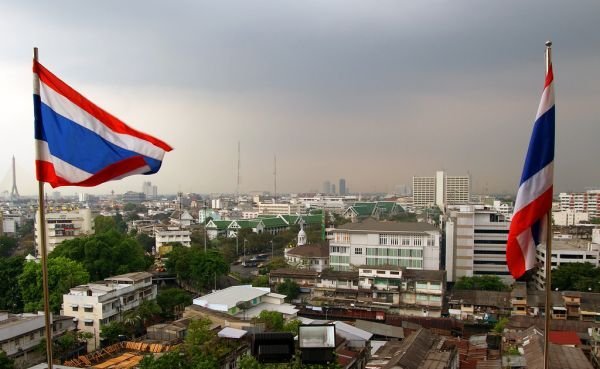
The shaking reached Bangkok. A skyscraper under construction near Chatuchak Market collapsed, while occupants of other tall buildings were evacuated down the emergency stairs and told to stay outside because of an M 6.4 aftershock (Adit, 2025a). We compare these two situations, an occupied building and a building still under construction, to see what an earthquake emergency plan needs to treat differently.
Comparison Criteria
We use four criteria: how the structure performs during shaking, who is inside and whether their number is known, evacuation routes and alarms, and control of aftershock risk. The available sources are mostly news reports from the first days, so this comparison is qualitative.
Finished Buildings
Bangkok's tall buildings generally held. The city is about 800 km from the source of the earthquake, and according to a member of the advisory board of the Indonesian Society of Civil and Structural Engineers (HAKI), ground acceleration there was only about 20 gal, slightly more than Jakarta has experienced in the past 20 years (Laksono, 2025). He also noted that Indonesia has earthquake design standards such as SNI 1726:2019, and that the challenge lies in implementation.
When the earthquake hit, alarms sounded in buildings, occupants walked down the emergency stairs, and people stayed in the streets after the shaking (Adit, 2025a). A finished building already has escape routes, alarms and wardens, so the main questions are when to leave and when it is safe to go back in.
Buildings Under Construction
The only high-rise that collapsed in Bangkok was still under construction (Laksono, 2025). On the day, local police had no information on how many workers were on site when it fell (Adit, 2025a). The sources we used do not include the results of an official investigation, so we do not discuss why it collapsed.
What can be compared is the setting. A project structure is incomplete, lifting equipment such as tower cranes still stands on it, and the workforce comes from many subcontractors that change from day to day. Permanent escape routes and alarm systems are usually not yet installed.
Strengths and Weaknesses
Finished buildings are stronger on systems: emergency stairs, alarms and a fairly stable population. Their weakness is that occupants may rush back in before the building has been checked. Project sites benefit from workers who are used to daily briefings and PPE, but their weaknesses run deeper: temporary structures, the load of lifting equipment at height, and often incomplete records of who is on site.
In our view the second criterion, knowing who is on site, is the one most often neglected on projects. Without an accurate attendance list, rescuers do not know how many people they are looking for. Casualty figures that keep changing in early reports are not new either. Shoaf et al. (1998) noted that injury counts for the 1994 Northridge earthquake ranged from 8,000 to 12,000 and deaths from 33 to 73, depending on which report was used. A limitation of this review is its reliance on early news coverage rather than technical reports.
The difference matters in Indonesia. Many industrial estates and office complexes have operating buildings and expansion projects on the same land. We often see emergency plans written for the operating building and then assumed to cover contractors as well, even though conditions on the project site differ on all four criteria above.
Recommended Steps
- Keep separate earthquake emergency plans for operating buildings and for each construction project.
- On projects, record everyone who enters and leaves, including subcontractor workers and visitors, so the list can be used at an emergency roll call.
- Set assembly points outside the fall radius of tower cranes and temporary structures.
- Do not allow anyone back into a building or project area until a competent person has inspected it, particularly while aftershocks remain possible.
- Run earthquake evacuation drills regularly with scenarios that suit the building type, including power cuts and lifts out of service.
Nusa Safety Support
Nusa Safety can help design scenarios and run exercises through its Emergency Preparedness and Drills service. The readiness of buildings, escape routes and emergency facilities can be reviewed through the Building and Facility Safety Assessment and the Fire and Emergency Safety Audit (FESA). Nusa Safety issues internal training certificates only.
This article is general information and not legal or professional advice for any specific case.
References
- Adit, A. (2025a, March 28). Detik-detik gedung pencakar langit di Thailand runtuh akibat gempa Myanmar M 7,7 [The moment a skyscraper in Thailand collapsed in the M 7.7 Myanmar earthquake]. Kompas.com. https://www.kompas.com/global/read/2025/03/28/152744570/detik-detik-gedung-pencakar-langit-di-thailand-runtuh-akibat-gempa
- Adit, A. (2025b, April 5). Jumlah korban tewas gempa Myanmar meningkat jadi 3.354 orang, 4.508 terluka [Myanmar earthquake death toll rises to 3,354, with 4,508 injured]. Kompas.com. https://www.kompas.com/global/read/2025/04/05/144700170/jumlah-korban-tewas-gempa-myanmar-meningkat-jadi-3.354-orang-4.508
- Laksono, M. Y. (2025, March 30). Gedung tinggi di Bangkok kokoh meski diguncang gempa, bagaimana Indonesia? [Bangkok's tall buildings stood firm in the earthquake: what about Indonesia?]. Kompas.com. https://www.kompas.com/properti/read/2025/03/30/153405821/gedung-tinggi-di-bangkok-kokoh-meski-diguncang-gempa-bagaimana
- Puspapertiwi, E. R. (2025, April 7). Hampir menelan 3.500 korban jiwa, mengapa gempa Myanmar mematikan? [Nearly 3,500 dead: why was the Myanmar earthquake so deadly?]. Kompas.com. https://www.kompas.com/tren/read/2025/04/07/210000665/hampir-menelan-3.500-korban-jiwa-mengapa-gempa-myanmar-mematikan-
- Sanjaya, Y. C. A. (2025, March 29). BMKG ungkap penyebab gempa Thailand-Myanmar M 7,7, terbesar sejak 2012 [BMKG explains the cause of the M 7.7 Thailand-Myanmar earthquake, the largest since 2012]. Kompas.com. https://www.kompas.com/tren/read/2025/03/29/121500465/bmkg-ungkap-penyebab-gempa-thailand-myanmar-m-7-7-terbesar-sejak-2012
- Shoaf, K. I., Sareen, H. R., Nguyen, L. H., & Bourque, L. B. (1998). Injuries as a result of California earthquakes in the past decade. Disasters, 22(3), 218-235. https://doi.org/10.1111/1467-7717.00088