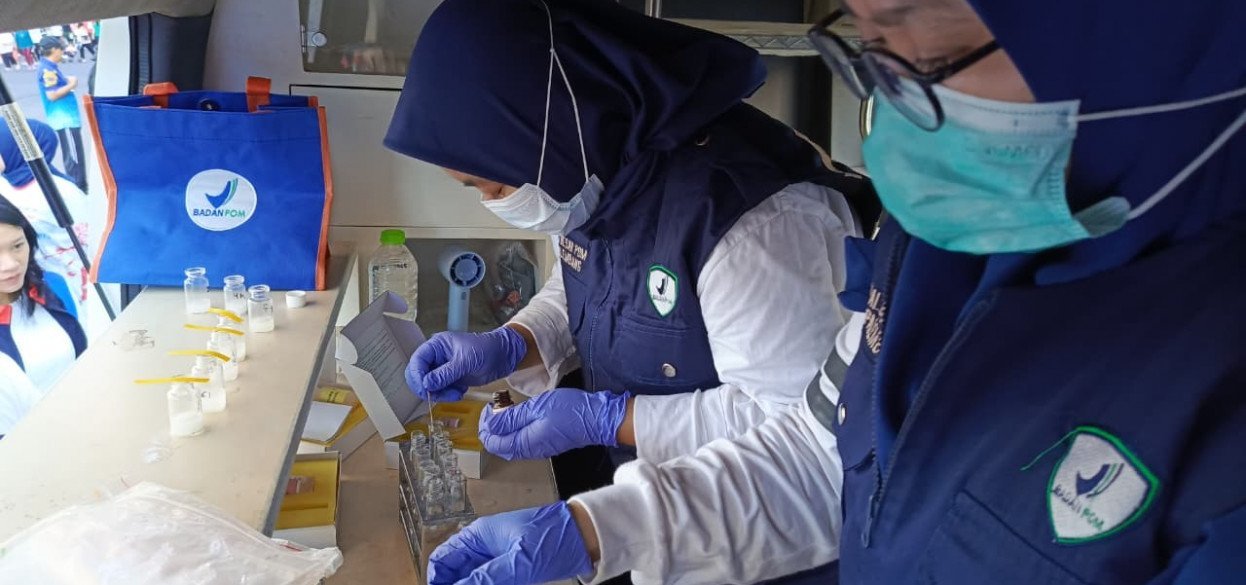
On 2 November 2026, Indonesia's food and drug authority issued a public explanation about a liquid table-top sweetener based on stevia that had been widely discussed on social media. The agency said it was tracing the product, inspecting, sampling, testing in the laboratory and evaluating, to confirm the product's content and its compliance with food safety, quality, labelling and advertising rules. Results will be released once the work is complete. Where nonconformity is found, sanctions can range from withdrawal from the market and temporary suspension of production to revocation of the marketing authorisation (Badan Pengawas Obat dan Makanan [BPOM], 2026).
The controversy began with an independent laboratory result posted on 28 October 2026 by a physician who also creates online content. The document reported 188.84 kcal per 100 g, 47.21 percent carbohydrate, and sucralose and neotame that do not appear on the ingredient list, while the product had been marketed as zero calorie (Arlinta, 2026; Journalarta, 2026). The regulator is still examining the case and has reached no official conclusion. This article therefore does not judge the product. We use the case as context to explain one method, 8D (eight disciplines), which quality teams commonly use to answer customer complaints in a structured way.
What Has Been Reported
According to press reports, the brand owner suspended all sales after the post spread. It said that formulation and raw material purchasing were handled by a contract manufacturer, which is also the registered holder of the marketing authorisation. The manufacturer said it had sent 150 bottles to two accredited laboratories and attached a test report from another laboratory dated 7 January 2026. The figures quoted from that report are total sugar 5.54 percent, sucrose 5.03 percent, carbohydrate 46.67 percent and energy 187.88 kcal per 100 g. The manufacturer argued that the value can be rounded to zero calories under BPOM labelling rules, and questioned the independent sample because it came without a production batch number (Journalarta, 2026).
Nuri Andarwulan, professor of food technology at IPB University, advised the public to wait for BPOM's results. In her view, samples should be tested by two or three accredited laboratories, because a single data point is not necessarily correct (Arlinta, 2026).
BPOM (2026) also noted that sucralose and neotame are among six permitted artificial sweeteners, while steviol glycosides are a natural sweetener with an acceptable daily intake of 0 to 4 mg/kg body weight per day. All sweeteners must meet the rules on type, food category, maximum level and labelling.
The Rules That Apply
Law No. 8 of 1999 on Consumer Protection prohibits businesses from producing or trading goods whose composition does not match the label (Article 8(1)(e)) or that do not deliver what the label, advertising or promotion promises (Article 8(1)(f)). Under Article 62(1), a breach of Article 8 carries up to 5 years' imprisonment or a fine of up to Rp2 billion (Republik Indonesia, 1999).
BPOM Regulation No. 22 of 2025 on the Recall and Destruction of Processed Food took effect when it was promulgated on 24 July 2025 and covers food additives, raw materials, packaging and labels. Food that fails safety and quality standards, labelling or advertising rules must be recalled, either on BPOM's order or on the producer's own initiative based on a risk assessment. Class II recalls include, among other situations, nonconforming quality, and Class III covers regulatory breaches that do not harm health; they must be completed within 30 and 180 calendar days of the recall instruction. Producers must run a food traceability system and a written recall procedure, and under Article 17 the recall report must include the investigation findings and the corrective and preventive actions taken to stop a recurrence (BPOM, 2025). The recall class for a given product is set against BPOM's criteria, so we do not classify a case that is still under examination.
Article 17 is, in effect, a request for a root cause investigation report. This is where 8D fits.
Eight Disciplines in Brief
8D is a team-based approach to resolving customer claims and complaints. Its original aim was to remove the defect behind a problem and restore customer satisfaction, and in practice it has nine steps because a preparatory step, D0, comes first (Wahyudi & Wulandari, 2020). In the automotive industry, 8D and quality planning are described as core pillars of quality management (Cirtina et al., 2025). The usual sequence is:
- D0, prepare and respond: decide whether consumers face a risk that needs immediate action.
- D1, form a cross-functional team: quality, production, purchasing, regulatory and marketing.
- D2, describe the problem: what, which batch, since when, and according to whose data.
- D3, contain: stop sales or quarantine the suspect batches.
- D4, identify and verify the root cause, often with a fishbone diagram.
- D5, choose permanent corrective actions and prove they work.
- D6, implement the corrective actions and monitor the results.
- D7, prevent recurrence by changing systems, procedures or specifications.
- D8, close the case and recognise the team.
These steps line up with ISO 9001:2015, which requires complaint handling as part of customer communication (clause 8.2.1), control of externally provided processes and products, including outsourced processes (8.4), identification and traceability (8.5.2), control of nonconforming outputs (8.7), and corrective action that reviews causes and the effectiveness of the action (10.2) (International Organization for Standardization [ISO], 2015). ISO 9001:2026 has been published, and certificates to the 2015 edition are expected to remain valid until 30 September 2029, pending a final decision by the global accreditation body (DQS, 2026). We use the 2015 clause numbers because most certificate holders still work to that edition. For the complaint process itself, ISO 10002:2018 gives guidance on planning, running and analysing complaints as input for quality improvement (ISO, 2018).
Applying 8D Here
We walk through the 8D steps using the public data above to show which questions need answers, not to reach a conclusion about cause.
D2 is the step most often skipped. The problem is not yet defined while the batch number of the independent sample is unknown, because the team cannot compare it with production records and retained samples from the same batch. The two energy values in circulation also need careful reading. The independent test reported 188.84 kcal per 100 g and the manufacturer's report 187.88 kcal per 100 g (Journalarta, 2026). The difference is 0.96 kcal, or about 0.5 percent. Our reading is that on energy the two laboratories nearly agree, so the gap lies in how that number is translated into a label claim. Whether rounding to zero calories is allowed depends on the serving size and the nutrition labelling rules in force; that decision rests with BPOM and cannot be settled from public data. The question about sucralose and neotame is of a different kind: the figures quoted from the manufacturer's report do not include those parameters, so the answer awaits testing with methods designed for those sweeteners.
D3 is already visible in the sales suspension. Within 8D, containment works best with clear limits, that is, which batches are held and where the stock sits, because a recall report under Article 17 of BPOM Regulation 22/2025 asks for the quantity produced per batch, the remaining stock and the quantity distributed to each outlet (BPOM, 2025).
D4 calls for a list of possible causes that are tested one by one, not picked by hunch. The categories usually examined when content and label do not match are the formula specification at the contract manufacturer, the quality or identity of raw materials from suppliers, mix-ups or cross-contamination on the line, labels and claims that do not follow the latest formula, and sampling or measurement error. A fishbone diagram is used to map such categories before they are checked against data (Widodo & Wahyudi, 2025). Without batch-level data, every category remains a possibility.
Sizing the Sample
How many samples are enough? For attribute inspection with an acceptance number of zero, the probability of finding at least one nonconforming unit is 1 - (1 - p)^n, where p is the proportion of nonconforming units in the lot and n is the sample size (Montgomery, 2020). If 5 percent of the bottles in a batch are off, 59 bottles give about a 95 percent chance of finding one. If only 1 percent are off, 299 bottles are needed for the same chance. With 150 bottles, a 95 percent chance is reached when at least about 2 percent of the bottles are off.
We read this calculation with one important caveat. The formula applies to random variation within a batch. If the cause is systematic, such as a wrong formula or ingredient, the whole batch will be off and a handful of bottles will show it. In that situation what matters is how many batches and production periods are sampled, not how many bottles come from one batch. Results also need to be compared across laboratories whose competence is recognised under ISO/IEC 17025:2017, the standard that requires evaluation of measurement uncertainty and monitoring of the validity of results (ISO & International Electrotechnical Commission [IEC], 2017).
Limits of the Method
Most evidence on 8D comes from single case studies. In a plastics plant making automotive parts, its use was followed by customer claims falling to zero and dimensional rejects falling from 0.07 percent to 0.01 percent (Wahyudi & Wulandari, 2020). In fibre drum production, dent defects fell from 2 percent to 0.8 percent (Widodo & Wahyudi, 2025). Both studies were done at one plant without a comparison group, and Cirtina et al. (2025) used a hypothetical case. These results show that 8D can work, but they do not prove that the improvement came from the method alone. Most published applications also come from automotive and packaging manufacturing rather than processed food.
Other limits are practical. 8D does not replace regulatory oversight, and an 8D report written only to close a complaint tends to stop at D3. Social media data may be incomplete, and the facts in this article may change once BPOM announces its findings.
Steps for Brand Owners
One belief worth correcting is that a certificate of analysis from a supplier or contract manufacturer proves the quality of every batch. A single test result represents only the sample tested on that date. Steps that follow from the rules and standards above:
- Write quality requirements into the contract manufacturing agreement, including specifications for critical raw materials, audit rights, notice of formula or supplier changes, and retained samples for every batch (ISO, 2015).
- Map every label claim, such as zero calories or a single ingredient, to the test parameter that proves it, and test those parameters periodically at a laboratory accredited by the National Accreditation Committee (KAN).
- Print batch numbers that consumers can read, and test the traceability system with a mock recall, since it is the basis of an effective recall (BPOM, 2025).
- Run a complaint channel that also watches social media and records each complaint as input for improvement, in line with ISO 10002:2018 (ISO, 2018).
- Prepare an 8D report template that matches the contents of the recall report in Article 17 of BPOM Regulation 22/2025, so investigation and reporting follow one path.
- Refer questions on nutrition claims and label rounding to BPOM and food regulatory specialists, and legal questions to an advocate.
How Nusa Safety Helps
Nusa Safety helps companies build an integrated quality management system through its Integrated ISO Management Systems service, covering control of external providers, traceability and corrective action. System readiness can be checked through an ISO Gap Assessment & Internal Audit that follows the ISO 19011 audit guidelines, while procedures for complaint handling, product hold and recall can be written through SOP and technical guideline development.
To build team capability, the Nusa Safety team runs incident investigation and root cause analysis training that can be adapted to quality cases and the 8D format, with an internal training certificate as proof of attendance. Nusa Safety does not carry out laboratory testing and is not a certification body, so product testing remains with accredited laboratories and certification with the certification body the company chooses. This article is general information and not legal or professional advice for any specific case.
References
- Arlinta, D. (2026, November 4). BPOM telusuri dugaan ketidaksesuaian produk pemanis alami stevia tetes [BPOM investigates suspected nonconformity of liquid stevia sweetener]. Kompas.id. https://www.kompas.id/artikel/bpom-telusuri-dugaan-ketidaksesuaian-produk-pemanis-alami-stevia-tetes
- Badan Pengawas Obat dan Makanan. (2025). Peraturan Badan Pengawas Obat dan Makanan Nomor 22 Tahun 2025 tentang Penarikan dan Pemusnahan Pangan Olahan [BPOM Regulation No. 22 of 2025 on the recall and destruction of processed food]. Berita Negara Republik Indonesia Tahun 2025 Nomor 545. https://peraturan.go.id/files/peraturan-bpom-no-22-tahun-2025.pdf
- Badan Pengawas Obat dan Makanan. (2026). Penjelasan publik Nomor HM.01.1.11.26.304 tentang produk bahan tambahan pangan pemanis alami stevia [Public explanation on stevia-based sweetener products]. https://www.pom.go.id/penjelasan-publik/produk-bahan-tambahan-pangan-pemanis-alami-stevia
- Cirtina, L.-M., Dumitrascu, A.-E., Cazacu, D. V., Ianasi, C. A., Rădulescu, C., Tătar, A. M., Pasăre, M. M., Nioață, A., & Cirtina, D. (2025). Eight-disciplines analysis method and quality planning for optimizing problem-solving in the automotive sector: A case study. Processes, 13(10), 3121. https://doi.org/10.3390/pr13103121
- DQS. (2026). ISO 9001:2026 published: The most important changes. https://www.dqsglobal.com/en/about/newsroom/iso-9001-2026-published
- International Organization for Standardization. (2015). ISO 9001:2015 Quality management systems, requirements. https://www.iso.org/standard/62085.html
- International Organization for Standardization. (2018). ISO 10002:2018 Quality management, customer satisfaction, guidelines for complaints handling in organizations. https://www.iso.org/standard/71580.html
- International Organization for Standardization & International Electrotechnical Commission. (2017). ISO/IEC 17025:2017 General requirements for the competence of testing and calibration laboratories. https://www.iso.org/standard/66912.html
- Journalarta. (2026, October 30). Dari TikTok ke uji lab: Kronologi polemik Beeru Stevia [From TikTok to the lab: Timeline of the Beeru Stevia controversy]. https://journalarta.com/news/2026/10/30/dari-tiktok-ke-uji-lab-kronologi-polemik-beeru-stevia/
- Montgomery, D. C. (2020). Introduction to statistical quality control (8th ed.). John Wiley & Sons.
- Republik Indonesia. (1999). Undang-Undang Nomor 8 Tahun 1999 tentang Perlindungan Konsumen [Law No. 8 of 1999 on Consumer Protection]. Lembaran Negara Republik Indonesia Tahun 1999 Nomor 42. https://peraturan.go.id/files/uu8-1999.pdf
- Wahyudi, P. L., & Wulandari, A. (2020). An analysis of product dimensions out of specification as quality claim improvement activity: Application of 8D method in the injection plastic industry. JMPM (Jurnal Material dan Proses Manufaktur), 4(2), 80-90. https://doi.org/10.18196/jmpm.v4i2.11358
- Widodo, D. S., & Wahyudi, P. L. (2025). Production process analysis to reduce defective products through the application of Pareto diagram and the eight disciplines problem solving method. Heuristic, 21(2), 219-228. https://doi.org/10.30996/heuristic.v21i2.12036