
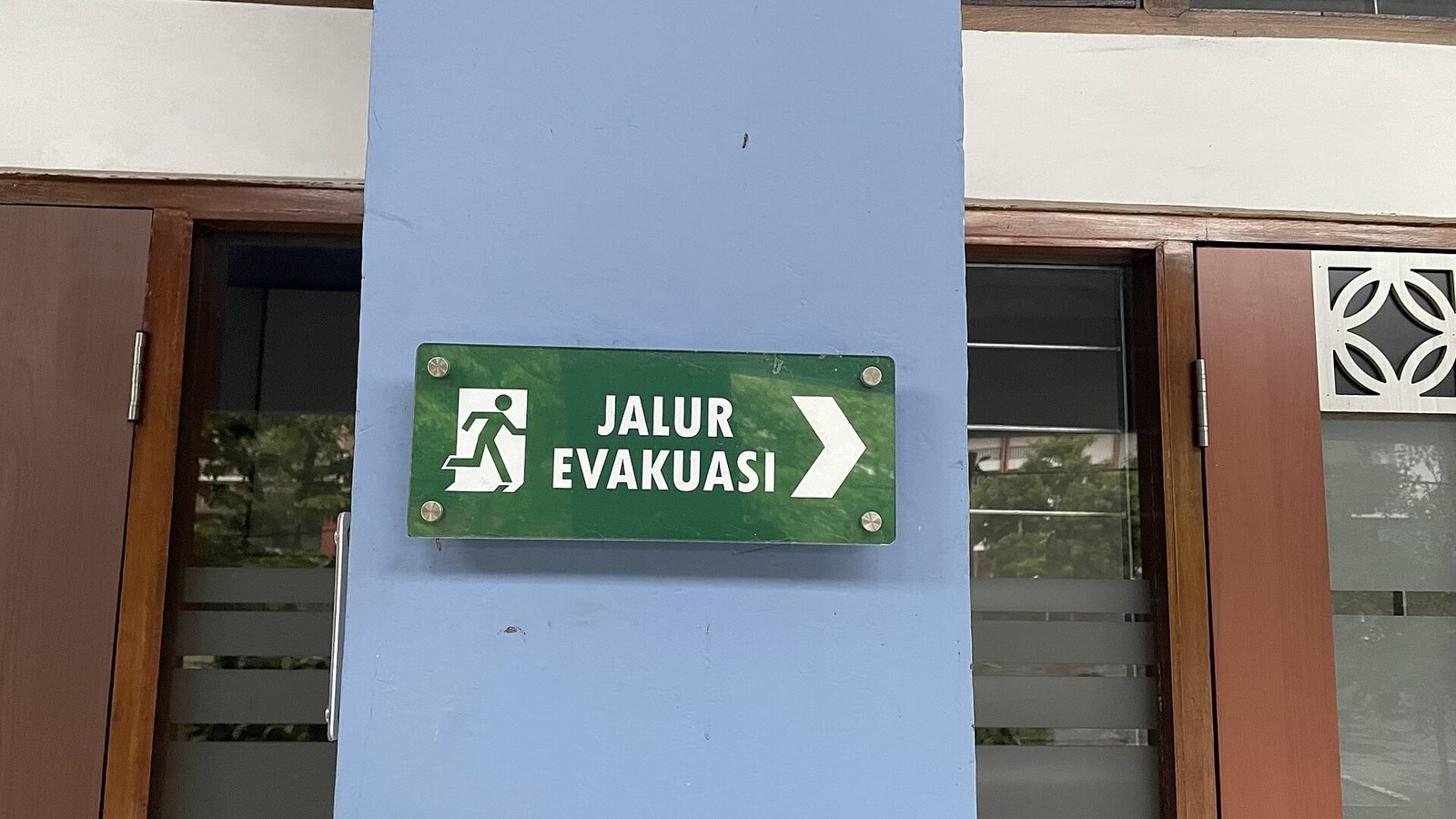
On 6 August 2026 a fire in a sugarcane field in Sukoanyar village, Ngoro, Mojokerto, spread into an open area holding piles of waste paper at a tissue factory beside the field. Local police said the company evacuated a number of employees from the affected area, and the company said the fire did not reach the main building and caused no deaths (Budianto, 2026). Six days later a picture frame factory in Duren Sawit, East Jakarta, caught fire before dawn. Twenty-two fire engines and 80 personnel were deployed, hampered by a distant water source and narrow access, as the factory sat in a lane close to housing (iNews.id, 2026). At the time of writing no official report on the cause of either fire was available, and this article does not guess at one.
Both events point to a question rarely answered with numbers: how much time do workers have to get out, and how much time do they need? Fire engineering answers it by comparing ASET and RSET.
Two Times Compared
Available Safe Egress Time (ASET) is the time from the start of a fire until conditions in a room or escape route can no longer be tolerated, for example because visibility drops, temperature rises or toxic gases build up. Required Safe Egress Time (RSET) is the time occupants need to reach a place of safety. RSET is made up of detection time, warning time, pre-movement time and movement time. An evacuation is judged safe when ASET exceeds RSET by an adequate margin.
Purser and Bensilum (2001) showed that models for calculating movement time are reasonably well developed, while pre-movement time, the period between people becoming aware of danger and starting to move towards an exit, remains poorly described and quantified. They compiled behavioural data from monitored evacuations and fire incident investigations in a range of building types so it could be used in design standards and escape time calculations.
An Indonesian application can be seen in a study of a five-storey public rental block in Surakarta. Fire simulation showed that untenable conditions in the fire room were reached about 96 to 105 seconds after ignition. Evacuation simulation found that 320 occupants needed 136 seconds when all three staircases were available and 313 seconds when only the middle staircase could be used (Sujatmiko et al., 2020).
Steps in Practice
- Define credible fire scenarios: where the fire starts, what burns, how many workers are present, and which routes may be blocked. Include fires arriving from beyond the fence, as in Mojokerto.
- Estimate ASET for each scenario, by simulation or by engineering judgement using criteria for visibility, temperature and gases.
- Calculate RSET as the sum of detection, warning, pre-movement and movement times, including queuing at doors or stairs.
- Compare the two and set a safety margin.
- Test the assumptions in evacuation drills and record the actual times.
A Worked Example
The figures below illustrate the reasoning and are not data from any real event. Take a warehouse with 60 workers, one exit and smoke detectors. Assume the detector responds 60 seconds after ignition, the alarm sounds 30 seconds later after a guard checks, workers spend 120 seconds finishing tasks and shutting down machines, walking 45 metres at about 1 metre per second takes 45 seconds, and queuing at the door takes 30 seconds. RSET is 285 seconds. Suppose simulation for this scenario gives an ASET of 240 seconds: the evacuation is not safe.
In this example the most effective fix is not a wider door but shorter warning and pre-movement times. An automatic alarm with no checking delay, a clear evacuation order, wardens who direct people at once, and a second exit could bring RSET down to, say, 40 seconds for detection, 60 for pre-movement, 25 for movement and 15 for queuing, or 140 seconds in total. With the same ASET, the margin becomes 100 seconds.
Indonesia's Minister of Manpower Decree No. KEP.186/MEN/1999 on workplace fire response units requires detection, alarm and evacuation facilities as well as regular exercises and drills. Fire wardens must number at least 2 for every 25 workers, and their duties include directing the evacuation of people and goods (Departemen Tenaga Kerja [Depnaker], 1999). In our view, a drill timed stage by stage is the cheapest way to replace pre-movement assumptions with data.
Limits of the Method
The calculation is only as good as its scenarios and assumptions. Human behaviour varies, and pre-movement times from a drill may differ from those in a real fire (Purser & Bensilum, 2001). Figures from the Surakarta rental block cannot simply be transferred to a factory or warehouse. For large or complex buildings, a simple calculation does not replace a fire engineering study or the applicable building technical requirements.
Nusa Safety can help assess detection, alarms, escape routes and warden readiness through the Fire & Emergency Safety Audit (FESA), measure real evacuation times through Emergency Preparedness & Drills, and prepare fire teams through Fire Brigade Certification, delivered with licensed PJK3 partners. Nusa Safety issues internal training certificates only and is not a PJK3. To discuss the needs of a specific workplace, please contact the Nusa Safety team.
This article is general information and not legal or professional advice for any specific case.
References
- Budianto, E. E. (2026, August 6). Kebakaran pabrik tisu di Mojokerto, karyawan dievakuasi [Tissue factory fire in Mojokerto, employees evacuated]. detikJatim. https://www.detik.com/jatim/berita/d-8607391/kebakaran-pabrik-tisu-di-mojokerto-karyawan-dievakuasi
- Departemen Tenaga Kerja. (1999). Keputusan Menteri Tenaga Kerja Nomor KEP.186/MEN/1999 tentang Unit Penanggulangan Kebakaran di Tempat Kerja [Minister of Manpower Decree No. KEP.186/MEN/1999 on workplace fire response units]. https://jdih.kemnaker.go.id/asset/data_puu/1999kmnaker186.pdf
- iNews.id. (2026, August 12). Pabrik bingkai di Duren Sawit Jaktim kebakaran, 22 mobil damkar dikerahkan [Picture frame factory in Duren Sawit, East Jakarta, on fire; 22 fire engines deployed]. RCTI+. https://www.rctiplus.com/news/detail/terkini/5449581/pabrik-bingkai-di-duren-sawit-jaktim-kebakaran--22-mobil-damkar-dikerahkan
- Purser, D. A., & Bensilum, M. (2001). Quantification of behaviour for engineering design standards and escape time calculations. Safety Science, 38(2), 157-182. https://doi.org/10.1016/S0925-7535(00)00066-7
- Sujatmiko, W., Rahmawati, Y., & Gumilar, R. P. (2020). Performance-based fire safety in an existing residential multi-story building in Surakarta. Journal of Architectural Research and Design Studies, 4(2), 77-85. https://doi.org/10.20885/jars.vol4.iss2.art10

