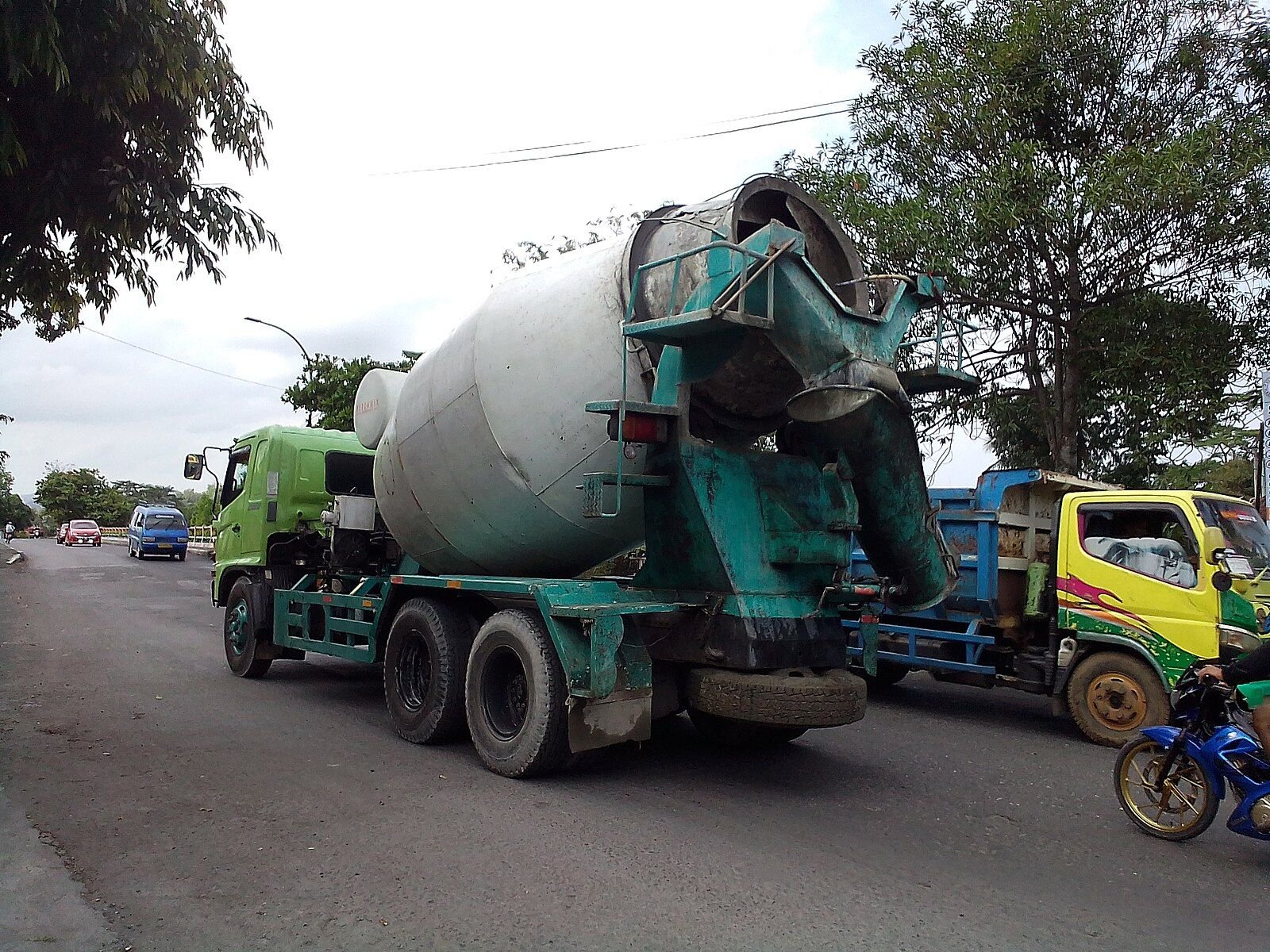
At about 16.30 WIB on Sunday, 1 November 2026, a concrete mixer truck carrying cement lost control on the downhill approach of a bridge on Jalan Cut Mutia, Rawalumbu, Bekasi. Police said the driver tried to stop it against the wall of a campus gate before it struck 12 people waiting at a bus stop: 6 died at the scene and 6 were injured (Liputan6.com, 2026). The Director General of Land Transportation said the truck had not undergone its periodic roadworthiness test (uji berkala, known as uji KIR) for 6 years, and that his office would summon the company for clarification and guidance on periodic testing and its safety management system for public transport companies (SMK PAU), while police, the local transport office and the National Transportation Safety Committee looked into the cause (Rahmawati, 2026; Ferdianto, 2026).
Police named the driver a suspect for negligence causing death and said they would also question the company (Jati & Pusparisa, 2026; CNN Indonesia, 2026). No official investigation report is available, a brake malfunction is a police suspicion rather than a finding, and we draw no conclusion about the cause or about anyone's guilt. Our question is different: when a heavy vehicle has been outside its testing regime for years, who along the chain of owners, suppliers, contractors and customers was expected to notice? We compare four ways of answering it.
What Is Known
The driver told police he could not brake on the descent (Liputan6.com, 2026), and investigators planned to combine the police traffic accident analysis with testimony from the manufacturer's agent on the truck's condition and to ask the transport office about its roadworthiness (Jati & Pusparisa, 2026). The load, maintenance records, earlier test history and the driver's hours have not been published.
Until that evidence is out, the lines of inquiry below are hypotheses that such investigations usually examine, not causes of this crash:
- Hypothesis 1, degraded brakes from poor maintenance. After the Ciawi toll gate crash of 4 February 2025, which killed 8 people, the National Transportation Safety Committee (Komite Nasional Keselamatan Transportasi [KNKT]) found worn drums and linings, a massive brake fluid leak at one wheel cylinder and no instrument panel, and named a weak maintenance programme and the absence of acceptance criteria for mechanics and drivers as contributing factors (KNKT, 2025).
- Hypothesis 2, brake fade on a descent. A fault tree study of a Banyumas road with a 1 km descent found that repeated braking on a gradient steeper than the critical limit overheated the brakes until they failed (Permatasari et al., 2023).
- Hypothesis 3, load above the permitted weight. The Ciawi truck was about 35% above its permitted gross weight (KNKT, 2025); no weight has been reported for the Bekasi truck.
- Hypothesis 4, emergency handling. At Ciawi, a downshift failed and the truck ran on in neutral down a slope; KNKT linked the driver's decisions to the absence of regular training on emergency decision-making (KNKT, 2025).
Ciawi also shows the limits of a test certificate. The ministry said that truck's periodic test was valid until 11 May 2025, and announced it would summon both the bottled water company and the haulier (Satria, 2025). KNKT later addressed recommendations to the factory, the distributor and the transporter (KNKT, 2025). In January 2026, KNKT said brake failure still dominates public transport crashes because no regulation requires brake maintenance, that maintenance is mostly reactive, and that SMK PAU is not yet implemented effectively (Sandi, 2026).
Comparing Four Approaches
The criteria are who holds a duty, whether it reaches those who hire, load or schedule the truck, whether it is prescriptive or outcome-based, and how compliance is checked.
Indonesia's operator-centred rules
Law No. 22 of 2009 on Road Traffic and Transportation requires every motor vehicle on the road to be roadworthy, including service and parking brake efficiency (Article 48(1) and (3)), and makes periodic testing mandatory for goods vehicles (Article 53(1)). Driving a goods vehicle without a valid test certificate carries up to 2 months' detention or a fine of up to Rp500,000 (Article 288(3)). The driver, the vehicle owner and/or the public transport company are liable for losses suffered by third parties through the driver's negligence (Article 234(1)). Public transport companies must run a safety management system (Article 204(1)), and an offence committed by a public transport company can bring criminal liability on the company and its management (Article 315) (Republic of Indonesia, 2009).
Minister of Transportation Regulation No. PM 19 of 2021 on Periodic Motor Vehicle Testing requires the owner to have the vehicle tested before it is operated (Article 3(2)) and to renew the test every 6 months (Article 7(2)). A vehicle not tested for 2 validity periods is removed from the testing register after 3 written warnings (Article 32), and an owner who breaches the obligation faces warnings and then an administrative fine of up to Rp24,000,000 (Article 89) (Ministry of Transportation [MoT], 2021). PM 85 of 2018 sets 10 SMK PAU elements, including hazard and risk management and vehicle maintenance facilities (Article 5(1)), with random routine inspection at least once every 2 years (Article 14(2)), but it covers companies that carry goods or people for a fee with public vehicles (MoT, 2018).
Law No. 1 of 1970 on Occupational Safety adds a layer: a workplace is any place, fixed or mobile, where people work and hazards exist (Article 1(1)), including places where goods are transported on land (Article 2(2)(f)) (Republic of Indonesia, 1970). Two changes are under way. Since 2 January 2026, test data must run through a fully integrated national system, introduced after the ministry found forged test certificates and records that were not real-time (InfoPublik, 2026). On 30 September 2026, parliament and the government discussed a third amendment to the traffic law, and the government agreed to extend criminal liability for overloading and over-dimension offences to vehicle owners, corporations and cargo owners (Nursyamsyi, 2026). It is not yet law.
Australia's chain of responsibility
Under the Heavy Vehicle National Law, every party performing one of 10 supply chain functions, among them employers, prime contractors, operators, schedulers, consignors, consignees, packers, loading managers, loaders and unloaders, has a primary duty to ensure the safety of its transport activities so far as is reasonably practicable (section 26C), and executives must exercise due diligence (section 26D). A party remains a party when transport is contracted out, and a breach does not depend on breaking a prescriptive rule; the regulator cites a prosecution in which failing to maintain heavy vehicles over an extended period breached the primary duty (National Heavy Vehicle Regulator [NHVR], n.d.).
UK construction logistics (CLOCS)
The CLOCS Standard places duties on regulators, clients, principal contractors, site operators and fleet operators for vehicles over 3.5 tonnes serving construction projects, building on client and principal contractor duties under the UK construction regulations. Clients must write CLOCS requirements into tenders and contracts, require reports of serious incidents and near misses involving project vehicles, and obtain roughly six-monthly independent monitoring. Principal contractors must risk-assess routes, run a delivery management system that records vehicle and driver details, and obtain evidence of compliance from fleet operators, or else verify the operator's own road safety management system while it works towards compliance (Construction Logistics and Community Safety [CLOCS], 2024).
ISO 39001
ISO 39001:2012 is a voluntary management system standard for any organisation that interacts with the road traffic system and wants to reduce the deaths and serious injuries it can influence (International Organization for Standardization [ISO], 2012). CLOCS lists it among the schemes a fleet operator may use to show performance, leaving the procurer to judge whether it demonstrates compliance (CLOCS, 2024).
Reading the Comparison
We use Rasmussen's risk management framework, which treats safety as control across the levels of a sociotechnical system, from government and regulators through companies and management to staff and the work itself, and warns that under pressure on cost and effort, practice drifts towards the boundary of safe performance unless the levels are tied together (Rasmussen, 1997). Newnam and Goode (2015) applied it to 27 US National Transportation Safety Board reports on road freight crashes that killed 89 people. Of these, 18 reports found factors at the freight company level, most often poor quality maintenance practices (7 reports), 2 found that federal inspections had missed deficient company maintenance, and 4 found factors among clients and other organisations, such as flawed manufacturer maintenance documentation that fed into poor brake maintenance.
Mapped onto those levels, the Indonesian rules put most of the enforceable weight at the bottom. The driver faces a criminal charge, the owner faces warnings and a fine of up to Rp24 million, and corporate criminal liability under Article 315 is written for public transport companies (Republic of Indonesia, 2009; MoT, 2021). The parties that buy the concrete, run the receiving site or award the supply contract are not named in the traffic law provisions we reviewed, although the OHS law covers their workplaces. That is our reading of the texts; whether a court would extend any duty to them is a legal question we leave open.
The testing regime shows the drift Rasmussen describes. Under Article 32 of PM 19/2021, a vehicle untested for 2 periods leaves the register that drives the warnings (MoT, 2021), so in our interpretation, after about a year the routine prompt stops and only roadside checks or the vehicle's customers remain to notice. Whether the Bekasi truck was in regular service over those years has not been reported, but every site gate a lapsed truck passes is an unused checkpoint. Ciawi shows the opposite gap: a valid test did not reveal worn brakes, because a test samples the vehicle on one day while maintenance decides its condition on all the others (Satria, 2025; KNKT, 2025).
The evidence on inspection supports that caution. A systematic review found only 6 studies sound enough to assess, published between 1978 and 2013; apart from a single case-control study, they showed a small fall in crashes of around 9%, no association, or more crashes among more inspected vehicles, and residual confounding could explain the results (Martín-delosReyes et al., 2021). We read the test as a necessary floor but a weak barrier alone; most of the weight falls on maintenance and use, which owners and customers control.
The Australian and UK models move duties up and across the chain, one by statute and the other by contract and planning conditions, and their strength, in our view, is reaching whoever sets schedules, loads and delivery terms. Yet we found no published causal evaluation showing that either model reduced crashes, Newnam and Goode drew on US reports of selected major crashes, and Indonesia's legal and enforcement setting differs, so a transplant would not work automatically. KNKT's Ciawi recommendations to the shipper and distributor, and the amendment on cargo owners now under discussion, suggest Indonesia is already moving that way (KNKT, 2025; Nursyamsyi, 2026).
Practical Steps
Owners and hirers of heavy vehicles, from ready-mix suppliers to contractors, project owners and shippers, need not wait for the amendment:
- Register every heavy vehicle that serves your contracts or enters your sites, check the test validity and permitted weight on its test card at the gate, and turn away vehicles whose test has lapsed.
- Write periodic testing, a preventive brake maintenance programme with acceptance criteria for mechanics and drivers, and pre-trip brake checks into haulage and supply contracts (KNKT, 2025).
- Roster drivers within the limits Article 90 sets for public vehicle drivers: at most 8 working hours a day and a break of at least half an hour after 4 consecutive hours of driving (Republic of Indonesia, 2009).
- Risk-assess delivery routes for long descents, bus stops and schools, and avoid schedules that reward speed or overloading (CLOCS, 2024; NHVR, n.d.).
- Train drivers in emergency decisions on descents through regular briefings, drills or simulation (KNKT, 2025).
- Require hauliers to report crashes, near misses and overheated brakes, and investigate them like site incidents.
- Use the SMK PAU elements or ISO 39001 as prequalification criteria, even for private fleets outside PM 85/2018 (MoT, 2018; ISO, 2012).
One belief needs correcting: a vendor's truck does not stop being your concern once it is inside your gate, and a valid test card does not prove the brakes are sound. See also our pieces on periodic truck brake testing and overloaded trucks and ETLE HUB.
How Nusa Safety Helps
As a third party, the Nusa Safety team can help companies set haulage safety requirements for suppliers through CSMS development and prequalification and check how hauliers apply them through an HSE and CSMS audit. Route, loading and fatigue risks can be mapped in a risk assessment and JSA workshop, gate checks and maintenance procedures written through SOP and technical guideline development, and incident investigation and RCA training helps internal teams look beyond the driver after a vehicle incident.
Nusa Safety issues only internal training certificates; it is not a vehicle testing unit or a PJK3 and does not issue roadworthiness test results or SMK PAU certificates. Legal questions on a specific case should go to an advocate; other needs can be discussed through the contact page.
This article is general information and not legal or professional advice for any specific case.
References
- CNN Indonesia. (2026, November 3). Polisi bakal periksa perusahaan truk molen kecelakaan maut Bekasi [Police to question the company that owns the concrete mixer truck in the fatal Bekasi crash]. https://www.cnnindonesia.com/nasional/20261103081742-12-1422585/polisi-bakal-periksa-perusahaan-truk-molen-kecelakaan-maut-bekasi
- Construction Logistics and Community Safety. (2024). CLOCS Standard: Version 5. https://clocs.org.uk/wp-content/uploads/2024/11/CLOCS-Standard-v5.pdf
- Ferdianto, A. (2026, November 2). Kecelakaan truk molen tewaskan 6 orang di Bekasi, Kemenhub panggil perusahaan [Concrete mixer truck crash kills 6 in Bekasi; the ministry summons the company]. Kontan. https://industri.kontan.co.id/news/kecelakaan-truk-molen-tewaskan-6-orang-di-bekasi-kemenhub-panggil-perusahaan
- InfoPublik. (2026, January 2). Kemenhub berlakukan SIM PKB Fullcycle serentak mulai Januari 2026 [Ministry of Transportation applies the fully integrated vehicle testing information system nationwide from January 2026]. https://infopublik.id/kategori/nasional-ekonomi-bisnis/953802/kemenhub-berlakukan-sim-pkb-fullcycle-serentak-mulai-januari-2026
- International Organization for Standardization. (2012). Road traffic safety (RTS) management systems - Requirements with guidance for use (ISO Standard No. 39001:2012). https://www.iso.org/standard/44958.html
- Jati, R. P., & Pusparisa, Y. D. R. (2026, November 3). Diduga lalai, pengemudi truk molen terancam enam tahun penjara [Concrete mixer truck driver faces up to six years in prison for alleged negligence]. Kompas.id. https://www.kompas.id/artikel/diduga-lalai-pengemudi-truk-molen-terancam-enam-tahun-penjara
- Komite Nasional Keselamatan Transportasi. (2025, December 9). KNKT rilis laporan akhir investigasi tabrakan beruntun truk flat deck di Gerbang Tol Ciawi [KNKT releases the final investigation report on the flat deck truck multiple collision at the Ciawi toll gate]. https://knkt.go.id/news/read/knkt-rilis-laporan-akhir-investigasi-tabrakan-beruntun-truk-flat-deck-di-gerbang-tol-ciawi-
- Liputan6.com. (2026, November 2). Truk molen maut Bekasi tak uji KIR 6 tahun, Kemenhub panggil pemilik [Fatal Bekasi mixer truck went six years without a roadworthiness test; the ministry summons the owner]. https://www.liputan6.com/bisnis/read/8326928/truk-molen-maut-bekasi-tak-uji-kir-6-tahun-kemenhub-panggil-pemilik
- Martín-delosReyes, L. M., Lardelli-Claret, P., García-Cuerva, L., Rivera-Izquierdo, M., Jiménez-Mejías, E., & Martínez-Ruiz, V. (2021). Effect of periodic vehicle inspection on road crashes and injuries: A systematic review. International Journal of Environmental Research and Public Health, 18(12), 6476. https://doi.org/10.3390/ijerph18126476
- Ministry of Transportation of the Republic of Indonesia. (2018). Peraturan Menteri Perhubungan Nomor PM 85 Tahun 2018 tentang Sistem Manajemen Keselamatan Perusahaan Angkutan Umum [Minister of Transportation Regulation No. PM 85 of 2018 on safety management systems for public transport companies]. https://pasal.id/peraturan/permen/permenhub-no-pm85-tahun-2018
- Ministry of Transportation of the Republic of Indonesia. (2021). Peraturan Menteri Perhubungan Nomor PM 19 Tahun 2021 tentang Pengujian Berkala Kendaraan Bermotor [Minister of Transportation Regulation No. PM 19 of 2021 on periodic motor vehicle testing]. https://peraturan.bpk.go.id/Details/254492/permenhub-no-19-tahun-2021
- National Heavy Vehicle Regulator. (n.d.). Regulatory advice: The primary duty. Retrieved November 17, 2026, from https://www.nhvr.gov.au/safety-accreditation-compliance/chain-of-responsibility/regulatory-advice/the-primary-duty
- Newnam, S., & Goode, N. (2015). Do not blame the driver: A systems analysis of the causes of road freight crashes. Accident Analysis & Prevention, 76, 141-151. https://doi.org/10.1016/j.aap.2015.01.016
- Nursyamsyi, M. (2026, October 1). Bahas RUU LLAJ, Menhub ungkap usulan pemerintah [Discussing the road traffic bill, the transport minister sets out the government's proposals]. Republika. https://ekonomi.republika.co.id/berita/tm7duh490/bahas-ruu-llaj-menhub-ungkap-usulan-pemerintah
- Permatasari, R. I., Budiharjo, A., & Purwantoro, A. B. (2023). Analisis lokasi rawan kecelakaan rem blong [Analysis of brake failure accident-prone locations]. Jurnal Transportasi, 23(3), 157-167. https://doi.org/10.26593/jtrans.v23i3.7549.157-167
- Rahmawati, D. (2026, November 3). Data Kemenhub: Truk molen tabrak kerumunan di Bekasi tak uji kir 6 tahun [Ministry data: the mixer truck that hit a crowd in Bekasi went six years without a roadworthiness test]. detikNews. https://news.detik.com/berita/d-8735733/data-kemenhub-truk-molen-tabrak-kerumunan-di-bekasi-tak-uji-kir-6-tahun
- Rasmussen, J. (1997). Risk management in a dynamic society: A modelling problem. Safety Science, 27(2-3), 183-213. https://doi.org/10.1016/S0925-7535(97)00052-0
- Republic of Indonesia. (1970). Undang-Undang Nomor 1 Tahun 1970 tentang Keselamatan Kerja [Law No. 1 of 1970 on Occupational Safety]. https://pasal.id/peraturan/uu/uu-no-1-tahun-1970
- Republic of Indonesia. (2009). Undang-Undang Nomor 22 Tahun 2009 tentang Lalu Lintas dan Angkutan Jalan [Law No. 22 of 2009 on Road Traffic and Transportation]. https://jdih.kemenkeu.go.id/fullText/2009/22TAHUN2009UU.htm
- Sandi, F. (2026, January 29). KNKT bongkar borok kecelakaan lalin di RI, tak terduga ternyata ini [KNKT sets out the weak points behind Indonesia's road crashes]. CNBC Indonesia. https://www.cnbcindonesia.com/news/20260129103626-4-706283/knkt-bongkar-borok-kecelakaan-lalin-di-ri-tak-terduga-ternyata-ini
- Satria, R. P. (2025, February 5). Kemenhub panggil perusahaan air minum dan operator angkutan imbas kecelakaan maut di Tol Ciawi [Ministry summons the bottled water company and the haulier after the fatal Ciawi toll crash]. Investortrust. https://investortrust.id/national/55576/kemenhub-panggil-perusahaan-air-minum-dan-operator-angkutan-imbas-kecelakaan-maut-di-tol-ciawi