Great Britain's workplace health statistics, published in November 2026, count 477,000 workers with a work-related musculoskeletal disorder in 2025/26. The back was affected in 38% of them, and these disorders cost 7.5 million working days. Among employer-reported injuries, handling, lifting or carrying accounted for 18% (Health and Safety Executive [HSE], 2026). Worldwide, low back pain affected 619 million people in 2020 and is projected to reach 843 million cases by 2050, with 38.8% of the years lived with disability from low back pain attributed to occupational factors, smoking and high body mass index (GBD 2021 Low Back Pain Collaborators, 2023).
The Indonesian figures tell a different story. In 2025 the country recorded 319,224 work accident claims but only 158 cases of occupational disease, and the Minister of Manpower said that number does not yet reflect conditions in the field because case reporting still faces obstacles (Kementerian Ketenagakerjaan Republik Indonesia [Kemnaker], 2026). This article reads those numbers alongside the lifting limit tables in Minister of Manpower Regulation No. 5 of 2018 on occupational safety and health of the work environment, the NIOSH lifting equation, and one set of measurements from a food warehouse in West Cikarang.
Three Sources of Numbers
The British data are self-reports from the Labour Force Survey. Rates of musculoskeletal disorders in construction and in transportation and storage sit above the all-industry average (HSE, 2026). The GBD estimates draw on population studies, surveys and medical claims data for 204 countries and territories (GBD 2021 Low Back Pain Collaborators, 2023).
Indonesia's count depends on recognised diagnoses. Presidential Regulation No. 7 of 2019 on occupational diseases gives workers diagnosed with an occupational disease by a doctor the right to work accident benefits (JKK), including when the disease appears up to 3 years after employment ends (Article 2(1) and (2)). Annex II, letter c, covers musculoskeletal disorders, but the seven conditions it names all involve the hand, wrist, elbow or knee. Back pain from lifting can only enter through item 8, which covers other musculoskeletal diseases whose direct link to a work exposure is scientifically proven (President of the Republic of Indonesia, 2019).
Limits in the Appendix
Article 23(2) of Permenaker 5/2018 lists three ergonomic hazards, one of which is lifting loads that exceed work capacity. Where measurement finds a hazard, controls such as redesigning the workplace, arranging work and rest periods, and using lifting aids must bring the work within the standard (Article 23(3) and (4)) (Kemnaker, 2018).
The standard sits in the appendix on manual handling design, adopted from ACGIH 2016. The threshold limit for a lifted load depends on lifting duration and frequency, the vertical zone where the lift starts, and the horizontal distance of the load from the body. For infrequent lifting, meaning no more than 2 hours a day with no more than 60 lifts an hour, the highest limit is 32 kg, and only when the load is close to the body (under 30 cm) and lifted between knuckle height and just below the shoulder. From the floor to mid-shin the limit is 14 kg. For work lasting more than 2 hours a day at more than 30 and up to 360 lifts an hour, the highest limit drops to 14 kg, and for lifts from the floor no safe limit is known. The appendix rules out routine lifting in those zones, sets the same limits for men and women, and does not cover carrying, pushing or pulling (Kemnaker, 2018).
The NIOSH lifting equation applies similar logic as a formula. The recommended weight limit (RWL) starts from a load constant of 23 kg under ideal conditions, then multiplies it by six factors for horizontal distance, starting height, vertical travel, trunk twisting, frequency and grip quality (Waters et al., 1993). The horizontal multiplier is 25/H with H in centimetres, so holding a load 50 cm from the body halves the limit (Waters et al., 1993). The lifting index (LI) is the load divided by the RWL. According to the NIOSH manual, tasks with an LI above 1 raise the risk of lifting-related low back pain for some workers, and nearly all workers face increased risk when the LI exceeds 3 (Waters et al., 2021).
A Warehouse in Cikarang
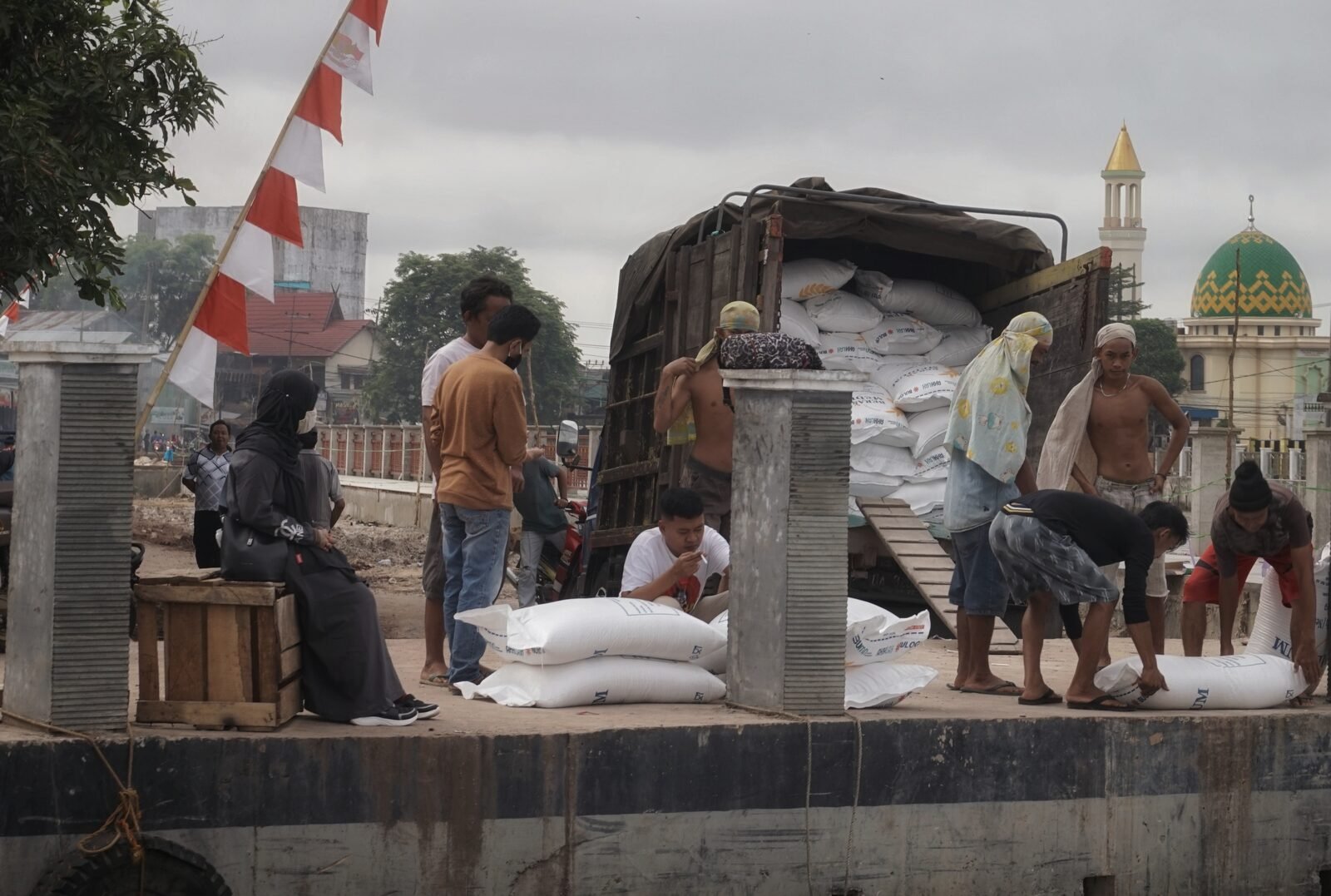
Maghfur et al. (2025) observed 20 workers in a food storage warehouse in West Cikarang, Bekasi Regency, in late 2024. There were no lifting aids or ergonomics training, workers lifted bent and twisted, and 70% reported low back pain at the initial observation. In the measurement table every worker handled a 30 kg load, and the discussion gives a frequency of 2 to 3 lifts a minute over roughly 8 working hours.
Every worker started with an LI above 1, the highest being 4.47. The researchers then introduced team lifting, two people per load. The LI fell, but only 3 of the 20 workers reached an LI below 1. The study recommended lifting aids, better work methods and ergonomics training (Maghfur et al., 2025).
Reading the Gap
By our calculation, 158 occupational disease cases against 319,224 accident claims is roughly one disease case for every 2,000 accident claims, while in Great Britain musculoskeletal disorders alone affect 477,000 workers (HSE, 2026; Kemnaker, 2026). The sources differ, but in our judgement a gap that size reflects gaps in recognition and reporting, not tougher Indonesian backs. Because the presidential regulation does not name back pain from lifting, recognition depends on proving a direct scientific link case by case (President of the Republic of Indonesia, 2019).
Read against the Permenaker 5/2018 tables, a 30 kg load lifted 2 to 3 times a minute, or 120 to 180 times an hour, for more than 2 hours a day falls under the third table. That table's highest limit is 14 kg in the best zone, so by our calculation a 30 kg load is more than double the limit even in the most favourable lifting position (Kemnaker, 2018; Maghfur et al., 2025). It also exceeds the 23 kg NIOSH load constant, the limit for ideal conditions before any multiplier applies (Waters et al., 2021). Better posture alone therefore cannot make a one-person 30 kg lift at that frequency safe; the weight, the frequency or the way goods are moved has to change.
Team lifting also needs to be placed in the order of controls. The NIOSH manual puts removing manual lifting through hoists, conveyors, lift trucks or automation first, redesigning the layout and cutting frequency and duration next, and sharing the load between two or more workers last (Waters et al., 2021, p. 28). The Cikarang result fits that ranking.
Cohort data link the index to injuries. Garg et al. (2014) followed 258 workers from 30 facilities for up to 4.5 years and recorded 123 new cases of low back pain; risk rose with the peak LI, with a maximum hazard ratio of 4.3. A meta-analysis of eight longitudinal studies found the odds of low back pain rose 1.11 times per extra 10 kg lifted and 1.09 times per extra 10 lifts a day, and estimated that lifting loads over 25 kg raises annual incidence by 4.32% compared with no lifting (Coenen et al., 2014).
A Cochrane review of 9 randomised controlled trials with 20,101 workers found moderate quality evidence that lifting technique training, with or without assistive devices, does not prevent back pain compared with no intervention (Verbeek et al., 2011). We covered that evidence in an earlier review of the limits of lifting technique training; training cannot replace redesigning a job whose loads exceed the limits.
What the Data Miss
The HSE figures are self-reports from a country with a different compensation system. The 158 disease cases and 319,224 claims come from a ministerial statement rather than a breakdown by disease, so the musculoskeletal share is unknown (Kemnaker, 2026). GBD estimates for many countries rely on modelling, and the GBD collaborators themselves call for more primary country-level data (GBD 2021 Low Back Pain Collaborators, 2023).
The Cikarang study is small, descriptive, based at one site and not fully consistent: its introduction mentions loads of 20 to 40 kg at 32 lifts an hour, and the overall mean LI of 2.328 does not match the shift means of 3.350 and 3.548 in the same table (Maghfur et al., 2025). We therefore use only the per-worker values and the comparison with the threshold tables, and that conclusion holds because even 20 kg at 32 lifts an hour exceeds the 14 kg limit (Kemnaker, 2018).
The NIOSH equation has limits of its own. The shape of the risk function is unknown, so the LI cannot predict the size of the risk for an individual worker. It does not apply to lifting for more than 8 hours, lifting combined with carrying, pushing or pulling, or temperatures outside 19 to 26 °C or relative humidity outside 35% to 50% (Waters et al., 2021). In our view, many un-air-conditioned warehouses and quays in Indonesia fall outside that range and porters usually carry loads while walking, so calculations there probably understate the risk; the Permenaker 5/2018 tables do not cover carrying either (Kemnaker, 2018).
Redesigning the Lift
These steps follow the NIOSH order of controls and Article 23(4) of Permenaker 5/2018.
- Measure against the tables. Follow the seven design steps in the Permenaker 5/2018 appendix, from duration and frequency to the zones at the start and end of each lift (Kemnaker, 2018). Calculate the RWL and LI to rank the tasks most in need of redesign (Waters et al., 2021).
- Mechanise repetitive lifts. Conveyors, hand pallet trucks, hoists, chain blocks or tackles remove manual lifting. These are lifting equipment (Article 21, letters b and c) and conveying equipment (Article 67, letters a and e) under Minister of Manpower Regulation No. 8 of 2020, so that regulation's safety requirements apply as well (Kemnaker, 2020).
- Raise the starting point. Place pallets or racks between knuckle and shoulder height, keep the load close to the body and avoid twisting. In the first table, this step alone lifts the limit from 14 kg at floor level to 32 kg (Kemnaker, 2018).
- Cut package weight and frequency. Set a maximum sack or carton weight in purchasing specifications, and arrange rotation and rest periods under Article 23(4), letter e (Coenen et al., 2014; Kemnaker, 2018).
- Treat team lifting as the last resort, not the main fix (Waters et al., 2021).
- Build it into the OHS management system. Government Regulation No. 50 of 2012 requires hazard identification, risk assessment and risk control in the initial review (Article 7(2)(a)(1)), and requires design, engineering and procurement to be based on hazard identification, risk assessment and risk control (Article 11(2) and (3)) (Government of the Republic of Indonesia, 2012).
- Record complaints and diagnoses. Complaint records support later proof, and the right to JKK benefits for an occupational disease lasts up to 3 years after employment ends (President of the Republic of Indonesia, 2019).
A belief worth correcting is that back injuries come from poor technique. The data show risk is driven mainly by weight, starting height, distance from the body and frequency, all set by job design.
Support from Nusa Safety
The Nusa Safety team can help warehouses, factories and distribution centres measure manual handling risk against the Permenaker 5/2018 threshold tables and the NIOSH equation through an ergonomics and work environment assessment, then carry the results into a risk assessment and JSA workshop and SOP and technical guideline development. Supervisors and HSE teams can learn to assess lifting tasks through applied ergonomics training.
For companies that choose to mechanise, Nusa Safety can coordinate statutory inspection of lifting and conveying equipment, carried out by licensed PJK3 partners and labour inspectors, with reports and certificates issued by the competent authorities. Nusa Safety works as a third party, issues only internal training certificates, not competency certificates or OHS licences, and does not hold a PJK3 licence. Conversations can start through the contact page.
This article is general information and not legal or professional advice for any specific case.
References
- Coenen, P., Gouttebarge, V., van der Burght, A. S. A. M., van Dieën, J. H., Frings-Dresen, M. H. W., van der Beek, A. J., & Burdorf, A. (2014). The effect of lifting during work on low back pain: A health impact assessment based on a meta-analysis. Occupational and Environmental Medicine, 71(12), 871-877. https://doi.org/10.1136/oemed-2014-102346
- Garg, A., Boda, S., Hegmann, K. T., Moore, J. S., Kapellusch, J. M., Bhoyar, P., Thiese, M. S., Merryweather, A., Deckow-Schaefer, G., Bloswick, D., & Malloy, E. J. (2014). The NIOSH lifting equation and low-back pain, Part 1: Association with low-back pain in the BackWorks prospective cohort study. Human Factors, 56(1), 6-28. https://doi.org/10.1177/0018720813486669
- GBD 2021 Low Back Pain Collaborators. (2023). Global, regional, and national burden of low back pain, 1990-2020, its attributable risk factors, and projections to 2050: A systematic analysis of the Global Burden of Disease Study 2021. The Lancet Rheumatology, 5(6), e316-e329. https://doi.org/10.1016/S2665-9913(23)00098-X
- Government of the Republic of Indonesia. (2012). Peraturan Pemerintah Nomor 50 Tahun 2012 tentang Penerapan Sistem Manajemen Keselamatan dan Kesehatan Kerja [Government Regulation No. 50 of 2012 on the Implementation of Occupational Safety and Health Management Systems]. https://peraturan.go.id/files/pp50-2012pjl.pdf
- Health and Safety Executive. (2026). Health and safety at work: Summary statistics for Great Britain 2026. https://www.hse.gov.uk/statistics/assets/docs/hssh2526.pdf
- Kementerian Ketenagakerjaan Republik Indonesia. (2018). Peraturan Menteri Ketenagakerjaan Nomor 5 Tahun 2018 tentang Keselamatan dan Kesehatan Kerja Lingkungan Kerja [Minister of Manpower Regulation No. 5 of 2018 on occupational safety and health of the work environment]. https://jdih.kemnaker.go.id/peraturan/detail/1546
- Kementerian Ketenagakerjaan Republik Indonesia. (2020). Peraturan Menteri Ketenagakerjaan Nomor 8 Tahun 2020 tentang Keselamatan dan Kesehatan Kerja Pesawat Angkat dan Pesawat Angkut [Minister of Manpower Regulation No. 8 of 2020 on occupational safety and health of lifting and conveying equipment]. https://jdih.kemnaker.go.id/peraturan/detail/1668/peraturan-menteri-ketenagakerjaan-nomor-8-tahun-2020
- Kementerian Ketenagakerjaan Republik Indonesia. (2026, May 21). Menaker: BPJS Ketenagakerjaan harus jadi motor penggerak K3 [Minister: BPJS Ketenagakerjaan must drive OHS]. https://kemnaker.go.id/news/detail/menaker-bpjs-ketenagakerjaan-harus-jadi-motor-penggerak-k3
- Maghfur, A., Hidayat, A. N., & Widya, A. R. (2025). Analisis risiko ergonomi pada pekerjaan mengangkat barang menggunakan metode NIOSH lifting equation di gudang PT. XYZ [Ergonomic risk analysis of lifting work using the NIOSH lifting equation in the warehouse of PT XYZ]. JUTIN: Jurnal Teknik Industri Terintegrasi, 8(3), 2905-2914. https://doi.org/10.31004/jutin.v8i3.47297
- President of the Republic of Indonesia. (2019). Peraturan Presiden Nomor 7 Tahun 2019 tentang Penyakit Akibat Kerja [Presidential Regulation No. 7 of 2019 on occupational diseases]. https://jdih.kemnaker.go.id/peraturan/detail/1588/peraturan-presiden-nomor-7-tahun-2019
- Verbeek, J. H., Martimo, K.-P., Karppinen, J., Kuijer, P. P. F. M., Viikari-Juntura, E., & Takala, E.-P. (2011). Manual material handling advice and assistive devices for preventing and treating back pain in workers. Cochrane Database of Systematic Reviews, 2011(6), CD005958. https://doi.org/10.1002/14651858.CD005958.pub3
- Waters, T. R., Putz-Anderson, V., Garg, A., & Fine, L. J. (1993). Revised NIOSH equation for the design and evaluation of manual lifting tasks. Ergonomics, 36(7), 749-776. https://doi.org/10.1080/00140139308967940
- Waters, T. R., Putz-Anderson, V., & Garg, A. (2021). Applications manual for the revised NIOSH lifting equation (DHHS [NIOSH] Publication No. 94-110, revised September 2021). National Institute for Occupational Safety and Health. https://doi.org/10.26616/NIOSHPUB94110revised092021