
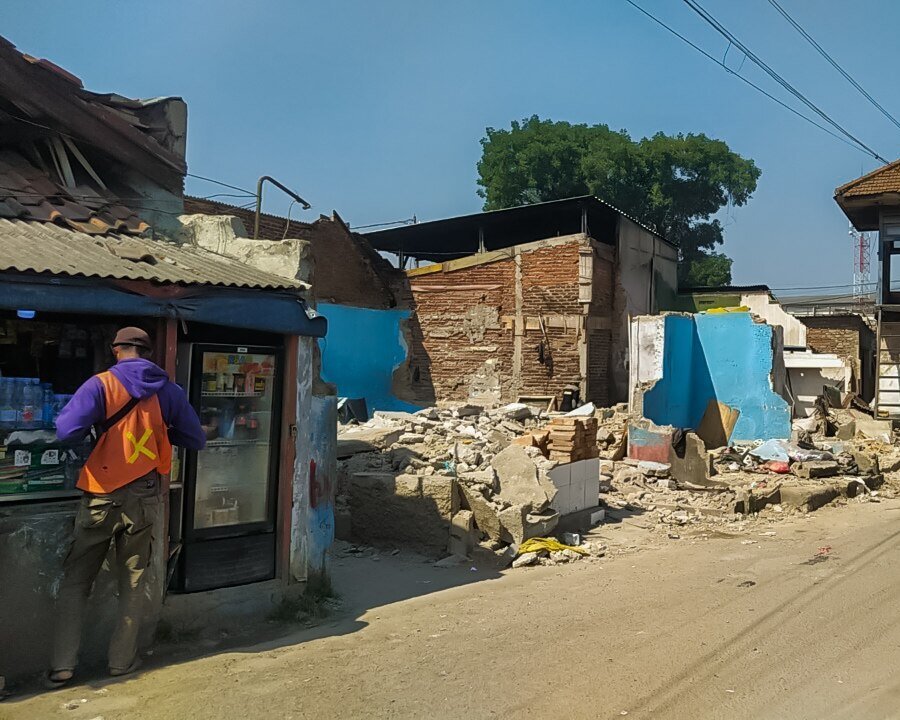
On the morning of Tuesday 7 May 2024, at around 08.55 WIB, two workers were demolishing a two-storey house in Nagan Kidul, Patehan, in Yogyakarta's Kraton district when the concrete roof slab for the second floor above them gave way. One worker died and the other was injured. The house was one of the buildings attached to the Kraton fortress wall due for revitalisation, and its occupants had already been asked to move out. According to the police, the demolition began with a deal in which a building contractor bought the salvage from the owner and then called in the workers. The city disaster management agency (BPBD) described the building as multi-storey and fragile, and the site was cordoned off because the walls were still unstable (Tim detikJogja, 2024). Speaking to another outlet, the BPBD said the roof collapsed as the workers were about to remove a door frame, and that the fire service, BPBD and volunteers carried out the rescue without heavy equipment (Medcom.id, 2024).
No official investigation report was available at the time of writing, and we do not speculate on the technical cause. Instead we review one widely cited study of construction accidents and consider what it means for demolition, which is easily mistaken for light work.
Study Background
Haslam and colleagues (2005) wrote an overview paper that combined earlier focus group research with studies of 100 individual construction accidents in the UK. The question they pursued was not simply who did what, but which influences shaped conditions at the workplace until the accident occurred.
How It Was Done
For each accident, the researchers interviewed the people involved and their supervisor or manager, inspected the accident location and reviewed relevant documents. Issues raised on site were then followed up with off-site stakeholders, including designers, manufacturers and suppliers (Haslam et al., 2005). That step matters, because many decisions that determine safety are made far from where the accident happens.
Main Findings
The levels of involvement of key factors across the 100 accidents were problems arising from workers or the work team (70 percent), workplace issues (49 percent), shortcomings with equipment including PPE (56 percent), problems with the suitability and condition of materials (27 percent) and deficiencies in risk management (84 percent). Using an ergonomics systems approach, the authors proposed a model in which originating managerial, design and cultural factors shape the circumstances found in the workplace, which in turn give rise to the acts and conditions that lead to accidents. They concluded that sustained improvement in construction safety requires attention to those originating influences (Haslam et al., 2005).
Limits of the Study
The study is qualitative, set in the UK more than two decades ago, and its summary does not treat demolition as a separate category. The percentages cannot be added together, since one accident can involve several factors. It says nothing about the Patehan event, so we use it as a lens, not as an explanation of what happened there.
Meaning for Demolition
We read the 84 percent figure for risk management as the most relevant message for demolition work. As a building is taken apart, the way it carries load changes from hour to hour. Elements that were supported by walls or frames can lose their support, and a fragile building speeds up that change. Without a plan, workers are left to judge for themselves which parts are still safe to be under.
United States regulation shows one way this is addressed. Before employees start demolition, an engineering survey must be made by a competent person to determine the condition of the framing, floors and walls and the possibility of unplanned collapse of any part of the structure, adjacent structures included, and the employer must have written evidence that the survey was done. Where employees must work within a structure damaged by fire, flood, explosion or other cause, the walls or floor must be shored or braced. Electric, gas, water and other service lines must be shut off, capped or otherwise controlled (Occupational Safety and Health Administration [OSHA], 2024).
The contracting pattern also deserves attention. When demolition grows out of a sale of salvage (Tim detikJogja, 2024), it is not always clear who acts as planner, supervisor and the person responsible for safety. In our view, this is an originating influence in Haslam's sense: a decision made off site that determines whether a survey and a work sequence were ever considered.
Practical steps for building owners, contractors and managers of revitalisation projects:
- Have a competent person check the structure before demolition starts, particularly in fragile multi-storey buildings (OSHA, 2024).
- Write down a top-down demolition sequence, and prohibit anyone from standing under a slab or roof whose supports are being removed.
- Install temporary props when supporting elements such as frames or walls must come out first.
- Name one person responsible for the job, even when the work is paid for out of the value of the salvage.
How Nusa Safety Helps
Nusa Safety helps contractors and project managers prepare demolition procedures that fit site conditions through its Technical Guidelines and SOP Development service, and trains site teams to build step-by-step risk assessments in its Risk Assessment and JSA Workshop. Nusa Safety does not certify structural soundness; structural checks remain the task of qualified structural engineers.
This article is general information and not legal or professional advice for any specific case.
References
- Haslam, R. A., Hide, S. A., Gibb, A. G. F., Gyi, D. E., Pavitt, T., Atkinson, S., & Duff, A. R. (2005). Contributing factors in construction accidents. Applied Ergonomics, 36(4), 401-415. https://doi.org/10.1016/j.apergo.2004.12.002
- Medcom.id. (2024, May 8). Kecelakaan kerja, pekerja proyek revitalisasi Benteng Kraton Yogyakarta meninggal [Work accident: worker on the Kraton fortress revitalisation project dies]. https://www.medcom.id/nasional/daerah/ybDYWjqk-kecelakaan-kerja-pekerja-proyek-revitalisasi-benteng-kraton-yogyakarta-meninggal
- Occupational Safety and Health Administration. (2024). 29 C.F.R. § 1926.850 Preparatory operations (version as of May 1, 2024). Electronic Code of Federal Regulations. https://www.ecfr.gov/on/2024-05-01/title-29/subtitle-B/chapter-XVII/part-1926/subpart-T/section-1926.850
- Tim detikJogja. (2024, May 8). Tragedi tukang tewas tertimpa puing saat bongkar rumah di Patehan [Builder killed by debris while demolishing a house in Patehan]. detikJogja. https://www.detik.com/jogja/berita/d-7329947/tragedi-tukang-tewas-tertimpa-puing-saat-bongkar-rumah-di-patehan

