
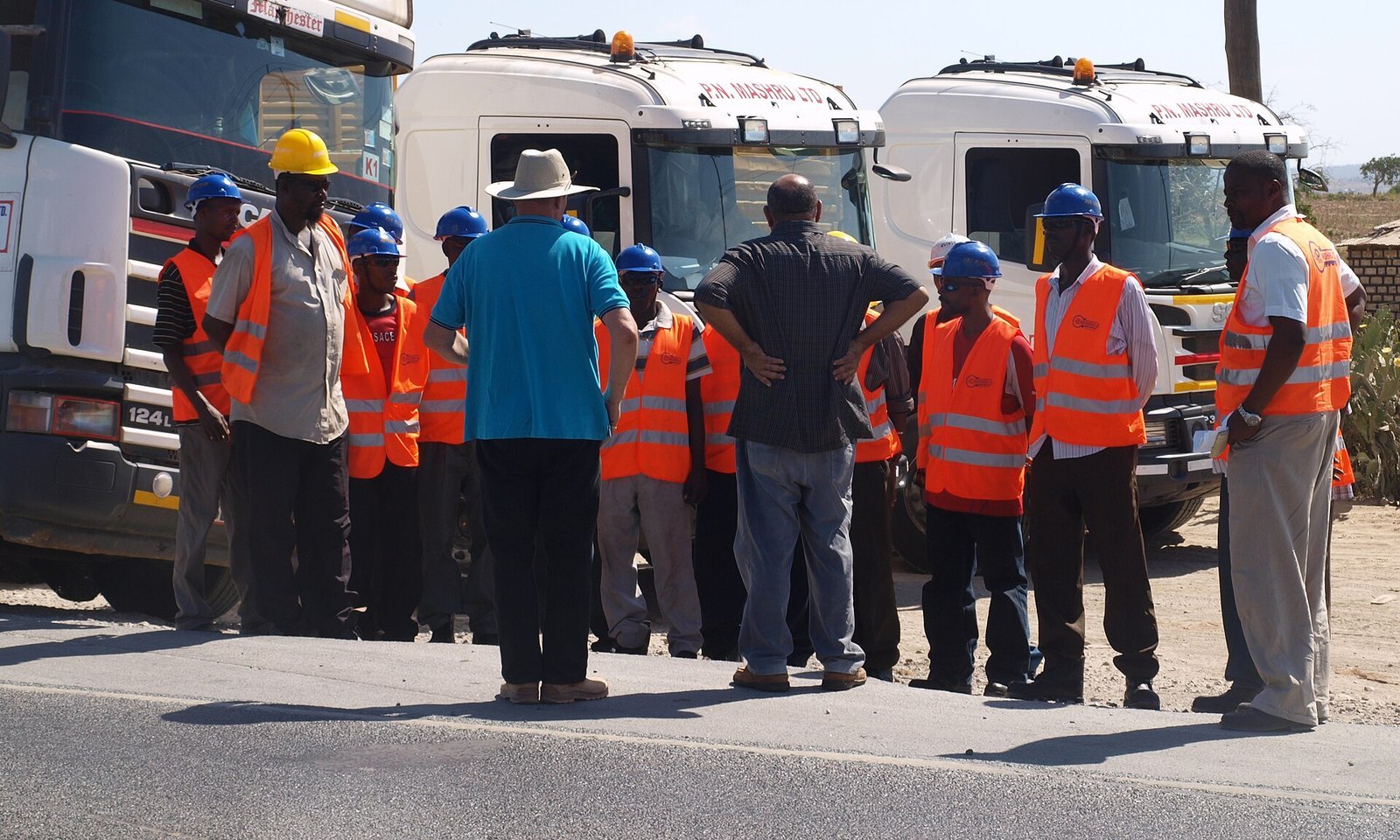
On 13 April 2026, two data portals republished Ministry of Manpower figures compiled from BPJS Ketenagakerjaan, the national employment social security agency: 319,382 work accident cases were recorded in 2025. East Java recorded 53,620 cases, West Java 53,404 and Central Java 37,804, so those three provinces account for 45 percent of the national total (Databoks, 2026; Rendanianti, 2026).
A day later, visiting the national OHS centre in Jakarta, the Minister of Manpower stressed that workers' safety must never be gambled with and asked the centre to step up supervision and education to bring fatality numbers down (SAGOE TV, 2026). This article reads the 2025 figures: where they come from, what they show and what they cannot yet tell us.
Source and Definitions
The figures come from cases among BPJS Ketenagakerjaan participants, not from a survey of all workplaces. The definition of a work accident covers accidents arising from employment, accidents while commuting between home and work, and occupational diseases (Databoks, 2026). Workers who are not registered participants are not covered, and accidents that are never claimed are not recorded.
What the Numbers Say
In 2025, 289,388 cases, or 90.61 percent, involved wage-earning participants, 26,399 cases, or 8.27 percent, involved non-wage participants, and 3,595 cases, or 1.13 percent, involved construction-service participants (Databoks, 2026; Rendanianti, 2026). For 2024 the ministry recorded 462,241 cases: 423,644 among wage earners, 34,364 among non-wage participants and 4,233 in construction services. The 2023 total was 370,747 cases (Susanto, 2025).
We calculated the differences. Total cases fell by 142,859, or 30.9 percent, from 2024 to 2025. The largest drop was among wage earners, down 134,256 cases or 31.7 percent. Non-wage cases fell 23.2 percent and construction-service cases 15.1 percent. The 2025 figure is also lower than the 2023 figure.
The provincial pattern follows the industrial map. After the three Java provinces come Banten with 26,921 cases, Riau with 25,663, North Sumatra with 20,184, the Riau Islands with 16,091 and Jakarta with 13,974 (Databoks, 2026). Provinces with many industrial estates, plantations and formal workers will naturally record more cases, so the ranking reflects how many participants are exposed more than how risky each province is.
Reading the Decline
A fall of almost a third in one year is a large change, and the published data do not explain it. At least four possibilities need to be separated: fewer accidents actually happened, the number of participants or hours worked changed, reporting and claiming habits shifted, or the data were processed differently between years. Without participant numbers and hours worked, absolute counts cannot be turned into accident rates, so concluding that Indonesian workplaces have become safer is premature.
The minister himself warned in January 2026 that a fall in accident numbers does not automatically mean workplaces are safe. He also said accidents are often attributed about 80 percent to human error, yet only about 30 percent of that share is purely individual error, while 70 percent stems from weaknesses in organisation and work systems (Hayat, 2026).
At company level, accident numbers depend heavily on reporting culture. A study of 1,390 employees from 38 contractors on a large US construction site found a reported injury rate of 3.11 per 100 workers, while eligible but unreported injuries reached 10.90 per 100. In firms with a poor safety climate, 81 percent of injuries went unreported, compared with 47 percent in firms with a positive climate (Probst et al., 2008). That setting differs from Indonesia's social security system, but the lesson carries over: a low number can mean few accidents, or few reports.
Testing Your Own Numbers
For companies, the national data are more useful as a mirror than as a benchmark. A few steps we recommend:
- Calculate accident rates per hours worked, not just case counts, and compare them with the previous year.
- Track leading indicators such as hazard and near miss reports, the share of actions closed on time, and site visits by senior managers.
- Be suspicious of a sudden fall that is not matched by any change in programmes. Check whether zero targets are tied to bonuses or penalties, because that kind of pressure can silence workers.
- Measure safety climate regularly with a validated questionnaire, then discuss the results with workers and the OHS committee.
- Respond fairly to workers' reports. A first report that ends in punishment is usually the last one.
How Nusa Safety Helps
Nusa Safety helps companies read the culture behind their numbers through the NOSACQ-50 safety climate survey and a safety culture maturity assessment, and prepares frontline leaders through HSE leadership training.
This article is general information, not legal or professional advice for any specific case.
References
- Databoks. (2026, April 13). Sebaran kasus kecelakaan kerja di RI 2025, Jatim terbanyak [Distribution of work accident cases in Indonesia in 2025, East Java highest]. Katadata. https://databoks.katadata.co.id/ketenagakerjaan/statistik/69dc599b93235/sebaran-kasus-kecelakaan-kerja-di-ri-2025-jatim-terbanyak
- Hayat, W. N. (2026, January 26). Menaker ungkap pentingnya K3 bagi pekerja dan perusahaan, simak! [Minister of Manpower on why OHS matters for workers and companies]. CNBC Indonesia. https://www.cnbcindonesia.com/news/20260126110026-4-705263/menaker-ungkap-pentingnya-k3-bagi-pekerja-dan-perusahaan-simak
- Probst, T. M., Brubaker, T. L., & Barsotti, A. (2008). Organizational injury rate underreporting: The moderating effect of organizational safety climate. Journal of Applied Psychology, 93(5), 1147-1154. https://doi.org/10.1037/0021-9010.93.5.1147
- Rendanianti, A. (2026, April 13). Indonesia catat 319 ribu kasus kecelakaan kerja pada 2025, Jawa Timur terbanyak [Indonesia records 319 thousand work accident cases in 2025, East Java highest]. GoodStats. https://data.goodstats.id/statistic/indonesia-catat-319-ribu-kasus-kecelakaan-kerja-pada-2025-jawa-timur-terbanyak-Fejk9
- SAGOE TV. (2026, April 15). Menaker: Nyawa pekerja tak boleh jadi taruhan, Balai K3 harus cegah kecelakaan kerja [Minister: Workers' lives must not be gambled, OHS centres must prevent accidents]. Good News From Indonesia. https://www.goodnewsfromindonesia.id/2026/04/15/menaker-nyawa-pekerja-tak-boleh-jadi-taruhan-balai-k3-harus-cegah-kecelakaan-kerja
- Susanto, V. Y. (2025, March 2). Jumlah kecelakaan kerja capai 462.241 kasus di sepanjang tahun 2024 [Work accidents reach 462,241 cases in 2024]. Kontan. https://nasional.kontan.co.id/news/jumlah-kecelakaan-kerja-capai-462241-kasus-di-sepanjang-tahun-2024

