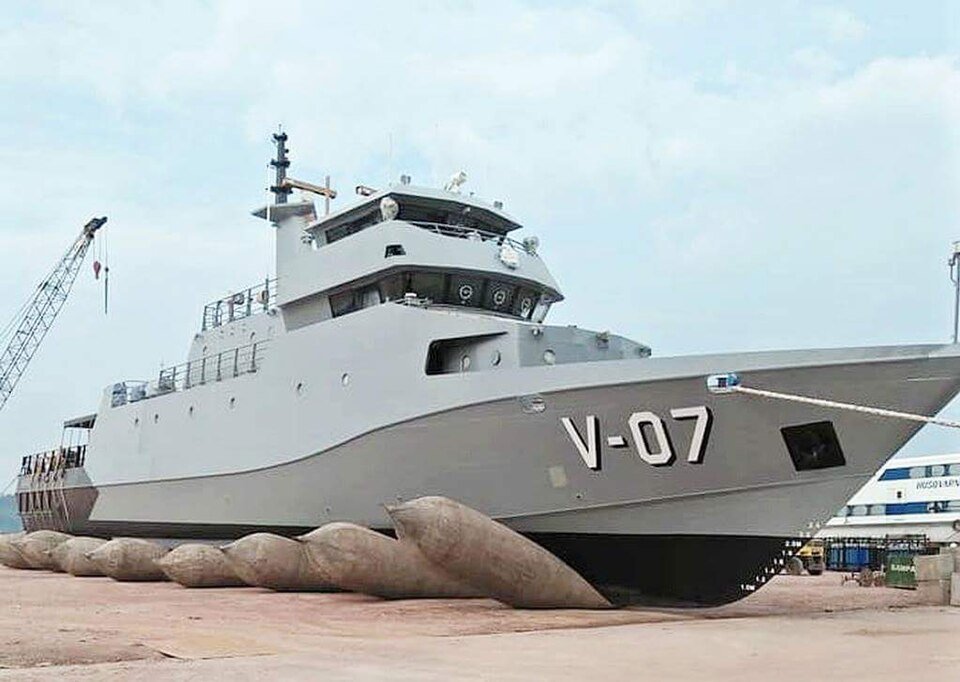
On Wednesday 8 January 2025, a shipyard worker in Awerange, Barru Regency, South Sulawesi, was hurt in an accident while a crane was manoeuvring. He received intensive care at the regional hospital but died. At a meeting at the Barru manpower office on 10 January 2025, the company said the accident had been reported to the office, and the office said it would help secure the worker's entitlements (Indonesiasatu, 2025). The details and cause had not been made public, so this article does not guess at what happened in Barru.
What we can do is look at what research has already found about crane accidents and consider what it means for lifting work in shipyards, plants and projects.
How the Studies Worked
The main study we review is Gharaie et al. (2015) on crane-related deaths in the Australian construction industry. The researchers searched the national coroners' database and found 258 closed cases of work-related deaths of construction workers, 22 of which involved a crane. Each case was analysed with the Loughborough model, which sorts causes into three layers: immediate circumstances on site, shaping factors (such as supervision and site constraints) and originating influences (such as the quality of risk management and safety culture) (Gharaie et al., 2015).
For comparison, Raviv et al. (2017) analysed tower crane near-miss and accident reports qualitatively and quantitatively, built a taxonomy of incidents and rated severity on a six-point scale, from near miss to fatality.
Key Findings
Of the 22 deaths, 10 (45.5 percent) involved a worker struck by a load, 5 (22.7 percent) involved electrocution, and 3 each (13.6 percent) involved boom or cable failure and falls from the crane (Gharaie et al., 2015).
In the 18 cases where immediate circumstances could be identified, site layout and restricted space around the crane appeared in 14 (77.8 percent). Unsafe actions by workers and the crane itself each appeared in 7 (38.9 percent). At the next layer, physical site constraints (56.3 percent) and the design of the work process (50.0 percent) were the most frequent shaping factors. At the deepest layer, the quality of the risk management system for crane operations was an originating influence in 9 of 13 cases (69.2 percent), followed by the choice of construction method (61.5 percent) (Gharaie et al., 2015).
Raviv et al. (2017) reached a complementary finding: technical failures were the most hazardous risk factors in tower crane incidents. The authors also proposed a crane incident database, including near misses, as a basis for analysing risk potential.
Where Evidence Stops
The Gharaie et al. (2015) sample is small, covers construction only and relies on coronial records that are not always complete; shaping factors could be identified in only 16 cases and originating influences in 13. The Raviv et al. (2017) data are limited to tower cranes. Both studies come from outside Indonesia and from construction, not shipbuilding.
Meaning for Practice
In our view, the most important lesson is that most crane-related deaths do not begin in the operator's cab. A cramped work area, a method chosen at the planning stage and poorly maintained equipment come together at one point, and the worker under the load bears the consequence. Shipyards, with heavy steel blocks, limited space and many jobs running at once, share features with the construction sites in this research, although we found no direct evidence from Indonesian shipyards.
The legal framework already exists. Permenaker 8/2020 requires the operator to work on the rigger's signals and to avoid lifting loads over people (Kementerian Ketenagakerjaan [Kemnaker], 2020, Pasal 49). The rigger must be visible to the operator and must confirm that lifting accessories are fitted and the load is balanced before signalling (Kemnaker, 2020, Pasal 50). Lifting accessories are checked by the rigger before use, and employers may not employ operators or riggers without an OHS licence (Kemnaker, 2020, Pasal 126 and Pasal 171). The UK HSE guidance adds a simple principle: every lifting operation is planned by a competent person, appropriately supervised and carried out safely (Health and Safety Executive [HSE], 2014).
Practical steps that follow from this evidence:
- Prepare a written lift plan for every non-routine lift, including the slewing area, an exclusion zone under the load and clearance from power lines.
- Review the layout of the work area before the crane arrives, since restricted space was the most frequent immediate circumstance.
- Inspect slings, shackles and other lifting accessories before every use and record the result.
- Make sure operators and riggers hold an OHS licence and work with agreed signals.
- Report and review crane near misses, such as a swinging load or a slipping sling, before they become accidents.
Nusa Safety runs lifting operator and rigger training and equipment inspection and testing together with licensed PJK3 partners. The Nusa Safety team can also facilitate a risk assessment and JSA workshop to build lift plans, and incident investigation training so that reviews reach the risk management layer. Nusa Safety issues internal training certificates only.
This article is general information and not legal or professional advice for any specific case.
References
- Gharaie, E., Lingard, H., & Cooke, T. (2015). Causes of fatal accidents involving cranes in the Australian construction industry. Construction Economics and Building, 15(2), 1-12. https://doi.org/10.5130/AJCEB.v15i2.4244
- Health and Safety Executive. (2014). Safe use of lifting equipment: Lifting Operations and Lifting Equipment Regulations 1998. Approved Code of Practice and guidance (L113, 2nd ed.). HSE Books. https://www.hse.gov.uk/pubns/books/l113.htm
- Indonesiasatu. (2025, January 10). Karyawan alami kecelakaan kerja, begini penjelasan Humas PT LPN Shipyard [Employee suffers a work accident: The shipyard's public relations explains]. Indonesiasatu Barru. https://barru.indonesiasatu.co.id/pdf-post/karyawan-alami-kecelakaan-kerja-begini-penjelasan-humas-pt-lpn-shipyard
- Kementerian Ketenagakerjaan Republik Indonesia. (2020). Peraturan Menteri Ketenagakerjaan Nomor 8 Tahun 2020 tentang Keselamatan dan Kesehatan Kerja Pesawat Angkat dan Pesawat Angkut [Minister of Manpower Regulation No. 8 of 2020 on occupational safety and health for lifting and conveying equipment]. https://jdih.kemnaker.go.id/peraturan/detail/1668/peraturan-menteri-ketenagakerjaan-nomor-8-tahun-2020
- Raviv, G., Fishbain, B., & Shapira, A. (2017). Analyzing risk factors in crane-related near-miss and accident reports. Safety Science, 91, 192-205. https://doi.org/10.1016/j.ssci.2016.08.022