
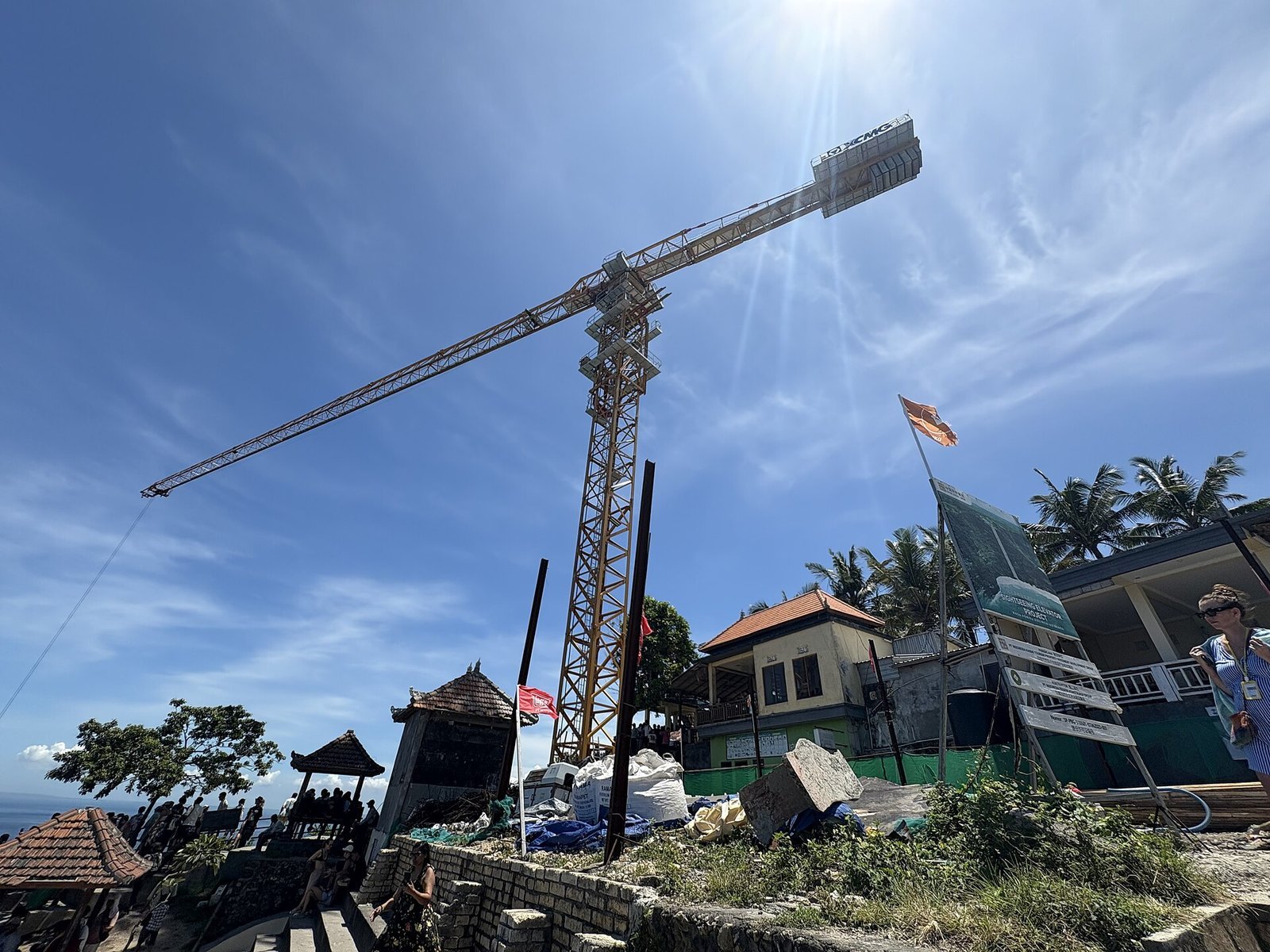
On Wednesday 4 June 2025 a large crane collapsed at the construction site of a new hospital on Merritt Island, Florida, in the United States. Two workers were taken to a nearby hospital, where they later died. Rain and strong winds had hit the area that afternoon, but the exact cause of the collapse was under investigation (Associated Press, 2025). The hospital operator described it as a serious weather-related incident, local television meteorologists measured winds of up to 55 mph (about 88 km/h) in the area, and OSHA investigators were on site (Spectrum News 13, 2025).
As of 12 June 2025 we had not found an official investigation report, so this article draws no conclusion about the cause. The event does raise a broader question for construction sites and ports in Indonesia: how much wind is still acceptable for lifting, and who decides? Four references are commonly used, and each answers a different question.
Comparison Criteria
The four references below are compared on four criteria: what they rest on, whether they give a firm number, whether they account for the load being lifted, and whether they say where and how wind is measured.
The Regulatory Limit
Minister of Manpower Regulation No. 8 of 2020 on occupational safety and health for lifting and conveying equipment gives firm numbers. Crane operators must stop operating when the wind exceeds 38 km/h (Article 49(2)(g)), and lifting accessories must not be used at the same wind speed (Article 127(1)(c)). For gondolas and personnel baskets carrying people the limit is stricter, at 32 km/h (Article 66(c) and Article 106(2)(b)), and gondolas must be fitted with a wind direction and speed indicator (Article 62(b)) (Kementerian Ketenagakerjaan [Kemnaker], 2020).
The strength is obvious: a single number that is easy to enforce and to teach. The weakness is that these articles do not say whether they mean mean wind or gusts, at what height it is measured, or for what kind of load. 38 km/h is about 10.6 m/s, the unit more often used in crane manuals.
The Manufacturer Limit
The European federation of lifting equipment makers and the association of mobile crane companies issued a safety alert after a number of serious accidents, especially in the wind turbine industry. The wind limits in manufacturers' load charts and manuals must be observed. Loads with relatively small mass but large sail area have a considerable effect on a crane's lifting performance. The effective sail area is the projected area of the load multiplied by its shape coefficient, and everyone planning the lift needs to know it. The same alert requires planners to obtain the expected wind, including gusts, from the meteorological office before lifting (European Federation of Materials Handling [FEM] & European Association of Heavy Haulage Transport and Mobile Cranes [ESTA], 2010).
This approach is closest to the physics of lifting because it is specific to a crane and a load. Its weakness is that it needs data that is often missing on site, such as the area and shape coefficient of a panel or steel frame.
The Performance Approach
The OSHA construction crane standard sets no number. It requires a competent person to adjust the equipment and/or operations to address the effect of wind, ice and snow on equipment stability and rated capacity (Occupational Safety and Health Administration [OSHA], 2010). The approach is flexible and fits the conditions, but the outcome depends heavily on the competence and authority of the person making the call.
Wind Data on Site
The fourth reference is not a limit but a source of numbers. Surface wind observations by meteorological services refer to a standard height of 10 m above open ground (World Meteorological Organization [WMO], 2017), while the jib of a tower crane or the boom tip of a mobile crane can sit tens of metres higher. Forecasts and observations remain important for planning, but they do not replace an anemometer on the crane itself.
Reading the Comparison
In our view the four references complement each other rather than compete. The figure in Permenaker 8/2020 is a legal ceiling that must not be exceeded, but it is no guarantee of safety below it. For loads with a large sail area the manufacturer's limit can be lower, and where two limits differ, the stricter one is the sensible choice. The Florida event cannot yet serve as evidence for any mechanism, but reported winds more than twice the 38 km/h limit show how quickly site conditions can overtake an operating limit.
Practical steps to build into a lift plan:
- Set a wind limit per crane and per load, taking the lower of the regulatory and manufacturer limits.
- Record the weight, area and shape of large sail-area loads before the lift day.
- Fit and maintain an anemometer on the crane, and agree whether decisions use mean wind or gusts.
- Check the forecast before and during the work, especially for rain with strong winds.
- Give operators and riggers written authority to stop a lift.
- Follow the manufacturer's procedure for securing the crane when out of service.
Nusa Safety Support
Nusa Safety helps companies prepare lifting decisions that account for wind through lifting operator and rigger training and risk assessment and JSA workshops for building lift plans. Certified training and statutory equipment inspection are delivered with licensed PJK3 partners; Nusa Safety issues internal training certificates only and is not a PJK3.
This article is general information and not legal or professional advice for any specific case.
References
- Associated Press. (2025, June 4). Crane collapse kills 2 at Florida construction site, officials say. NBC News. https://www.nbcnews.com/news/us-news/crane-collapse-kills-2-florida-construction-site-officials-say-rcna211067
- European Federation of Materials Handling & European Association of Heavy Haulage Transport and Mobile Cranes. (2010). Safety alert: Mobile cranes, influence of wind forces during crane operation (FEM PG CLE MC N 0219). https://fem-eur.com/wp-content/uploads/2025/01/CLE-N-0219.pdf
- Kementerian Ketenagakerjaan Republik Indonesia. (2020). Peraturan Menteri Ketenagakerjaan Nomor 8 Tahun 2020 tentang Keselamatan dan Kesehatan Kerja Pesawat Angkat dan Pesawat Angkut [Minister of Manpower Regulation No. 8 of 2020 on occupational safety and health for lifting and conveying equipment]. https://jdih.kemnaker.go.id/peraturan/detail/1668/peraturan-menteri-ketenagakerjaan-nomor-8-tahun-2020
- Occupational Safety and Health Administration. (2010). 29 CFR 1926.1417 Operation (Subpart CC, Cranes and derricks in construction). https://www.ecfr.gov/current/title-29/subtitle-B/chapter-XVII/part-1926/subpart-CC/section-1926.1417
- Spectrum News 13. (2025, June 5). Health First says weather caused deadly crane collapse. https://mynews13.com/fl/orlando/news/2025/06/05/two-dead-in-merritt-island-crane-collapse-update
- World Meteorological Organization. (2017). Guide to meteorological instruments and methods of observation (WMO-No. 8, 2014 edition, updated in 2017). https://library.wmo.int/opac/index.php?lvl=notice_display&id=12407

