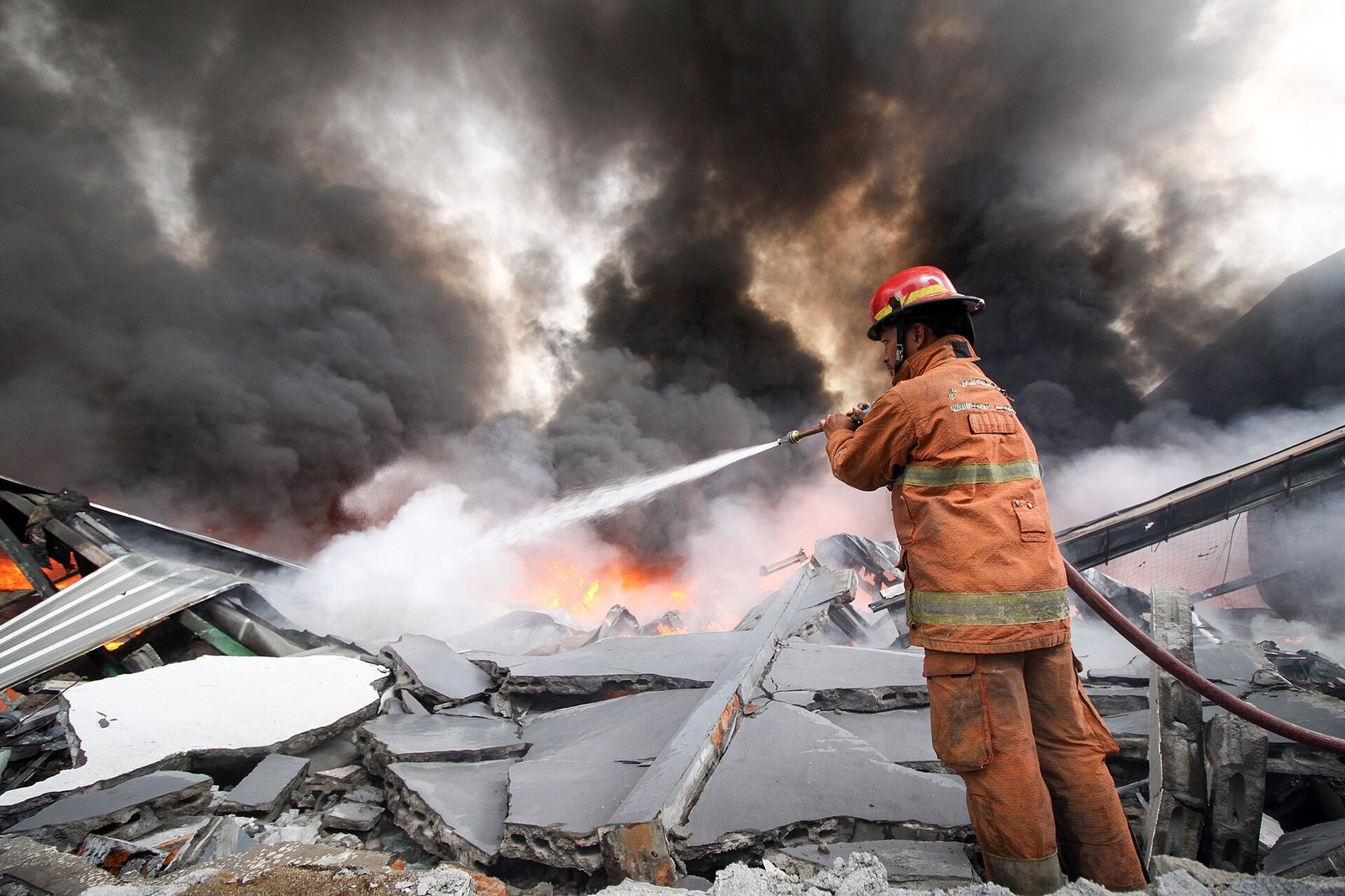
On the evening of Tuesday 8 April 2025, fire broke out in a warehouse at a sandal factory complex on Jalan Tanjungsari, Surabaya. The city fire and rescue service sent 23 fire units, including 3 Bronto Skylift aerial platforms. After about 14 hours, crews were still damping down on Wednesday 9 April, breaking through warehouse walls so hoses could reach the interior, and waiting for heavy equipment to pull apart piles of burnt material. No one died. The head of the Surabaya disaster management agency (BPBD) pointed to the shortage of hydrants at the factory and said a site of 2 hectares should have had its own hydrant system (Pratama, 2025).
The event raises a question common across industrial estates: how much do hydrants and sprinklers do to keep a warehouse fire small, and which parts of that belief lack evidence? This short literature review reads the technical regulation, sprinkler performance data, the maintenance standard and evaluations of fire protection at Indonesian plants. We do not discuss the cause of the Surabaya fire, as we found no official findings on it.
The Rulebook
The main technical reference for buildings in Indonesia is Minister of Public Works Regulation No. 26/PRT/M/2008 on technical requirements for fire protection systems in buildings and their environment. It covers active and passive protection, including the placement of yard hydrants and firefighting water as part of site planning (Kementerian Pekerjaan Umum [Kemen PU], 2008). To keep systems working, NFPA 25 sets out periodic inspection, testing and maintenance of water-based systems, namely sprinklers, standpipes and hoses, hydrant mains, fire pumps and water tanks, and places that duty on the property owner (National Fire Protection Association [NFPA], 2023).
The two systems work differently. Hydrants and hoses need trained people, a running pump and enough water. Automatic sprinklers act on their own once heat above the fire reaches the activation temperature of a sprinkler head, so water falls while the fire is still small.
What Is Known
The most complete data on sprinkler performance come from the United States. The April 2024 NFPA report for 2017 to 2021 found sprinklers present in about 11 percent of structure fires. In sprinklered buildings, 94 percent of fires stayed within the room or object of origin, and the civilian death rate was about 90 percent lower than in buildings with no automatic extinguishing system. Sprinklers operated in 92 percent of fires large enough to trigger them and were effective in 97 percent of those, or about 89 percent overall (McGree, 2024).
The same report shows that failures seldom come from the technology. The most common reason sprinklers did not operate was that the system had been shut off, and when sprinklers operated but were ineffective, the usual reason was that water did not reach the fire (McGree, 2024). Both are matters of maintenance and storage layout covered by NFPA 25, which also requires owners to re-evaluate fire protection before changing a building's use or the materials stored in it (NFPA, 2023).
The Indonesian Picture
Indonesian research is mostly single-site compliance evaluation. A study of a pine resin processing plant that had burned in 2016 found weaknesses in the layout of extinguishers and hydrants, detection and alarm, the assembly point, evacuation routes, fire engine access and fire safety management (Addina & Sufianto, 2018). This fits the Surabaya agency's point that hydrants are often a gap on large factory sites (Pratama, 2025).
Gaps in the Evidence
The available evidence does not map neatly onto Indonesian factory warehouses. The NFPA data come from a country where sprinklers are far more common, cover all building types, and rely on fire department reports rather than inspection by sprinkler specialists (McGree, 2024). Warehouses holding rubber, plastics or foam carry a high fire load, and sprinkler performance there depends heavily on whether the design matches the commodity and stack height. We found no national data on how many Indonesian factories and warehouses have working sprinklers or hydrants, how many pass periodic tests, or how they perform in real fires.
Our Assessment
On this evidence, we see hydrants and sprinklers as complements, not substitutes. A hydrant is a tool for fighting a fire, while a sprinkler is a tool for keeping it small until people arrive. Firefighting that needs walls broken open and heavy equipment, as in Surabaya, suggests a fire beyond the reach of an attack from outside, and at that stage hydrants mainly limit the loss. This is our interpretation, not a conclusion about that event, whose cause and protection status had not been officially reported.
Practical Steps
- List the active protection in each warehouse and compare it with Permen PU 26/PRT/M/2008, including yard hydrant locations and fire engine access (Kemen PU, 2008).
- Set an inspection, testing and maintenance schedule based on NFPA 25, paying particular attention to control valves, which must stay open (NFPA, 2023).
- Check for obstructions to sprinkler spray patterns and keep stacks within design limits, since water not reaching the fire is the most common reason sprinklers fail to control it (McGree, 2024; NFPA, 2023).
- Re-evaluate the system whenever the goods stored, the storage method or the rack height changes (NFPA, 2023).
- Train the in-house fire team on hydrants and hoses regularly, not only on portable extinguishers.
How Nusa Safety Helps
Nusa Safety helps plant and warehouse operators check their fire readiness through the Fire and Emergency Safety Audit (FESA), which reviews hydrants, sprinklers, alarms and emergency procedures against regulations and standards. The Nusa Safety team also runs fire brigade training with licensed PJK3 partners and emergency preparedness drills; Nusa Safety itself issues internal training certificates only.
This article is general information and not legal or professional advice for any specific case.
References
- Addina, F., & Sufianto, H. (2018). Evaluasi sistem proteksi kebakaran pada pabrik pengolahan getah pinus PT. Oleo Resina Indonesia [Evaluation of the fire protection system at a pine resin processing plant]. Jurnal Mahasiswa Jurusan Arsitektur, 6(4). https://garuda.kemdiktisaintek.go.id/documents/detail/820110
- Kementerian Pekerjaan Umum. (2008). Peraturan Menteri Pekerjaan Umum Nomor 26/PRT/M/2008 tentang Persyaratan Teknis Sistem Proteksi Kebakaran pada Bangunan Gedung dan Lingkungan [Minister of Public Works Regulation No. 26/PRT/M/2008 on technical requirements for fire protection systems in buildings and their environment]. https://peraturan.bpk.go.id/Details/104475/permen-pupr-no-26-prtm2008
- McGree, T. (2024). U.S. experience with sprinklers. National Fire Protection Association. https://www.nfpa.org/education-and-research/research/nfpa-research/fire-statistical-reports/us-experience-with-sprinklers
- National Fire Protection Association. (2023). NFPA 25: Standard for the inspection, testing, and maintenance of water-based fire protection systems (2023 ed.). https://www.nfpa.org/codes-and-standards/nfpa-25-standard-development/25
- Pratama, W. (2025, April 9). Kebakaran pabrik Ardiles Surabaya: Proses pembasahan diperkirakan tuntas Rabu sore [Surabaya factory fire: Damping down expected to finish Wednesday afternoon]. Suara Surabaya. https://www.suarasurabaya.net/kelanakota/2025/kebakaran-pabrik-ardiles-surabaya-proses-pembasahan-diperkirakan-tuntas-rabu-sore