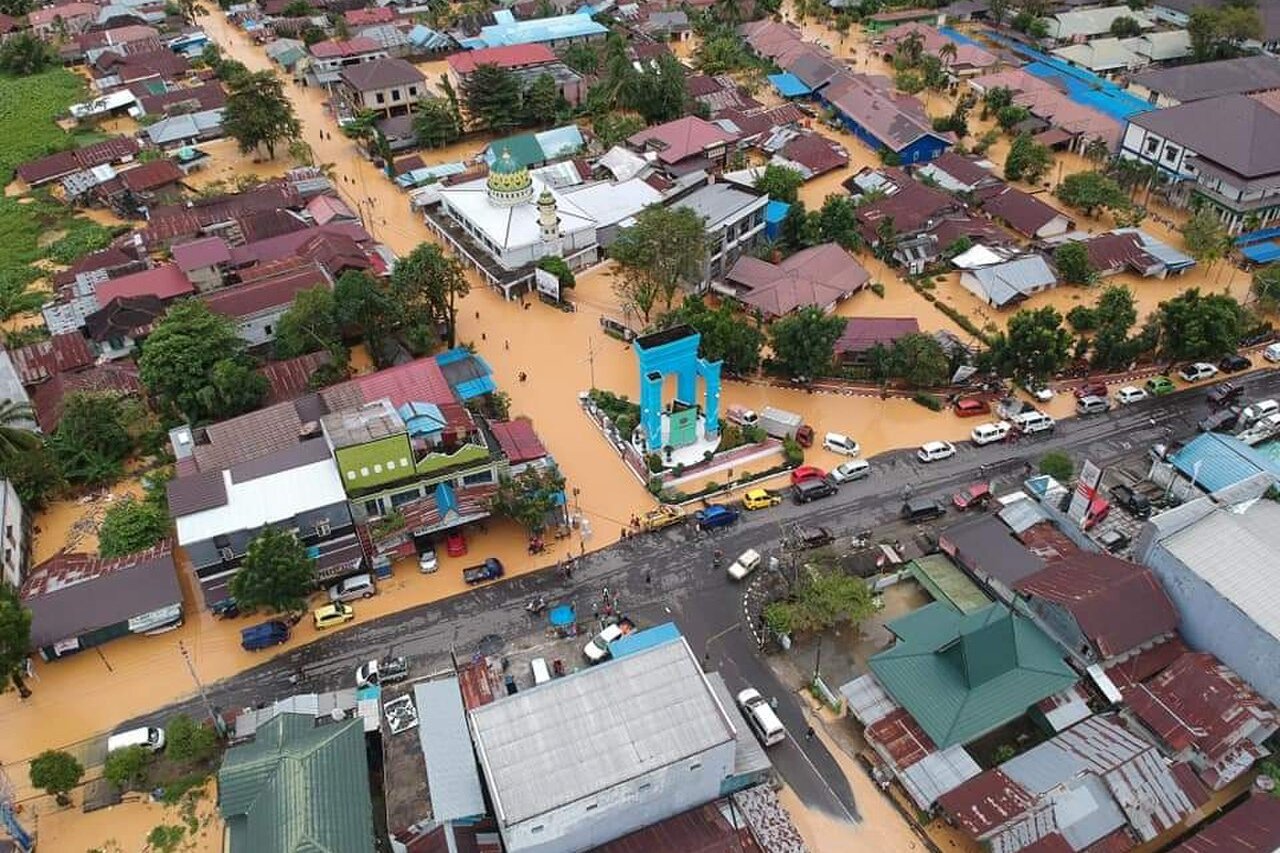
Indonesia's National Disaster Management Agency (BNPB) recorded 4,940 disasters in 2023, or 15 to 17 a day. Among wet hydrometeorological disasters, floods were the most frequent with 1,170 events, while landslides numbered 579. Forest and land fires reached 1,802 events, linked to a moderate El Nino. At a press conference on 12 January 2024, the head of BNPB stressed that floods are certain every year, early 2024 included (Nita, 2024). BMKG had already forecast January and February as the rainy season peak for most of Lampung, Banten, West Java, Central Java, Central Kalimantan, South Kalimantan, and East Kalimantan (InfoPublik, 2023).
Workplace flood preparedness usually focuses on evacuation and protecting assets. The two studies below help with a side that is counted less often: the losses that come from a business standing still.
Thailand's 2011 Floods
The first study is a background paper by Haraguchi and Lall (2013) for the Global Assessment Report on Disaster Risk Reduction 2013. It is a case study that draws on data from the Thai government, the World Bank, and company reports to trace how the 2011 floods hit the automotive and electronics supply chains, then compares supply chain structures across industries to identify the risk components that private investment decisions should consider.
The results describe a scale that is hard to imagine. The floods caused 813 deaths and damage and losses of about THB 1.43 trillion (USD 46.5 billion), with about USD 32 billion in manufacturing. Seven industrial estates holding 804 companies were inundated, and draining them took 33 to 62 days. As of 1 June 2012, 75 percent of factories in those estates had resumed operations, including partial operation, yet only 40 percent of those were back at pre-flood production levels, and about 17.5 percent had not resumed at all (Haraguchi & Lall, 2013). The effects spread far beyond the estates: in November 2011 Thailand's output of transport equipment fell 84 percent and of office equipment, mainly hard disk drives, 77.2 percent compared with the same month a year earlier (Haraguchi & Lall, 2013).
The finding most relevant to preparedness practitioners concerns duration. The peak flows were not individually extreme in terms of return period; what was extreme was how long the flooding lasted. The paper also stresses that the impact on each firm differed depending on how well it was prepared and how it responded (Haraguchi & Lall, 2013).
A Global Loss Model
The second study, by Taguchi et al. (2022), used a global river and inundation model driven by bias-corrected meteorological data to separate business interruption losses from asset damage. Averaged over 1960 to 2013, business interruption losses were estimated at USD 26.9 billion a year and asset damage at USD 130.9 billion (2005 purchasing power parity). Business interruption losses tended to be larger in river basins with mild slopes, where inundation lasts longer, and projections under a high-emission scenario showed both kinds of loss rising relative to GDP (Taguchi et al., 2022).
Where They Fall Short
Both studies have limits that should be acknowledged. Haraguchi and Lall (2013) wrote a background paper built on secondary data from a single event in a single country. Taguchi et al. (2022) worked at a global scale with a model, so their figures cannot be turned directly into a loss estimate for one plant, and the researchers themselves note regional differences against historical loss records.
Meaning for Practice
Despite their different methods, both studies send the same message: how long the water stays decides how much a business loses. In our view this is what workplace flood emergency plans most often miss. A good plan sets out when power is cut and where workers evacuate, but it rarely answers how many weeks the plant can survive if the estate floods, which suppliers will stop at the same time, and how production will be restored. BNPB's data show that floods are routine rather than rare, so these questions deserve answers before the rainy season peaks.
Practical steps to start with:
- Prepare a business impact analysis for inundation lasting days to weeks, not only for water rising for a few hours (International Organization for Standardization [ISO], 2019).
- Map dependence on suppliers and logistics routes located in flood-prone areas (Haraguchi & Lall, 2013).
- Test the plan through exercises that include the recovery phase, not just evacuation, and update it from the results (ISO, 2019).
- Use BMKG early warnings during the rainy season peak as triggers for early action (InfoPublik, 2023).
How Nusa Safety Helps
Nusa Safety helps companies prepare flood scenarios, from evacuation to recovery, through emergency preparedness and drills. To assess facility vulnerability and build risk scenarios, the Nusa Safety team can be engaged through engineering studies and risk assessments. Nusa Safety issues internal training certificates only.
This article is general information and not legal or professional advice for any specific case.
References
- Haraguchi, M., & Lall, U. (2013). Flood risks and impacts: Future research questions and implication to private investment decision-making for supply chain networks (Background paper prepared for the Global Assessment Report on Disaster Risk Reduction 2013). United Nations Office for Disaster Risk Reduction. https://water.columbia.edu/sites/default/files/content/publications/Flood-Risks-and-Impacts-2012.pdf
- InfoPublik. (2023, December 31). BMKG imbau waspadai cuaca buruk malam pergantian tahun 2023/24 [BMKG urges vigilance for bad weather on New Year's Eve 2023/24]. https://infopublik.id/kategori/nataru/812875/bmkg-imbau-waspadai-cuaca-buruk-malam-pergantian-tahun-202324
- International Organization for Standardization. (2019). Security and resilience - Business continuity management systems - Requirements (ISO Standard No. 22301:2019). https://www.iso.org/standard/75106.html
- Nita, D. (2024, January 12). BNPB: Sebanyak 4.940 bencana terjadi selama tahun 2023, 17 kali dalam sehari [BNPB: 4,940 disasters occurred in 2023, 17 a day]. Kompas TV. https://www.kompas.tv/nasional/476387/bnpb-sebanyak-4-940-bencana-terjadi-selama-tahun-2023-17-kali-dalam-sehari
- Taguchi, R., Tanoue, M., Yamazaki, D., & Hirabayashi, Y. (2022). Global-scale assessment of economic losses caused by flood-related business interruption. Water, 14(6), 967. https://doi.org/10.3390/w14060967