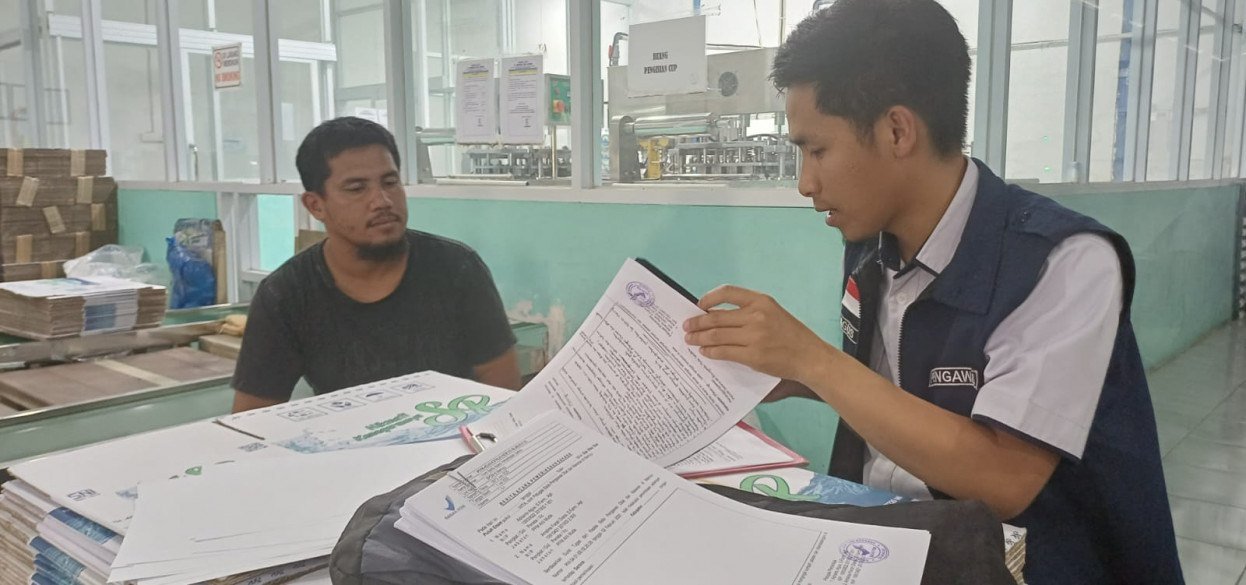
In 2025, Indonesia's food and drug authority tested 16,557 samples of processed food selected on a risk basis, and 1,861 of them failed. In the same year it inspected 4,391 production sites registered for MD (domestic processed food) products: only 2,304 (52.47%) were applying Good Manufacturing Practice for Processed Food (CPPOB), while 1,464 (33.34%) were not applying it consistently (Badan Pengawas Obat dan Makanan [BPOM], 2026).
The rules for what happens once a defective product is already on the market have also just changed. BPOM Regulation No. 22 of 2025 on the Recall and Destruction of Processed Food was enacted on 24 July 2025, promulgated on 28 July 2025, and revoked BPOM Head Regulation No. 22 of 2017 on the Withdrawal of Food from Circulation (BPOM, 2025). We set out its core provisions, compare them with the FAO and WHO recall guide and with ISO 9001, and then read company readiness through the Plan-Do-Check-Act (PDCA) cycle.
Core Provisions
The scope goes beyond finished products: it also covers food additives, raw materials, processing aids, packaging and labels (Article 2). Food that fails safety, quality, licensing, labelling or advertising rules must be recalled by the producer, importer or distributor (Articles 3 and 4) (BPOM, 2025).
A recall is either mandatory or voluntary (Article 5). A mandatory recall is ordered by the Head of BPOM or a regional government through a Recall Instruction, for example after test results or a food poisoning outbreak, and the instruction includes an order to investigate the cause and take corrective and preventive action (Article 6). A voluntary recall is initiated by the business on the basis of its own risk assessment (Article 7). In both cases the recall letter to distribution points must state at least the identity of the food, the reason, the time frame and the reach of the recall (Article 8) (BPOM, 2025).
Recalls fall into three classes with different deadlines (Articles 12, 14 and 18) (BPOM, 2025):
- Class I, where the food is suspected of causing serious harm to health or even death: completed within 14 calendar days of the Recall Instruction and made public within 1x24 hours.
- Class II, where the food is suspected of causing temporary or reversible harm, has a small chance of serious harm, or does not conform on quality: completed within 30 calendar days.
- Class III, where the food does not harm health but breaches other legal requirements: completed within 180 calendar days.
Producers, importers and distributors must have a food traceability system as the basis for an effective recall (Article 10), a written recall procedure, and monitoring and evaluation of recall effectiveness (Article 11). The recall report covers at least twelve items, including the quantity of the recalled batch, remaining stock, the quantity sent to each distribution point, investigation results and corrective actions (Article 17). Reprocessing is allowed only when the recall reason is unrelated to food safety after a BPOM risk assessment (Article 23), and the destruction record must state the batch number or production code (Article 26). Breaches attract administrative sanctions ranging from a written warning and a fine to revocation of the product registration (Article 29) (BPOM, 2025).
Quality in Class II
For quality managers, the Class II wording deserves the most attention. Nonconforming quality is now named explicitly as a Class II recall situation, with a 30-day deadline (BPOM, 2025). The class of a product is still decided against the criteria in Appendix IV (Article 13), so any quality example here is our illustration, not a class determination.
Compared with the FAO and WHO guide, the framework already contains the recommended elements: a recall plan held by businesses, the authority's power to enforce a recall, and traceability that records at least from whom supplies came and to whom products went, the one-step-back and one-step-forward principle. The guide also recommends verifying recall procedures through regular simulation exercises, so that contact lists stay current and staff remain trained (Food and Agriculture Organization of the United Nations [FAO] & World Health Organization [WHO], 2012). In the articles of BPOM Regulation 22/2025 that we read, simulation is not set out as a separate obligation. Article 11(4) does allow reference to recall mechanisms used internationally (BPOM, 2025).
In ISO 9001:2015, the closest requirements sit in three clauses. Clause 8.5.2 requires unique identification of outputs and retained documented information when traceability is required, clause 8.7 covers nonconforming outputs, and clause 10.2 covers corrective action (International Organization for Standardization [ISO], 2015). We use the 2015 edition because ISO 9001:2026, published on 16 September 2026, gives holders of the earlier certificate a 3-year transition (DNV, 2026).
What Inspectors Found
BPOM's surveillance data show where quality systems leak. Of 203 salt samples taken at production sites in 2025, 142 (69.95%) met the iodine content in SNI 3556:2024, a minimum of 30 ppm KIO3. Micro and small businesses supplied 88% of the samples, and 32% of their samples fell short on fortificant content, which BPOM reads as weak process control at the fortification step. For palm cooking oil, only 118 of 184 samples (64.13%) met the vitamin A content required by SNI 7709:2019 (BPOM, 2026).
Record keeping is a recurring problem. At MD sites, BPOM noted missing procedures or records to ensure consistent quality. At home-industry food producers, the most frequent findings included labels without a production code and production documents that were out of date, inaccurate, untraceable and not kept for twice the product's shelf life. In distribution, 1,545 of 7,134 outlets and warehouses (21.66%) did not meet Good Distribution Practice for Processed Food (CPerPOB) (BPOM, 2026).
A survey of 92 home-industry food producers holding a PIRT permit in Jakarta and Bogor found that 30 of them (32.6%) had not implemented traceability in any form, whether paper records, barcodes or QR codes (Frido et al., 2025).
The most widely reported recent case predates the new regulation. On 1 November 2024, BPOM announced food poisoning outbreaks in Lampung, Sukabumi, Wonosobo, South Tangerang, West Bandung, Pamekasan and Riau suspected to be caused by latiao, a flour-based snack imported from China, with symptoms of stomach pain, dizziness, nausea and vomiting. Preliminary testing found Bacillus cereus contamination, and four of the 73 latiao products registered with BPOM tested positive. The importer and distributor warehouses did not meet CPerPOB. BPOM ordered importers to recall and destroy the products, secured all latiao from circulation and temporarily suspended registration and import (BPOM, 2024a, 2024b).
Globally, a review of 2,932 food safety incidents and recalls with known or suspected causes between 2008 and 2018 found undeclared allergens (40.45%) and cross contamination (28.58%) to be the two leading causes, followed by GMP failures (9.17%) and incoming material control (7.64%). The authors used Ishikawa fishbone diagrams to trace possible root causes and noted that root cause information in the reports they reviewed was limited (Soon et al., 2020).
A PDCA Reading
ISO 9001 uses the PDCA cycle as the working logic of a quality management system (ISO, 2015). Mapped onto that cycle, most of the burden of BPOM Regulation 22/2025 falls before a defective product is ever found.
Plan holds the traceability system (Article 10) and the written procedure (Article 11(1)), and together they decide whether the later deadlines are realistic. The Article 17 report asks for quantities per batch and per distribution point (BPOM, 2025). Those numbers exist only when every pack carries a production code and every shipment is recorded against it. Missing production codes, untraceable documents and the 32.6% of home businesses without any tracing show that this is the weak point (BPOM, 2026; Frido et al., 2025). Lot size is a quality decision too. FAO and WHO (2012) point out that a large tracing unit simplifies record keeping but increases the amount of food that has to be recalled when something goes wrong. In our view, a plant that assigns one code to a week of production has chosen, knowingly or not, to recall a week of production at once.
Do is execution: the recall letter, the public notice and the physical retrieval. The 1x24-hour publication deadline for Class I and the 14-day completion deadline (BPOM, 2025) are hard to meet when the distributor list, retailer contacts and letter templates are drafted only after the instruction arrives. The latiao case shows the scale involved, with outbreaks in seven areas far apart from one another (BPOM, 2024a). No report on that recall has been published, so we cannot judge its speed, but a spread that wide needs distribution records in place beforehand.
At the Check stage, Article 11(2) requires monitoring and evaluation of recall effectiveness, and Article 17 asks for recall results and their evaluation, but the articles we read set no effectiveness threshold (BPOM, 2025). We propose two measures built from the report itself: the share of product returned or destroyed against the quantity distributed, by type of distribution point, and the time needed to trace one batch from raw material to the last buyer. Clause 9.1 of ISO 9001 gives such indicators a home (ISO, 2015).
Act separates a recall from simply collecting goods. The Article 17 report must include investigation results and corrective and preventive actions to stop recurrence (BPOM, 2025), in line with clause 10.2 of ISO 9001, which asks for the causes to be determined, similar nonconformities to be checked and the effectiveness of actions to be reviewed (ISO, 2015). Soon et al. (2020) found that root causes rarely surface in incident reports, which is a warning: without cause and effect analysis, for instance with an Ishikawa diagram, corrective action easily stops at the symptom. When low iodine comes from process control at the fortification step, as BPOM (2026) reads it, recalling one batch does nothing to the odds that the next batch will fail in the same way. Measured dosing, verified mixing and a content test on each lot before release do.
Limits of This Reading
We reviewed the body of the regulation; its appendices, including the class criteria and recall strategy, have not been examined in detail. BPOM does not publish aggregate data on food recalls per class or their success, so recall effectiveness in Indonesia cannot yet be measured.
The 2025 sampling was targeted on a risk basis, unlike the random sampling of 2021 to 2024, and BPOM itself cautions against reading changes in proportions between periods as changes in compliance (BPOM, 2026). In the same table the failure rate is printed as 9.53%, while our own calculation of 1,861 divided by 16,557 gives about 11.24%; for that reason we quote the sample counts. The traceability study we cite covers 92 home businesses in two cities with self-reported answers (Frido et al., 2025), and the global review draws on databases of authorities in high-income countries with mature reporting systems (Soon et al., 2020).
Tested Compliance
These steps can start before any incident:
- Put a production code on every pack and choose the lot size deliberately, then record every incoming material and shipment against that code, one step back and one step forward (BPOM, 2025; FAO & WHO, 2012).
- Write a recall procedure that sets out the team and its authority, an updated contact list of distributors and retailers, a recall letter template with the four elements of Article 8, a public notice template for the 1x24-hour deadline, and a report format that follows the twelve items of Article 17 (BPOM, 2025).
- Test the procedure through regular simulations: pick one batch at random and measure how long tracing takes and how much of it can be accounted for (FAO & WHO, 2012).
- Link every recall to corrective action, trace the root cause, for example with an Ishikawa diagram, and verify the action before closing the case (ISO, 2015; Soon et al., 2020).
- For quality parameters set by a standard, such as fortificant content, test each lot before release and keep the results, because BPOM reads content nonconformities as a process control problem (BPOM, 2026).
One belief needs correcting: a recall is often treated as an embarrassment. The regulation instead provides for voluntary recalls initiated by the business (BPOM, 2025), and FAO and WHO (2012) treat a tested recall plan as a normal responsibility of any food business. A company that can pull one batch quickly and precisely is showing that its quality system works.
Quality System Support
Nusa Safety helps companies organise traceability, the control of nonconforming products and corrective action as part of integrated ISO management systems. Recall procedures with their letter, notice and report templates can be developed through SOP and technical guideline development, and their readiness, including the results of recall simulations, can be checked by the Nusa Safety team as a third party through an ISO gap assessment and internal audit.
For the Act stage, Nusa Safety runs incident investigation and root cause analysis training that can be tailored to quality nonconformity cases. Nusa Safety is not a certification body and issues internal training certificates only; a conversation can start through the contact page. This article is general information, not legal or professional advice for any specific case.
References
- Badan Pengawas Obat dan Makanan. (2024a, 1 November). Penjelasan publik Nomor HM.01.1.2.11.24.92 tanggal 1 November 2024 tentang kejadian luar biasa keracunan pangan yang diduga disebabkan oleh pangan olahan latiao [Public explanation on the food poisoning outbreaks suspected to be caused by latiao processed food]. https://www.pom.go.id/penjelasan-publik/penjelasan-publik-nomor-hm-01-1-2-11-24-92-tanggal-1-november-2024-tentang-kejadian-luar-biasa-keracunan-pangan-yang-diduga-disebabkan-oleh-pangan-olahan-latiao
- Badan Pengawas Obat dan Makanan. (2024b, 2 November). BPOM perintahkan tarik latiao tercemar bakteri penyebab keracunan [BPOM orders the recall of latiao contaminated with bacteria that cause poisoning]. https://www.pom.go.id/berita/bpom-perintahkan-tarik-latiao-tercemar-bakteri-penyebab-keracunan
- Badan Pengawas Obat dan Makanan. (2025). Peraturan Badan Pengawas Obat dan Makanan Nomor 22 Tahun 2025 tentang Penarikan dan Pemusnahan Pangan Olahan [BPOM Regulation No. 22 of 2025 on the recall and destruction of processed food]. Berita Negara Republik Indonesia Tahun 2025 Nomor 545. https://peraturan.go.id/files/peraturan-bpom-no-22-tahun-2025.pdf
- Badan Pengawas Obat dan Makanan. (2026). Laporan tahunan Badan Pengawas Obat dan Makanan tahun 2025 [BPOM annual report 2025]. https://www.pom.go.id/storage/sakip/Laporan%20Tahunan%20BPOM%20Tahun%202025.pdf
- DNV. (2026, 21 September). The new edition of the quality management system standard ISO 9001 is released. https://www.dnv.com/news/2026/new-edition-of-the-quality-management-system-standard-iso-9001-released/
- Food and Agriculture Organization of the United Nations, & World Health Organization. (2012). FAO/WHO guide for developing and improving national food recall systems. https://www.fao.org/4/i3006e/i3006e.pdf
- Frido, S. S., Adawiyah, D. R., & Muhandri, T. (2025). Kajian sistem ketertelusuran dan recall pada usaha mikro kecil dan menengah (UMKM) pangan yang telah memiliki PIRT di Jakarta dan Bogor [Study of traceability and recall systems in micro, small and medium food enterprises holding a PIRT permit in Jakarta and Bogor]. Manajemen IKM: Jurnal Manajemen Pengembangan Industri Kecil Menengah, 20(1), 34-44. https://doi.org/10.29244/mikm.20.1.34-44
- International Organization for Standardization. (2015). ISO 9001:2015 Quality management systems: Requirements. https://www.iso.org/standard/62085.html
- Soon, J. M., Brazier, A. K. M., & Wallace, C. A. (2020). Determining common contributory factors in food safety incidents: A review of global outbreaks and recalls 2008-2018. Trends in Food Science & Technology, 97, 76-87. https://doi.org/10.1016/j.tifs.2019.12.030